
#FactCheck:Digitally Altered Video Falsely Shows BJP Chief Nitin Nabin Claiming India Included Pakistan in Talks Under Chinese Pressure
Executive Summary
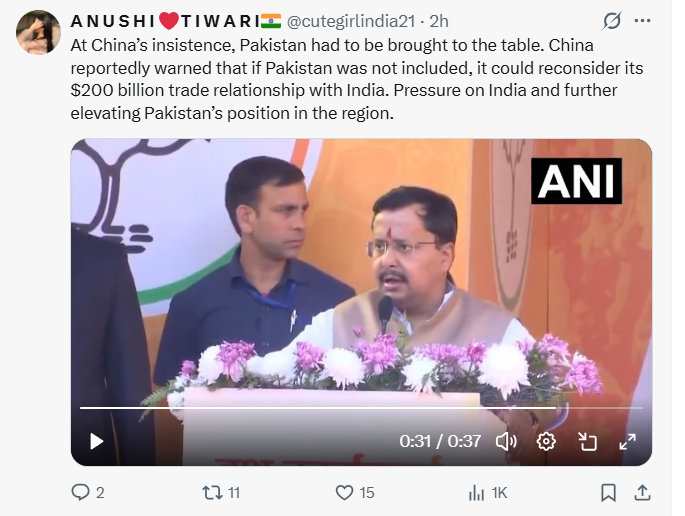
A video of BJP national president Nitin Nabin is going viral on social media. In the video, he can allegedly be heard saying that India had not invited Pakistan for talks but was forced to include it under pressure from China.The video further claims that China had warned India that it would reconsider its $200 billion trade relationship with the country if Pakistan was not included in the talks. Several users are sharing the video, claiming that it features Nitin Nabin's actual statement. However, CyberPeace Research found that these claims are entirely false and fabricated. The viral video has been digitally manipulated and is being circulated through Pakistani propaganda networks as part of a disinformation campaign against India.In his actual statement, BJP national president Nitin Nabin says, “There was a time when the Indian economy was considered weak, and India was counted among the world's poorest and weakest countries. However, it is our good fortune that under the leadership of the Prime Minister, India has emerged as the world's fourth-largest economy.”
Claim:
Social media users are claiming that India was forced to bring Pakistan to the negotiating table under pressure from China. China had allegedly warned that if Pakistan was not included, it could reconsider its $200 billion trade relationship with India.
https://x.com/cutegirlindia21/status/2124527425090724073?a=9oC4mzwwDbdcAAgUqkA&s=20
Fact Check
To investigate the viral claim, we conducted a Google search using relevant keywords. However, we did not find any credible media reports corroborating the claim.
As part of our further investigation, we extracted keyframes from the viral video and conducted a reverse image search using Google Lens. During this process, we found the original video on ANI, in which Nitin Nabin can be heard saying, “There was a time when the Indian economy was considered weak, and India was counted among the world's poorest and weakest countries. However, it is our good fortune that under the leadership of the Prime Minister, India has emerged as the world's fourth-largest economy.”
https://x.com/ANI/status/2124454082555584811
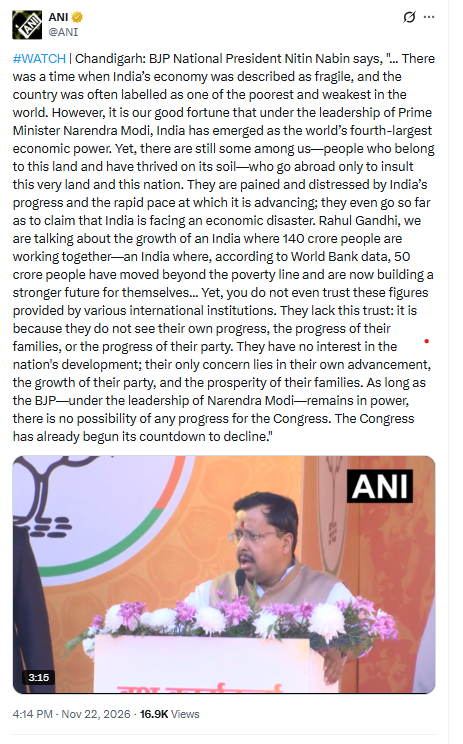
During our research, we also found the original video of the event on the official Facebook page of BJP Arunachal Pradesh. A comparison of the statement in this video with the footage released by ANI revealed that both were identical, confirming that the original statement had been distorted in the viral video.
https://www.facebook.com/reel/961787877012313

Conclusion:
Our research established that the viral video has been digitally manipulated to alter the original statement made by BJP national president Nitin Nabin. His actual statement makes no mention of Pakistan being included in talks under pressure from China or any warning concerning the $200 billion trade relationship between India and China. Therefore, the claim accompanying the viral video is false.

Related Blogs
Introduction
Imagine a scenario where a call is received by a senior citizen. The phone rings, he picks up. On the other side of the line is a polite and seemingly genuine bank official who informs him that his bank account has somehow been jeopardised and that he should quickly move his money to a safer escrow account right away. Or another situation where a police officer ends up threatening a senior citizen over a video call and places him under a digital arrest, pressuring him to pay up money in order to be set free.
This is not the storyline of a heist movie. This is the frightening new digital reality of millions of elderly people living all over the world.
Cybercrime against senior citizens has surged dramatically over the last few years. The year 2023 witnessed people (aged 60 and above), who submitted more than 101,000 complaints to the Federal Bureau of Investigation’s (FBI) Internet Crime Complaint Centre (IC3) in the United States. The total losses reached approximately 3.4 billion dollars, which reflected an increase of 11% in comparison to the previous year. Tech-support scams, investment frauds, government impersonation schemes, etc., have been some of the most recent and significant risks to the financial security of senior citizens.
This sharp increase in cyber fraud that has been targeting the seniors has shocked everyone, from the authorities to families. From phishing emails to fake customer care numbers to various digital payment scams, cyber criminals have deliberately been exploiting the senior population. They have repeatedly displayed the ability to wipe out a senior’s entire lifetime of savings in just a matter of minutes. The rise in cyber scams has been so alarming that even the Supreme Court of India expressed a deep concern over an estimated 3,000 crore rupees that was lost due to digital arrest scams.
Behind these statistics, there have been several individual cases that have revealed the true reality and the personal impact of such scams. The scale of this threat was clearly illustrated when, reportedly, an 86-year-old woman from Mumbai lost 20 crore rupees in a well-planned digital arrest scam in a timeline of 3-4 months between December 2024 and March 2025. In other real-life instances, in December 2025, multiple senior citizens from Hyderabad and Delhi were manipulated into transferring tens of lakhs under the false implication of undergoing a legal action.
This blog aims to focus specifically on the ways and means of:
- How cybercriminals operate against senior citizens,
- The most typical online scams that target seniors and
- How to quickly identify them.
Revealing the Insides of the Scammer’s Playbook: How They Operate, Trick and Steal
- Picking out the prey: Fraudsters use classified information from various leaked online databases, social media profiles, online images, phone directories and in some instances, even obituaries, to build comprehensive lists of potential and vulnerable senior citizen targets. It may be shocking to know that these scammers could already be aware of your age, bank, city and the details of your family members.
- Masquerading and trust theatrics: Scammers pose as authoritative figures such as bank officers, RBI (Reserve Bank of India) or tax officials, telecom staff, Microsoft or Apple tech support, CBI (Central Bureau of Investigation), ED (Enforcement Directorate) and even judges. They further support this spectacle by creating professional emails, logos, illegal websites and forged notices. Caller IDs can be spoofed and can even appear in the name of a trusted bank or a government helpline. In digital arrest scams, scammers may build a fake courtroom or police station to showcase their authority and authenticity over video calls.
- Tugging at emotions and pulling the strings of fear: Cyber fraudsters rarely rely on logic as the basis. Instead, they attack emotions. They may make statements such as: ‘your account is being used for money laundering, you may be arrested today’, thus creating feelings of fear and panic in the mind of the targeted individual. ‘You’ve won a lottery!’, another example that appeals to the emotions of greed and excitement, or ‘Grandma, I’ve been in an accident; please send money and don’t tell anyone’, a classic example that preys on the emotions of love, urgency and concern.
There are more such illustrations: ‘Once in a lifetime investment opportunity’, ‘verify your details in the next 10 minutes or else your account will be frozen, ‘your computer has been hacked; only our technical team can fix it’, and the list goes on.
- The final grab: Cash, Credentials and Control: After all that pretending and emotional manipulation, cyber criminals make their last and final move that essentially closes the deal. They may ask for OTPs (one-time passwords), internet banking credentials, or remote access via screen sharing mode. In other cases, they may pressurise their victims into making direct UPI (Unified Payments Interface) transfers, RTGS (Real-time Gross Settlement) / NEFT (National Electronic Funds Transfer) transfers and payment in the form of gift cards, vouchers or cryptocurrency. This marks the extraction phase. This is the moment where access and control is attained by the fraudster. After this, financial accounts, sensitive information, data, etc., can all be quickly drained, beyond any chance of recovery.
Unveiling the Cyber Scam Spectrum
Below are some of the most commonly deployed online scams that are targeted towards the senior citizens of the present day.
- Imposters in Power: Impersonation scams, on a global level, have proved to be one of the fastest-growing and costliest frauds that occur against seniors. The scammers feign and impersonate officials from banks, income tax departments or even big companies such as Amazon. They would generally warn you about a failed KYC (Know Your Customer) update, your account being blocked or a legal violation. The victim is basically caught off-guard and is forced to share crucial details such as login credentials and OTPs.
- The Digital Arrest Scam: From Call to Con: Lately, digital arrest has become one of the most terrifying scams that senior citizens have had to face. Seniors receive a voice call or a video call from someone who claims to be a police officer or a CBI/ED officer. Then, in a strict and authoritative tone, they make false claims about how the elderly’s Aadhaar, PAN (Permanent Account Number) or phone details have come under scrutiny for being linked to serious crimes such as drug trafficking, money laundering and terrorism. They threaten the elderly that they could be put under immediate arrest, their property could be seized, or they could be publicly humiliated. Once they have established fear, they then go on to show fake documents or court orders to corroborate their assertions.
Thereafter, the senior citizen is informed that he or she has been placed under a digital house arrest. They force the victim to stay on the video call, sometimes for hours and days, ask them to follow certain instructions and repeatedly warn them not to communicate with anyone else. Scammers further exploit the fear of being jailed or the fear of legal action, and gradually extract huge sums of money from the victim. In some cases, this scam can unfold and continue over an extended timeline spanning several months.
- Tech Support Hoax: When Help turns Hostile: As per the FBI and other multiple security analyses, tech support scams are the most commonly reported senior citizen-related frauds in the US.
A pop-up may appear on the elderly’s screen stating that: ‘your computer is infected, call this number now’. Or they might receive a call from a person posing as a tech support person from either Microsoft, Apple, a bank’s IT team or as an internet service provider. He then goes on to guide the elderly to install certain remote access software or to grant screen control access to fix the issue. Once they gain access, they pretend to find some serious infection in the user’s system or they talk about how the speed of the internet is slow and that it needs to be fixed. As a result, they quietly steal passwords, introduce malware into perfectly healthy systems, lock user access and demand ransom in return.
- Payment App Scams: Phishing, Deadly Links and OTP Snares: Phishing as a cyber scam tactic sits at the heart of many payment app scams that target senior citizens. It may begin with a harmless SMS, an email or a WhatsApp alert. These correspondences may look like they have been received from a trusted bank or a familiar online payment platform.
The messages are engineered in a way that aim at grabbing attention and trigger a feeling of panic and pressure. They push the elderly users who spring into action without any caution or thought. The victim may be urged to click a link, coupled with warnings of a blocked account, a failed transaction, a failed delivery or a KYC update. The message may also ask the user to ‘verify’ certain account details. They send urgent payment links that put pressure on the senior citizen to act immediately and transfer the said amount of money.
There are also instances where an SMS or WhatsApp link may claim to offer some kind of discount or reward only if the user enters his or her card details, UPI pin or OTP. This is an extremely dangerous scenario. If these details are given away, scammers acquire access to the user’s bank account.
- Family in Crisis: Staging Fake Emergencies: These cyber-enabled scams, also known as ‘grandparent scams’, specifically target senior citizens by impersonating their kin and creating a fake impression of them being in some kind of trouble. With the help of methods such as AI (Artificial Intelligence) voice cloning, fraudsters mimic the voice of a grandchild or a family member (which they originally obtain from social media posts or videos), making their deception tactics extremely believable. The caller may claim to be in an accident or could say they have been arrested or are stranded somewhere. They may plead with the senior citizen to make an immediate payment.
In order to avoid cross verification of their fraudulent claims, they may insist on maintaining secrecy and brainwash their victim to not inform other family members of their made-up dilemma.
- Fraudulent Friendships and Hijacked Hearts: For many senior citizens who live alone and in the absence of family and support systems, isolation becomes a vulnerability that is very hard to overcome. Fraudsters, who closely monitor such individuals, wait to seize any opportunity to use this weakness as a gateway to carry out their deceptive schemes.
‘Companionship scams’ and ‘romance scams’ are slowly turning into a serious problem among older adults. Cyber criminals befriend or connect with older adults on social networking, matrimonial and dating apps under false pretences. As time goes by, sometimes over weeks or months, these scammers work on building emotional intimacy and trust. Once this is accomplished, they then start making requests for money. These requests can be for (fake) medical emergencies, visas, travel tickets or business deals. Sadly, victims, who are already deeply invested emotionally, end up making these money transfers, sometimes losing their lifetime savings in the process.
In some cases, when things go too far, intimate photos or private conversations are later used by cyber fraudsters for sextortion. They threaten to leak these personal materials unless the victim pays money, further adding elements of fear and pressure to an already manipulative situation.
- Fraud in the name of Health and Benefits: For most senior citizens, their daily life depends on access to basic healthcare, uninterrupted pensions and government benefits. These systems are put in place to provide not just for the seniors’ financial stability, but also to ensure their peace of mind.
Conversely, fraudsters exploit this dependability. Fake medical offers, insurance plans, benefit claims and pension enhancement schemes, etc., are some of the methods that are being used to defraud the seniors. Scammers offer free medical equipment or health checkups in exchange for personal information related to banking and finances.
Another dangerous facet of these scams is ‘counterfeit medications’. These are sold under false claims and big promises and are advertised in a manner that tempts seniors to go for it. These fake medicines not only lead to loss of money but also gravely impact the elderly’s health.
Spot the Scam: Tips to Identify Early Warning Signs before the Scam Unfolds
Cyber criminals are clever, creative and notorious, but their tricks come with familiar warning signs. Timely recognition of these signs can save senior citizens from falling into the scammer’s trap. Some of the most common and apparent warning signs are discussed below:
- Don’t think fast, think twice! The urgency ploy: Cyber criminals thrive on creating a situation of panic and urgency. In instances where a senior citizen feels that he or she is being pushed towards rushed choices, it is better to take a step back to pause and think. Any unreasonable demand to act ‘immediately’ or within minutes, especially when it involves a transfer of money or confidential information, is very likely to be a scam. Not giving in to this hasty push can save the individual from getting tangled in the scammer’s web of lies.
- Scammer’s best friend: Secrecy and silence: First comes the urgency, and then comes the demand to stay silent. Scammers strategically cite and invent so-called ‘security reasons’ and instruct their elderly victims not to inform their bank, friends or family of their situation. This secrecy prevents verification and keeps the victim trapped. Recognising this forced isolation can stop a cybercrime before it escalates and gets out of hand.
- Red flag! When the deal sounds unreal: Scammers lure elderly victims with extraordinary offers and deals. Lottery wins, miracle investment returns, massive discounts or exclusive time-bound rewards are a few examples. These larger-than-life promises are designed in a manner that clouds an elderly person’s sound judgment. Therefore, if an offer feels too good to be true and unlike anything anyone’s ever heard before, then that’s the time to pause and take a step back. In almost all such cases, these unbelievable deals are simply a bait for a looming scam.
- Beware! They want your access codes: Senior citizens need to exercise extra caution when it comes to handing out their personal access codes. No legitimate bank, government office or reputable company will directly ask for OTPs, PINs or full passwords over calls or messaging apps. If someone asks for such details, it is an indication that a fraud may be imminent.
- Don’t pay just yet! Dubious payment gambits: If demands for payments are made in the form of gift cards, cryptocurrency or wire transfers to personal or unknown accounts, it is most definitely a scam. Scammers use these unconventional payment methods to avoid traceability. This strategy allows them to easily disappear with the victim’s funds, which in turn makes recovery of the stolen money nearly impossible.
- Threats and intimidation over a phone call: Hang up! It’s a scam: It is important to understand that legitimate police and court proceedings do not take place over calls or messaging apps. Genuine officials will never demand or negotiate fines, legal payments or bail online. If someone uses the intimidation ploy on a senior citizen and threatens him with legal trouble or police action unless some money is paid, then that’s a clear warning sign of a cyber scam.
Empowered, not Exploited: When Knowledge Becomes the Best Defence
Cyber scams targeting senior citizens are a deliberate and very well-orchestrated industry that thrives on uncertainty, ignorance and fear. The call of the moment is for the elderly and their families to turn awareness into armour. Knowledge about how scammers operate, how they steal, and the techniques they employ can prepare and empower our seniors to protect themselves in such critical situations. The early warning signs mentioned above are more than just mere cautions. They should be taken as ‘cues’ to ‘pause, reflect and re-check’. Being wary of unsolicited communication, safeguarding financial information, double-checking hurried correspondences, etc., can nip a scam in the bud before it plays out. Most importantly, digital safety for the senior citizens is a unified and collaborative responsibility that every responsible individual of the society needs to undertake.
References
- https://frontline.thehindu.com/social-issues/ai-deepfake-digital-arrest-scams-india-cybercrime/article70587955.ece
- https://www.ic3.gov/annualreport/reports/2023_ic3elderfraudreport.pdf
- https://www.thehindu.com/news/national/supreme-court-shocked-over-3000-crore-loss-in-digital-arrest-scams/article70235621.ece
- https://www.thehindu.com/news/cities/mumbai/elderly-woman-loses-20-crore-to-digital-arrest-fraud-3-held/article69353437.ece
- https://timesofindia.indiatimes.com/city/hyderabad/three-senior-citizens-duped-of-rs-1-7cr-in-digital-arrest-scam-spree/articleshow/125876194.cms
- https://www.aninews.in/news/national/general-news/82-year-old-senior-citizen-digitally-arrested-and-cheated-of-rs-116-crore-cyber-cell-arrests-three-key-members-of-syndicate20251213145528/
- https://crr.bc.edu/preventing-cyber-scams-that-target-seniors/
- https://dos.ny.gov/scams-targeting-older-adults
- https://indianexpress.com/article/cities/chandigarh/victims-in-8-of-top-10-digital-arrest-scams-in-chandigarh-are-senior-citizens-data-reveals-10444252/
- https://www.seniorliving.org/research/common-elderly-scams/
- https://www.ftc.gov/news-events/data-visualizations/data-spotlight/2025/08/false-alarm-real-scam-how-scammers-are-stealing-older-adults-life-savings
- https://www.psca.org/news/psca-news/2025/8/scams-against-seniors-increasing-dramatically-ftc-warns/
- https://www.pcmatic.com/blog/the-rising-threat-of-elder-fraud-insights-from-ic3s-2023-report/?srsltid=AfmBOorC069NIYFwFO0W56nPcg_K0Wfv_oq0V-MI7fImI5ityAUrQTO9
- https://www.quickheal.co.in/knowledge-centre/guarding-our-elders-a-comprehensive-report-on-the-elder-fraud-epidemic-in-india/?srsltid=AfmBOorviPvoRuecjsOtAfVxyQEJF2vyICnr15GqbDfP1m3UXAnXndMw
- https://www.ncoa.org/article/top-5-financial-scams-targeting-older-adults/
- https://www.uchealth.org/today/elder-fraud-is-rising-and-it-is-hurting-more-than-just-finances/
- https://centerlighthealthcare.org/protecting-yourself-online-recognizing-and-avoiding-online-scams/

Introduction
The Reserve Bank of India (RBI) has mandated banks to switch their digital banking domains to 'Bank.in' by October 31, 2025, as part of a strategy to modernise the sector and maintain consumer confidence. The move is expected to provide a consistent and secure interface for online banking, as a response to the increasing threats posed by cybercriminals who exploit vulnerabilities in online platforms. The RBI's directive is seen as a proactive measure to address the growing concerns over cybersecurity in the banking sector.
RBI Circular - Migration to '.bank.in' domain
The official circular released by the RBI dated April 22, 2025, read as follows:
“It has now been decided to operationalise the ‘. bank.in’ domain for banks through the Institute for Development and Research in Banking Technology (IDRBT), which has been authorised by National Internet Exchange of India (NIXI), under the aegis of the Ministry of Electronics and Information Technology (MeitY), to serve as the exclusive registrar for this domain. Banks may contact IDRBT at sahyog@idrbt.ac.in to initiate the registration process. IDRBT shall guide the banks on various aspects related to application process and migration to new domain.”
“All banks are advised to commence the migration of their existing domains to the ‘.bank.in’ domain and complete the process at the earliest and in any case, not later than October 31, 2025.”
CyberPeace Outlook
The Reserve Bank of India's directive mandating banks to shift to the 'Bank.in' domain by October 31, 2025, represents a strategic and forward-looking measure to modernise the nation’s digital banking infrastructure. With this initiative, the RBI is setting a new benchmark in cybersecurity by creating a trusted, exclusive domain that banks must adopt. This move will drastically reduce cyber threats, phishing attacks, and fake banking websites, which have been major sources of financial fraud. This fixed domain will simplify verification for consumers and tech platforms to more easily identify legitimate banking websites and apps. Furthermore, a strong drop in online financial fraud will have a long-term effect by this order. Since phishing and domain spoofing are two of the most prevalent forms of cybercrime, a shift to a strictly regulated domain name system will remove the potential for lookalike URLs and fraudulent websites that mimic banks. As India’s digital economy grows, RBI’s move is timely, essential, and future-ready.
References
Introduction
The digital landscape of the nation has reached a critical point in its evolution. The rapid adoption of technologies such as cloud computing, mobile payment systems, artificial intelligence, and smart infrastructure has led to a high degree of integration between digital systems and governance, commercial activity, and everyday life. As dependence on these systems continues to grow, a wide range of cyber threats has emerged that are complex, multi-layered, and closely interconnected. By 2026, cyber security threats directed at India are expected to include an increasing number of targeted, well-organised, and strategic cyber attacks. These attacks are likely to focus on exploiting the trust placed in technology, institutions, automation, and the fast pace of technological change.
1. Social Engineering 2.0: Hyper-Personalised AI Phishing & Mobile Banking Malware
Cybercriminals have moved from generalised methods to hyper-targeted attacks through AI-based psychological manipulation. In addition to social media profiles, data breaches, and digital/tracking footprints, the latest types of cybercrimes expected in 2026 will involve AI-based analysis of this information to create and increase the use of hyper-targeted phishing emails.
Phishing emails are capable of impersonating banks, employers, and even family members, with all the same regionally or culturally relevant tone, language, and context as would be done if these persons were sending the emails in person.
With malicious applications disguised as legitimate service apps, cybercriminals have the ability to intercept and capture One-Time Passwords (OTPs), hijack user sessions, and steal money from user accounts in a matter of minutes.
These types of attempts or attacks are successful not only because of their technical sophistication, but because they take advantage of human trust at scale, giving them an almost limitless reach into the financial systems of people around the world through their computers and mobile devices.
2. Cloud and Supply Chain Vulnerabilities
As Indian organisations increasingly migrate to cloud infrastructure, cloud misconfigurations are emerging as a major cybersecurity risk. Weak identity controls, exposed storage, and improper access management can allow attackers to bypass traditional network defences. Alongside this, supply chain attacks are expected to intensify in 2026.
In supply chain attacks, cybercriminals compromise a trusted software vendor or service provider to infiltrate multiple downstream organisations. Even entities with strong internal security can be affected through third-party dependencies. For India’s startup ecosystem, government digital platforms, and IT service providers, this presents a systemic risk. Strengthening vendor risk management and visibility across digital supply chains will be essential.
3. Threats to IoT and Critical Infrastructure
By implementing smart cities, digital utilities, and connected public services, IoT has opened itself up to increased levels of operational technology (OT) through India’s initiative. However, there is currently a lack of adequate security in the form of strong authentication, encryption, and update methods available on many IoT devices. By the year 2026, attackers are going to be able to exploit these vulnerabilities much more than they already are.
Cyberattacks on critical infrastructure such as energy, transportation, healthcare, and telecom systems have far-reaching consequences that extend well beyond data loss; they directly affect the provision of essential services, can damage public safety, and raise concerns over national security. Effectively securing critical infrastructure needs to involve dedicated security solutions to deal with the specific needs of critical infrastructure, in contrast to conventional IT security.
4. Hidden File Vectors and Stealth Payload Delivery
SVG File Abuse in Stealth Attacks
Cybercriminals are continually searching for ways to bypass security filters, and hidden file vectors are emerging as a preferred tactic. One such method involves the abuse of SVG (Scalable Vector Graphics) files. Although commonly perceived as harmless image files, SVGs can contain embedded scripts capable of executing malicious actions.
By 2026, SVG-based attacks are expected to be used in phishing emails, cloud file sharing, and messaging platforms. Because these files often bypass traditional antivirus and email security systems, they provide an effective stealth delivery mechanism. Indian organisations will need to rethink assumptions about “safe” file formats and strengthen deep content inspection capabilities.
5. Quantum-Era Cyber Risks and “Harvest Now, Decrypt Later” Attacks
Although practical quantum computers are still emerging, quantum-era cyber risks are already a present-day concern. Adversaries are believed to be intercepting and storing encrypted data now with the intention of decrypting it in the future once quantum capabilities mature—a strategy known as “harvest now, decrypt later.” This poses serious long-term confidentiality risks.
Recognising this threat, the United States took early action during the Biden administration through National Security Memorandum 10, which directed federal agencies to prepare for the transition to quantum-resistant cryptography. For India, similar foresight is essential, as sensitive government communications, financial data, health records, and intellectual property could otherwise be exposed retrospectively. Preparing for quantum-safe cryptography will therefore become a strategic priority in the coming years.
6. AI Trust Manipulation and Model Exploitation
Poisoning the Well – Direct Attacks on AI Models
As artificial intelligence systems are increasingly used for decision-making—ranging from fraud detection and credit scoring to surveillance and cybersecurity—attackers are shifting focus from systems to models themselves. “Poisoning the well” refers to attacks that manipulate training data, feedback mechanisms, or input environments to distort AI outputs.
In the context of India's rapidly growing digital ecosystem, compromised AI models can result in biased decisions, false security alerts or denying legitimate services. The big problem with these types of attacks is they may occur without triggering conventional security measures. Transparency, integrity and continuous monitoring of AI systems will be key to creating and maintaining stakeholder confidence in the decision-making process of the automated systems.
Recommendations
Despite the increasing sophistication of malicious cyber actors, India is entering this phase with a growing level of preparedness and institutional capacity. The country has strengthened its cyber security posture through dedicated mechanisms and relevant agencies such as the Indian Cyber Crime Coordination Centre, which play a central role in coordination, threat response, and capacity building. At the same time, sustained collaboration among government bodies, non-governmental organisations, technology companies, and academic institutions has expanded cyber security awareness, skill development, and research. These collective efforts have improved detection capabilities, response readiness, and public resilience, placing India in a stronger position to manage emerging cyber threats and adapt to the evolving digital environment.
Conclusion
By 2026, complexity, intelligence, and strategic intent will increasingly define cyber threats to the digital ecosystem. Cyber criminals are expected to use advanced methods of attack, including artificial intelligence assisted social engineering and the exploitation of cloud supply chain risks. As these threats evolve, adversaries may also experiment with quantum computing techniques and the manipulation of AI models to create new ways of influencing and disrupting digital systems. In response, the focus of cybersecurity is shifting from merely preventing breaches to actively protecting and restoring digital trust. While technical controls remain essential, they must be complemented by strong cybersecurity governance, adherence to regulatory standards, and sustained user education. As India continues its digital transformation, this period presents a valuable opportunity to invest proactively in cybersecurity resilience, enabling the country to safeguard citizens, institutions, and national interests with confidence in an increasingly complex and dynamic digital future.
References
- https://www.seqrite.com/india-cyber-threat-report-2026/
- https://www.uscsinstitute.org/cybersecurity-insights/blog/ai-powered-phishing-detection-and-prevention-strategies-for-2026
- https://www.expresscomputer.in/guest-blogs/cloud-security-risks-that-should-guide-leadership-in-2026/130849/
- https://www.hakunamatatatech.com/our-resources/blog/top-iot-challenges
- https://csrc.nist.gov/csrc/media/Presentations/2024/u-s-government-s-transition-to-pqc/images-media/presman-govt-transition-pqc2024.pdf
- https://www.cyber.nj.gov/Home/Components/News/News/1721/214
