
Cybersecurity Threats to India’s Digital Ecosystem in 2026
Introduction
The digital landscape of the nation has reached a critical point in its evolution. The rapid adoption of technologies such as cloud computing, mobile payment systems, artificial intelligence, and smart infrastructure has led to a high degree of integration between digital systems and governance, commercial activity, and everyday life. As dependence on these systems continues to grow, a wide range of cyber threats has emerged that are complex, multi-layered, and closely interconnected. By 2026, cyber security threats directed at India are expected to include an increasing number of targeted, well-organised, and strategic cyber attacks. These attacks are likely to focus on exploiting the trust placed in technology, institutions, automation, and the fast pace of technological change.
1. Social Engineering 2.0: Hyper-Personalised AI Phishing & Mobile Banking Malware
Cybercriminals have moved from generalised methods to hyper-targeted attacks through AI-based psychological manipulation. In addition to social media profiles, data breaches, and digital/tracking footprints, the latest types of cybercrimes expected in 2026 will involve AI-based analysis of this information to create and increase the use of hyper-targeted phishing emails.
Phishing emails are capable of impersonating banks, employers, and even family members, with all the same regionally or culturally relevant tone, language, and context as would be done if these persons were sending the emails in person.
With malicious applications disguised as legitimate service apps, cybercriminals have the ability to intercept and capture One-Time Passwords (OTPs), hijack user sessions, and steal money from user accounts in a matter of minutes.
These types of attempts or attacks are successful not only because of their technical sophistication, but because they take advantage of human trust at scale, giving them an almost limitless reach into the financial systems of people around the world through their computers and mobile devices.
2. Cloud and Supply Chain Vulnerabilities
As Indian organisations increasingly migrate to cloud infrastructure, cloud misconfigurations are emerging as a major cybersecurity risk. Weak identity controls, exposed storage, and improper access management can allow attackers to bypass traditional network defences. Alongside this, supply chain attacks are expected to intensify in 2026.
In supply chain attacks, cybercriminals compromise a trusted software vendor or service provider to infiltrate multiple downstream organisations. Even entities with strong internal security can be affected through third-party dependencies. For India’s startup ecosystem, government digital platforms, and IT service providers, this presents a systemic risk. Strengthening vendor risk management and visibility across digital supply chains will be essential.
3. Threats to IoT and Critical Infrastructure
By implementing smart cities, digital utilities, and connected public services, IoT has opened itself up to increased levels of operational technology (OT) through India’s initiative. However, there is currently a lack of adequate security in the form of strong authentication, encryption, and update methods available on many IoT devices. By the year 2026, attackers are going to be able to exploit these vulnerabilities much more than they already are.
Cyberattacks on critical infrastructure such as energy, transportation, healthcare, and telecom systems have far-reaching consequences that extend well beyond data loss; they directly affect the provision of essential services, can damage public safety, and raise concerns over national security. Effectively securing critical infrastructure needs to involve dedicated security solutions to deal with the specific needs of critical infrastructure, in contrast to conventional IT security.
4. Hidden File Vectors and Stealth Payload Delivery
SVG File Abuse in Stealth Attacks
Cybercriminals are continually searching for ways to bypass security filters, and hidden file vectors are emerging as a preferred tactic. One such method involves the abuse of SVG (Scalable Vector Graphics) files. Although commonly perceived as harmless image files, SVGs can contain embedded scripts capable of executing malicious actions.
By 2026, SVG-based attacks are expected to be used in phishing emails, cloud file sharing, and messaging platforms. Because these files often bypass traditional antivirus and email security systems, they provide an effective stealth delivery mechanism. Indian organisations will need to rethink assumptions about “safe” file formats and strengthen deep content inspection capabilities.
5. Quantum-Era Cyber Risks and “Harvest Now, Decrypt Later” Attacks
Although practical quantum computers are still emerging, quantum-era cyber risks are already a present-day concern. Adversaries are believed to be intercepting and storing encrypted data now with the intention of decrypting it in the future once quantum capabilities mature—a strategy known as “harvest now, decrypt later.” This poses serious long-term confidentiality risks.
Recognising this threat, the United States took early action during the Biden administration through National Security Memorandum 10, which directed federal agencies to prepare for the transition to quantum-resistant cryptography. For India, similar foresight is essential, as sensitive government communications, financial data, health records, and intellectual property could otherwise be exposed retrospectively. Preparing for quantum-safe cryptography will therefore become a strategic priority in the coming years.
6. AI Trust Manipulation and Model Exploitation
Poisoning the Well – Direct Attacks on AI Models
As artificial intelligence systems are increasingly used for decision-making—ranging from fraud detection and credit scoring to surveillance and cybersecurity—attackers are shifting focus from systems to models themselves. “Poisoning the well” refers to attacks that manipulate training data, feedback mechanisms, or input environments to distort AI outputs.
In the context of India's rapidly growing digital ecosystem, compromised AI models can result in biased decisions, false security alerts or denying legitimate services. The big problem with these types of attacks is they may occur without triggering conventional security measures. Transparency, integrity and continuous monitoring of AI systems will be key to creating and maintaining stakeholder confidence in the decision-making process of the automated systems.
Recommendations
Despite the increasing sophistication of malicious cyber actors, India is entering this phase with a growing level of preparedness and institutional capacity. The country has strengthened its cyber security posture through dedicated mechanisms and relevant agencies such as the Indian Cyber Crime Coordination Centre, which play a central role in coordination, threat response, and capacity building. At the same time, sustained collaboration among government bodies, non-governmental organisations, technology companies, and academic institutions has expanded cyber security awareness, skill development, and research. These collective efforts have improved detection capabilities, response readiness, and public resilience, placing India in a stronger position to manage emerging cyber threats and adapt to the evolving digital environment.
Conclusion
By 2026, complexity, intelligence, and strategic intent will increasingly define cyber threats to the digital ecosystem. Cyber criminals are expected to use advanced methods of attack, including artificial intelligence assisted social engineering and the exploitation of cloud supply chain risks. As these threats evolve, adversaries may also experiment with quantum computing techniques and the manipulation of AI models to create new ways of influencing and disrupting digital systems. In response, the focus of cybersecurity is shifting from merely preventing breaches to actively protecting and restoring digital trust. While technical controls remain essential, they must be complemented by strong cybersecurity governance, adherence to regulatory standards, and sustained user education. As India continues its digital transformation, this period presents a valuable opportunity to invest proactively in cybersecurity resilience, enabling the country to safeguard citizens, institutions, and national interests with confidence in an increasingly complex and dynamic digital future.
References
- https://www.seqrite.com/india-cyber-threat-report-2026/
- https://www.uscsinstitute.org/cybersecurity-insights/blog/ai-powered-phishing-detection-and-prevention-strategies-for-2026
- https://www.expresscomputer.in/guest-blogs/cloud-security-risks-that-should-guide-leadership-in-2026/130849/
- https://www.hakunamatatatech.com/our-resources/blog/top-iot-challenges
- https://csrc.nist.gov/csrc/media/Presentations/2024/u-s-government-s-transition-to-pqc/images-media/presman-govt-transition-pqc2024.pdf
- https://www.cyber.nj.gov/Home/Components/News/News/1721/214

Related Blogs

Executive Summary
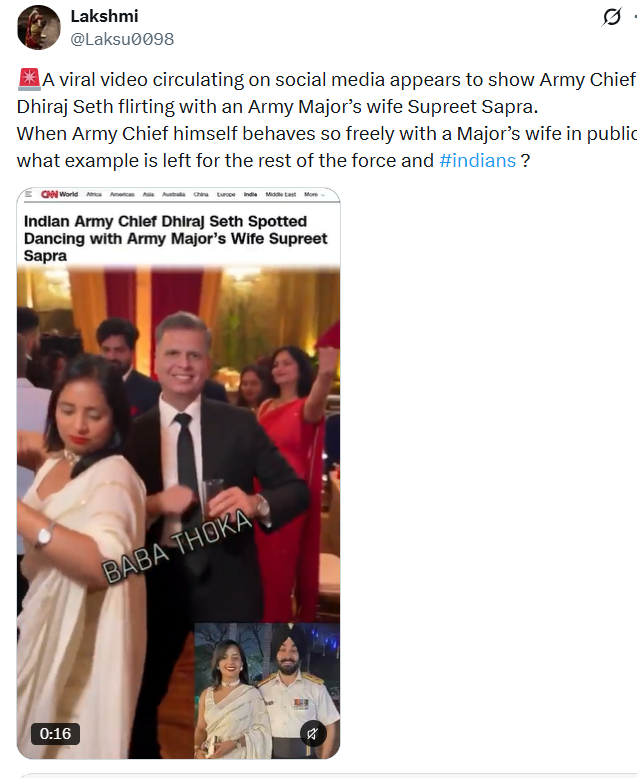
A video is going viral on social media, purportedly showing Indian Army Chief General Dhiraj Seth dancing with a woman. The video is being shared with the claim that Army Chief General Dhiraj Seth was seen dancing with Supreet Sapra, the wife of an Army Major. The video also uses a format resembling the CNN website, and several social media users are sharing it as genuine. However, CyberPeace Research found the video to be completely fake. In reality, an original video was manipulated using AI technology and circulated as part of a disinformation campaign targeting the Army Chief. The Indian Army has also denied the claim.
Claim
An X handle, ‘@Laksu0098’, shared a purported CNN report on September 29. It featured a video allegedly showing Army Chief General Dhiraj Seth dancing with an Army Major’s wife, Supreet Sapra, while holding a glass of alcohol. The bottom portion of the video also displayed a photograph of a woman with an Army officer, implying that the woman in the photograph was the same person seen dancing with the Army Chief. The claim shared along with the video read: “A viral video circulating on social media appears to show Army Chief Dhiraj Seth flirting with an Army Major’s wife, Supreet Sapra. When the Army Chief himself behaves so freely with a Major’s wife in public, what example is left for the rest of the force and Indians?”
https://x.com/Laksu0098/status/2104830327059566641?s=20
Fact Check
We began our research into the viral video by conducting a keyword search. Since the video uses the name and format of CNN, we first searched CNN for any news report related to the video. However, we did not find any such report.
In the next stage of our research, we closely examined the video to assess its authenticity. The movements of the people shown in the viral video, as well as the alcohol in the glasses they were holding, appeared unnatural. Normally, when a person dances while holding a glass filled with liquid, the liquid would show some movement. However, no such movement can be seen in the viral video. This raised suspicions that the video may have been generated or manipulated using AI.
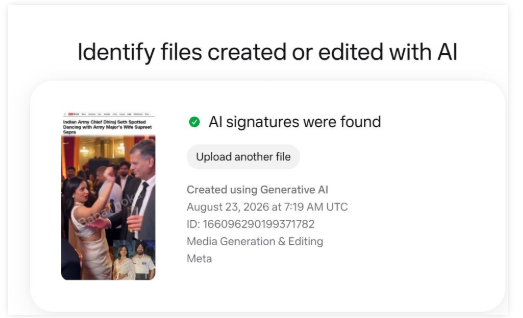
As part of the next step in our research, we used AI detection tools to analyse the video. We first analysed the video using ZeroGPT, which indicated that the viral video was likely AI-generated.

Taking our research forward, we analysed the viral video using Meta AI’s detection tool. The tool’s results indicated that the video had been altered using AI on August 23, 2026.
Conclusion
Our research found that the video being circulated in the name of Army Chief General Dhiraj Seth is fake. The Indian Army has also denied the claim. In reality, the viral video was created and circulated using AI technology.

Introduction
In an age where the lines between truth and fiction blur with an alarming regularity, we stand at the precipice of a new and dangerous era. Amidst the wealth of information that characterizes the digital age, deep fakes and disinformation rise like ghosts, haunting our shared reality. These manifestations of a technological revolution that promised enlightenment instead threaten the foundations upon which our societies are built: trust, truth, and collective understanding.
These digital doppelgängers, enabled by advanced artificial intelligence, and their deceitful companion—disinformation—are not mere ghosts in the machine. They are active agents of chaos, capable of undermining the core of democratic values, human rights, and even the safety of individuals who dare to question the status quo.
The Perils of False Narratives in the Digital Age
As a society, we often throw around terms such as 'fake news' with a mixture of disdain and a weary acceptance of their omnipresence. However, we must not understate their gravity. Misinformation and disinformation represent the vanguard of the digital duplicitous tide, a phenomenon growing more complex and dire each day. Misinformation, often spread without malicious intent but with no less damage, can be likened to a digital 'slip of the tongue' — an error in dissemination or interpretation. Disinformation, its darker counterpart, is born of deliberate intent to deceive, a calculated move in the chess game of information warfare.
Their arsenal is varied and ever-evolving: from misleading memes and misattributed quotations to wholesale fabrications in the form of bogus news sites and carefully crafted narratives. Among these weapons of deceit, deepfakes stand out for their audacity and the striking challenge they pose to the concept of seeing to believe. Through the unwelcome alchemy of algorithms, these video and audio forgeries place public figures, celebrities, and even everyday individuals into scenarios they never experienced, uttering words they never said.
The Human Cost: Threats to Rights and Liberties
The impact of this disinformation campaign transcends inconvenience or mere confusion; it strikes at the heart of human rights and civil liberties. It particularly festers at the crossroads of major democratic exercises, such as elections, where the right to a truthful, unmanipulated narrative is not just a political nicety but a fundamental human right, enshrined in Article 25 of the International Convention on Civil and Political Rights (ICCPR).
In moments of political change, whether during elections or pivotal referenda, the deliberate seeding of false narratives is a direct assault on the electorate's ability to make informed decisions. This subversion of truth infects the electoral process, rendering hollow the promise of democratic choice.
This era of computational propaganda has especially chilling implications for those at the frontline of accountability—journalists and human rights defenders. They find themselves targets of character assassinations and smear campaigns that not only put their safety at risk but also threaten to silence the crucial voices of dissent.
It should not be overlooked that the term 'fake news' has, paradoxically, been weaponized by governments and political entities against their detractors. In a perverse twist, this label becomes a tool to shut down legitimate debate and shield human rights violations from scrutiny, allowing for censorship and the suppression of opposition under the guise of combatting disinformation.
Deepening the societal schisms, a significant portion of this digital deceit traffic in hate speech. Its contents are laden with xenophobia, racism, and calls to violence, all given a megaphone through the anonymity and reach the internet so readily provides, feeding a cycle of intolerance and violence vastly disproportionate to that seen in traditional media.
Legislative and Technological Countermeasures: The Ongoing Struggle
The fight against this pervasive threat, as illustrated by recent actions and statements by the Indian government, is multifaceted. Notably, Union Minister Rajeev Chandrasekhar's commitment to safeguarding the Indian populace from the dangers of AI-generated misinformation signals an important step in the legislative and policy framework necessary to combat deepfakes.
Likewise, Prime Minister Narendra Modi's personal experience with a deepfake video accentuates the urgency with which policymakers, technologists, and citizens alike must view this evolving threat. The disconcerting experience of actor Rashmika Mandanna serves as a sobering reminder of the individual harm these false narratives can inflict and reinforces the necessity of a robust response.
In their pursuit to negate these virtual apparitions, policymakers have explored various avenues ranging from legislative action to penalizing offenders and advancing digital watermarks. However, it is not merely in the realm of technology that solutions must be sought. Rather, the confrontation with deepfakes and disinformation is also a battle for the collective soul of societies across the globe.
As technological advancements continue to reshape the battleground, figures like Kris Gopalakrishnan and Manish Gangwar posit that only a mix of rigorous regulatory frameworks and savvy technological innovation can hold the front line against this rising tidal wave of digital distrust.
This narrative is not a dystopian vision of a distant future - it is the stark reality of our present. And as we navigate this new terrain, our best defenses are not just technological safeguards, but also the nurturing of an informed and critical citizenry. It is essential to foster media literacy, to temper the human inclination to accept narratives at face value and to embolden the values that encourage transparency and the robust exchange of ideas.
As we peer into the shadowy recesses of our increasingly digital existence, may we hold fast to our dedication to the truth, and in doing so, preserve the essence of our democratic societies. For at stake is not just a technological arms race, but the very quality of our democratic discourse and the universal human rights that give it credibility and strength.
Conclusion
In this age of digital deceit, it is crucial to remember that the battle against deep fakes and disinformation is not just a technological one. It is also a battle for our collective consciousness, a battle to preserve the sanctity of truth in an era of falsehoods. As we navigate the labyrinthine corridors of the digital world, let us arm ourselves with the weapons of awareness, critical thinking, and a steadfast commitment to truth. In the end, it is not just about winning the battle against deep fakes and disinformation, but about preserving the very essence of our democratic societies and the human rights that underpin them.
.webp)
Introduction
In the intricate maze of our interconnected world, an unseen adversary conducts its operations with a stealth almost poetic in its sinister intent. This adversary — malware — has extended its tendrils into the digital sanctuaries of Mac users, long perceived as immune to such invasive threats. Our narrative today does not deal with the physical and tangible frontlines we are accustomed to; this is a modern tale of espionage, nestled in the zeros and ones of cyberspace.
The Mac platform, cradled within the fortifications of Apple's walled garden ecosystem, has stood as a beacon of resilience amidst the relentless onslaught of cyber threats. However, this sense of imperviousness has been shaken at its core, heralding a paradigm shift. A new threat lies in wait, bridging the gap between perceived security and uncomfortable vulnerability.
The seemingly invincible Mac OS X, long heralded for its robust security features and impervious resilience to virus attacks, faces an undercurrent of siege tactics from hackers driven by a relentless pursuit for control. This narrative is not about the front-and-centre warfare we see so often reported in media headlines. Instead, it veils itself within the actions of users as benign as the download of pirated software from the murky depths of warez websites.
The Incident
The casual act, born out of innocence or economic necessity, to sidestep the financial requisites of licensed software, has become the unwitting point of compromised security. Users find themselves on the battlefield, one that overshadows the significance of its physical counterpart with its capacity for surreptitious harm. The Mac's seeming invulnerability is its Achilles' heel, as the wariness against potential threats has been eroded by the myth of its impregnability.
The architecture of this silent assault is not one of brute force but of guile. Cyber marauders finesse their way through the defenses with a diversified arsenal; pirated content is but a smokescreen behind which trojans lie in ambush. The very appeal of free access to premium applications is turned against the user, opening a rift that permits these malevolent forces to ingress.
The trojans that permeate the defenses of the Mac ecosystem are architects of chaos. They surreptitiously enrol devices into armies of sorts – botnets which, unbeknownst to their hosts, become conduits for wider assaults on privacy and security. These machines, now soldiers in an unconsented war, are puppeteered to distribute further malware, carry out phishing tactics, and breach the sanctity of secure data.
The Trojan of Mac
A recent exposé by the renowned cybersecurity firm Kaspersky has shone a spotlight on this burgeoning threat. The meticulous investigation conducted in April of this year unveiled a nefarious campaign, engineered to exploit the complacency among Mac users. This operation facilitates the sale of proxy access, linking previously unassailable devices to the infrastructure of cybercriminal networks.
This revelation cannot be overstated in its importance. It illustrates with disturbing clarity the evolution and sophistication of modern malware campaigns. The threat landscape is not stagnant but ever-shifting, adapting with both cunning and opportunity.
Kaspersky's diligence in dissecting this threat detected nearly three dozen popular applications, and tools relied upon by individuals and businesses alike for a multitude of tasks. These apps, now weaponised, span a gamut of functionalities - image editing and enhancement, video compression, data recovery, and network scanning among them. Each one, once a benign asset to productivity, is twisted into a lurking danger, imbued with the power to betray its user.
The duplicity of the trojan is shrouded in mimicry; it disguises its malicious intent under the guise of 'WindowServer,' a legitimate system process intrinsic to the macOS. Its camouflage is reinforced by an innocuously named file, 'GoogleHelperUpdater.plist' — a moniker engineered to evade suspicion and blend seamlessly with benign processes affiliated with familiar applications.
Mode of Operation
Its mode of operation, insidious in its stealth, utilises the Transmission Control Protocol(TCP) and User Datagram Protocol(UDP) networking protocols. This modus operandi allows it to masquerade as a benign proxy. The full scope of its potential commands, however, eludes our grasp, a testament to the shadowy domain from which these threats emerge.
The reach of this trojan does not cease at the periphery of Mac's operating system; it harbours ambitions that transcend platforms. Windows and Android ecosystems, too, find themselves under the scrutiny of this burgeoning threat.
This chapter in the ongoing saga of cybersecurity is more than a cautionary tale; it is a clarion call for vigilance. The war being waged within the circuits and code of our devices underscores an inescapable truth: complacency is the ally of the cybercriminal.
Safety measures and best practices
It is imperative to safeguard the Mac system from harmful intruders, which are constantly evolving. Few measures can play a crucial role in protecting your data in your Mac systems.
- Refrain from Unlicensed Software - Refrain from accessing and downloading pirated software. Plenty of software serves as a decoy for malware which remains dormant till downloaded files are executed.
- Use Trusted Source: Downloading files from legitimate and trusted sources can significantly reduce the threat of any unsolicited files or malware making its way into your Mac system.
- Regular system updates: Regular updates to systems released by the company ensure the latest patches are installed in the system critical to combat and neutralize emerging threats.
- General Awareness: keeping abreast of the latest developments in cyberspace plays a crucial role in avoiding new and emerging threats. It is crucial to keep pace with trends and be well-informed about new threats and ways to combat them.
Conclusion
In conclusion, this silent conflict, though waged in whispers, echoes with repercussions that reverberate through every stratum of digital life. The cyber threats that dance in the shadows cast by our screens are not figments of paranoia, but very real specters hunting for vulnerabilities to exploit. Mac users, once confident in their platforms' defenses, must awaken to the new dawn of cybersecurity awareness.
The battlefield, while devoid of the visceral carnage of physical warfare, is replete with casualties of privacy and breaches of trust. The soldiers in this conflict are disguised as serviceable code, enacting their insidious agendas beneath a façade of normalcy. The victims eschew physical wounds for scars on their digital identities, enduring theft of information, and erosion of security.
As we course through the daunting terrain of digital life, it becomes imperative to heed the lessons of this unseen warfare. Shadows may lie unseen, but it is within their obscurity that the gravest dangers often lurk, a reminder to remain ever vigilant in the face of the invisible adversary.
