
#FactCheck-Bangladesh Garment Workers’ Protest Video Falsely Linked to Delhi Police Firing
Executive Summary
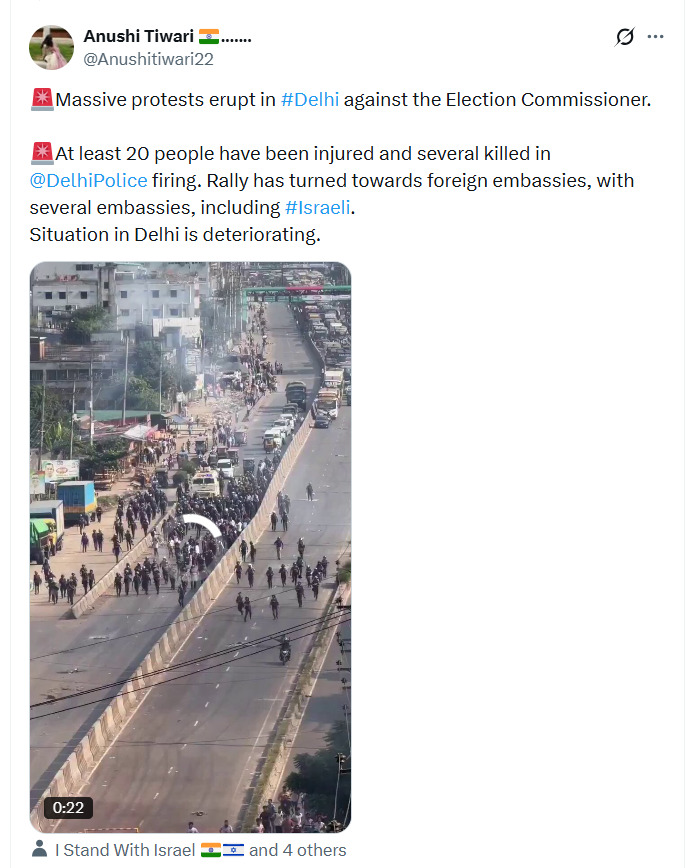
A video is being shared on social media with the claim that at least 20 people were injured and several others were killed in police firing during a protest against the Election Commissioner in Delhi. The post further claims that the protesters marched towards foreign embassies. CyberPeace Research found that the viral video is related to a protest by garment workers in Bangladesh. It has no connection to any incident involving Delhi Police or any protest against the Election Commissioner in Delhi.
Claim
A social media post claims that massive protests have erupted in Delhi against the Election Commissioner. It further alleges that at least 20 people were injured and several others killed in Delhi Police firing. The post also claims that protesters marched towards several foreign embassies, including the Israeli Embassy, and that the situation in Delhi is deteriorating.
https://x.com/Anushitiwari22/status/2117175390989107290
Fact Check
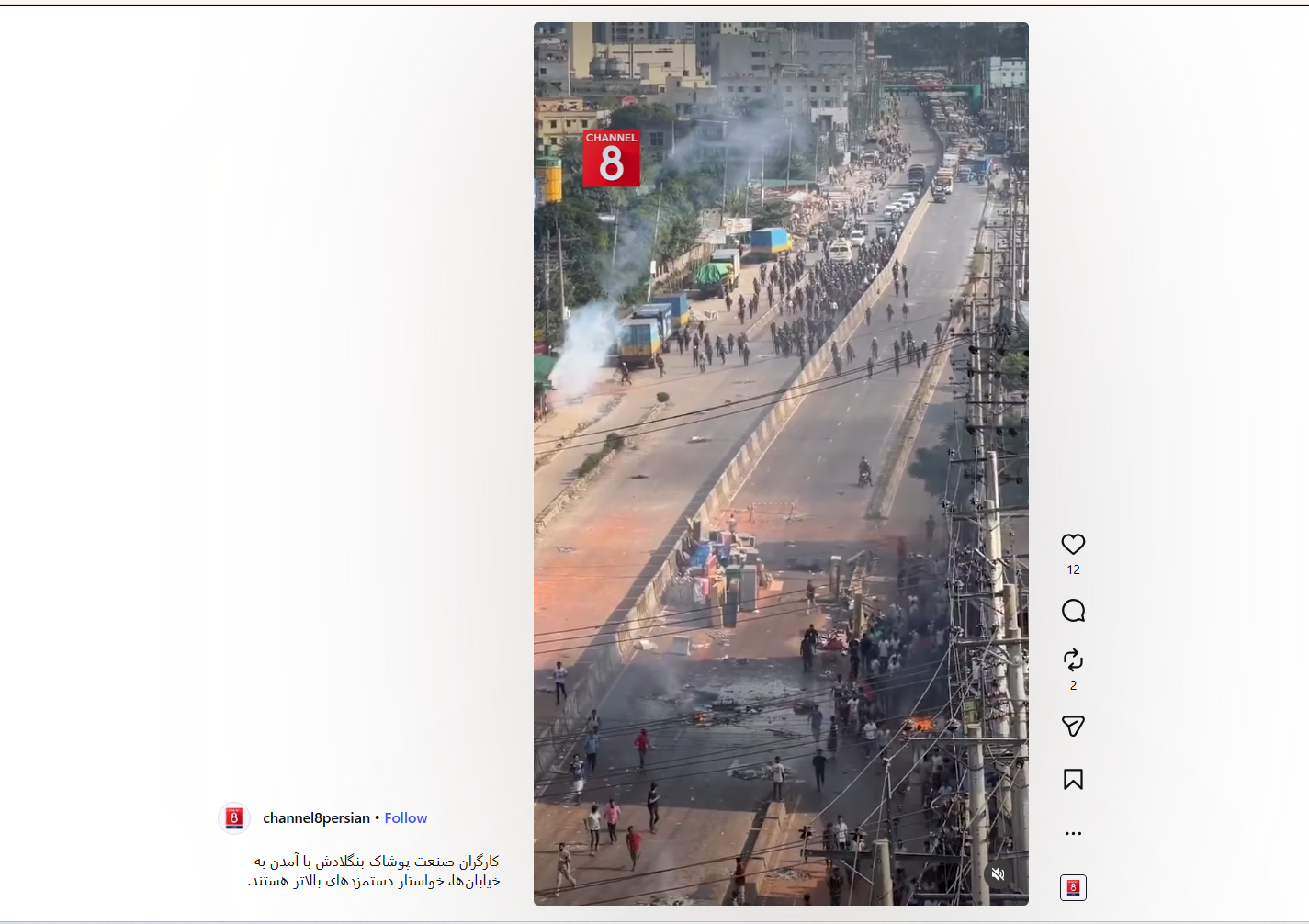
To verify the viral video, we extracted its keyframes and conducted a reverse image search. During the search, we found the video on an Instagram channel, where it was shared with the claim that garment workers in Bangladesh had taken to the streets demanding higher wages.
https://www.instagram.com/reels/DfPQefAic64/
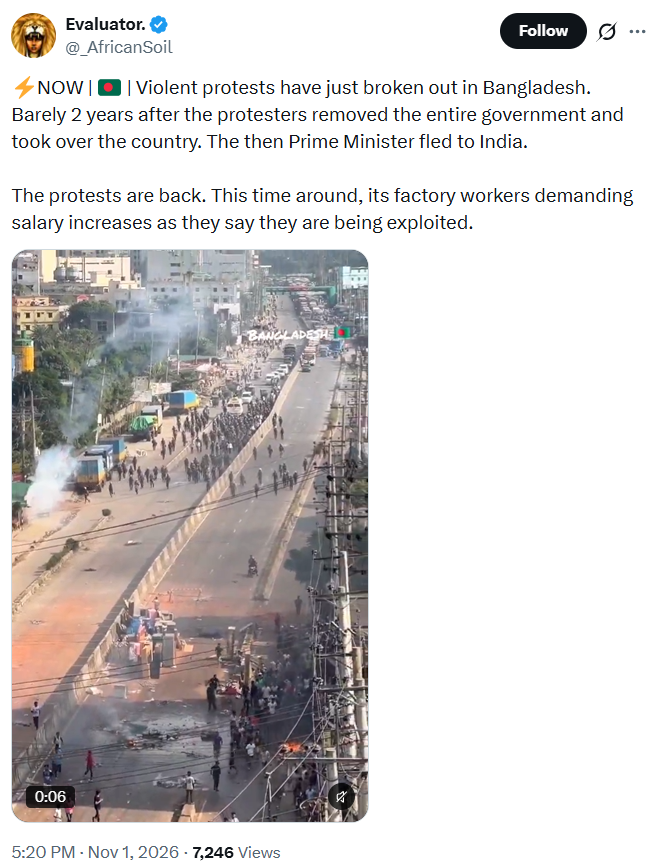
In the next step of our research, we found the video on an X account. The post claimed that violent protests had once again erupted in Bangladesh. According to the post, nearly two years ago, protesters had removed the then government from power and taken control of the country, following which the then prime minister had to leave the country and come to India.The post further claimed that factory workers had taken to the streets this time to demand higher wages. They alleged that they were being exploited
https://x.com/_AfricanSoil/status/2116860302440443948
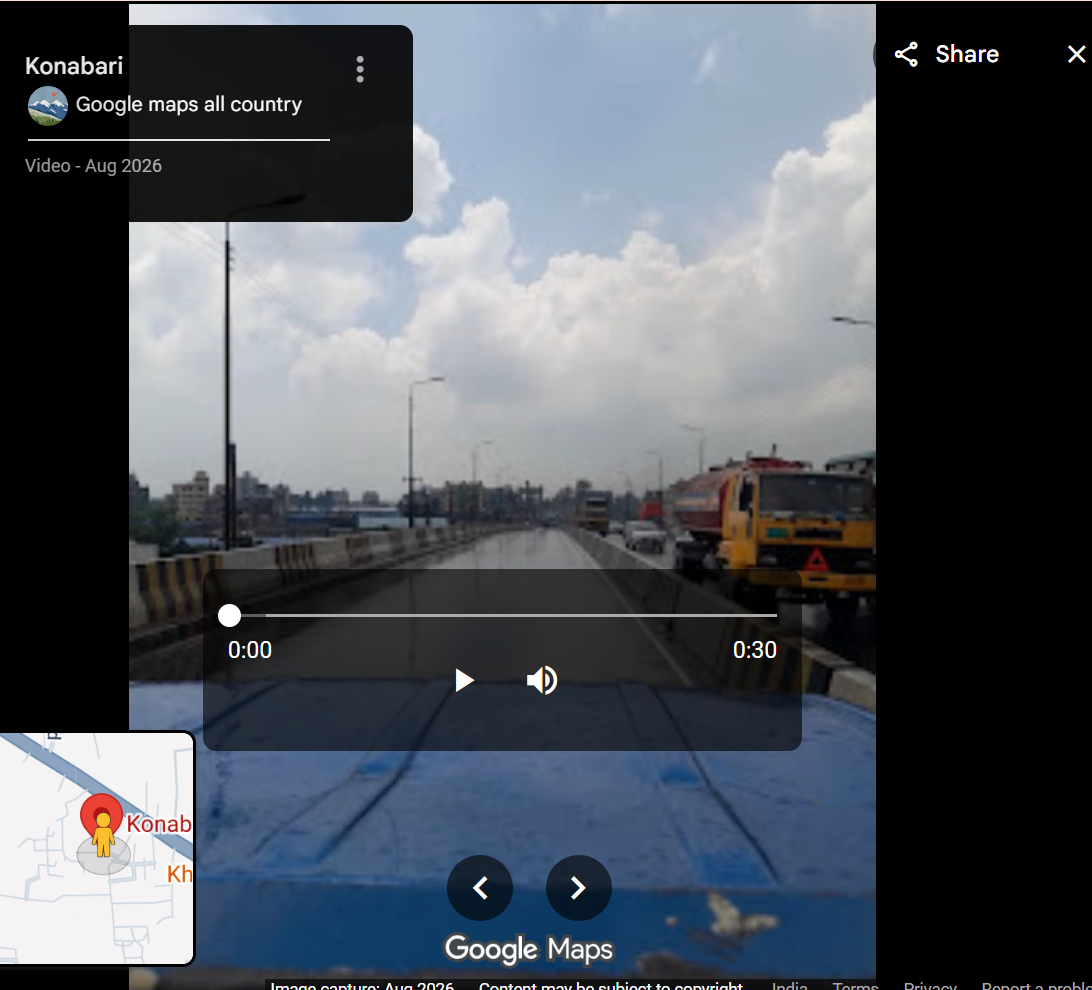
Taking our research forward, we examined the video using Google Street View and identified the location as Konabari, Gazipur. This established that the viral video is from Dhaka, Bangladesh, and not Delhi.
Conclusion
Our research found that the viral video is related to a protest by garment workers in Bangladesh. It has no connection to any incident of Delhi Police firing or any protest against the Election Commissioner in Delhi

Related Blogs
Executive Summary
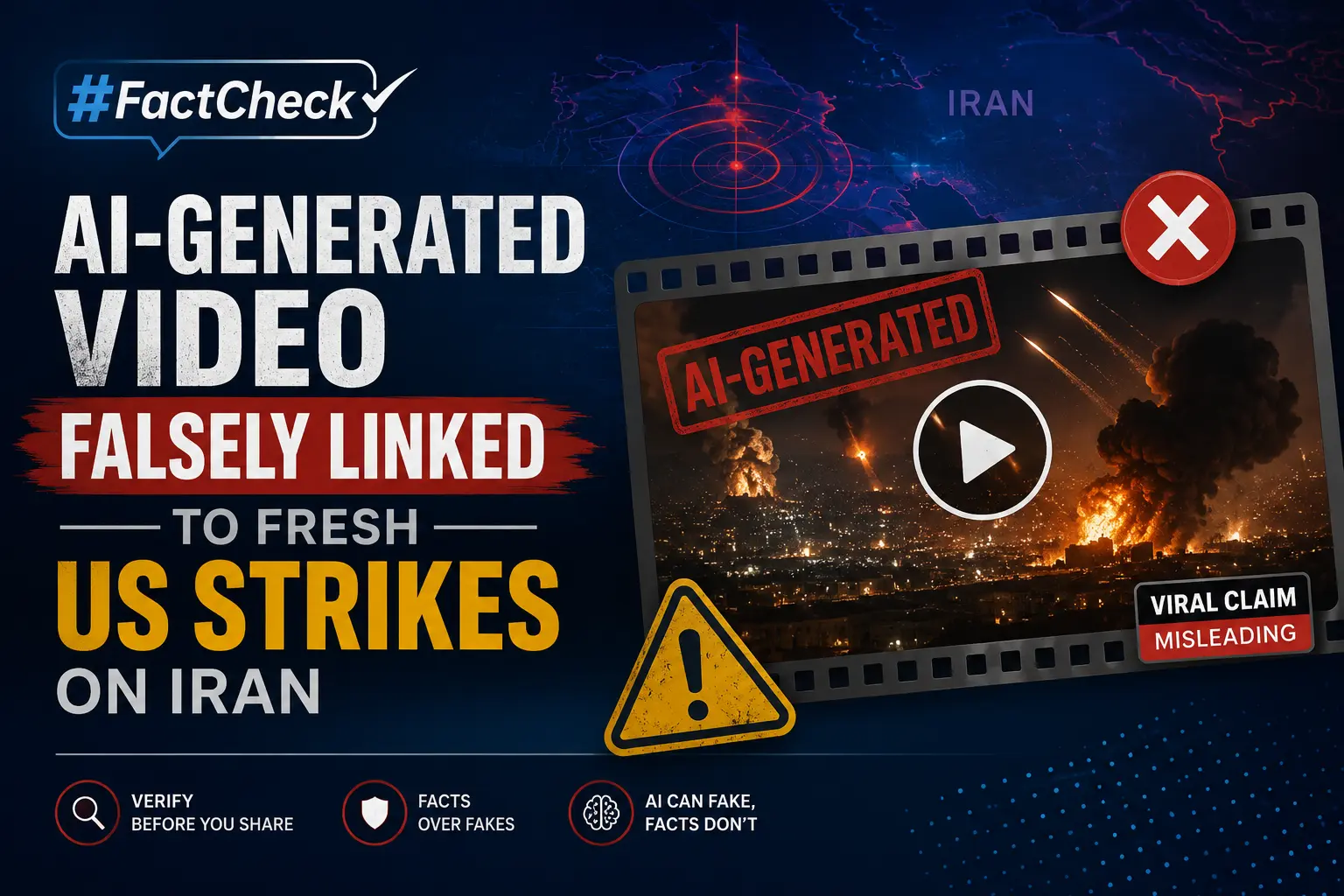
A video is being widely shared on social media showing what appears to be a military facility coming under heavy aerial bombardment. Soldiers can be seen running for cover as explosions occur, followed by thick plumes of smoke rising from the site. Users sharing the clip claim that tensions in the Middle East have escalated once again and that the United States has launched fresh strikes on Iranian-linked military positions. CyberPeace Research Wing's research found the viral claim to be false. Our research revealed that the circulating video is AI-generated and has no connection with the ongoing tensions between the United States and Iran.
Claim
An Instagram user shared the video claiming that fresh US strikes on Iranian-linked targets had significantly escalated the situation in the Middle East.
https://www.instagram.com/reel/DZeaatFNv2E/?igsh=aWRvaTZvNTV2aDR3
https://www.instagram.com/reel/DZeaatFNv2E/?igsh=aWRvaTZvNTV2aDR3

Fact Check
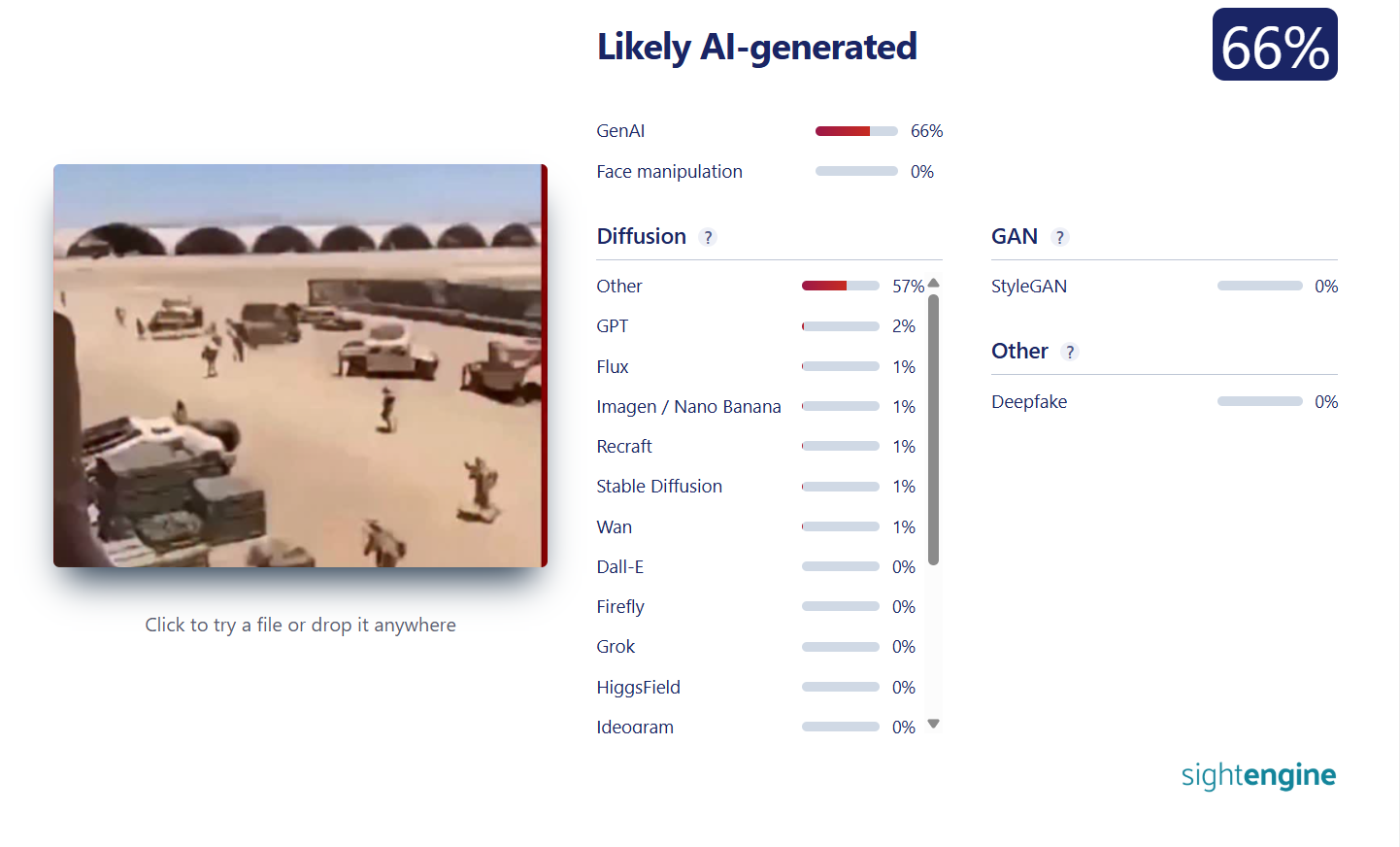
We extracted several keyframes from the viral video and conducted a reverse image search using Google Lens. The search did not lead to any credible news reports or verified sources related to the footage. We then closely examined the video and observed several visual inconsistencies. In the opening frames, the soldiers, military vehicles, and surrounding objects display unnatural shapes and distortions—artifacts commonly associated with AI-generated content. In the next stage of our research, we analysed the clip using the AI detection tool Sightengine. The analysis indicated that the video is approximately 66 per cent AI-generated, further supporting our findings that the footage is not authentic.
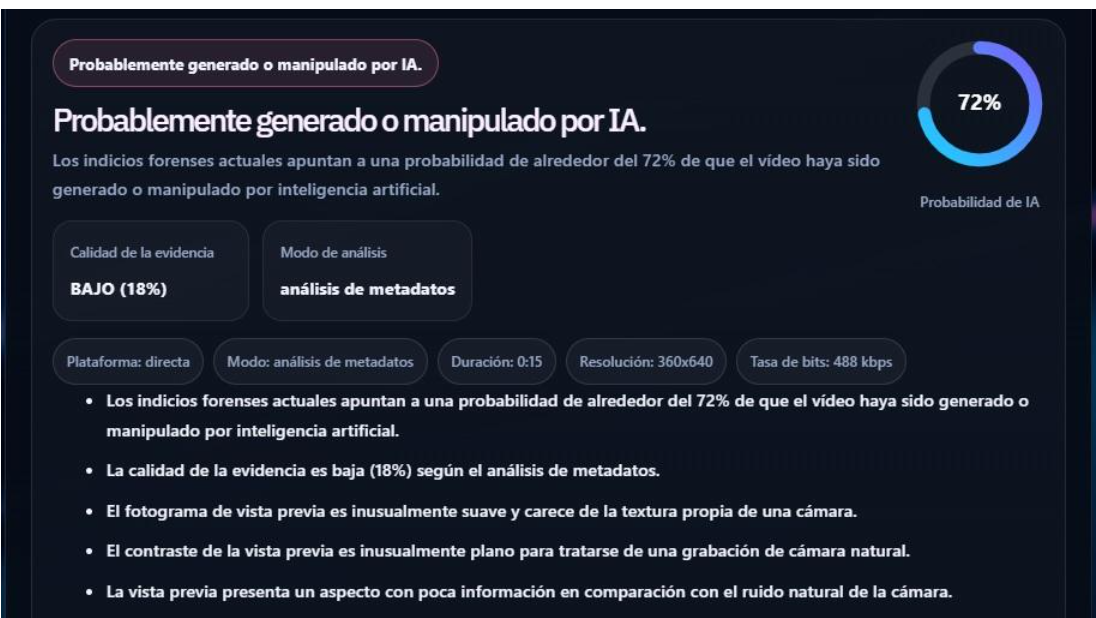
Another analysis of the recording using the DetectVideo AI tool found a 72 per cent probability that it was generated using artificial intelligence (AI).
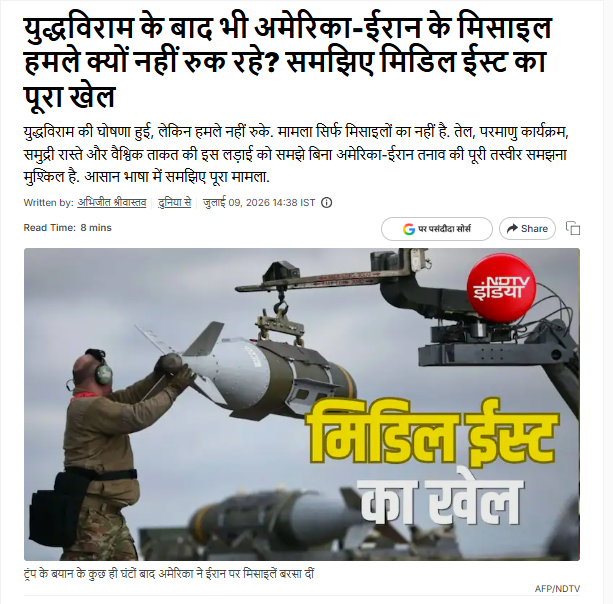
Finally, we searched for recent developments related to the US-Iran tensions using relevant keywords on Google. During the search, we found an NDTV report published on July 9, 2026. The report explains that despite ongoing diplomatic engagement, tensions between the United States and Iran continue to persist due to decades-old political, strategic, and geopolitical disputes. It discusses why incidents of military escalation continue to occur despite repeated attempts at dialogue and de-escalation.
https://ndtv.in/world-news/us-iran-conflict-explained-why-peace-remains-so-elusive-11747960
Conclusion
Our research found that the viral video is not genuine. It is an AI-generated video being circulated with a false claim linking it to recent US military strikes on Iran. There is no credible evidence to suggest that the video depicts any real incident connected to the current US-Iran conflict.
Introduction
Digital evidence has become part of almost every modern investigation. A photograph can place a person at a location, an audio recording can capture a conversation, and a video can appear to show an event as it happened. For years, the main forensic concern was whether such material had been altered. The rapid growth of generative artificial intelligence has added a harder question: even when a file is preserved exactly as received, can investigators still trust what it appears to show?
Deepfakes have made this question practical rather than theoretical. Synthetic or manipulated audio, video and images can imitate real people and real events with increasing realism. CERT-In describes deepfakes as a high-risk threat because they can support disinformation, fraud, social engineering and reputational harm.[1] NIST research likewise treats AI-generated media as a digital-forensics challenge that requires systematic evaluation of detection technologies.[2]
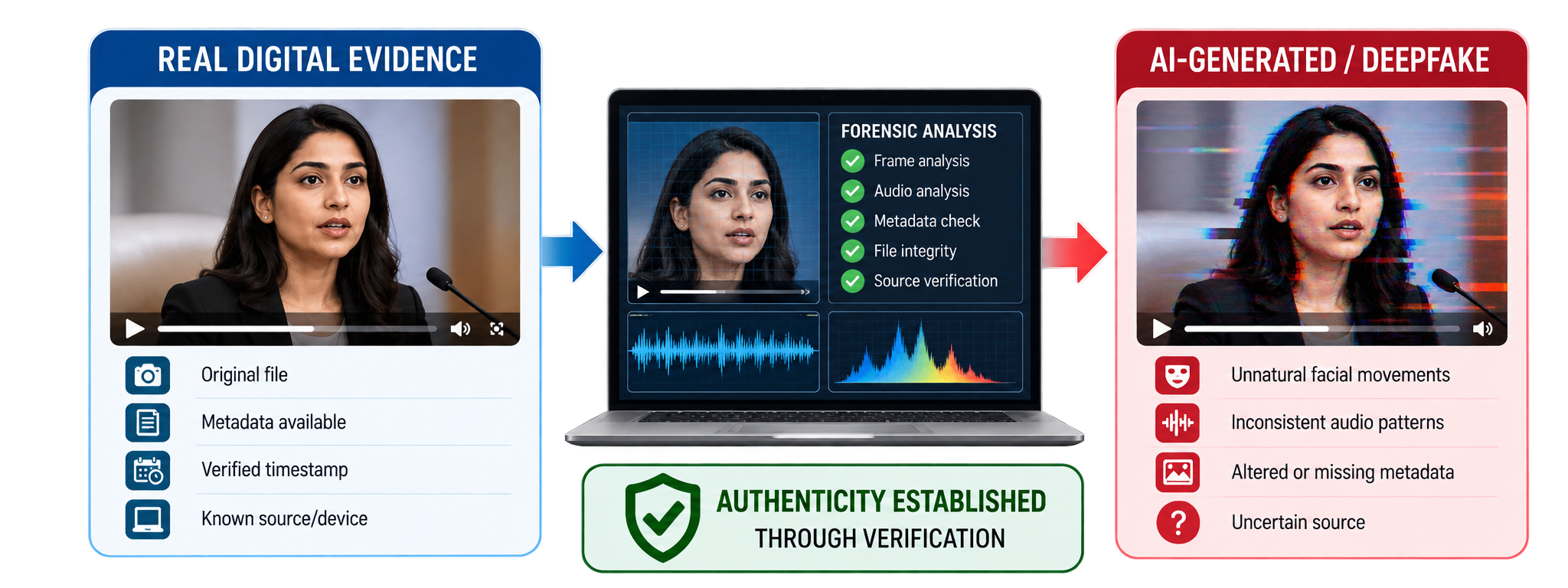
The result is an evidence problem. The answer is not to stop trusting digital evidence, but to become more disciplined about establishing its origin, integrity, context and authenticity.
The evidence problem begins before the laboratory
When a suspicious video reaches an investigator through WhatsApp, Telegram, email or social media, the file may already have passed through several transformations. It may have been compressed, re-encoded, cropped, renamed or stripped of metadata. A screenshot may preserve what is visible but lose the original file structure. A forwarded audio clip may contain no reliable information about where it was first recorded.
For that reason, forensic examination should begin with acquisition and provenance, not with a quick “deepfake detector” result. Investigators should ask: Who supplied the file? Where was it obtained? Is there an original version? What device or account produced it? What happened to the file before it reached the investigator?
Cryptographic hashing remains important because it can demonstrate that an acquired working copy has not changed during examination. But a valid hash does not prove that the underlying event was genuine. A perfectly preserved fake is still a fake.
What a professional examination should look for
A reliable assessment combines several forms of evidence rather than relying on one technical indicator.
Source and acquisition. The original artefact should be preserved whenever possible. Investigators should record the acquisition method, date and time, source account or device, and any known transformations before collection. A documented chain of custody is essential when material may later support a legal, disciplinary or regulatory decision.
Metadata and file structure. Metadata may provide useful clues about creation, encoding, editing software and timestamps. File structure, compression behaviour and related technical characteristics can also reveal inconsistencies. However, these indicators are supporting evidence, not proof on their own, because metadata can be removed or rewritten during normal processing.
Content-level examination. Forensic analysis can include frame-by-frame video review, audio waveform and spectral examination, and inspection for inconsistencies in lighting, reflections, facial movement, lip synchronisation or background elements. Such signs may help guide an investigation, but they are not a permanent checklist. Generative systems continue to improve.
Independent corroboration. This is often the strongest step. If a recording allegedly shows that a person was in a particular place at a particular time, investigators can compare it with CCTV, access-control records, device artefacts, communications, location information, eyewitness accounts or other independent records. The goal is to determine whether the wider evidence supports the event represented by the media.
A real-world lesson: the Pikesville case
The 2024 Pikesville High School incident in Maryland provides a practical example of why authenticity cannot be assumed from appearance alone. An audio recording circulated online that was presented as the principal making racist and antisemitic comments. On January 17, 2024, Baltimore County Public Schools said it could not yet confirm the recording’s veracity and opened an investigation.[3]
Several months later, the school district reported that investigators, with assistance from the FBI and other experts, had verified that the audio had been created using artificial intelligence.[4] Police subsequently arrested the school’s former athletic director in connection with the fabricated recording.[5]
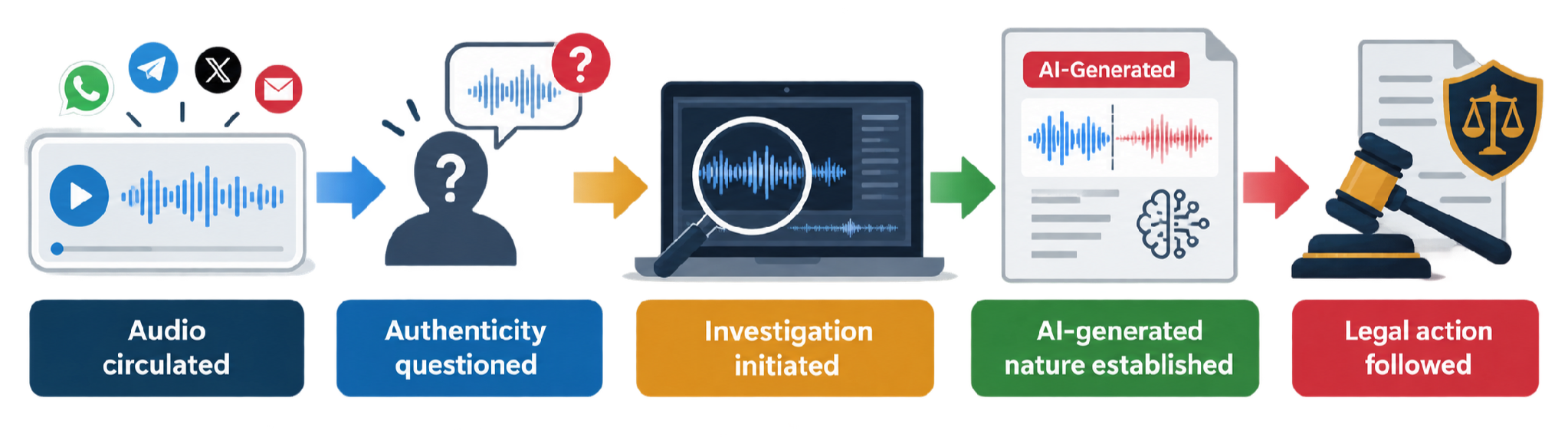
The forensic lesson is larger than the incident itself. The recording had social consequences before its authenticity was established. In a fast-moving online environment, the first version of an event can travel much further than the later correction. Deepfake investigations therefore have to consider not only whether media is authentic, but also how quickly unverified material can influence decisions.
From deepfake detection to content provenance
Detection tools will remain useful, but they should be treated as part of an examination rather than an automatic verdict. NIST’s Guardians of Forensic Evidence work reflects the need to evaluate how analytic systems perform against changing forms of AI-generated media and how well they generalise beyond controlled conditions.[2]
Another important direction is content provenance. The Coalition for Content Provenance and Authenticity (C2PA) has developed a technical framework for recording verifiable information about how digital content was created and changed. Content Credentials can bind provenance information to an asset using cryptographic techniques, allowing later users to inspect a recorded content history when that information is available.[6]
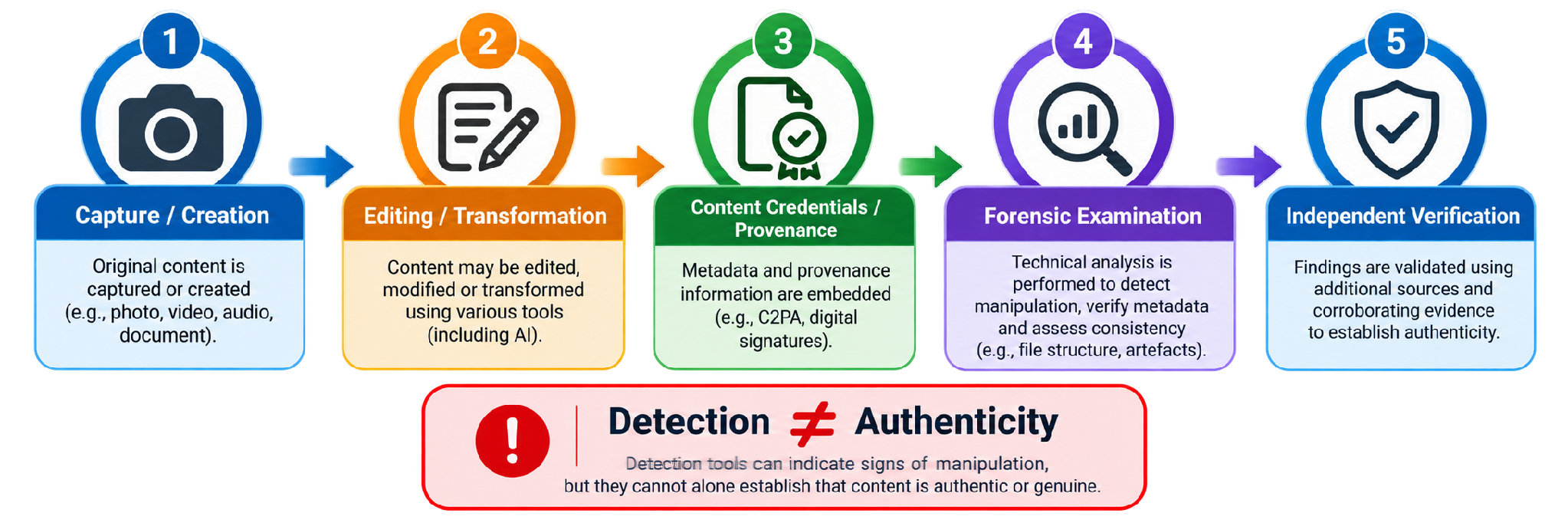
Provenance does not mean that every claim associated with a file is automatically true. It adds context: who created it, what actions were taken and how the asset changed. In a deepfake environment, that context can be as important as the content itself.
Why this matters in India
The issue is especially relevant to India’s fast-growing digital environment. CERT-In’s 2024 advisory identifies misinformation, fraud and reputational damage among the risks associated with synthetic media.[1] In August 2026, the Government of India stated that the regulatory framework addresses AI-generated deepfakes and noted amendments to the IT Rules in February 2026 concerning harms arising from synthetically generated information, including requirements related to labelling and traceable metadata for permissible AI-generated content.[7]
For organisations, deepfake response should therefore not be treated only as a media or public-relations issue. It can become an incident-response and forensic issue. A suspicious executive voice note, a manipulated employee video or a fabricated screen recording may require preservation, technical examination and independent corroboration before any action is taken.
Conclusion
Deepfakes do not make digital evidence useless. Deepfakes make handling of evidence more dangerous. The professional response is not to believe everything or to doubt everything. The professional response is to build a process around evidence: preserve the original where possible document how evidence was acquired, calculate and record hashes, examine metadata and technical characteristics use detection tools while understanding their limitations compare media with independent evidence and examine provenance information where it is available.
Importantly investigators and decision-makers should separate three questions: Is the file intact? Is the content authentic? Does the content actually prove the event being alleged? Deepfakes can pass the test while failing the other two.
In the age of AI evidence will increasingly be judged not only by how convincing it looks but, by how well its origin, integrity, context and history can be demonstrated. That is the standard that can help preserve trust when seeing and hearing're no longer enough.
References
1. CERT-In, “Deepfakes - Threats and Countermeasures,” Advisory CIAD-2024-0060, 27 November 2024. View source
2. NIST, “Guardians of Forensic Evidence: Evaluating Analytic Systems Against AI-Generated Deepfakes,” 27 January 2025. View source
3. Baltimore County Public Schools, “January 17, 2024, Community Update: Message from Superintendent Dr. Myriam Rogers Regarding Pikesville High School.” View source
4. Baltimore County Public Schools, “April 24, 2024 Staff and Community Update: Message from Superintendent Dr. Myriam Rogers Regarding Pikesville High School Investigation.” View source
5. The Baltimore Banner / WYPR, “Ex-athletic director framed principal with AI-generated voice, police say,” 25 April 2024. View source
6. Coalition for Content Provenance and Authenticity (C2PA), “Content Credentials: C2PA Technical Specification,” Version 2.1. View source
7. Government of India, Ministry of Electronics & Information Technology, “Government Strengthens Regulatory Framework to Address AI-Generated Deepfakes,” 6 August 2026. View source

Introduction
In the ever-evolving world of technological innovation, a new chapter is being inscribed by the bold visionaries at Figure AI, a startup that is not merely capitalising on artificial intelligence rage but seeking to crest its very pinnacle. With the recent influx of a staggering $675 million in funding, this Sunnyvale, California-based enterprise has captured the imagination of industry giants and venture capitalists alike, all betting on a future where humanoid robots transcend the realm of science fiction to become an integral part of our daily lives.
The narrative of Figure AI's ascent is punctuated by the names of tech luminaries and corporate giants. Jeff Bezos, through his firm Explore Investments LLC, has infused a hefty $100 million into the venture. Microsoft, not to be outdone, has contributed a cool $95 million. Nvidia and an Amazon-affiliated fund have each bestowed $50 million upon Figure AI's ambitious endeavours. This surge of capital is a testament to the potential seen in the company's mission to develop general-purpose humanoid robots that promise to revolutionise industries and redefine human labour.
The Catalyst for Change
This investment craze can be traced back to the emergence of OpenAI's ChatGPT, a chatbot that caught the public eye in November 2022. Its success has not only ushered in a new era for AI but has also sparked a race among investors eager to stake their claim in startups determined to outshine their more established counterparts. OpenAI itself, once mulling over the acquisition of Figure AI, has now joined the ranks of its benefactors with a $5 million investment.
The roster of backers reads like a who's who of the tech and venture capital world. Intel's venture capital arm, LG Innotek, Samsung's investment group, Parkway Venture Capital, Align Ventures, ARK Venture Fund, Aliya Capital Partners, and Tamarack—all have invested their lot with Figure AI, signalling a broad consensus on the startup's potential to disrupt and innovate.
Yet, when probed for insights, these major players—Amazon, Nvidia, Microsoft, and Intel—have maintained a Sphinx-like silence, while Figure AI and other entities mentioned in the report have refrained from immediate responses to inquiries. This veil of secrecy only adds to the intrigue surrounding the company's prospects and the transformative impact its technology may have on society.
Need For AI Robots
Figure AI's robots are not mere assemblages of metal and circuitry; they are envisioned as versatile beings capable of navigating a multitude of environments and executing a diverse array of tasks. From working at aisles of warehouses to the bustling corridors of retail spaces, these humanoid automatons are being designed to fill the void of millions of jobs projected to remain vacant due to a shrinking human labour force.
The company's long-term mission statement is as audacious as it is altruistic: 'to develop general-purpose humanoids that make a positive impact on humanity and create a better life for future generations.' This noble pursuit is not just about engineering efficiency; it is about reshaping the very fabric of work, liberating humans from hazardous and menial tasks, and propelling us towards a future where our lives are enriched with purpose and fulfilment.
Conclusion
As we stand on the cusp of a new digital world, the strides of Figure AI serve as a beacon, illuminating the path towards machine and human symbiosis. The investment frenzy that has enveloped the company is a clarion call to all dreamers, pragmatists and innovators alike that the age of humanoid helpers is upon us, and the possibilities are as endless as our collective imagination.
Figure AI is forging a future where robots walk among us, not as novelties or overlords but as partners in forging a world where technology and humanity work together to unlock untold potential. The story of Figure AI is not just one of investment and innovation; it is a narrative of hope, a testament to the indomitable spirit of human ingenuity, and a preview of the wondrous epoch that lies just beyond the horizon.
References
- https://cybernews.com/tech/openai-bezos-nvidia-fund-robot-startup-figure-ai/
- https://www.thedailystar.net/business/news/bezos-nvidia-join-openai-funding-humanoid-robot-startup-3551476
- https://www.bloomberg.com/news/articles/2024-02-23/bezos-nvidia-join-openai-microsoft-in-funding-humanoid-robot-startup-figure-ai
- https://economictimes.indiatimes.com/tech/technology/bezos-nvidia-join-openai-in-funding-humanoid-robot-startup-report/articleshow/107967102.cms?from=mdr
