
#FactCheck: Viral 360-Degree Catch Video Is AI-Generated, Not From a Real Match
Executive Summary
A video is being shared on social media showing a female cricket player seemingly making an impressive catch in the air after rotating 360 degrees. The video is being shared with claims that the player pulled off the extraordinary catch in an incredible feat on the cricket field. Research by CyberPeace found the viral claim to be false. Our research revealed that the viral video was edited with the help of AI. The video uses actual broadcast footage from the 2024 Women’s T20 World Cup match between India and New Zealand, but the 360-degree catch shown in the video was not part of the actual match.
Claim:
A video of a female cricketer making an incredible 360-degree catch is being shared on social media as a real incident from a cricket match.
https://www.instagram.com/reels/DdEca3LNT00/

Fact Check
To verify the authenticity of the viral claim, we conducted a Google search using relevant keywords. However, we did not find any credible media reports confirming the claim.

As part of the next step in our research, we conducted a reverse image search of the keyframes from the video. During the search, we found the same video on a YouTube channel, where it was identified as AI-generated.
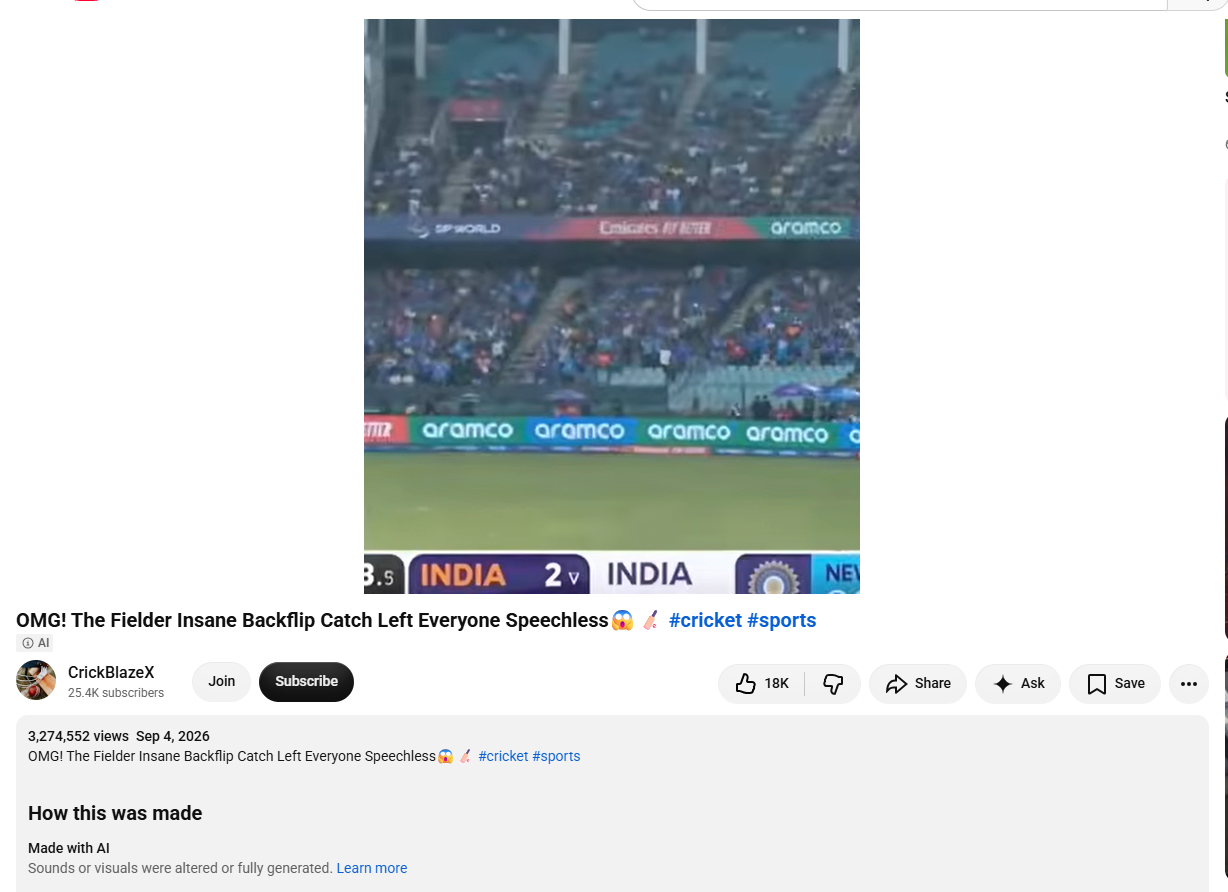
As the next step, we scanned the viral video using the AI detection tool Hive Moderation. According to the tool’s results, there is a 70 percent probability that the video is AI-generated.

As part of the next step in our research, we scanned the viral video using an AI detection tool. According to the results, the viral video is AI-generated.

Conclusion
Our research found that the viral video was edited with the help of AI. The video uses actual broadcast footage from the 2024 Women’s T20 World Cup match between India and New Zealand. However, the 360-degree catch shown in the video was not part of the actual match.

Related Blogs

Executive Summary
A video circulating on social media has sparked controversy, showing a man allegedly vandalising an idol of Lord Ram. Users sharing the clip claim that the incident recently took place in Ayodhya, Uttar Pradesh. The posts further allege that a Muslim individual climbed the idol and attempted to damage it. However, research by the CyberPeace found the viral claim to be misleading. The research revealed that the video is not recent but nearly three years old. At the time of the incident, the police had already arrested the accused. Social media users are now resharing the old video with false claims that it is a recent event.
Claim:
On February 14, 2026, a Facebook user shared the viral video claiming that the incident occurred in Ayodhya, where a large religious gathering was underway. The post alleged that a man identified as Mohammad Mukhtar Mandal climbed the idol of Lord Ram and attempted to break it. The post was widely circulated with inflammatory remarks. (Link and archived version of the post were provided along with a screenshot.)
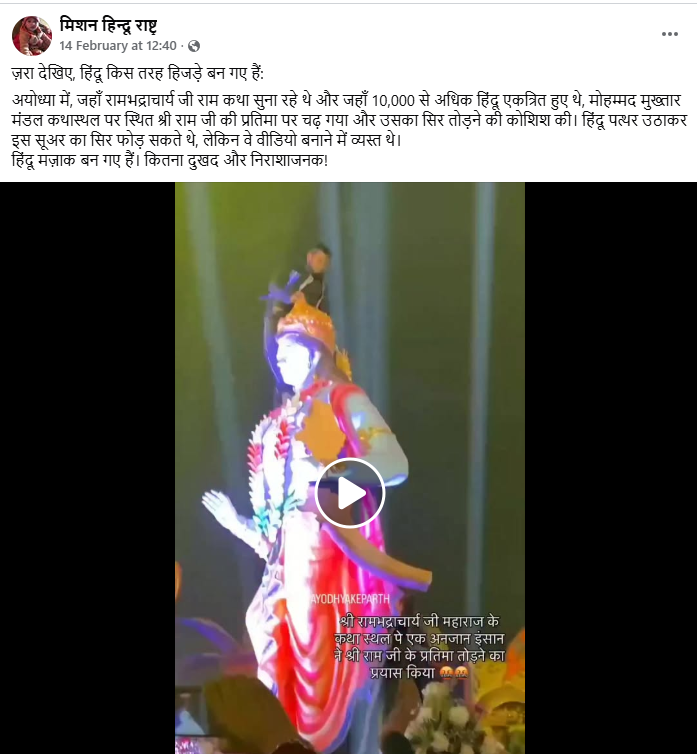
Fact Check
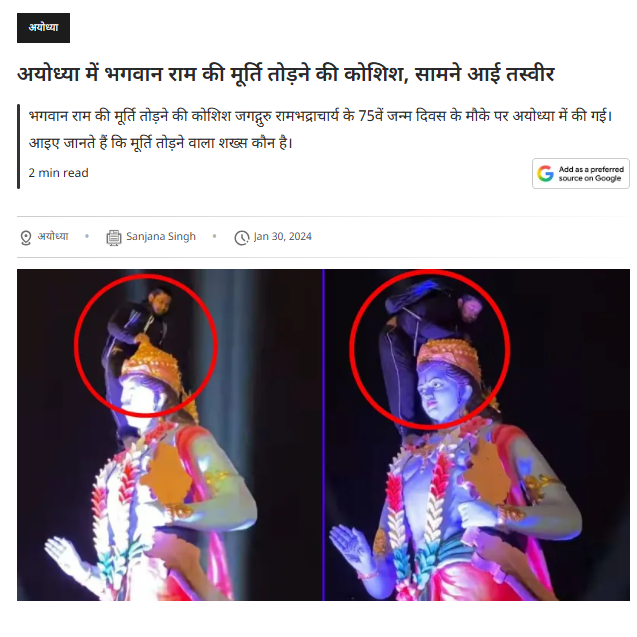
To verify the authenticity of the claim, we extracted key frames from the viral video and conducted a reverse image search using Google Lens. During the search, we found a report published on January 30, 2024, on the Hindi website of Patrika, which carried visuals matching the viral footage. According to the report, a video had surfaced showing a man climbing an idol of Lord Ram in Ayodhya and attempting to damage it. The video had gone viral at the time, following which police registered a case against the accused, Mukhtar Ali Mandal, and arrested him.
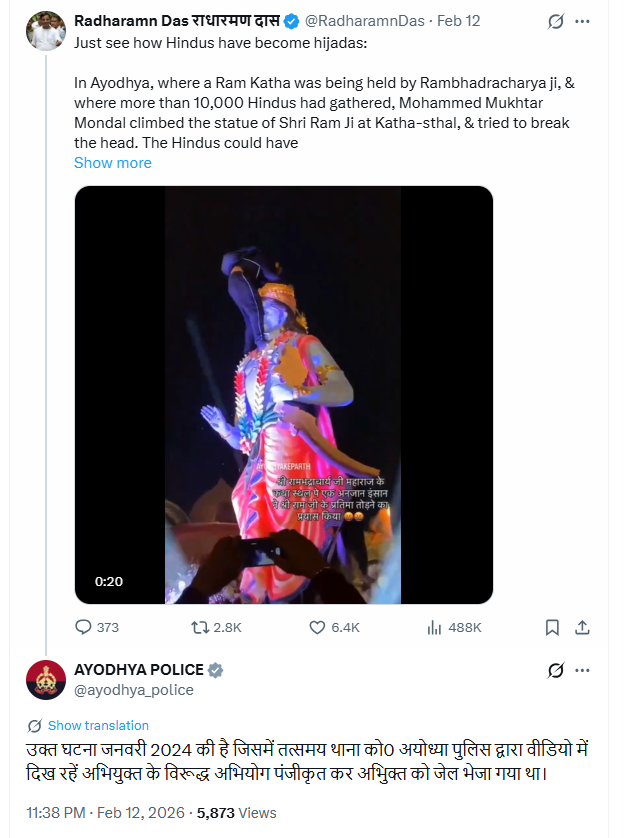
Further research led us to another Facebook post featuring the same video. In the comment section of that post, Uttar Pradesh Police clarified that the incident dated back to January 2024. The Ayodhya police had registered a case against the accused shown in the video and sent him to jail.
Conclusion:
The research confirms that the viral video is not recent but an old incident from January 2024. The accused was arrested at the time. The video is being reshared with misleading claims falsely presenting it as a recent event.

Introduction
India & Bangladesh have adopted proactive approaches, focusing on advancing cyber capacity building in the region. Bangladeshi and Indian cybersecurity experts have emphasised the importance of continuous technology training to protect the digital space from growing cyber-attacks and threats. They call for greater collaboration to share knowledge and expertise in cyber resilience, network vulnerability, and cyber risk assessment. The Cyber-Maitree 2023 event held in Dhaka aimed to enrich and build capacity to counter cyber-attacks and threats. The senior director of India's Computer Emergency Response Team acknowledged the growing dependence on cyberspace and the need for increased preparedness as critical infrastructures, energy systems, banks, and utilities are connected to the internet. Recently, Bangladesh Cyber Security Summit 2024, organised by Grameenphone, was held in Dhaka on March 5th, 2024. Such collaborative dialogues between the countries serve as a shining example of cooperation between the governments of Bangladesh and India, serving as a platform for knowledge sharing, capacity building, and international cooperation in cyber security.
Cyber Maitree held in 2023
In 2023, India and Bangladesh held 'Cyber Maitree 2023', an initiative hosted by the ICT Division of the Bangladeshi Government, to address cybersecurity challenges in a rapidly globalising world characterised by digitisation. The event, which translates to "Cyber Friendship," was an interface for cybersecurity experts and aspirants from both nations, creating an avenue for extensive training, practical exercises, and a dynamic exchange of information. We need to emphasise the importance of bolstering digital safety as both nations grapple with the rapid digitisation of the world.
India-Bangladesh joint efforts aim to fortify cyber resilience, pinpoint potential network vulnerabilities, bolster rigorous risk assessments, and illuminate the landscape of cyber threats. It encompasses various sectors, including cybersecurity, artificial intelligence, ICT, and IT-driven human resource expansion. The growing camaraderie between India and Bangladesh has been evident through strategic engagements, such as the India-Bangladesh Startup Bridge and the establishment of 12 High Tech Parks in Bangladesh.
Highlights of the India-Bangladesh MoUs for Cyber Security Cooperation
In 2017, India and Bangladesh signed a Memorandum of Understanding (MoU) focused on cyber security cooperation.
In 2022, Both nations crafted a Memorandum of Understanding (MoU), highlighting collaboration in spheres such as e-governance, e-public service delivery, research, and development. A separate agreement was also inked focusing on mutual information sharing pertaining to cyber-attacks and incidents. The first MoU aims to provide a framework for training Bangladesh Railway employees at Indian Railways' training institutes, including field visits. The Indian Railways will coordinate with officials from the Ministry of Railways, Government of Bangladesh to improve training facilities in Bangladesh. The second MoU focuses on collaboration in IT systems, for the Bangladesh Railway. The Ministry of Railway, Government of India, will offer IT solutions for passenger ticketing, freight operations, train inquiry systems, asset management digitisation, HR and finance infrastructure. The MoUs aim to strengthen the friendship bond between India and Bangladesh and promote friendly cooperation in the railway sector.
Way Ahead
Zunaid Ahmed Palak, State Minister for Posts, Telecom and ICT, Bangladesh, has announced that Bangladesh and India will collaborate to ensure the safety of the cyber world. The two countries are expected to sign a final agreement within the next three to six months. He stressed the importance of attracting investments in the postal, telecommunication, and IT sectors. He also highlighted the strong ties between Bangladesh and India. He also announced that 12 high-tech parks will be constructed in Bangladesh with an Indian Line of Credit, starting operation by 2025. He further referred to the Indian Cyber Emergency Response Team (CERT), and said "We are very much enthusiastic in fighting against the cyber attacks and crimes as the team is now working with us".
Bangladesh Cyber Security Summit 2024
The Bangladesh Cyber Security Summit 2024, organised by Grameenphone, was held in Dhaka on 5th March 2024, focusing on cybersecurity issues and opportunities, fostering collaboration between government, private organisations, industry experts, and sponsors investing in Bangladesh's digital future.
Conclusion
India and Bangladesh share a common vision for a secure digital future, focusing on cybersecurity collaboration to safeguard shared aspirations and empower nations to thrive in the digital age. We must emphasise the need to fortify digital defenses, leveraging expertise, innovation, and collaboration to secure interconnected futures. Collaborative relations in Information and Communication Technology and Cyber Security will strengthen digital defense and establish cyber resilience.
References:
- https://caribbeannewsglobal.com/bangladesh-and-india-call-for-more-cyber-security-training/?amp=1
- https://www.indianewsnetwork.com/en/20231005/bangladesh-and-india-strengthen-ties-through-cyber-maitree-2023
- https://www.bssnews.net/news-flash/150763
- https://digibanglatech.news/english/bangladesh-english/125439/
- https://www.mea.gov.in/Portal/LegalTreatiesDoc/BG17B3024.pdf
- https://digibanglatech.news/english/bangladesh-english/125439/
- https://www.tbsnews.net/tech/ict/bangladesh-india-work-together-cyber-security-palak-712182

Introduction
WhatsApp has become the new platform for scams, and the number of cases of WhatsApp scams is increasing daily. Just like that, a new WhatsApp scam has been started, and many WhatsApp users in India have reported receiving missed calls from unknown international numbers. Worse, one does not even have to answer the call to be scammed. A missed call is sufficient to be scammed.
Millions of populations switch from normal SMS to WhatsApp, usually, people used to get fake messages and marketing messages, but the trend of scamming has been evolving now. Most people get calls from different countries, and they are concerned about how these scammers got the numbers. WhatsApp works through VoIP networks, so no extra charges from any country exist. And about 500 million WhatsApp users are getting these scam calls, the calls are mainly on job-scams of promising part-time employment and opportunities. These types of job scam calls have been started reporting in 2023.
People reporting missed calls from countries like Ethiopia (+251), Malaysia (+60), Indonesia (+62), Vietnam (+84), etc.
The agenda of these calls are still unclear. Still, in some cases, the scammers ask for confidential information from WhatsApp users, like bank details, so the users must not reveal their personal information. Also, it is important to note that if you get any calls from a particular country, it necessarily does not mean it is from that country. Various agencies sell international numbers for WhatsApp calls.
Why has WhatsApp become a hub scam?
The generation has evolved and dumped the old SMS into WhatsApp. From school to college and offices, people use WhatsApp for their official work, as it is very easy and user-friendly, so people avoid safety measures. Generally, users need to understand the consequences of technology and use it with safeguards and awareness. Many people lose money and become victims of scams on WhatsApp as they share their confidential information. And the worse is that one does not even have to answer the call to be scammed. A missed call is sufficient to be scammed.
Before these international calls scam, the user received a call from the scam that they were from KBC, and the user won something. Then sought confidential information by the excuse that they would transfer the money to the user, and because of that user got scammed by the scammers. These scams have risen rapidly lately.
Safeguards users can use against these scam calls
WhatsApp responds to complaints regarding international calls to “block and report.”
If you have already received such calls, the best thing you can do is report and block them right away. As a result, the same number does not return to your phone, and numerous identical reports may persuade WhatsApp to delete the number entirely.
WhatsApp is also working on an update allowing users to block calls from unknown numbers on the service.

Users must modify their phone’s and app’s fundamental privacy settings to protect themselves from data breaches. The calls are directed toward app users who are actively using the app. However, by modifying the account’s appearance, a user can lessen the likelihood of being added to the scammers’ attack lists.
Limit Privacy
Begin by modifying WhatsApp’s ‘who can see’ settings. If your profile photo, last seen, and online status are visible to anybody, restrict them to persons on your contact list only. Change the About and Groups options as well.
Turn on two-factor authentication
Enabling two-factor authentication on WhatsApp adds more security to your data. In addition, the app also supports biometric protection in case of theft or loss.
Active Reporting
The users should report as soon as they see something odd or suspicious activity.
A typical question that users have is, ‘Where do the scammers acquire my phone number from?’
The answer is a little more complicated than we thought. Your data is retained on the company database from the time you sign up on a website or reveal your phone number at a store in order to take advantage of promotional offers and promotions. Due to a lack of technological infrastructure and legislation to protect personal data, a scammer can simply obtain your information.
According to Palo Alto research, India is the second most vulnerable country in the APAC region in terms of cyberattacks and data breaches. A data protection law is essential in the face of increasing calls and data breaches.
The Digital Personal Data Protection bill is set to be introduced in the parliament’s monsoon session. The bill has the potential to protect data, which will help to eliminate scams.
Conclusion
Several people had tweeted on tweeter about receiving fake calls on WhatsApp from international numbers more than once. WhatsApp encrypts calls and messages, making it difficult to track the person, and it appears that hackers are taking advantage of this to swindle customers. If you receive a WhatsApp call from any of the above ISD codes, we strongly advise you not to answer it and to block the number so the bad actors do not call you again. Report & block immediately that’s what WhatsApp has been responding to the complainants.
