
#FactCheck: AI-Generated Video Falsely Shows 95-Year-Old Woman Performing Pole Vault
Executive Summary
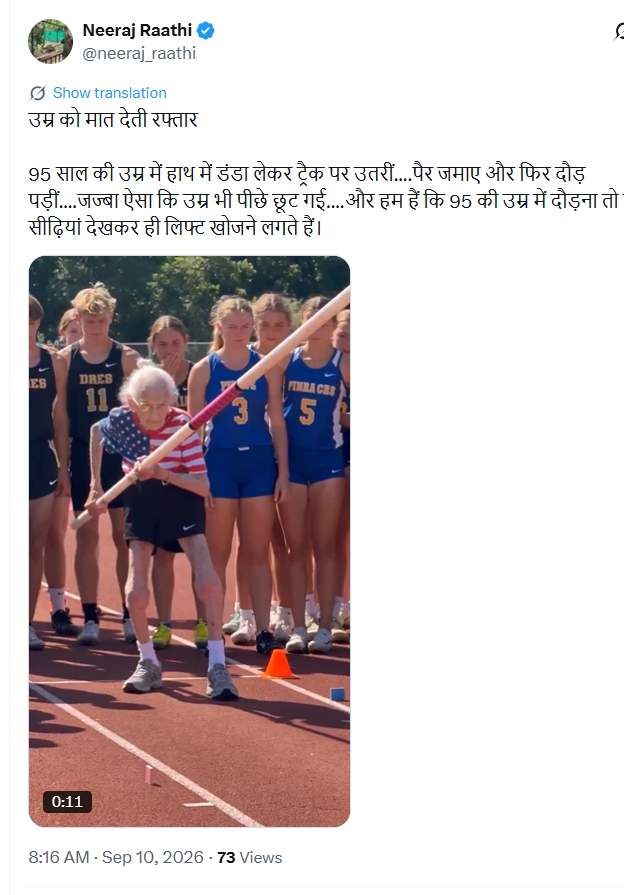
A video of an elderly woman performing a pole vault is being widely shared on social media. The video is being shared with the claim that the woman, who can be seen performing the astonishing feat, is 95 years old. Several people can also be seen around her in the video. She runs at full speed while carrying a pole and then leaps over a bar placed at a height. People present at the venue can be seen applauding her remarkable performance. A research done by the Research Wing of CyberPeace found that the video is not real but AI-generated.
Claim
An X user shared the video with the caption: “Defying age with speed. At the age of 95, she stepped onto the track with a stick in her hand… planted her feet and started running… such determination that even age was left behind… and here we are, at 95, forget running, we start looking for a lift the moment we see the stairs.”
https://x.com/neeraj_raathi/status/2097879324573798613
https://archive.ph/8Invi
Fact Check
To verify the authenticity of the viral video showing the elderly woman performing a pole vault, we first conducted a Google search using relevant keywords. However, we did not find any credible media reports or other reliable sources identifying the video as footage of a real pole vault competition.
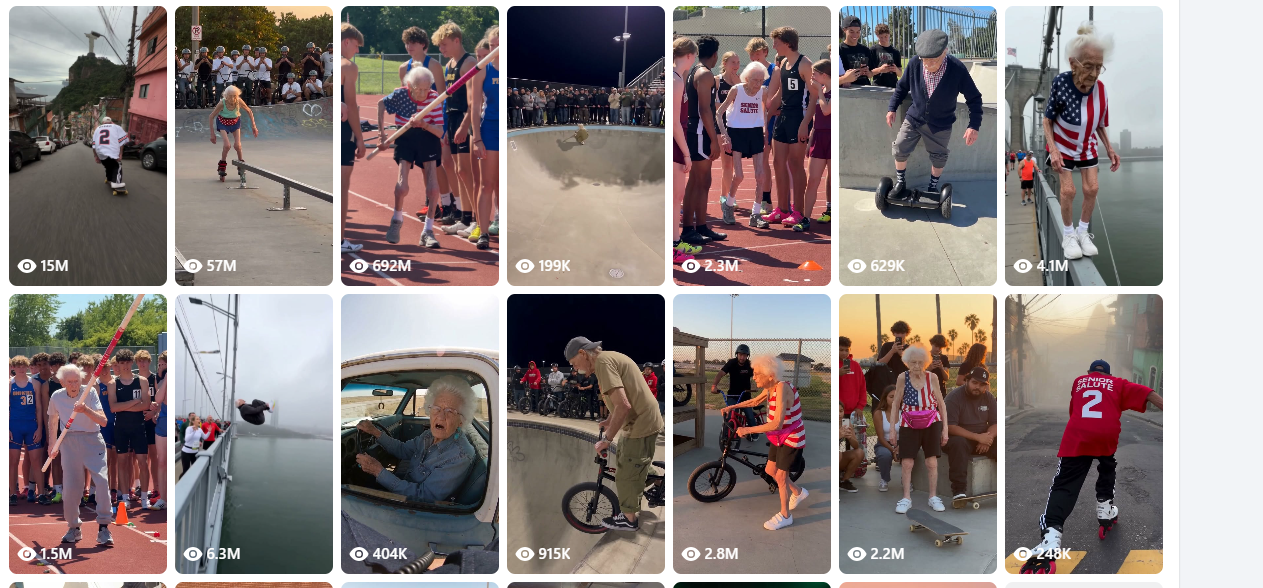
We then conducted a keyframe search and found the same video uploaded on September 8, 2026, on a Facebook page called ‘Senior Salute’, an AI content creator. The post also carries an AI-generated content label.

Upon reviewing the Facebook account, we found several similar videos showing elderly people performing various stunts. The account appears to exclusively create and share AI-generated videos.
We also checked the video using another AI detection tool, Truth Scan. In its analysis, the tool gave the viral video a 90 percent score, indicating that it was likely AI-generated.

In addition, we checked the visuals in the viral video using another AI detection platform, AIorNOT. In its analysis, the tool also indicated a high likelihood that the visuals in the video were AI-generated.

Conclusion
The evidence gathered during our research makes it clear that the viral video showing an elderly woman performing a pole vault is not genuine but AI-generated. The same video was found on a Facebook page that primarily shares AI-generated content and was posted with an AI-generated content label. Further, multiple AI detection tools also indicated a high likelihood that the video was created using AI. Therefore, the claim that the video shows a 95-year-old woman performing a real pole vault is false.

Related Blogs

Disclaimer:
This report is based on extensive research conducted by CyberPeace Research using publicly available information, and advanced analytical techniques. The findings, interpretations, and conclusions presented are based on the data available at the time of study and aim to provide insights into global ransomware trends.
The statistics mentioned in this report are specific to the scope of this research and may vary based on the scope and resources of other third-party studies. Additionally, all data referenced is based on claims made by threat actors and does not imply confirmation of the breach by CyberPeace. CyberPeace includes this detail solely to provide factual transparency and does not condone any unlawful activities. This information is shared only for research purposes and to spread awareness. CyberPeace encourages individuals and organizations to adopt proactive cybersecurity measures to protect against potential threats.
CyberPeace Research does not claim to have identified or attributed specific cyber incidents to any individual, organization, or nation-state beyond the scope of publicly observable activities and available information. All analyses and references are intended for informational and awareness purposes only, without any intention to defame, accuse, or harm any entity.
While every effort has been made to ensure accuracy, CyberPeace Research is not liable for any errors, omissions, subsequent interpretations and any unlawful activities of the findings by third parties. The report is intended to inform and support cybersecurity efforts globally and should be used as a guide to foster proactive measures against cyber threats.
Executive Summary:
The 2024 ransomware landscape reveals alarming global trends, with 166 Threat Actor Groups leveraging 658 servers/underground resources and mirrors to execute 5,233 claims across 153 countries. Monthly fluctuations in activity indicate strategic, cyclical targeting, with peak periods aligned with vulnerabilities in specific sectors and regions. The United States was the most targeted nation, followed by Canada, the UK, Germany, and other developed countries, with the northwestern hemisphere experiencing the highest concentration of attacks. Business Services and Healthcare bore the brunt of these operations due to their high-value data, alongside targeted industries such as Pharmaceuticals, Mechanical, Metal, Electronics, and Government-related professional firms. Retail, Financial, Technology, and Energy sectors were also significantly impacted.
This research was conducted by CyberPeace Research using a systematic modus operandi, which included advanced OSINT (Open-Source Intelligence) techniques, continuous monitoring of Ransomware Group activities, and data collection from 658 servers and mirrors globally. The team utilized data scraping, pattern analysis, and incident mapping to track trends and identify hotspots of ransomware activity. By integrating real-time data and geographic claims, the research provided a comprehensive view of sectoral and regional impacts, forming the basis for actionable insights.
The findings emphasize the urgent need for proactive Cybersecurity strategies, robust defenses, and global collaboration to counteract the evolving and persistent threats posed by ransomware.
Overview:
This report provides insights into ransomware activities monitored throughout 2024. Data was collected by observing 166 Threat Actor Groups using ransomware technologies across 658 servers/underground resources and mirrors, resulting in 5,233 claims worldwide. The analysis offers a detailed examination of global trends, targeted sectors, and geographical impact.
Top 10 Threat Actor Groups:
The ransomware group ‘ransomhub’ has emerged as the leading threat actor, responsible for 527 incidents worldwide. Following closely are ‘lockbit3’ with 522 incidents and ‘play’ with 351. Other Groups are ‘akira’, ‘hunters’, ‘medusa’, ‘blackbasta’, ‘qilin’, ‘bianlian’, ‘incransom’. These groups usually employ advanced tactics to target critical sectors, highlighting the urgent need for robust cybersecurity measures to mitigate their impact and protect organizations from such threats.

Monthly Ransomware Incidents:
In January 2024, the value began at 284, marking the lowest point on the chart. The trend rose steadily in the subsequent months, reaching its first peak at 557 in May 2024. However, after this peak, the value dropped sharply to 339 in June. A gradual recovery follows, with the value increasing to 446 by August. September sees another decline to 389, but a sharp rise occurs afterward, culminating in the year’s highest point of 645 in November. The year concludes with a slight decline, ending at 498 in December 2024 (till 28th of December).

Top 10 Targeted Countries:
- The United States consistently topped the list as the primary target probably due to its advanced economic and technological infrastructure.
- Other heavily targeted nations include Canada, UK, Germany, Italy, France, Brazil, Spain, and India.
- A total of 153 countries reported ransomware attacks, reflecting the global scale of these cyber threats

Top Affected Sectors:
- Business Services and Healthcare faced the brunt of ransomware threat due to the sensitive nature of their operations.
- Specific industries under threats:
- Pharmaceutical, Mechanical, Metal, and Electronics industries.
- Professional firms within the Government sector.
- Other sectors:
- Retail, Financial, Technology, and Energy sectors were also significant targets.

Geographical Impact:
The continuous and precise OSINT(Open Source Intelligence) work on the platform, performed as a follow-up action to data scraping, allows a complete view of the geography of cyber attacks based on their claims. The northwestern region of the world appears to be the most severely affected by Threat Actor groups. The figure below clearly illustrates the effects of this geographic representation on the map.

Ransomware Threat Trends in India:
In 2024, the research identified 98 ransomware incidents impacting various sectors in India, marking a 55% increase compared to the 63 incidents reported in 2023. This surge highlights a concerning trend, as ransomware groups continue to target India's critical sectors due to its growing digital infrastructure and economic prominence.

Top Threat Actors Group Targeted India:
Among the following threat actors ‘killsec’ is the most frequent threat. ‘lockbit3’ follows as the second most prominent threat, with significant but lower activity than killsec. Other groups, such as ‘ransomhub’, ‘darkvault’, and ‘clop’, show moderate activity levels. Entities like ‘bianlian’, ‘apt73/bashe’, and ‘raworld’ have low frequencies, indicating limited activity. Groups such as ‘aps’ and ‘akira’ have the lowest representation, indicating minimal activity. The chart highlights a clear disparity in activity levels among these threats, emphasizing the need for targeted cybersecurity strategies.

Top Impacted Sectors in India:
The pie chart illustrates the distribution of incidents across various sectors, highlighting that the industrial sector is the most frequently targeted, accounting for 75% of the total incidents. This is followed by the healthcare sector, which represents 12% of the incidents, making it the second most affected. The finance sector accounts for 10% of the incidents, reflecting a moderate level of targeting. In contrast, the government sector experiences the least impact, with only 3% of the incidents, indicating minimal targeting compared to the other sectors. This distribution underscores the critical need for enhanced cybersecurity measures, particularly in the industrial sector, while also addressing vulnerabilities in healthcare, finance, and government domains.

Month Wise Incident Trends in India:
The chart indicates a fluctuating trend with notable peaks in May and October, suggesting potential periods of heightened activity or incidents during these months. The data starts at 5 in January and drops to its lowest point, 2, in February. It then gradually increases to 6 in March and April, followed by a sharp rise to 14 in May. After peaking in May, the metric significantly declines to 4 in June but starts to rise again, reaching 7 in July and 8 in August. September sees a slight dip to 5 before the metric spikes dramatically to its highest value, 24, in October. Following this peak, the count decreases to 10 in November and then drops further to 7 in December.

CyberPeace Advisory:
- Implement Data Backup and Recovery Plans: Backups are your safety net. Regularly saving copies of your important data ensures you can bounce back quickly if ransomware strikes. Make sure these backups are stored securely—either offline or in a trusted cloud service—to avoid losing valuable information or facing extended downtime.
- Enhance Employee Awareness and Training: People often unintentionally open the door to ransomware. By training your team to spot phishing emails, social engineering tricks, and other scams, you empower them to be your first line of defense against attacks.
- Adopt Multi-Factor Authentication (MFA): Think of MFA as locking your door and adding a deadbolt. Even if attackers get hold of your password, they’ll still need that second layer of verification to break in. It’s an easy and powerful way to block unauthorized access.
- Utilize Advanced Threat Detection Tools: Smart tools can make a world of difference. AI-powered systems and behavior-based monitoring can catch ransomware activity early, giving you a chance to stop it in its tracks before it causes real damage.
- Conduct Regular Vulnerability Assessments: You can’t fix what you don’t know is broken. Regularly checking for vulnerabilities in your systems helps you identify weak spots. By addressing these issues proactively, you can stay one step ahead of attackers.
Conclusion:
The 2024 ransomware landscape reveals the critical need for proactive cybersecurity strategies. High-value sectors and technologically advanced regions remain the primary targets, emphasizing the importance of robust defenses. As we move into 2025, it is crucial to anticipate the evolution of ransomware tactics and adopt forward-looking measures to address emerging threats.
Global collaboration, continuous innovation in cybersecurity technologies, and adaptive strategies will be imperative to counteract the persistent and evolving threats posed by ransomware activities. Organizations and governments must prioritize preparedness and resilience, ensuring that lessons learned in 2024 are applied to strengthen defenses and minimize vulnerabilities in the year ahead.
Executive Summary:
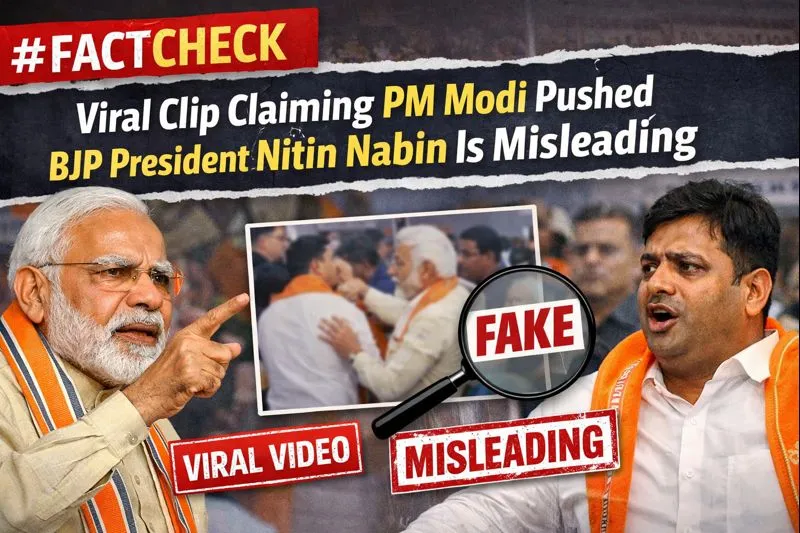
A video clip featuring Prime Minister Narendra Modi and the newly elected Bharatiya Janata Party (BJP) national president, Nitin Nabin, is going viral on social media. In the clip, PM Modi is seen apparently pushing Nitin Nabin, prompting claims that Nabin had accidentally stepped between the Prime Minister and the camera, after which Modi allegedly pushed him out of the frame. CyberPeace’s research found that the viral clip is misleading and cropped. The original, unedited video shows Prime Minister Modi gesturing for Nitin Nabin to move ahead and offer floral tributes to the statues of Bharatiya Jana Sangh founder Syama Prasad Mukherjee and Pandit Deendayal Upadhyaya at the BJP headquarters in Delhi. It is pertinent to note that on 20 January 2026, BJP leader Nitin Nabin was elected as the party’s national president. Several senior BJP leaders, including Prime Minister Narendra Modi, were present at the event. During his address, PM Modi remarked, “Nitin Nabin ji is my boss, and I am a party worker.” The statement received widespread attention, following which multiple videos linking to the remark began circulating on social media. A Facebook user shared the viral clip with a Hindi caption alleging that despite calling himself a “party worker,” PM Modi pushed his “boss” out of the camera frame. The post further mocked the position of BJP president, claiming it to be merely ceremonial. (Archived link)
To verify the claim, we conducted a reverse image and video search, which led us to a longer version of the video uploaded on news agency INS’s official X handle on 20 January 2026. The caption stated that PM Modi, BJP president Nitin Nabin, Defence Minister Rajnath Singh, Home Minister Amit Shah, Union Minister Nitin Gadkari and senior leader J.P. Nadda paid tributes to Syama Prasad Mukherjee and Pandit Deendayal Upadhyaya at the BJP headquarters.
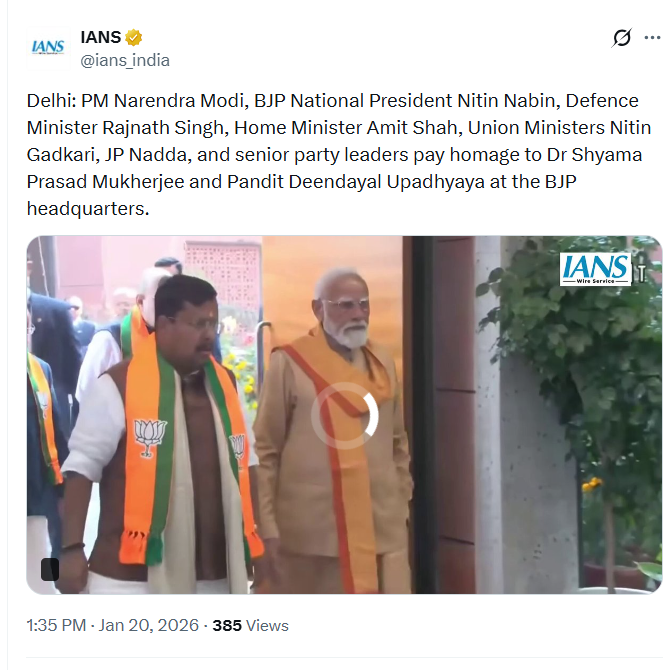
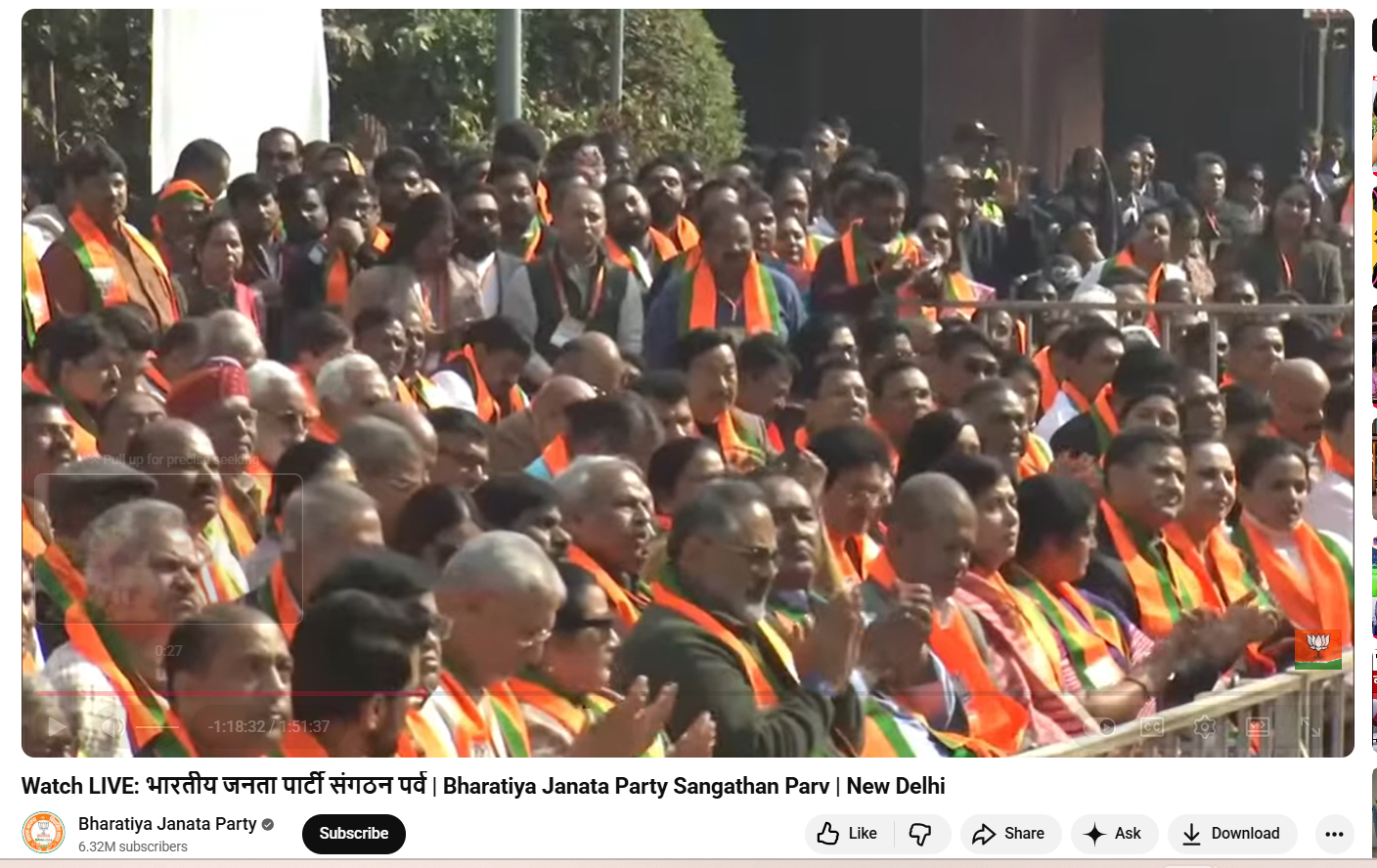
In the full video, PM Modi and Nitin Nabin are seen walking together. PM Modi then requests Nitin Nabin to proceed first for the floral tribute, placing his hand on Nabin’s back as a gesture to move forward. The viral clip selectively cuts this moment out of context and loops it to create a misleading impression. The complete footage clearly shows that PM Modi asked Nitin Nabin to offer tributes first, after which other leaders followed. There is no indication whatsoever that Nitin Nabin was pushed out of the camera frame, as claimed in the viral posts. We also found the live broadcast of the ‘Bharatiya Janata Party Sangathan Parv’ on BJP’s official YouTube channel. The same visuals appear at the end of the live stream, further confirming that PM Modi was merely gesturing for Nitin Nabin to proceed first.
Additionally, photographs available on Nitin Nabin’s official X handle show him offering floral tributes ahead of PM Modi, who is seen standing behind and waiting.
Conclusion:
CyberPeace research confirms that the viral clip has been cropped and shared with a false narrative. In the original context, Prime Minister Narendra Modi was respectfully inviting BJP national president Nitin Nabin to move ahead and pay tributes, not pushing him out of the camera frame.

Introduction
February marks the beginning of Valentine’s Week, the time when we transcend from the season of smog to the season of love. This is a time when young people are more active on social media and dating apps with the hope of finding a partner to celebrate the occasion. Dating Apps, in order to capitalise on this occasion, launch special offers and campaigns to attract new users and string on the current users with the aspiration of finding their ideal partner. However, with the growing popularity of online dating, the tactics of cybercriminals have also penetrated this sphere. Scammers are now becoming increasingly sophisticated in manipulating individuals on digital platforms, often engaging in scams, identity theft, and financial fraud under the guise of romance. As love fills the air, netizens must stay vigilant and cautious while searching for a connection online and not fall into a scammer’s trap.
Here Are Some CyberPeace Tips To Avoid Romance Scams
- Recognize Red Flags of Romance Scams:- Online dating has made it easier to connect with people, but it has also become a tool for scammers to exploit the emotions of netizens for financial gain. They create fake profiles, build trust quickly, and then manipulate victims into sending money. Understanding their tactics can help you stay safe.
- Warning Signs of a Romance Scam:- If someone expresses strong feelings too soon, it’s a red flag. Scammers often claim to have fallen in love within days or weeks, despite never meeting in person. They use emotional pressure to create a false sense of connection. Their messages might seem off. Scammers often copy-paste scripted responses, making conversations feel unnatural. Poor grammar, inconsistencies in their stories, or vague answers are warning signs. Asking for money is the biggest red flag. They might have an emergency, a visa issue, or an investment opportunity they want you to help with. No legitimate relationship starts with financial requests.
- Manipulative Tactics Used by Scammers:- Scammers use love bombing to gain trust. They flood you with compliments, calling you their soulmate or destiny. This is meant to make you emotionally attached. They often share fake sob stories. It could be anything ranging from losing a loved one, facing a medical emergency, or even being stuck in a foreign country. These are designed to make you feel sorry for them and more willing to help. Some of these scammers might even pretend to be wealthy, being investors or successful business owners, showing off their fabricated luxury lifestyle in order to appear credible. Eventually, they’ll try to lure you into a fake investment. They create a sense of urgency. Whether it’s sending money, investing, or sharing personal details, scammers will push you to act fast. This prevents you from thinking critically or verifying your claims.
- Financial Frauds Linked to Romance Scams:- Romance scams have often led to financial fraud. Victims may be tricked into sending money directly or get roped into elaborate schemes. One common scam is the disappearing date, where someone insists on dining at an expensive restaurant, only to vanish before the bill arrives. Crypto scams are another major concern. Scammers convince victims to invest in fake cryptocurrency platforms, promising huge returns. Once the money is sent, the scammer disappears, leaving the victim with nothing.
- AI & Deepfake Risks in Online Dating:- Advancements in AI have made scams even more convincing. Scammers use AI-generated photos to create flawless, yet fake, profile pictures. These images often lack natural imperfections, making them hard to spot. Deepfake technology is also being used for video calls. Some scammers use pre-recorded AI-generated videos to fake live interactions. If a person’s expressions don’t match their words or their screen glitches oddly, it could be a deepfake.
- How to Stay Safe:-
- Always verify the identities of those who contact you on these sites. A simple reverse image search can reveal if someone’s profile picture is stolen.
- Avoid clicking suspicious links or downloading unknown apps sent by strangers. These can be used to steal your personal information.
- Trust your instincts. If something feels off, it probably is. Stay alert and protect yourself from online romance scams.
Best Online Safety Practices
- Prioritize Social Media Privacy:- Review and update your privacy settings regularly. Think before you share and be mindful of who can see your posts/stories. Avoid oversharing personal details.
- Report Suspicious Activities:- Even if a scam attempt doesn’t succeed, report it. Indian Cyber Crime Coordination Centre (I4C) 'Report Suspect' feature allow users to flag potential threats, helping prevent cybercrimes.
- Think Before You Click or Download:- Avoid clicking on unknown links or downloading attachments from unverified sources. These can be traps leading to phishing scams or malware attacks.
- Protect Your Personal Information:- Be cautious with whom and how you share your sensitive details online. Cybercriminals exploit even the smallest data points to orchestrate fraud.
