
#FactCheck: Scripted Video Falsely Claims Indian Father Married His Biological Daughter Over Dowry
Executive Summary
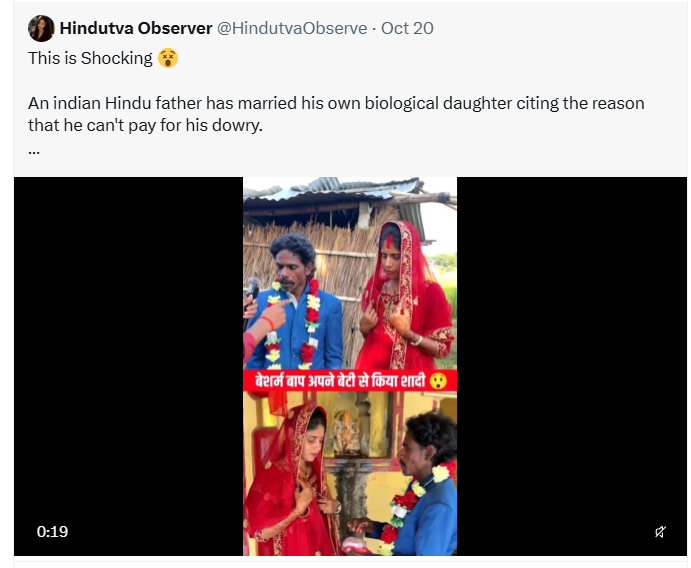
A video is going viral on social media, claiming that an Indian Hindu father married his own biological daughter because he could not afford to pay her dowry. CyberPeace Research found that the video features scripted content being presented as a real-life incident, making the claim misleading. The claim that the man married his own biological daughter is false.
Claim:
A video is being shared on social media with the claim that an Indian Hindu father married his own biological daughter because he was unable to afford her dowry.
https://x.com/i/birdwatch/t/2112470461011599390?source=6
Fact Check
To verify the viral video, we conducted a reverse image search of its keyframes. However, we did not find any credible media reports about the incident. As the next step in our research, we found the video on a Facebook account named Kundan Kumar Mukhiya, where the creator had identified the video as scripted content.
https://www.facebook.com/reel/1170873325369168

As the next step in our research, we found another video on the same page, which was also identified as scripted content.

We examined the user's Facebook account and found that he is a content creator who makes scripted videos.

Conclusion
Our research found that the video features scripted content being shared with a misleading claim, presenting it as a real-life incident. The claim that the man married his own biological daughter is false.

Related Blogs

Executive Summary:
False information spread on social media that Flight Lieutenant Shivangi Singh, India’s first female Rafale pilot, had been captured by Pakistan during “Operation Sindoor”. The allegations are untrue and baseless as no credible or official confirmation supports the claim, and Singh is confirmed to be safe and actively serving. The rumor, likely originating from unverified sources, sparked public concern and underscored the serious threat fake news poses to national security.
Claim:
An X user posted stating that “ Initial image released of a female Indian Shivani singh Rafale pilot shot down in Pakistan”. It was falsely claimed that Flight Lieutenant Shivangi Singh had been captured, and that the Rafale aircraft was shot down by Pakistan.


Fact Check:
After doing reverse image search, we found an instagram post stating the two Indian Air Force pilots—Wing Commander Tejpal (50) and trainee Bhoomika (28)—who had ejected from a Kiran Jet Trainer during a routine training sortie from Bengaluru before it crashed near Bhogapuram village in Karnataka. The aircraft exploded upon impact, but both pilots were later found alive, though injured and exhausted.

Also we found a youtube channel which is showing the video from the past and not what it was claimed to be.

Conclusion:
The false claims about Flight Lieutenant Shivangi Singh being captured by Pakistan and her Rafale jet being shot down have been debunked. The image used was unrelated and showed IAF pilots from a separate training incident. Several media also confirmed that its video made no mention of Ms. Singh’s arrest. This highlights the dangers of misinformation, especially concerning national security. Verifying facts through credible sources and avoiding the spread of unverified content is essential to maintain public trust and protect the reputation of those serving in the armed forces.
- Claim: False claims about Flight Lieutenant Shivangi Singh being captured by Pakistan and her Rafale jet being shot down
- Claimed On: Social Media
- Fact Check: False and Misleading

Introduction
Rajeev Chandrasekhar, Minister of State at the Ministry of Electronics and Information Technology, has emphasised the need for an open internet. He stated that no platform can deny content creators access to distribute and monetise content and that large technology companies have begun to play a significant role in the digital evolution. Chandrasekhar emphasised that the government does not want the internet or monetisation to be in the purview of just one or two companies and does not want 120 crore Indians on the internet in 2025 to be catered to by big islands on the internet.
The Voice for Open Internet
India's Minister of State for IT, Rajeev Chandrasekhar, has stated that no technology company or social media platform can deny content creators access to distribute and monetise their content. Speaking at the Digital News Publishers Association Conference in Delhi, Chandrasekhar emphasized that the government does not want the internet or monetization of the internet to be in the hands of just one or two companies. He argued that the government does not like monopoly or duopoly and does not want 120 crore Indians on the Internet in 2025 to be catered to by big islands on the internet.
Chandrasekhar highlighted that large technology companies have begun to exert influence when it comes to the dissemination of content, which has become an area of concern for publishers and content creators. He stated that if any platform finds it necessary to block any content, they need to give reasons or grounds to the creators, stating that the content is violating norms.
As India tries to establish itself as an innovator in the technology sector, a recent corpus of Rs 1 lakh crore was announced by the government in the interim Budget of 2024-25. As big companies continue to tighten their stronghold on the sector, content moderation has become crucial. Under the IT Rules Act, 11 types of categories are unlawful under IT Act and criminal law. Platforms must ensure no user posts content that falls under these categories, take down any such content, and gateway users to either de-platforming or prosecuting. Chandrasekhar believes that the government has to protect the fundamental rights of people and emphasises legislative guardrails to ensure platforms are accountable for the correctness of the content.
Monetizing Content on the Platform
No platform can deny a content creator access to the platform to distribute and monetise it,' Chandrasekhar declared, boldly laying down a gauntlet that defies the prevailing norms. This tenet signals a nascent dawn where creators may envision reaping the rewards borne of their creative endeavours unfettered by platform restrictions.
An increasingly contentious issue that shadows this debate is the moderation of content within the digital realm. In this vast uncharted expanse, the powers that be within these monolithic platforms assume the mantle of vigilance—policing the digital avenues for transgressions against a conscribed code of conduct. Under the stipulations of India's IT Rules Act, for example, platforms are duty-bound to interdict user content that strays into territories encompassing a spectrum of 11 delineated unlawful categories. Violations span the gamut from the infringement of intellectual property rights to the propagation of misinformation—each category necessitating swift and decisive intervention. He raised the alarm against misinformation—a malignant growth fed by the fertile soils of innovation—a phenomenon wherein media reports chillingly suggest that up to half of the information circulating on the internet might be a mere fabrication, a misleading simulacrum of authenticity.
The government's stance, as expounded by Chandrasekhar, pivots on an axis of safeguarding citizens' fundamental rights, compelling digital platforms to shoulder the responsibility of arbiters of truth. 'We are a nation of over 90 crores today, a nation progressing with vigour, yet we find ourselves beset by those who wish us ill,'
Upcoming Digital India Act
Awaiting upon the horizon, India's proposed Digital India Act (DIA), still in its embryonic stage of pre-consultation deliberation, seeks to sculpt these asymmetries into a more balanced form. Chandrasekhar hinted at the potential inclusion within the DIA of regulatory measures that would sculpt the interactions between platforms and the mosaic of content creators who inhabit them. Although specifics await the crucible of public discourse and the formalities of consultation, indications of a maturing framework are palpable.
Conclusion
It is essential that the fable of digital transformation reverberates with the voices of individual creators, the very lifeblood propelling the vibrant heartbeat of the internet's culture. These are the voices that must echo at the centre stage of policy deliberations and legislative assembly halls; these are the visions that must guide us, and these are the rights that we must uphold. As we stand upon the precipice of a nascent digital age, the decisions we forge at this moment will cascade into the morrow and define the internet of our future. This internet must eternally stand as a bastion of freedom, of ceaseless innovation and as a realm of boundless opportunity for every soul that ventures into its infinite expanse with responsible use.
References
- https://www.financialexpress.com/business/brandwagon-no-platform-can-deny-a-content-creator-access-to-distribute-and-monetise-content-says-mos-it-rajeev-chandrasekhar-3386388/
- https://indianexpress.com/article/india/meta-content-monetisation-social-media-it-rules-rajeev-chandrasekhar-9147334/
- https://www.medianama.com/2024/02/223-rajeev-chandrasekhar-content-creators-publishers/

According to Statista, the number of users in India's digital assets market is expected to reach 107.30m users by 2025 (Impacts of Inflation on Financial Markets, August 2023). India's digital asset market has been experiencing exponential growth fueled by the increased adoption of cryptocurrencies and blockchain technology. This furthers the need for its regulation. Digital assets include cryptocurrencies, NFTs, asset-backed tokens, and tokenised real estate.
India has defined Digital Assets under Section 47(A) of the Income Tax Act, 1961. The Finance Act 2022-23 has added the word 'virtual' to make it “Virtual Digital Assets”. A “virtual digital asset” is any information or code, number, or token, created through cryptographic methods or otherwise, by any name, giving a digital representation of value exchanged with or without consideration. A VDA should contain an inherent value and represent a store of value or unit of account, functional in any financial transaction or investment. These can be stored, transferred, or traded in electronic format.
Digital Asset Governance: Update and Future Outlook
Indian regulators have been conservative in their approach towards digital assets, with the Reserve Bank of India first issuing directions against cryptocurrency transactions in 2018. This ban was removed by the Supreme Court through a court order in 2020. The presentation of the Cryptocurrency and Regulation of Official Digital Currency Bill of 2021 is a fairly important milestone in its attempts to lay down the framework for issuing an official digital currency by the Reserve Bank of India. While some digital assets seem to have potential, like the Central Bank Digital Currencies (CBDCs) and blockchain-based financial applications, a blanket prohibition has been enforced on private cryptocurrencies.
However, in more recent trends, the landscape is changing as the RBI's CBDC is to provide a state-backed digital alternative to cash under a more structured regulatory framework. This move seeks to balance state control with innovation on investor safety and compliance, expecting to reduce risk and enhance security for investors by enacting strict anti-money laundering and know-your-customer laws. Highlighting these developments is important to examine how global regulatory trends influence India's digital asset policies.
Impact of Global Development on India’s Approach
Global regulatory developments have an impact on Indian policies on digital assets. The European Union's Markets in Crypto-assets (MiCA) is to introduce a comprehensive regulatory framework for cryptocurrencies that could act as an inspiration for India. MiCA regulation covers crypto-assets that are not currently regulated by existing financial services legislation. Its particular focus on consumer protection and market integrity resonates with India in terms of investigating needs related to digital assets, including fraud and price volatility. Additionally, evolving policies in the US, such as regulating crypto exchanges and classifying certain tokens as securities, could also form the basis for India's regulatory posture.
Collaboration on the international level is also a chief contributing factor. India’s regular participation in global forums like the G20, facilitates an opportunity to align its regulations on digital assets with other countries, tending toward an even more standardised and predictable framework for cross-border transactions. This can significantly help India given that the nation has a huge diaspora providing a critical inflow of remuneration.
CyberPeace Outlook
Though digital assets offer many opportunities to India, challenges also exist. Cryptocurrency volatility affects investors, posing concerns over fraud and illicit dealings. A balance between the need for innovation and investor protection is paramount to avoid killing the growth of India's digital asset ecosystem with overly restrictive regulations.
Financial inclusion, efficient cross-border payments with low transaction costs, and the opening of investment opportunities are a few opportunities offered by digital assets. For example, the tokenisation of real estate throws open real estate investment to smaller investors. To strengthen the opportunities while addressing challenges, some policy reforms and new frameworks might prove beneficial.
CyberPeace Policy Recommendations
- Establish a regulatory sandbox for startups working in the area of blockchain and digital assets. This would allow them to test innovative solutions in a controlled environment with regulatory oversight minimising risks.
- Clear guidelines for the taxation of digital assets should be provided as they will ensure transparency, reduce ambiguity for investors, and promote compliance with tax regulations. Specific guidelines can be drawn from the EU's MiCA regulation.
- Workshops, online resources, and campaigns are some examples of initiatives aimed at improving consumer awareness about digital assets, benefits and associated risks that should be implemented. Partnerships with global fintech firms will provide a great opportunity to learn best practices.
Conclusion
India is positioned at a critical juncture with respect to the debate on digital assets. The challenge which lies ahead is one of balancing innovation with effective regulation. The introduction of the Central Bank Digital Currency (CBDC) and the development of new policies signal a willingness on the part of the regulators to embrace the digital future. In contrast, issues like volatility, fraud, and regulatory compliance continue to pose hurdles. By drawing insights from global frameworks and strengthening ties through international forums, India can pave the way for a secure and dynamic digital asset ecosystem. Embracing strategic measures such as regulatory sandboxes and transparent tax guidelines will not only protect investors but also unlock the immense potential of digital assets, propelling India into a new era of financial innovation and inclusivity.
References
- https://www.weforum.org/agenda/2024/10/different-countries-navigating-uncertainty-digital-asset-regulation-election-year/
- https://www.acfcs.org/eu-passes-landmark-crypto-regulation
- https://www.indiabudget.gov.in/budget2022-23/doc/Finance_Bill.pdf
- https://www.weforum.org/agenda/2024/10/different-countries-navigating-uncertainty-digital-asset-regulation-election-year/
- https://www3.weforum.org/docs/WEF_Digital_Assets_Regulation_2024.pdf
