
#FactCheck-AI-Generated Video Falsely Shared as Drone Footage of Flooded Surat, Gujarat
Executive Summary
A 20-second video showing skyscrapers submerged in water is being widely circulated on social media with the claim that it depicts the flood situation in Surat, Gujarat. The video is also being used by some users to criticize the Bharatiya Janata Party (BJP) government in Gujarat and Prime Minister Narendra Modi. Many social media users are sharing the clip as authentic footage of flooding in Surat. CyberPeace Research Wing’s research found the viral claim to be false. Our research revealed that the video is AI-generated and has no connection with Surat. While it is true that heavy rainfall caused flooding in parts of Surat and nearby districts in early July 2026, the viral video does not show any real scenes from the city.
Claim
Facebook user ‘Amresh Kumar’ shared the viral video on July 16, 2026, with the caption, “Thirty years of the Modi-BJP government. Drone footage of Gujarat Model – Surat city.”
https://www.facebook.com/reel/2440459239767277

Fact Check
To verify the claim, we first conducted a keyword search using terms related to flooding in Surat during July 2026. Our search confirmed that Surat experienced heavy rainfall during the first week of July, resulting in waterlogging and disruption in several low-lying areas. According to a report published by Bhaskar.com on July 8, 2026, intense rainfall led to flooding in several parts of Surat, and a few deaths due to electrocution were also reported.

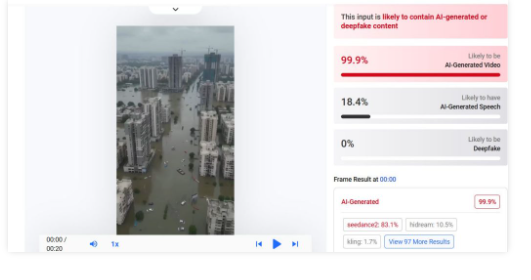
However, none of the credible reports or images from the actual flooding resembled the scenes shown in the viral video. To further investigate, we analysed the video using multiple AI detection tools.We first scanned the video using Hive Moderation, which indicated a 99.9% probability that the footage was generated using Artificial Intelligence.
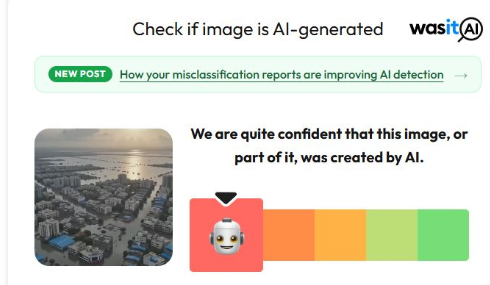
For additional verification, we examined the clip using another AI detection platform, WasItAI, which also concluded that the video had been created using AI. The analysis from multiple tools strongly suggests that the viral footage is digitally generated and does not represent a real event.
Conclusion
Our research found that the viral video being shared as drone footage of flooding in Surat is fake. Although Surat experienced heavy rainfall and flooding in early July 2026, the video circulating on social media is AI-generated and has no connection with the actual situation in the city. The clip is being falsely shared to spread misleading information.

Related Blogs

Introduction
In the boundless world of the internet—a digital frontier rife with both the promise of connectivity and the peril of deception—a new spectre stealthily traverses the electronic pathways, casting a shadow of fear and uncertainty. This insidious entity, cloaked in the mantle of supposed authority, preys upon the unsuspecting populace navigating the virtual expanse. And in the heart of India's vibrant tapestry of diverse cultures and ceaseless activity, Mumbai stands out—a sprawling metropolis of dreams and dynamism, yet also the stage for a chilling saga, a cyber charade of foul play and fraud.
The city's relentless buzz and hum were punctuated by a harrowing tale that unwound within the unassuming confines of a Kharghar residence, where a 46-year-old individual's brush with this digital demon would unfold. His typical day veered into the remarkable as his laptop screen lit up with an ominous pop-up, infusing his routine with shock and dread. This deceiving popup, masquerading as an official communication from the National Crime Records Bureau (NCRB), demanded an exorbitant fine of Rs 33,850 for ostensibly browsing adult content—an offence he had not committed.
The Cyber Deception
This tale of deceit and psychological warfare is not unique, nor is it the first of its kind. It finds echoes in the tragic narrative that unfurled in September 2023, far south in the verdant land of Kerala, where a young life was tragically cut short. A 17-year-old boy from Kozhikode, caught in the snare of similar fraudulent claims of NCRB admonishment, was driven to the extreme despair of taking his own life after being coerced to dispense Rs 30,000 for visiting an unauthorised website, as the pop-up falsely alleged.
Sewn with a seam of dread and finesse, the pop-up which appeared in another recent case from Navi Mumbai, highlights the virtual tapestry of psychological manipulation, woven with threatening threads designed to entrap and frighten. In this recent incident a 46-year-old Kharghar resident was left in shock when he got a pop-up on a laptop screen warning him to pay Rs 33,850 fine for surfing a porn website. This message appeared from fake website of NCRB created to dupe people. Pronouncing that the user has engaged in browsing the Internet for some activities, it delivers an ultimatum: Pay the fine within six hours, or face the critical implications of a criminal case. The panacea it offers is simple—settle the demanded amount and the shackles on the browser shall be lifted.
It was amidst this web of lies that the man from Kharghar found himself entangled. The story, as retold by his brother, an IT professional, reveals the close brush with disaster that was narrowly averted. His brother's panicked call, and the rush of relief upon realising the scam, underscores the ruthless efficiency of these cyber predators. They leverage sophisticated deceptive tactics, even specifying convenient online payment methods to ensnare their prey into swift compliance.
A glimmer of reason pierced through the narrative as Maharashtra State cyber cell special inspector general Yashasvi Yadav illuminated the fraudulent nature of such claims. With authoritative clarity, he revealed that no legitimate government agency would solicit fines in such an underhanded fashion. Rather, official procedures involve FIRs or court trials—a structured route distant from the scaremongering of these online hoaxes.
Expert Take
Concurring with this perspective, cyber experts facsimiles. By tapping into primal fears and conjuring up grave consequences, the fraudsters follow a time-worn strategy, cloaking their ill intentions in the guise of governmental or legal authority—a phantasm of legitimacy that prompts hasty financial decisions.
To pierce the veil of this deception, D. Sivanandhan, the former Mumbai police commissioner, categorically denounced the absurdity of the hoax. With a voice tinged by experience and authority, he made it abundantly clear that the NCRB's role did not encompass the imposition of fines without due process of law—a cornerstone of justice grossly misrepresented by the scam's premise.
New Lesson
This scam, a devilish masquerade given weight by deceit, might surge with the pretence of novelty, but its underpinnings are far from new. The manufactured pop-ups that propagate across corners of the internet issue fabricated pronouncements, feigned lockdowns of browsers, and the spectre of being implicated in taboo behaviours. The elaborate ruse doesn't halt at mere declarations; it painstakingly fabricates a semblance of procedural legitimacy by preemptively setting penalties and detailing methods for immediate financial redress.
Yet another dimension of the scam further bolsters the illusion—the ominous ticking clock set for payment, endowing the fraud with an urgency that can disorient and push victims towards rash action. With a spurious 'Payment Details' section, complete with options to pay through widely accepted credit networks like Visa or MasterCard, the sham dangles the false promise of restored access, should the victim acquiesce to their demands.
Conclusion
In an era where the demarcation between illusion and reality is nebulous, the impetus for individual vigilance and scepticism is ever-critical. The collective consciousness, the shared responsibility we hold as inhabitants of the digital domain, becomes paramount to withstand the temptation of fear-inducing claims and to dispel the shadows cast by digital deception. It is only through informed caution, critical scrutiny, and a steadfast refusal to capitulate to intimidation that we may successfully unmask these virtual masquerades and safeguard the integrity of our digital existence.
References:
- https://www.onmanorama.com/news/kerala/2023/09/29/kozhikode-boy-dies-by-suicide-after-online-fraud-threatens-him-for-visiting-unauthorised-website.html
- https://timesofindia.indiatimes.com/pay-rs-33-8k-fine-for-surfing-porn-warns-fake-ncrb-pop-up-on-screen/articleshow/106610006.cms
- https://www.indiatoday.in/technology/news/story/people-who-watch-porn-receiving-a-warning-pop-up-do-not-pay-it-is-a-scam-1903829-2022-01-24

Introduction
The Union Minister of Information and Broadcasting Ashwini Vaishnaw addressed the Press Council of India on the occasion of National Press Day regarding emergent concerns in the digital media and technology landscape. Union Minister of Information and Broadcasting Ashwini Vaishnaw has identified four major challenges facing news media in India, including fake news, algorithmic bias, artificial intelligence, and fair compensation. He emphasized the need for greater accountability and fairness from Big Tech to combat misinformation and protect democracy. Vaishnaw argued that platforms do not verify information posted online, leading to the spread of false and misleading information. He called on online platforms and Big Tech to combat misinformation and protect democracy.
Key Concerns Highlighted by Union Minister Ashwini Vaishnaw
- Misinformation: Due to India's unique sensitivities, digital platforms should adopt country-specific responsibilities and metrics. The Minister also questioned the safe harbour principle, which shields platforms from liability for user-generated content.
- Algorithmic Biases: The prioritisation of viral content, which is often divisive, by social media algorithms can have serious implications on societal peace.
- Impact of AI on intellectual Property: The training of AI on pre-existing datasets presents the ethical challenge of robbing original creators of their rights to their intellectual property
- Fair compensation: Traditional news media is increasingly facing financial strain since news consumption is shifting rapidly to social media platforms, creating uneven compensation dynamics.
Cyberpeace Insights
- Misinformation: Marked by routine upheavals and moral panics, Indian society is vulnerable to the severe impacts of fake news, including mob violence, political propaganda, health misinformation and more. Inspired by the EU's Digital Services Act, 2022, and other related legislation that addresses hate speech and misinformation, the Indian Minister has called for revisiting the safe harbour protection under Section 79 of the IT Act, 2000. However, any legislation on misinformation must strike a balance between protecting the fundamental rights to freedom of speech, and privacy while safeguarding citizens from its harmful effects.
- Algorithmic Biases: Social media algorithms are designed to boost user engagement since this increases advertisement revenue. This leads to the creation of filter bubbles- exposure to personalized information online and echo chambers interaction with other users with the same opinions that align with their worldview. These phenomena induce radicalization of views, increase intolerance fuel polarization in public discourse, and trigger the spread of more misinformation. Tackling this requires algorithmic design changes such as disincentivizing sensationalism, content labelling, funding fact-checking networks, etc. to improve transparency.
- Impact of AI on Intellectual Property: AI models are trained on data that may contain copyrighted material. It can lead to a loss of revenue for primary content creators, while tech companies owning AI models may financially benefit disproportionately by re-rendering their original works. Large-scale uptake of AI models will significantly impact fields such as advertising, journalism, entertainment, etc by disrupting their market. Managing this requires a push for Ethical AI regulations and the protection of original content creators.
Conclusion: Charting a Balanced Path
The socio-cultural and economic fabric of the Indian subcontinent is not only distinct from the rest of the world but has cross-cutting internal diversities, too. Its digital landscape stands at a crossroads as rapid global technological advancements present increasing opportunities and challenges. In light of growing incidents of misinformation on social media platforms, it is also crucial that regulators consider framing rules that encourage and mandate content verification mechanisms for online platforms, incentivizing them to adopt advanced AI-driven fact-checking tools and other relevant measures. Additionally, establishing public-private partnerships to monitor misinformation trends is crucial to rapidly debunking viral falsehoods. However ethical concerns and user privacy should be taken into consideration while taking such steps. Addressing misinformation requires a collaborative approach that balances platform accountability, technological innovation, and the protection of democratic values.
Sources
- https://www.indiatoday.in/india/story/news-media-4-challenges-ashwini-vaishnaw-national-press-day-speech-big-tech-fake-news-algorithm-ai-2634737-2024-11-17
- https://ec.europa.eu/commission/presscorner/detail/en/ip_24_881
- https://www.legaldive.com/news/digital-services-act-dsa-eu-misinformation-law-propaganda-compliance-facebook-gdpr/691657/
- https://www.fondationdescartes.org/en/2020/07/filter-bubbles-and-echo-chambers/
- https://www.google.com/searchq=News+Media+Bargaining+Code&oq=News+Media+Bargaining+Code&gs_lcrp=EgZjaHJvbWUyBggAEEUYOTIHCAEQABiABDIHCAIQABiABDIHCAMQABiABDIHCAQQABiABDIHCAUQABiABDIICAYQABgWGB4yCAgHEAAYFhgeMggICBAAGBYYHjIICAkQABgWGB7SAQcyMjVqMGo3qAIIsAIB&sourceid=chrome&ie=UTF-8

Introduction
In this ever-evolving world of technology, cybercrimes and criminals continue to explore new and innovative methods to exploit and intimidate their victims. One of the recent shocking incidents has been reported from the city of Bharatpur, Rajasthan, where the cyber crooks organised a mock court session This complex operation, meant to induce fear and force obedience, exemplifies the daring and intelligence of modern hackers. In this blog article, we’ll go deeper into this concerning occurrence, delving into it to offer light on the strategies used and the ramifications for cybersecurity.to frighten their targets.
The Setup
The case was reported from Gopalgarh village in Bharatpur, Rajasthan, and has unfolded with a shocking twist -the father-son duo, Tahir Khan and his son Talim Khano — from Gopalgarh village in Bharatpur, Rajasthan, has been fooling people to gain their monetary gain by staging a mock court setting and recorded the proceedings to intimidate their victims into paying hefty sums. In the recent case, they have gained 2.69 crores through sextortion. the duo uses to trace their targets on social media platforms, blackmail them, and earn a hefty amount.
An official complaint was filed by a 69-year-old victim who was singled out through his social media accounts, his friends, and his posts Initially, they contacted the victim with a pre-recorded video featuring a nude woman, coaxing him into a compromising situation. As officials from the Delhi Crime Branch and the CBI, they threatened the victim, claiming that a girl had approached them intending to file a complaint against him. Later, masquerading as YouTubers, they threatened to release the incriminating video online. Adding to the charade, they impersonated a local MLA and presented the victim with a forged stamp paper alleging molestation charges. Eventually, posing as Delhi Crime Branch officials again, they demanded money to settle the case after falsely stating that they had apprehended the girl. To further manipulate the victim, the accused staged a court proceeding, recording it and subsequently sending it to him, creating the illusion that everything was concluded. This unique case of sextortion stands out as the only instance where the culprits went to such lengths, staging and recording a mock court to extort money. Furthermore, it was discovered that the accused had fabricated a letter from the Delhi High Court, adding another layer of deception to their scheme.
The Investigation
The complaint was made in a cyber cell. After the complaint was filed, the investigation was made, and it was found that this case stands as one of the most significant sextortion incidents in the country. The father-son pair skillfully assumed five different roles, meticulously executing their plan, which included creating a simulated court environment. “We have also managed to recover Rs 25 lakh from the accused duo—some from their residence in Gopalgarh and the rest from the bank account where it was deposited.
The Tricks used by the duo
The father-son The setup in the fake court scene event was a meticulously built web of deception to inspire fear and weakness in the victim. Let’s look at the tricks the two used to fool the people.
- Social Engineering strategies: Cyber criminals are skilled at using social engineering strategies to acquire the trust of their victims. In this situation, they may have employed phishing emails or phone calls to get personal information about the victim. By appearing as respectable persons or organisations, the crooks tricked the victim into disclosing vital information, giving them weapons they needed to create a sense of trustworthiness.
- Making a False Narrative: To make the fictitious court scenario more credible, the cyber hackers concocted a captivating story based on the victim’s purported legal problems. They might have created plausible papers to give their plan authority, such as forged court summonses, legal notifications, or warrants. They attempted to create a sense of impending danger and an urgent necessity for the victim to comply with their demands by deploying persuasive language and legal jargon.
- Psychological Manipulation: The perpetrators of the fictitious court scenario were well aware of the power of psychological manipulation in coercing their victims. They hoped to emotionally overwhelm the victim by using fear, uncertainty, and the possible implications of legal action. The offenders probably used threats of incarceration, fines, or public exposure to increase the victim’s fear and hinder their capacity to think critically. The idea was to use desperation and anxiety to force the victim to comply.
- Use of Technology to Strengthen Deception: Technological advancements have given cyber thieves tremendous tools to strengthen their misleading methods. The simulated court scenario might have included speech modulation software or deep fake technology to impersonate the voices or appearances of legal experts, judges, or law enforcement personnel. This technology made the deception even more believable, blurring the border between fact and fiction for the victim.
The use of technology in cybercriminals’ misleading techniques has considerably increased their capacity to fool and influence victims. Cybercriminals may develop incredibly realistic and persuasive simulations of judicial processes using speech modulation software, deep fake technology, digital evidence alteration, and real-time communication tools. Individuals must be attentive, gain digital literacy skills, and practice critical thinking when confronting potentially misleading circumstances online as technology advances. Individuals can better protect themselves against the expanding risks posed by cyber thieves by comprehending these technological breakthroughs.
What to do?
Seeking Help and Reporting Incidents: If you or anyone you know is the victim of cybercrime or is fooled by cybercrooks. When confronted with disturbing scenarios such as the imitation court scene staged by cybercrooks, victims must seek help and act quickly by reporting the occurrence. Prompt reporting serves various reasons, including increasing awareness, assisting with investigations, and preventing similar crimes from occurring again. Victims should take the following steps:
- Contact your local law enforcement: Inform local legal enforcement about the cybercrime event. Provide them with pertinent incident facts and proof since they have the experience and resources to investigate cybercrime and catch the offenders involved.
- Seek Assistance from a Cybersecurity specialist: Consult a cybersecurity specialist or respected cybersecurity business to analyse the degree of the breach, safeguard your digital assets, and obtain advice on minimising future risks. Their knowledge and forensic analysis can assist in gathering evidence and mitigating the consequences of the occurrence.
- Preserve Evidence: Keep any evidence relating to the event, including emails, texts, and suspicious actions. Avoid erasing digital evidence, and consider capturing screenshots or creating copies of pertinent exchanges. Evidence preservation is critical for investigations and possible legal procedures.
Conclusion
The setting fake court scene event shows how cybercriminals would deceive and abuse their victims. These criminals tried to use fear and weakness in the victim through social engineering methods, the fabrication of a false narrative, the manipulation of personal information, psychological manipulation, and the use of technology. Individuals can better defend themselves against cybercrooks by remaining watchful and sceptical.
