
#FactCheck-AI-generated image falsely shows Yusuf Pathan joining BJP with JP Nadda
Executive Summary
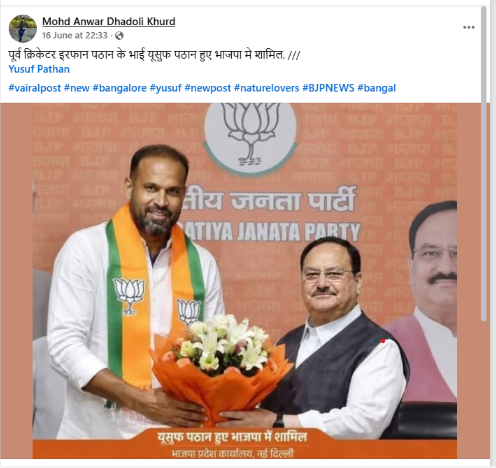
Amid political developments following the 2026 West Bengal Assembly elections, a photo is being widely circulated on social media claiming that former cricketer and Baharampur MP Yusuf Pathan has joined the Bharatiya Janata Party (BJP). The viral image shows Pathan wearing a BJP scarf and standing alongside Union Health Minister JP Nadda. CyberPeace Research Wing research found the claim to be false. The image in circulation is AI-generated and does not depict any real event.
Claim:
A Facebook user ‘Mohd Anwar Dhadoli Khurd’ shared the viral image on June 16, 2026, claiming that Yusuf Pathan has joined the BJP. The post has since been widely shared across platforms.
Post link: https://www.facebook.com/mohd.anwar.dhadoli.khurd/posts/pfbid02WAo4uXhhM1qEVTMbxTjKpTHkoeAbfEztwkX6tWLWpN8WBzNavgtJgKV8JoBGULSul
Archive link: https://perma.cc/4A3H-YTPL
Fact Check:
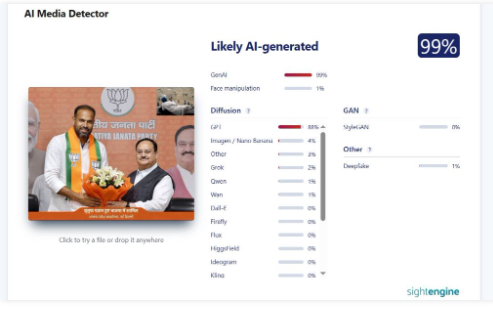
A reverse image search of the viral photo did not yield any credible news reports or authentic sources linking the image to any such political development. No related information was found on Yusuf Pathan’s official social media accounts either, raising suspicion about the authenticity of the image. The image was then analysed using AI detection tools. Sightengine reported a 99% probability of the image being AI-generated.
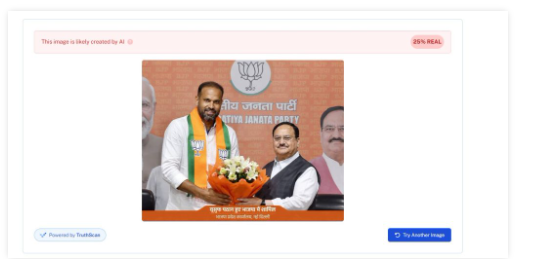
Additionally, analysis using “Undetectable.ai” also indicated a high likelihood of AI manipulation.
Conclusion:
The research confirms that the viral image claiming Yusuf Pathan’s entry into the BJP is AI-generated and does not reflect any real-world event.

Related Blogs

Executive Summary
A misleading advertisement circulating in social media providing attractive offers like iPhone15, AirPods and Smartwatches from the Indian e-commerce platform ‘Myntra’. This “Myntra - Festival Gifts” scam aims to attract the unsuspecting users into a series of redirects and fake interactions to compromise their personal information and devices. It is important to stay vigilant to protect ourselves from misleading attractive offers. Through this report, the Research Wing of CyberPeace explains about a series of processes that happens when the link gets clicked. Through this knowledge, we aim to provide awareness and empower the users to guard themselves and not fall into deceptive offers that aim to scam them.
False Claim
The widely shared WhatsApp message claims that Myntra is offering a wide range of high-valued prizes including the latest iPhone 15, AirPods, various smartwatches among all as a Festival Gift promotion. The campaign invites the users to click on the link provided and take a short quiz to be eligible for the prize.

The Deceptive Scheme
- The link in the social media post is tailored to work only on mobile devices, users are taken through a chain of redirects.
- Users are greeted with the Myntra's "Big Fashion Festival" branding accompanied by Myntra’s logo once they reach the landing page, which gives an impression of authenticity.
- Next, a simple quiz asks basic questions about the user's shopping experience with Myntra, their age, and gender.
- On the bottom of the quiz, there is a comment section that shows the comments from users who are supposedly provided with the prizes to look real,
- After the completion of the quiz, users are presented with a Spin-to-Win mechanism, to win the prize.
- After winning, a congratulatory message is displayed which says that the user has won an iPhone 15.
- The final step requires the user to share the campaign over WhatsApp in order to claim the prize.
Analyzing the Fraudulent Campaign
- The use of Myntra's branding and the promise of exclusive, high-value prizes are designed to attract users' interest.
- The fake comments and social proof elements aim to create a false sense of legitimacy and widespread participation, making the offer seem more credible.
- The series of redirects, quizzes, and Spin-to-Win mechanics are tactics to keep users engaged and increase the likelihood of them falling for the scam.
- The final step of sharing the post on WhatsApp is a way for the scammers to further spread the campaign and compromise more victims. Through sharing the link over WhatsApp, users become unaware accomplices that are simply assisting the scammers to reach an even bigger audience and hence their popularity.
- The primary objectives of such scams are to gather users' personal information and potentially gain access to their devices. By luring users with the promise of exclusive gifts and creating a false sense of legitimacy, the scammers aim to exploit user trust and compromise their data, leading to potential identity theft, financial fraud, or the installation of potentially unwanted softwares.
- We have also cross-checked and as of now there is no well established and credible source or any official notification that has confirmed such an offer advertised by Myntra.
- Domain Analysis: If we closely look at the viral message, it is clearly visible that the scammers mentioned myntra.com in the url. However, the actual url takes the user to a different domain as the campaign is hosted on a third party domain instead of the official Website of Myntra, this raised suspicion. This is the common way to deceive users into falling for a Phishing scam. Whois information reveals that the domain has been registered not long ago i.e on 8th April 2024, just a few days back. Cybercriminals used Cloudflare technology to mask the actual IP address of the fraudulent website.

- Domain Name: MYTNRA.CYOU
- Registry Domain ID: D445770144-CNIC
- Registrar WHOIS Server: whois.hkdns.hk
- Registrar URL: http://www.hkdns.hk
- Updated Date: 2024-04-08T03:27:58.0Z
- Creation Date: 2024-04-08T02:58:14.0Z
- Registry Expiry Date: 2025-04-08T23:59:59.0Z
- Registrar: West263 International Limited
- Registrant State/Province: Delhi
- Registrant Country: IN
- Name Server: NORMAN.NS.CLOUDFLARE.COM
- Name Server: PAM.NS.CLOUDFLARE.COM
CyberPeace Advisory and Best Practices
- Do not open those messages received from social platforms in which you think that such messages are suspicious or unsolicited. In the beginning, your own discretion can become your best weapon.
- Falling prey to such scams could compromise your entire system, potentially granting unauthorized access to your microphone, camera, text messages, contacts, pictures, videos, banking applications, and more. Keep your cyber world safe against any attacks.
- Never, in any case, reveal such sensitive data as your login credentials and banking details to entities you haven't validated as reliable ones.
- Before sharing any content or clicking on links within messages, always verify the legitimacy of the source. Protect not only yourself but also those in your digital circle.
- For the sake of the truthfulness of offers and messages, find the official sources and companies directly. Verify the authenticity of alluring offers before taking any action.
Conclusion:
The “Myntra - Festival Gift” scam is a kind of manipulation in which the fraudsters exploit the trust of the users and take advantage of a popular e-commerce website. It is equally crucial to equip the users by imparting them knowledge on fraudulent behavior tactics like impersonating brands, creating fake social proof and application of different engagement strategies. We are required to remain alert and stand firm against cyber attacks. Be careful, make sure that information is verified and share awareness to help make a safe online environment for all users.

Executive Summary:
In the age of virtuality, misinformation and misleading techniques shape the macula of the internet, and these threaten human safety and well-being. Recently, an alarming fake information has surfaced, intended to provide a fake Government subsidy scheme with the name of Indian Post. This serves criminals, who attack people's weaknesses, laying them off with proposals of receiving help in exchange for info. In this informative blog, we take a deep dive into one of the common schemes of fraud during this time. We will go through the stages involved which illustrates how one is deceived and offer practical tips to avoid the fall.
Introduction:
Digital communication reaches individuals faster, and as a result, misinformation and mails have accelerated their spread globally. People, therefore, are susceptible to online scams as they add credibility to phenomena. In India, the recently increased fake news draws its target with the deceptive claims of being a subsidy from the Government mainly through the Indian post. These fraudulent schemes frequently are spread via social networks and messaging platforms, influence trust of the individual’s in respectable establishments to establish fraud and collect private data.
Understanding the Claim:
There is a claim circulating on the behalf of the Government at the national level of a great subsidy of $1066 for deserving residents. The individual will be benefited with the subsidy when they complete the questionnaire they have received through social media. The questionnaire may have been designed to steal the individual’s confidential information by way of taking advantage of naivety and carelessness.
The Deceptive Journey Unveiled:
Bogus Offer Presentation: The scheme often appeals to people, by providing a misleading message or a commercial purposely targeted at convincing them to act immediately by instilling the sense of an urgent need. Such messages usually combine the mood of persuasion and highly evaluative material to create an illusion of being authentic.
Questionnaire Requirement: After the visitors land on attractive content material they are directed to fill in the questionnaire which is supposedly required for processing the economic assistance. This questionnaire requests for non private information in their nature.
False Sense of Urgency: Simultaneously, in addition to the stress-causing factor of it being a fake news, even the false deadline may be brought out to push in the technique of compliance. This data collection is intended to put people under pressure and influence them to make the information transfer that immediate without thorough examination.
Data Harvesting Tactics: Despite the financial help actually serving, you might be unaware but lies beneath it is a vile motive, data harvesting. The collection of facts through questionnaires may become something priceless for scammers that they can use for a good while to profit from identity theft, financial crimes and other malicious means.
Analysis Highlights:
- It is important to note that at this particular point, there has not been any official declaration or a proper confirmation of an offer made by the India Post or from the Government. So, people must be very careful when encountering such messages because they are often employed as lures in phishing attacks or misinformation campaigns. Before engaging or transmitting such claims, it is always advisable to authenticate the information from trustworthy sources in order to protect oneself online and prevent the spread of wrongful information
- The campaign is hosted on a third party domain instead of any official Government Website, this raised suspicion. Also the domain has been registered in very recent times.

- Domain Name: ccn-web[.]buzz
- Registry Domain ID: D6073D14AF8D9418BBB6ADE18009D6866-GDREG
- Registrar WHOIS Server: whois[.]namesilo[.]com
- Registrar URL: www[.]namesilo[.]com
- Updated Date: 2024-02-27T06:17:21Z
- Creation Date: 2024-02-11T03:23:08Z
- Registry Expiry Date: 2025-02-11T03:23:08Z
- Registrar: NameSilo, LLC
- Name Server: tegan[.]ns[.]cloudflare[.]com
- Name Server: nikon[.]ns[.]cloudflare[.]com
Note: Cybercriminal used Cloudflare technology to mask the actual IP address of the fraudulent website.
CyberPeace Advisory:
Verification and Vigilance: It makes complete sense in this case that you should be cautious and skeptical. Do not fall prey to this criminal act. Examine the arguments made and the facts provided by either party and consult credible sources before disclosures are made.
Official Channels: Governments usually invoke the use of reliable channels which can as well be by disseminating subsidies and assistance programs through official websites and the legal channels. Take caution for schemes that are not following the protocols previously established.
Educational Awareness: Providing awareness through education and consciousness about on-line scams and the approaches which are fraudulent has to be considered a primary requirement. Through empowering individuals with capabilities and targets we, as a collective, can be armed with information that will prevent erroneous scheme spreading.
Reporting and Action: In a case of mission suspicious and fraudulent images, let them understand immediately by making the authorities and necessary organizations alert. Your swift actions do not only protect yourself but also help others avoid the costs of related security compromises.
Conclusion:
The rise of the ‘Indian Post Countrywide - government subsidy fake news’ poses a stern warning of the present time that the dangers within the virtual ecosystem are. The art of being wise and sharp in terms of scams always reminds us to show a quick reaction to the hacks and try to do the things that we should identify as per the CyberPeace advisories; thereby, we will contribute to a safer Cyberspace for everyone. Likewise, the ability to critically judge, and remain alert, is important to help defeat the variety of tricks offenders use to mislead you online.
.webp)
Introduction
The link between social media and misinformation is undeniable. Misinformation, particularly the kind that evokes emotion, spreads like wildfire on social media and has serious consequences, like undermining democratic processes, discrediting science, and promulgating hateful discourses which may incite physical violence. If left unchecked, misinformation propagated through social media has the potential to incite social disorder, as seen in countless ethnic clashes worldwide. This is why social media platforms have been under growing pressure to combat misinformation and have been developing models such as fact-checking services and community notes to check its spread. This article explores the pros and cons of the models and evaluates their broader implications for online information integrity.
How the Models Work
- Third-Party Fact-Checking Model (formerly used by Meta) Meta initiated this program in 2016 after claims of extraterritorial election tampering through dis/misinformation on its platforms. It entered partnerships with third-party organizations like AFP and specialist sites like Lead Stories and PolitiFact, which are certified by the International Fact-Checking Network (IFCN) for meeting neutrality, independence, and editorial quality standards. These fact-checkers identify misleading claims that go viral on platforms and publish verified articles on their websites, providing correct information. They also submit this to Meta through an interface, which may link the fact-checked article to the social media post that contains factually incorrect claims. The post then gets flagged for false or misleading content, and a link to the article appears under the post for users to refer to. This content will be demoted in the platform algorithm, though not removed entirely unless it violates Community Standards. However, in January 2025, Meta announced it was scrapping this program and beginning to test X’s Community Notes Model in the USA, before rolling it out in the rest of the world. It alleges that the independent fact-checking model is riddled with personal biases, lacks transparency in decision-making, and has evolved into a censoring tool.
- Community Notes Model ( Used by X and being tested by Meta): This model relies on crowdsourced contributors who can sign up for the program, write contextual notes on posts and rate the notes made by other users on X. The platform uses a bridging algorithm to display those notes publicly, which receive cross-ideological consensus from voters across the political spectrum. It does this by boosting those notes that receive support despite the political leaning of the voters, which it measures through their engagements with previous notes. The benefit of this system is that it is less likely for biases to creep into the flagging mechanism. Further, the process is relatively more transparent than an independent fact-checking mechanism since all Community Notes contributions are publicly available for inspection, and the ranking algorithm can be accessed by anyone, allowing for external evaluation of the system by anyone.
CyberPeace Insights
Meta’s uptake of a crowdsourced model signals social media’s shift toward decentralized content moderation, giving users more influence in what gets flagged and why. However, the model’s reliance on diverse agreements can be a time-consuming process. A study (by Wirtschafter & Majumder, 2023) shows that only about 12.5 per cent of all submitted notes are seen by the public, making most misleading content go unchecked. Further, many notes on divisive issues like politics and elections may not see the light of day since reaching a consensus on such topics is hard. This means that many misleading posts may not be publicly flagged at all, thereby hindering risk mitigation efforts. This casts aspersions on the model’s ability to check the virality of posts which can have adverse societal impacts, especially on vulnerable communities. On the other hand, the fact-checking model suffers from a lack of transparency, which has damaged user trust and led to allegations of bias.
Since both models have their advantages and disadvantages, the future of misinformation control will require a hybrid approach. Data accuracy and polarization through social media are issues bigger than an exclusive tool or model can effectively handle. Thus, platforms can combine expert validation with crowdsourced input to allow for accuracy, transparency, and scalability.
Conclusion
Meta’s shift to a crowdsourced model of fact-checking is likely to have bigger implications on public discourse since social media platforms hold immense power in terms of how their policies affect politics, the economy, and societal relations at large. This change comes against the background of sweeping cost-cutting in the tech industry, political changes in the USA and abroad, and increasing attempts to make Big Tech platforms more accountable in jurisdictions like the EU and Australia, which are known for their welfare-oriented policies. These co-occurring contestations are likely to inform the direction the development of misinformation-countering tactics will take. Until then, the crowdsourcing model is still in development, and its efficacy is yet to be seen, especially regarding polarizing topics.
References
- https://www.cyberpeace.org/resources/blogs/new-youtube-notes-feature-to-help-users-add-context-to-videos
- https://en-gb.facebook.com/business/help/315131736305613?id=673052479947730
- http://techxplore.com/news/2025-01-meta-fact.html
- https://about.fb.com/news/2025/01/meta-more-speech-fewer-mistakes/
- https://communitynotes.x.com/guide/en/about/introduction
- https://blogs.lse.ac.uk/impactofsocialsciences/2025/01/14/do-community-notes-work/?utm_source=chatgpt.com
- https://www.techpolicy.press/community-notes-and-its-narrow-understanding-of-disinformation/
- https://www.rstreet.org/commentary/metas-shift-to-community-notes-model-proves-that-we-can-fix-big-problems-without-big-government/
- https://tsjournal.org/index.php/jots/article/view/139/57
