
#FactCheck: AI-Generated Image Falsely Shows Sonia Gandhi Shaking Hands with Jeffrey Epstein
Executive Summary
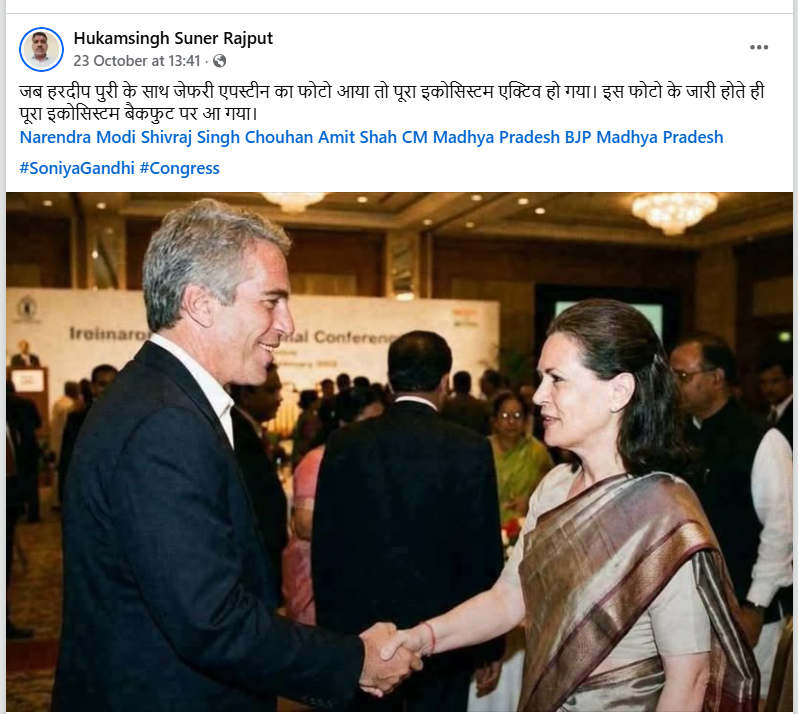
A photograph is currently going viral on social media showing former Congress president Sonia Gandhi shaking hands with American sex offender Jeffrey Epstein. Several social media users are sharing the image as authentic. Some posts also use objectionable language against Sonia Gandhi in their captions. CyberPeace Research found the viral claim to be false. Our research found that the viral image is not authentic but AI-generated.
Claim
On October 23, 2026, Facebook user ‘Hukamsingh Suner Rajput’ uploaded the image with the caption: “When Jeffrey Epstein’s photo with Hardeep Puri came out, the entire ecosystem became active. As soon as this photo was released, the entire ecosystem went on the back foot.”
https://www.facebook.com/photo/?fbid=4839481413005242&set=a.1849023385384408
FactCheck
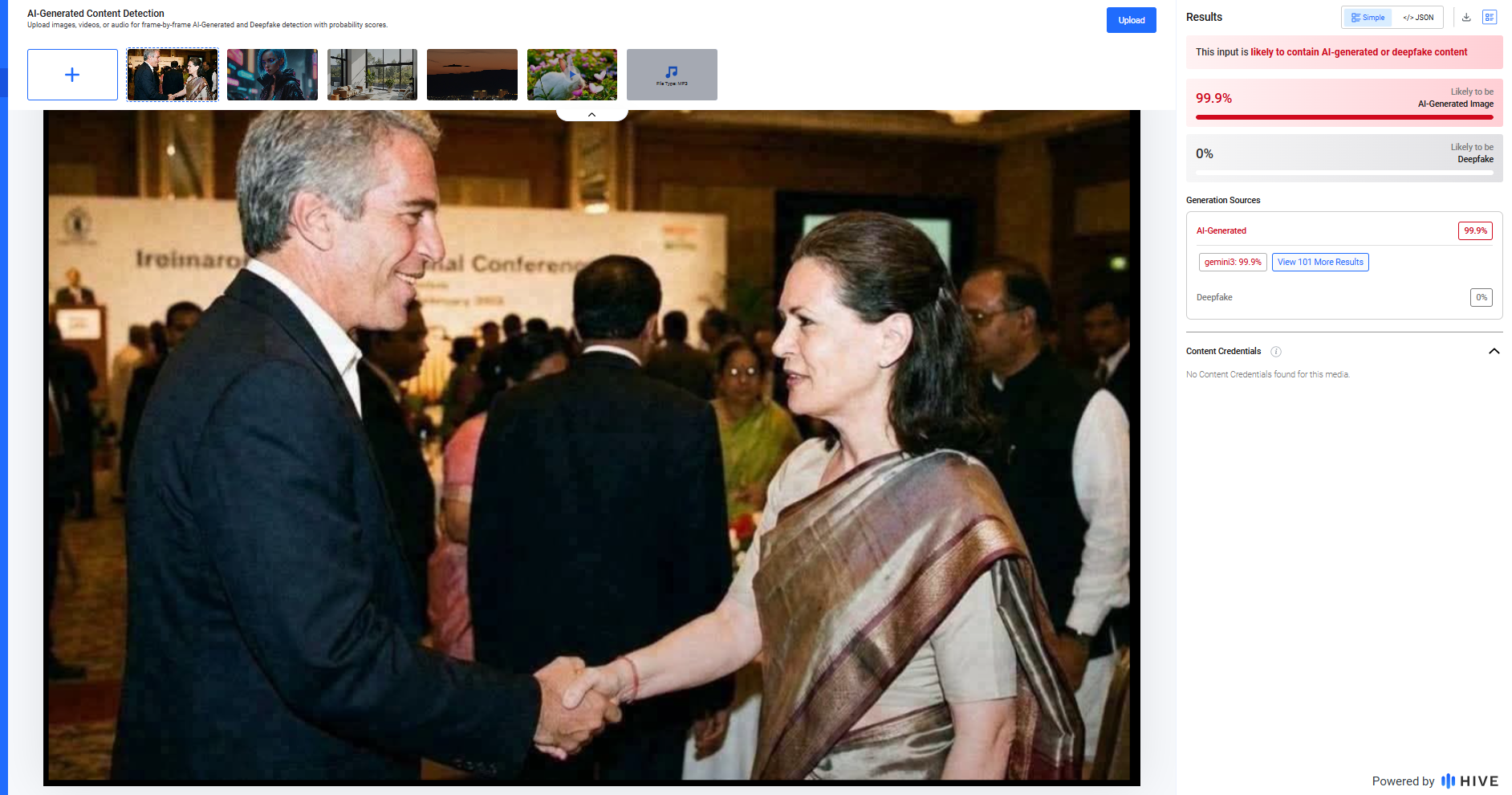
As part of our research, we first used Google’s open search tool. A search using relevant keywords did not yield any news report that could verify the authenticity of the viral image. This indicated that the viral image was fake. Based on this, we used AI detection tools to further verify the image. We first used the ‘Hive Moderation’ tool, which indicated a 99 per cent probability that the viral image was generated using AI.
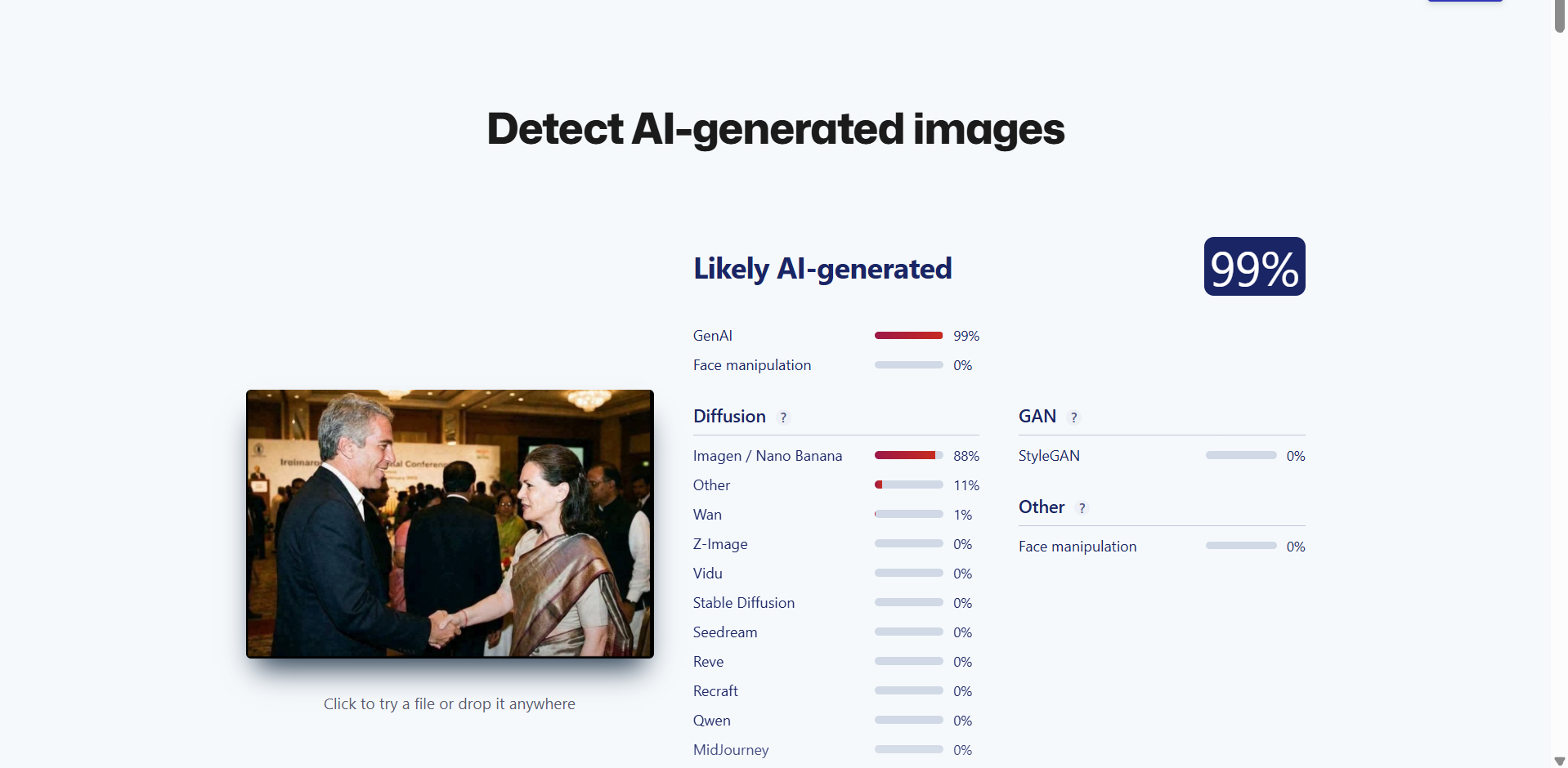
We also scanned the image using another AI detection tool, Sightengine. According to the results, the viral image is 99 per cent likely to be AI-generated.
Conclusion:
Our research found that the viral image is not authentic but AI-generated.

Related Blogs

What is Deepfake
Deepfakes have been, a fascinating but unsettling phenomenon that is now prominent in this digital age. These incredibly convincing films have drawn attention and blended in well with our high-tech surroundings. The lifelike but completely manufactured quality of deepfake videos has become an essential component of our digital environment as we traverse the broad reaches of our digital society. While these works have an undoubtedly captivating charm, they have important ramifications. Come along as we examine the deep effects that misuse of deepfakes can have on our globalized digital culture. After many actors now business tycoon Ratan Tata has become the latest victim of deepfake. Tata called out a post from a user that used a fake interview of him in a video recommending Investments.
Case Study
The nuisance of deep fake is sparing none from actors politicians to entrepreneurs everyone is getting caught in the Trap. Soon after the actresses Rashmika Mandana, Katrina Kaif, Kajol and other actresses fell prey to the rising scenario of deepfake, a new case from the industry emerged, which took Mr. Ratan Tata on storm. Business tycoon Ratan Tata has become the latest victim of deepfake. He took to his social media sharing an image of the interview that asked people to invest money in a project in a post on Instagram. Ratan Tata called out a post from a user that used a fake interview of him in a video recommending these Investments.
This nuisance that has been created because of the deepfake is sparing nobody from actors to politicians to entrepreneurs now everyone is getting caught in the trap the latest victim being Ratan Tata. Tech magnate Ratan Tata is the most recent victim of this deepfake phenomenon. The millionaire was seen in the video, which was posted by the Instagram user, giving his followers a once-in-a-million opportunity to "exaggerate investments risk-free."
In the stated video, Ratan Tata was seen giving everyone in India advice mentioning to the public regarding the opportunity to increase their money with no risk and a 100% guarantee. The caption of the video clip stated, "Go to the channel right now."
Tata annotated both the video and the screenshot of the caption with the word "FAKE."
Ongoing Deepfake Assaults in India
Deepfake videos continue to target celebrities, and Priyanka Chopra is also a recent victim of this unsettling trend. Priyanka's deepfake adopts a different strategy than other examples, including actresses like Rashmika Mandanna, Katrina Kaif, Kajol, and Alia Bhatt. Rather than editing her face in contentious situations, the misleading film keeps her looking the same but modifies her voice and replaces real interview quotes with made-up commercial phrases. The deceptive video shows Priyanka promoting a product and talking about her yearly salary, highlighting the worrying development of deepfake technology and its possible effects on prominent personalities.
Prevention and Detection
In order to effectively combat the growing threat posed by deepfake technology, people and institutions should place a high priority on developing critical thinking abilities, carefully examining visual and auditory cues for discrepancies, making use of tools like reverse image searches, keeping up with the latest developments in deepfake trends, and rigorously fact-check reputable media sources. Important actions to improve resistance against deepfake threats include putting in place strong security policies, integrating cutting-edge deepfake detection technologies, supporting the development of ethical AI, and encouraging candid communication and cooperation. We can all work together to effectively and mindfully manage the problems presented by deepfake technology by combining these tactics and making adjustments to the constantly changing terrain.
Conclusion
The current instance involving Ratan Tata serves as an example of how the emergence of counterfeit technology poses an imminent danger to our digital civilization. The fake video, which was posted to Instagram, showed the business tycoon giving financial advice and luring followers with low-risk investment options. Tata quickly called out the footage as "FAKE," highlighting the need for careful media consumption. The Tata incident serves as a reminder of the possible damage deepfakes can do to prominent people's reputations. The issue, in Ratan Tata's instance specifically, demands that public personalities be more mindful of the possible misuse of their virtual identities. We can all work together to strengthen our defenses against this sneaky phenomenon and maintain the trustworthiness of our internet-based culture in the face of ever-changing technological challenges by emphasizing preventive measures like strict safety regulations and the implementation of state-of-the-art deepfake detection technologies.
References
- https://economictimes.indiatimes.com/magazines/panache/ratan-tata-slams-deepfake-video-that-features-him-giving-risk-free-investment-advice/articleshow/105805223.cms
- https://www.ndtv.com/india-news/ratan-tata-flags-deepfake-video-of-his-interview-recommending-investments-4640515
- https://www.businesstoday.in/bt-tv/short-video/viralvideo-business-tycoon-ratan-tata-falls-victim-to-deepfake-408557-2023-12-07
- https://www.livemint.com/news/india/false-ratan-tata-calls-out-a-deepfake-video-of-him-giving-investment-advice-11701926766285.html

Introduction
Misinformation has the potential to impact people, communities and institutions alike, and the ramifications can be far-ranging. From influencing voter behaviours and consumer choices to shaping personal beliefs and community dynamics, the information we consume in our daily lives affects every aspect of our existence. And so, when this very information is flawed or incomplete, whether accidentally or deliberately so, it has the potential to confuse and mislead people.
‘Debunking’ is the process of exposing false information or countering inaccuracies and manipulation by presenting actual facts. The goal is to minimise the harmful effects of misinformation by informing and educating people. Debunking initiatives work hard to expose false information and cut down conspiracies, catalogue evidence of false information, clearly identify sources of misinformation vs. accurate information, and assert the truth. Debunking looks at building capacity and educating people both as a strategy and goal.
Debunking is most effective when it comes from trusted sources, provides detailed explanations, and offers guidance and verifiable advice. Debunking is reactive in nature and it focuses on specific instances of misinformation and is closely tied to fact-checking. Debunking aims to mitigate the impact of misinformation that has already spread. As such, the approach is to contain and correct, post-occurrence. The most common method of debunking is collaboration between fact-checking groups and social media companies. When journalists or other fact-checkers identify false or misleading content, social media sites flag or label it such, so that audiences are alerted. Debunking is an essential method for reducing the impact and incidence of misinformation by providing real facts and increasing overall accuracy of content in the digital information ecosystem.
Role of Debunking the Misinformation
Debunking fights against false or misleading information by correcting false claims, myths, and misinformation with evidence-based rebuttals. It combats untruths and the spread of misinformation by providing and disseminating debunked evidence to the public. Debunking by presenting evidence that contradicts misleading facts and encourages individuals to develop fact-checking habits and proactively check for authenticated sources. Debunking plays a vital role in boosting trust in credible sources by offering evidence-based corrections and enhancing the credibility of online information. By exposing falsehoods and endorsing qualities like information completeness and evidence-backed data and logic, debunking efforts help create a culture of well-informed and constructive public conversations and analytical exchanges. Effectively dispelling myths and misinformation can help create communities and societies that are more educated, resilient, and goal-oriented.
Debunking as a tailoring Strategy to counter Misinformation
Understanding the information environment and source trustworthiness is critical for developing effective debunking techniques. Successful debunking efforts use clear messages, appealing forms, and targeted distribution to reach a wide range of netizens. Debunking as an effective method for combating misinformation includes analysing successful efforts, using fact-checking, relying on reputable sources for corrections, and using scientific communication. Fact-checking plays a critical role in ensuring information accuracy and holding people accountable for making misleading claims. Collaborative efforts and transparent techniques can boost the credibility and efficacy of fact-checking activities and boost the legitimacy and effectiveness of debunking initiatives at a larger scale. Scientific communication is also critical for debunking myths about different topics/concerns by giving evidence-based information. Clear and understandable framing of scientific knowledge is critical for engaging broad audiences and effectively refuting misinformation.
CyberPeace Policy Recommendations
- It is recommended that debunking initiatives must highlight core facts, emphasising what is true over what is wrong and establishing a clear contrast between the two. This is crucial as people are more likely to believe familiar information even if they learn later that it is incorrect. Debunking must provide a comprehensive explanation, filling the ‘information gap’ created by the myth. This can be done by explaining things as clearly as possible, as people may stop paying attention if they are faced with an overload of competing information. The use of visuals to illustrate core facts is an effective way to help people understand the issue and clearly tell the difference between information and misinformation.
- Individuals can play a role in debunking misinformation on social media by highlighting inconsistencies, recommending related articles with corrections or sharing trusted sources and debunking reports in their communities.
- Governments and regulatory agencies can improve information openness by demanding explicit source labelling and technical measures to be implemented on platforms. This can increase confidence in information sources and equip people to practice discernment when they consume content online. Governments should also support and encourage independent fact-checking organisations that are working to disprove misinformation. Digital literacy programmes may teach the public how to critically assess information online and spot any misinformation.
- Tech businesses may enhance algorithms for detecting and flagging misinformation, therefore reducing the propagation of misleading information. Offering options for people to report suspicious/doubtful information and misinformation can empower them and help them play an active role in identifying and rectifying inaccurate information online and foster a more responsible information environment on the platforms.
Conclusion
Debunking is an effective strategy to counter widespread misinformation through a combination of fact-checking, scientific evidence, factual explanations, verified facts and corrections. Debunking can play an important role in fostering a culture where people look for authenticity while consuming the information and place a high value on trusted and verified information. A collaborative strategy can increase the legitimacy and reach of debunking efforts, making them more effective in reaching larger audiences and being easy-to-understand for a wide range of demographics. In a complex and ever-evolving digital ecosystem, it is important to build information resilience both at the macro level for the ecosystem as a whole and at the micro level, with the individual consumer. Only then can we ensure a culture of mindful, responsible content creation and consumption.
References
Introduction
Parliament is about to begin its Monsoon Session from July 20, 2026 to August 13, 2026, and the mood in Delhi already feels charged. Ahead of the opening bell, the government has flagged five new bills for introduction, alongside a couple of pending pieces of legislation it may take up for passage. Predictably, the political oxygen in the run-up has gone almost entirely to what isn't on that list — reports this week noted the conspicuous absence of the long-anticipated Delimitation Bill and a Constitutional amendment for women's reservation in the Lok Sabha, a gap that has already drawn sharp reactions from Congress leaders. What is on the list has generated its own share of noise: a Foreign Contribution (Regulation) Amendment Bill that NGOs are watching warily, a Prevention of Insults to National Honour (Amendment) Bill tied to safeguards for the National Flag and Anthem, and a Supreme Court (Number of Judges) Amendment Bill proposing to raise the Court's sanctioned strength from 33 to 37. Every one of these will command its share of prime-time debate. But tucked quietly among the five is a bill that, headline for headline, may end up mattering more to the everyday Indian economy than all the others combined: the Micro, Small and Medium Enterprises Development (Amendment) Bill, 2026.
MSMEs play a foundational role in India’s economic engine, powering employment, entrepreneurship and growth across the country. That makes this Bill one worth watching closely, because even seemingly technical changes to the MSME framework could have very real consequences for millions of businesses and the people whose livelihoods depend on them.
What the Bill Actually Does
The MSME sector hasn't seen a structural legal update since the original MSMED Act of 2006 nearly two decades in an economy that looks nothing like it did back then. The new amendment is designed to close that gap. According to the government's own description of the bill, it aims to align the 2006 law with the sector's changed realities, improve ease of doing business, and shift toward what officials are calling "trust-based" regulation rather than a purely compliance-driven approach.
Three provisions stand out.
- First, it strengthens the mechanism for resolving delayed payments to micro and small enterprises, arguably the single biggest complaint MSME owners have voiced for years.
- Second, it creates a pathway to enforce arbitral awards specifically for micro and small units, giving smaller suppliers real teeth when a dispute is decided in their favor.
- Third, it gives states more flexibility in deciding the composition of Micro and Small Enterprises Facilitation Councils (MSEFCs) , the bodies that adjudicate payment disputes which should allow more councils to be formed and cut down on case backlogs.
The Delayed Payment Crisis, in Numbers
To understand why this matters, look at the scale of the problem the bill is trying to fix. The MSME Ministry's Samadhaan portal, which lets small enterprises file delayed-payment complaints online, had received close to 2.57 lakh applications as of June 2026, involving claimed dues of roughly ₹55,244 crore. Of these, only about 58,000 cases had actually been resolved by facilitation councils. That's a resolution rate that leaves the vast majority of small businesses waiting often for money already owed to them for goods or services delivered.
The government did tighten the screws somewhat in 2024 through Section 43B(h) of the Income Tax Act, which denies large buyers a tax deduction if they don't pay MSME suppliers within the 15-to-45-day window mandated by law. Enforcement, however, has remained patchy, and industry bodies like Assocham have continued to flag delayed payments including from PSUs and government departments as a core source of financial stress for small firms, with high interest charges on overdue statutory dues compounding the problem.
Why This Is Bigger Than One Bill
A regulation targeting the payments practices of India's micro, small, and medium-sized enterprises is more than just paperwork and procedural wrangling; the stakes for the Indian economy and society are enormous. According to the 2025-26 Economic Survey, MSMEs now contribute about 31.1% of India’s GDP, 35.4% of its manufacturing output, and 48.58% of its exports, while employing 33 to 39 crore people and providing India’s second largest source of employment after agriculture. The official Udyam database of MSMEs crossed the 8.7 crore mark by June 2026, underscoring a clear trend towards the sector’s formalisation in the last few years. Access to finance is the second pillar of MSME empowerment. The Credit Guarantee Fund Trust for Micro and Small Enterprises has authorised several lakh crores in guarantees, and most recently, the government increased its loan guarantee cover ceiling from Rs 5 crore to Rs 10 crore to facilitate more collateral-free loans to businesses. However, the actual credit gap remains estimated in the tens of lakh crores, with the biggest gaps faced by women-led and medium enterprises. While the MSME Bill doesn’t directly address access to finance, improved and quicker payment settlement mechanisms are expected to relieve some working-capital stress and dissuade small firms from falling into expensive informal credit markets. The MSME Bill also adds to a wave of recent measures to de-regulate smaller enterprises, such as the Jan Vishwas (Amendment of Provisions) Bill that was passed earlier in 2026. That Bill modified or deleted criminal offences with a more lenient civil equivalent across numerous central acts, a change industry lobby FISME called a significant move towards ease of doing business.
The Data Protection Clock Is Already Ticking - The Gap Payment Reform Won't Close
It's also worth noting that India's Digital Personal Data Protection (DPDP) Act, 2023 is now in force, with rules notified in November 2025 and full compliance — including breach notification, security safeguards. With nearly half of Indian small businesses already reporting cyber incidents each year, MSMEs have a narrowing runway to build the security practices this regime will expect of them. Given that scale of exposure, there's a real case for the MSME Amendment Bill, or a companion policy, to go further — mandating baseline cyber-hygiene standards for Udyam-registered firms or tying credit-guarantee schemes to demonstrated security practices. Payment reform alone protects an MSME's right to be paid; it does little to protect what happens to that money, or that data, once it arrives.Payment reform alone protects an MSME's right to be paid; it does little to protect what happens to that money, or that data, once it arrives. CyberPeace calls on relevant agencies to issue clearer advisories and introduce additional, cost-friendly cybersecurity safeguards tailored to MSMEs' limited budgets and IT capacity.
What to Watch For
Whether the MSME Bill gets the attention it deserves during this session is an open question. With the Opposition expected to spend political capital on delimitation, the Vande Mataram bill, unemployment, inflation, and the NEET paper-leak controversy, a technical amendment to an enterprise development law is unlikely to dominate floor debate even though it may end up affecting more households than any single headline bill this session.
Conclusion
For India's roughly 7-8 crore MSMEs, most of them family-run and thinly capitalised, the details that get finalised in the coming weeks how MSEFCs are reconstituted, how arbitral awards get enforced, how "trust-based" regulation is actually defined will matter far more than who wins the argument over delimitation. It's worth watching this one closely, even if the cameras are pointed elsewhere.
Sources
- https://www.business-standard.com/india-news/vande-mataram-bill-among-five-new-legislations-listed-for-monsoon-session-126071601319_1.html
- https://www.prokerala.com/news/articles/a1780267.html
