
#FactCheck- AI Video Fuels False Claims of Israeli Soldiers’ Death in Plane Crash
Executive Summary
A video circulating on social media is being linked to the ongoing tensions in West Asia involving the United States, Israel, and Iran. The clip shows an aircraft crashing into a residential area, with users claiming that a Dubai-bound plane carrying Israeli soldiers crashed near Tel Aviv airport, killing everyone on board. However, an research by the CyberPeace has found the claim to be false. The viral video is AI-generated, and no such incident has taken place in Israel.
Claim
An Instagram user “bebakawaaztv” shared the video on April 7, 2026, claiming that a Dubai aircraft carrying Israeli soldiers crashed near Tel Aviv airport in a residential area, allegedly after being hit by debris from an Iranian hypersonic missile.

Fact Check
To verify the claim, we closely examined the viral video. Several visual inconsistencies indicated that it was not real. The aircraft appears to be flying unusually low over a residential area—something that is highly improbable under normal aviation conditions. Its landing gear seems to touch rooftops without causing any visible damage. Additionally, the wings of the aircraft pass through structures like poles without any collision impact, which is physically impossible. These anomalies strongly suggested that the video was artificially created.
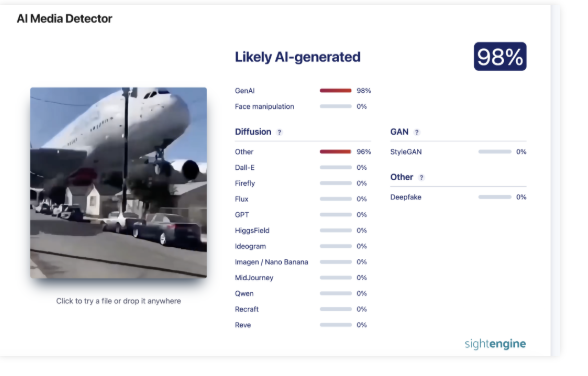
We further analyzed the video using the AI detection tool HIVE Moderation, which indicated a 99% probability that the content is AI-generated.

Another analysis using Sightengine also flagged the video as likely AI-generated.
Conclusion
The viral claim is false and misleading. There is no credible evidence or verified report confirming that any Dubai aircraft carrying Israeli soldiers crashed near Tel Aviv airport. No such incident has been reported by any reliable international or local media outlets. The video in question is digitally fabricated using AI technology, and the visual inconsistencies within the clip clearly indicate manipulation. Such content is often designed to exploit ongoing geopolitical tensions and spread misinformation at scale

Related Blogs

Executive Summary
A digitally manipulated image of World Bank President Ajay Banga has been circulating on social media, falsely portraying him as holding a Khalistani flag. The image was shared by a Pakistan-based X (formerly Twitter) user, who also incorrectly identified Banga as the President of the International Monetary Fund (IMF), thereby fuelling misleading speculation that he supports the Khalistani movement against India.
The Claim
On February 5, an X user with the handle @syedAnas0101010 posted an image allegedly showing Ajay Banga holding a Khalistani flag. The user misidentified him as the IMF President and captioned the post, “IMF president sending signals to INDIA.” The post quickly gained traction, amplifying false narratives and political speculation. Here is the link and archive link to the post, along with a screenshot:
Fact Check:
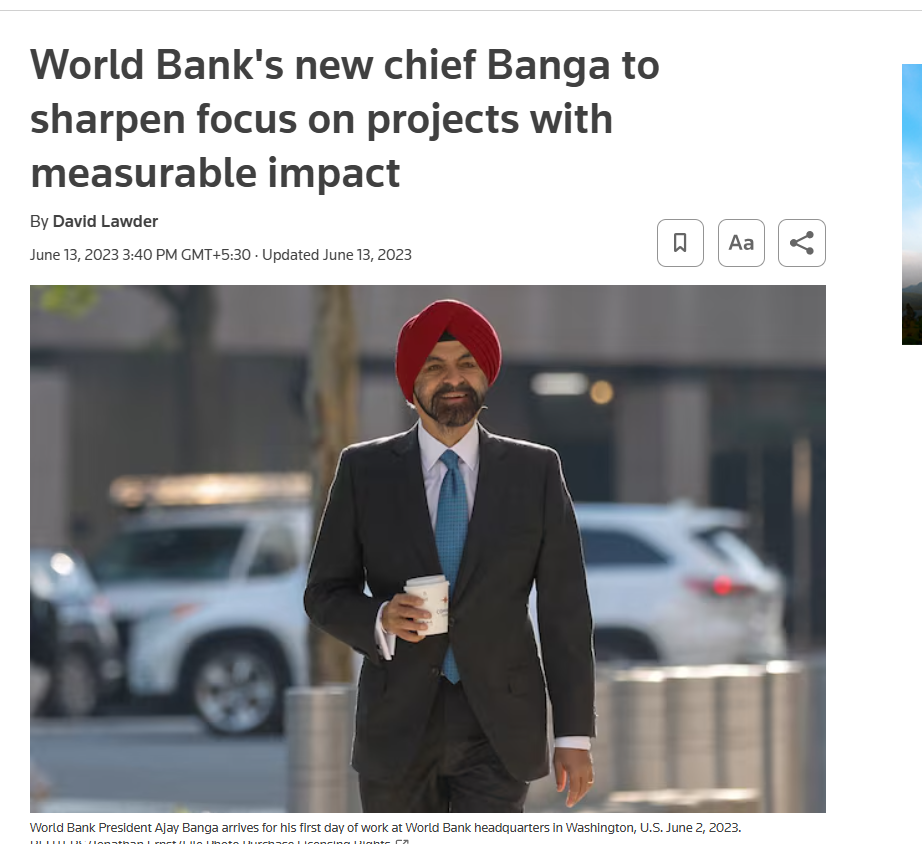
To verify the authenticity of the image, the CyberPeace Fact Check Desk conducted a detailed research . The image was first subjected to a reverse image search using Google Lens, which led to a Reuters news report published on June 13, 2023. The original photograph, captured by Reuters photojournalist Jonathan Ernst, showed Ajay Banga arriving at the World Bank headquarters in Washington, D.C., on June 2, 2023, marking his first day in office. In the authentic image, Banga is seen holding a coffee cup, not a flag.
Further analysis confirmed that the viral image had been digitally altered to replace the coffee cup with a Khalistani flag, thereby misrepresenting the context and intent of the original photograph. Here is the link to the report, along with a screenshot.
To strengthen the findings, the altered image was also analysed using the Hive Moderation AI detection tool. The tool’s assessment indicated a high likelihood that the image contained AI-generated or manipulated elements, reinforcing the conclusion that the image was not genuine. Below is a screenshot of the result.

Conclusion
The viral image claiming to show World Bank President Ajay Banga holding a Khalistani flag is fake. The photograph was digitally manipulated to spread misinformation and provoke political speculation. In reality, the original Reuters image from June 2023 shows Banga holding a coffee cup during his arrival at the World Bank headquarters. The claim that he supports the Khalistani movement is false and misleading.

Introduction
Generative AI models are significant consumers of computational resources and energy required for training and running models. While AI is being hailed as a game-changer, however underneath the shiny exterior, cracks are present which significantly raises concerns for its environmental impact. The development, maintenance, and disposal of AI technology all come with a large carbon footprint. The energy consumption of AI models, particularly large-scale models or image generation systems, these models rely on data centers powered by electricity, often from non-renewable sources, which exacerbates environmental concerns and contributes to substantial carbon emissions.
As AI adoption grows, improving energy efficiency becomes essential. Optimising algorithms, reducing model complexity, and using more efficient hardware can lower the energy footprint of AI systems. Additionally, transitioning to renewable energy sources for data centers can help mitigate their environmental impact. There is a growing need for sustainable AI development, where environmental considerations are integral to model design and deployment.
A breakdown of how generative AI contributes to environmental risks and the pressing need for energy efficiency:
- Gen AI during the training phase has high power consumption, when vast amounts of computational power which is often utilising extensive GPU clusters for weeks or at times even months, consumes a substantial amount of electricity. Post this phase, the inference phase where the deployment of these models takes place for real-time inference, can be energy-extensive especially when we take into account the millions of users of Gen AI.
- The main source of energy used for training and deploying AI models often comes from non-renewable sources which then contribute to the carbon footprint. The data centers where the computations for Gen AI take place are a significant source of carbon emissions if they rely on the use of fossil fuels for their energy needs for the training and deployment of the models. According to a study by MIT, training an AI can produce emissions that are equivalent to around 300 round-trip flights between New York and San Francisco. According to a report by Goldman Sachs, Data Companies will use 8% of US power by 2030, compared to 3% in 2022 as their energy demand grows by 160%.
- The production and disposal of hardware (GPUs, servers) necessary for AI contribute to environmental degradation. Mining for raw materials and disposing of electronic waste (e-waste) are additional environmental concerns. E-waste contains hazardous chemicals, including lead, mercury, and cadmium, that can contaminate soil and water supplies and endanger both human health and the environment.
Efforts by the Industry to reduce the environmental risk posed by Gen AI
There are a few examples of how companies are making efforts to reduce their carbon footprint, reduce energy consumption and overall be more environmentally friendly in the long run. Some of the efforts are as under:
- Google's TPUs in particular the Google Tensor are designed specifically for machine learning tasks and offer a higher performance-per-watt ratio compared to traditional GPUs, leading to more efficient AI computations during the shorter periods requiring peak consumption.
- Researchers at Microsoft, for instance, have developed a so-called “1 bit” architecture that can make LLMs 10 times more energy efficient than the current leading system. This system simplifies the models’ calculations by reducing the values to 0 or 1, slashing power consumption but without sacrificing its performance.
- OpenAI has been working on optimizing the efficiency of its models and exploring ways to reduce the environmental impact of AI and using renewable energy as much as possible including the research into more efficient training methods and model architectures.
Policy Recommendations
We advocate for the sustainable product development process and press the need for Energy Efficiency in AI Models to counter the environmental impact that they have. These improvements would not only be better for the environment but also contribute to the greater and sustainable development of Gen AI. Some suggestions are as follows:
- AI needs to adopt a Climate justice framework which has been informed by a diverse context and perspectives while working in tandem with the UN’s (Sustainable Development Goals) SDGs.
- Working and developing more efficient algorithms that would require less computational power for both training and inference can reduce energy consumption. Designing more energy-efficient hardware, such as specialized AI accelerators and next-generation GPUs, can help mitigate the environmental impact.
- Transitioning to renewable energy sources (solar, wind, hydro) can significantly reduce the carbon footprint associated with AI. The World Economic Forum (WEF) projects that by 2050, the total amount of e-waste generated will have surpassed 120 million metric tonnes.
- Employing techniques like model compression, which reduces the size of AI models without sacrificing performance, can lead to less energy-intensive computations. Optimized models are faster and require less hardware, thus consuming less energy.
- Implementing scattered learning approaches, where models are trained across decentralized devices rather than centralized data centers, can lead to a better distribution of energy load evenly and reduce the overall environmental impact.
- Enhancing the energy efficiency of data centers through better cooling systems, improved energy management practices, and the use of AI for optimizing data center operations can contribute to reduced energy consumption.
Final Words
The UN Sustainable Development Goals (SDGs) are crucial for the AI industry just as other industries as they guide responsible innovation. Aligning AI development with the SDGs will ensure ethical practices, promoting sustainability, equity, and inclusivity. This alignment fosters global trust in AI technologies, encourages investment, and drives solutions to pressing global challenges, such as poverty, education, and climate change, ultimately creating a positive impact on society and the environment. The current state of AI is that it is essentially utilizing enormous power and producing a product not efficiently utilizing the power it gets. AI and its derivatives are stressing the environment in such a manner which if it continues will affect the clean water resources and other non-renewable power generation sources which contributed to the huge carbon footprint of the AI industry as a whole.
References
- https://cio.economictimes.indiatimes.com/news/artificial-intelligence/ais-hunger-for-power-can-be-tamed/111302991
- https://earth.org/the-green-dilemma-can-ai-fulfil-its-potential-without-harming-the-environment/
- https://www.technologyreview.com/2019/06/06/239031/training-a-single-ai-model-can-emit-as-much-carbon-as-five-cars-in-their-lifetimes/
- https://www.scientificamerican.com/article/ais-climate-impact-goes-beyond-its-emissions/
- https://insights.grcglobalgroup.com/the-environmental-impact-of-ai/

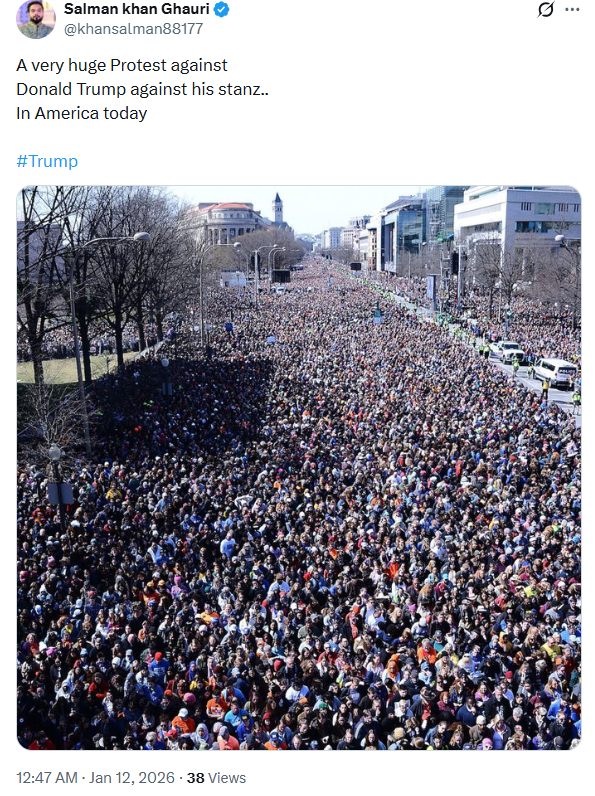
A photograph showing a massive crowd on a road is being widely shared on social media. The image is being circulated with the claim that people in the United States are staging large-scale protests against President Donald Trump.
However, CyberPeace Foundation’s research has found this claim to be misleading. Our fact-check reveals that the viral photograph is nearly eight years old and has been falsely linked to recent political developments.
Claim:
Social media users are sharing a photograph and claiming that it shows people protesting against US President Donald Trump.An X (formerly Twitter) user, Salman Khan Gauri (@khansalman88177), shared the image with the caption:“Today, a massive protest is taking place in America against Donald Trump.”
The post can be viewed here, and its archived version is available here.
FactCheck:
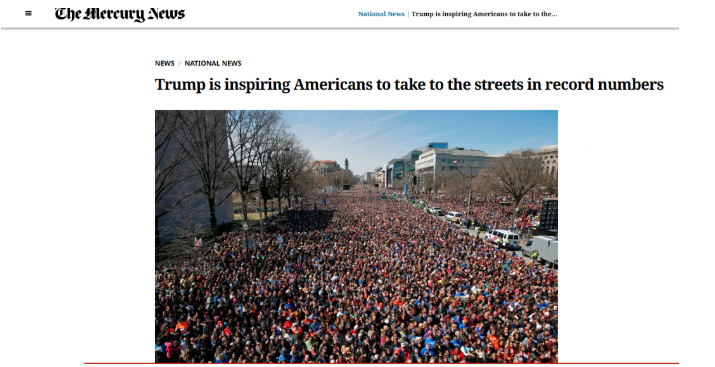
To verify the claim, we conducted a reverse image search of the viral photograph using Google. This led us to a report published by The Mercury News on April 6, 2018.
The report features the same image and states that the photograph was taken on March 24, 2018, during the ‘March for Our Lives’ rally in Washington, DC. The rally was organized to demand stricter gun control laws in the United States. The image shows a large crowd gathered on Pennsylvania Avenue in support of gun reform.
The report further notes that the Associated Press, on March 30, 2018, debunked false claims circulating online which alleged that liberal billionaire George Soros and his organizations had paid protesters $300 each to participate in the rally.
Further research led us to a report published by The Hindu on March 25, 2018, which also carries the same photograph. According to the report, thousands of Americans across the country participated in ‘March for Our Lives’ rallies following a mass shooting at a school in Florida. The protests were led by survivors and victims, demanding stronger gun laws.
The objective of these demonstrations was to break the legislative deadlock that has long hindered efforts to tighten firearm regulations in a country frequently rocked by mass shootings in schools and colleges.

Conclusion
The viral photograph is nearly eight years old and is unrelated to any recent protests against President Donald Trump.The image actually depicts a gun control protest held in 2018 and is being falsely shared with a misleading political claim.By circulating this outdated image with an incorrect context, social media users are spreading misinformation.
