
#FactCheck-AI-Generated Graphic Falsely Claims Union Education Minister Dharmendra Pradhan Will Resign on July 22.
Executive Summary
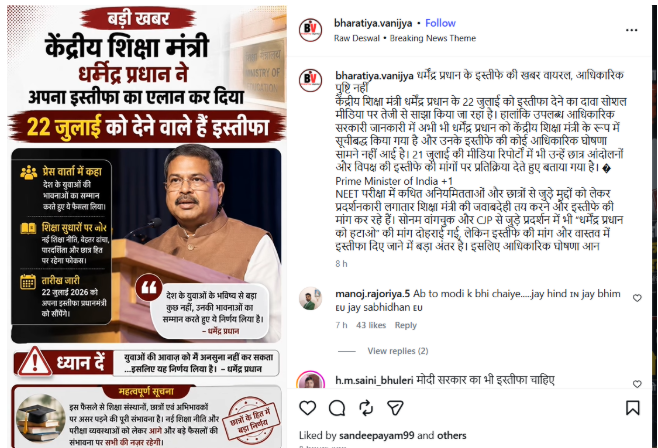
A news graphic is being widely shared on social media claiming that Union Education Minister Dharmendra Pradhan will resign on July 22. The graphic quotes him as saying, "Respecting the sentiments of the country's youth, I have taken this decision." CyberPeace Research Wing ’s research found the claim to be false. The probe revealed that no official announcement has been made regarding Dharmendra Pradhan’s resignation as Union Education Minister. However, demands for his resignation have intensified from opposition parties and student groups over alleged irregularities in NEET and other examinations, leading to protests in Delhi and other places. The research also found that the viral news graphic circulating on social media was likely created using Artificial Intelligence (AI).
Claim:
A social media user on Instagram shared the viral news graphic on July 21, 2026, claiming that Union Education Minister Dharmendra Pradhan is set to resign on July 22. The post also claimed that Pradhan said during a press conference, "Respecting the sentiments of the country's youth, I have taken this decision."
https://www.instagram.com/reel/DbEMoRtgLfT/?igsh=c3g3dzZxZ2U3YW01
Fact Check:
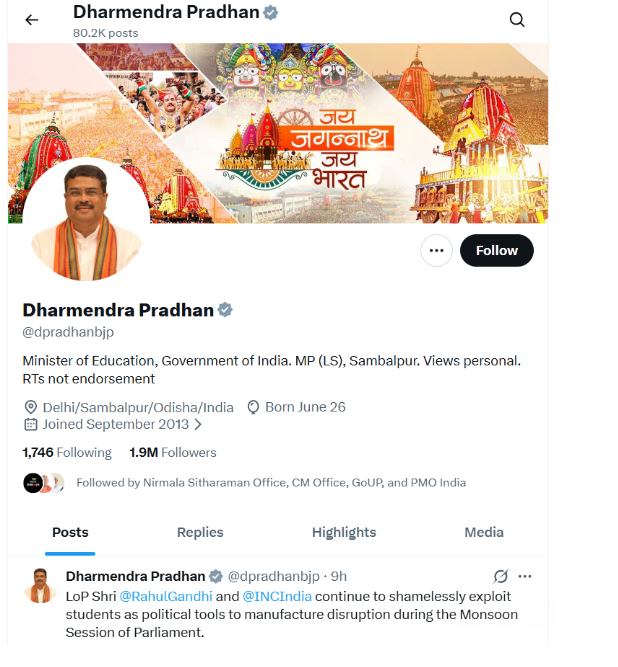
To verify the authenticity of the viral claim, we conducted a Google search using relevant keywords. However, we did not find any credible media reports confirming that Union Education Minister Dharmendra Pradhan is resigning on July 22.Further, we examined the official X (formerly Twitter) account of Union Education Minister Dharmendra Pradhan. No official announcement or post related to his resignation was found on his account.
https://x.com/dpradhanbjp?lang=en
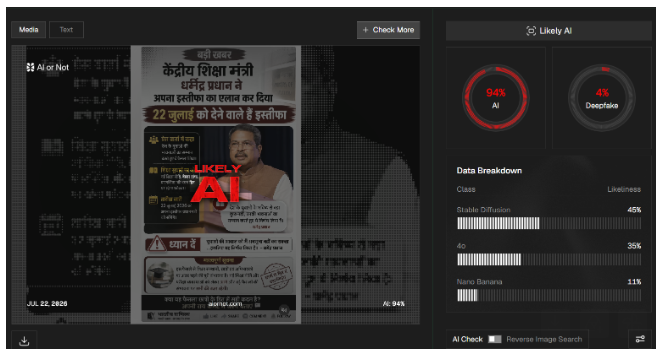
Upon examining the viral news graphic, we noticed several indicators suggesting that it could be AI-generated. To verify this, we analysed the graphic using the AI detection tool AI or Not. The tool’s analysis indicated a 94% probability that the graphic was generated using AI.
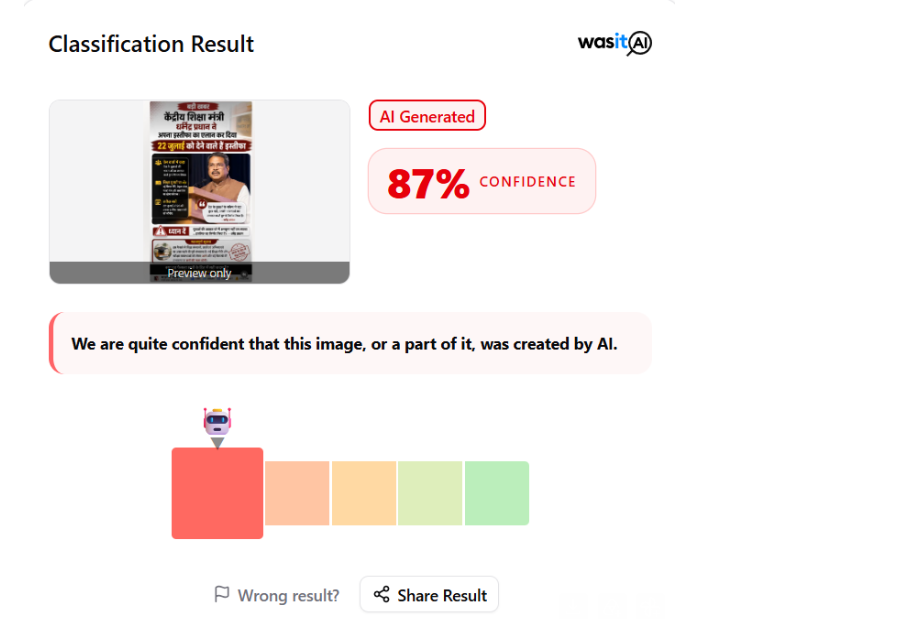
We also scanned the viral graphic through another AI detection tool, WasIt AI. According to the tool’s results, the probability of the graphic being AI-generated was found to be 87%.
Conclusion:
CyberPeace Research Wing ’s fact check found the viral claim to be false. No official announcement has been made regarding Union Education Minister Dharmendra Pradhan’s resignation, and reports claiming that he will resign on July 22 are incorrect. The research further revealed that the viral news graphic circulating on social media was created using Artificial Intelligence (AI).

Related Blogs

Introduction
In the face of escalating cybercrimes in India, criminals are adopting increasingly inventive methods to deceive victims. Imagine opening your phone to the notification of an incoming message from a stranger with a friendly introduction - a beginning that appears harmless, but is the beginning of an awful financial nightmare. "Pig Butchering '' scam—an increasingly sophisticated form of deception that's gaining more widespread popularity. Unlike any other scams, this one plays a long game, spinning a web of trust before it strikes. It's a modern-day financial thriller happening in the real world, with real victims. "pig butchering" scam, involves building trust through fake profiles and manipulating victims emotionally to extort money. The scale of such scams has raised concerns, emphasising the need for awareness and vigilance in the face of evolving cyber threats.
How does 'Pig Butchering' Scam Work?
At its core, the scam starts innocuously, often with a stranger reaching out via text, social media, or apps like WhatsApp or WeChat. The scammer, hiding behind a well-crafted and realistic online persona, seeks to forge a connection. This could be under the pretence of friendship or romance, employing fake photos and stories to seem authentic. Gradually, the scammer builds a rapport, engaging in personal and often non-financial conversations. They may portray themselves as a widow, single parent, or even a military member to evoke empathy and trust. Over time, this connection pivots to investment opportunities, with the scammer presenting lucrative tips or suggestions in stocks or cryptocurrencies. Initially, modest investments are encouraged, and falsified returns are shown to lure in larger sums. Often, the scammer claims affiliation with a profitable financial institution or success in cryptocurrency trading. They direct victims to specific, usually fraudulent, trading platforms under their control. The scam reaches its peak when significant investments are made, only for the scammer to manipulate the situation, block access to the trading platform, or vanish, leaving the victim with substantial losses.
Real-Life Examples and Global Reach
These scams are not confined to one region. In India, for instance, scammers use emotional manipulation, often starting with a WhatsApp message from an unknown, attractive individual. They pose as professionals offering part-time jobs, leading victims through tasks that escalate in investment and complexity. These usually culminate in cryptocurrency investments, with victims unable to withdraw their funds, the money often traced to accounts in Dubai.
In the West, several cases highlight the scam's emotional and financial toll: A Michigan woman was lured by an online boyfriend claiming to make money from gold trading. She invested through a fake brokerage, losing money while being emotionally entangled. A Canadian man named Sajid Ikram lost nearly $400,000 in a similar scam, initially misled by a small successful withdrawal. In California, a man lost $440,000, succumbing to pressure to invest more, including retirement savings and borrowed money. A Maryland victim faced continuous demands from scammers, losing almost $1.4 million in hopes of recovering previous losses. A notable case involved US authorities seizing about $9 million in cryptocurrency linked to a global pig butchering scam, showcasing its extensive reach.
Safeguarding Against Such Scams
Vigilance is crucial to prevent falling victim to these scams. Be skeptical of unsolicited contacts and wary of investment advice from strangers. Conduct thorough research before any financial engagement, particularly on unfamiliar platforms. Indian Cyber Crime Coordination Center warns of red flags like sudden large virtual currency transactions, interest in high-return investments mentioned by new online contacts, and atypical customer behaviour.
Victims should report incidents to various Indian and foreign websites and the Securities Exchange Commission. Financial institutions are advised to report suspicious activities related to these scams. In essence, the pig butchering scam is a cunning blend of emotional manipulation and financial fraud. Staying informed and cautious is key to avoiding these sophisticated traps.
Conclusion
The Pig Butchering Scams are one of the many new breeds of emerging cyber scams that have become a bone of contention for cyber security organisations. It is imperative for netizens to stay vigilant and well-informed about the dynamics of cyberspace and emerging cyber crimes.
References
- https://www.sentinelassam.com/more-news/national-news/from-impersonating-cbi-officers-to-pig-butchering-cyber-criminals-get-creative
- https://hiindia.com/from-impersonating-cbi-officers-to-pig-butchering-cyber-criminals-get-creative/

Introduction
The Indian Ministry of Information and Broadcasting has proposed a new legislation. On the 10th of November, 2023, a draft bill emerged, a parchment of governance seeking to sculpt the contours of the nation's broadcasting landscape. The Broadcasting Services (Regulation) Bill, 2023, is not merely a legislative doctrine; it is a harbinger of change, an attestation to the storm of technology and the diversification of media in the age of the internet.
The bill, slated to replace the Cable Television Networks (Regulation) Act of 1995, acknowledges the paradigm shifts that have occurred in the media ecosystem. The emergence of Internet Protocol Television (IPTV), over-the-top (OTT) platforms and other digital broadcasting services has rendered the previous legislation a relic, ill-suited to the dynamism of the current milieu. The draft bill, therefore, stands at the precipice of the future, inviting stakeholders and the vox populi to weigh in on its provisions, to shape the edifice of regulation that will govern the airwaves and the digital streams.
Defining the certain Clauses of the bill
Clause 1 (dd) - The Programme
In the intricate tapestry of the bill's clauses, certain threads stand out, demanding scrutiny and careful consideration. Clause 1(dd), for instance, grapples with the definition of 'Programme,' a term that, in its current breadth, could ensnare the vast expanse of audio, visual, and written content transmitted through broadcasting networks. The implications are profound: content disseminated via YouTube or any website could fall within the ambit of this regulation, a prospect that raises questions about the scope of governmental oversight in the digital realm.
Clause 2(v) - The news and current affairs
Clause 2(v) delves into the murky waters of 'news and current affairs programmes,' a definition that, as it stands, is a maelstrom of ambiguity. The phrases 'newly-received or noteworthy audio, visual or audio-visual programmes' and 'about recent events primarily of socio-political, economic or cultural nature' are a siren's call, luring the unwary into a vortex of subjective interpretation. The threat of potential abuse looms larger, threatening the right to freedom of expression enshrined in Article 19 of the Indian Constitution. It is a clarion call for stakeholders to forge a definition that is objective and clear, one that is in accordance with the Supreme Court's decision in Shreya Singhal v. Union of India, which upheld the sanctity of digital expression while advocating for responsible content creation.
Clause 2(y) Over the Top Broadcasting Services
Clause 2(y) casts its gaze upon OTT broadcasting services, entities that operate in a realm distinct from traditional broadcasting. The one-to-many paradigm of broadcast media justifies a degree of governmental control, but OTT streaming is a more intimate affair, a one-on-one engagement with content on personal devices. The draft bill's attempt to umbrella OTT services under the broadcasting moniker is a conflation that could stifle the diversity and personalised nature of these platforms. It is a conundrum that other nations, such as Australia and Singapore, have approached with nuanced regulatory frameworks that recognise the unique characteristics of OTT services.
Clause 4(4) - Requirements for Broadcasters and Network Operators
The bill's journey through the labyrinth of regulation is fraught with other challenges. The definition of 'Person' in Clause 2(z), the registration exemptions in Clause 4(4), the prohibition on state governments and political parties from engaging in broadcasting in Clause 6, and the powers of inspection and seizure in Clauses 30(2) and 31, all present a complex puzzle. Each clause, each sub-section, is a cog in the machinery of governance that must be calibrated with precision to balance the imperatives of regulation with the freedoms of expression and innovation.
Clause 27 - Advisory Council
The Broadcast Advisory Council, envisioned in Clause 27, is yet another crucible where the principles of impartiality and independence must be tempered. The composition of this council, the public consultations that inform its establishment, and the alignment with constitutional principles are all vital to its legitimacy and efficacy.
A Way Forward
It is up to us, as participants in the democratic process and citizens, to interact with the bill's provisions as it makes its way through the halls of public discourse and legislative examination. To guarantee that the ultimate version of the Broadcasting Services (Regulation) Bill, 2023, is a symbol of advancement and a charter that upholds our most valued liberties while welcoming the opportunities presented by the digital era, we must employ the instruments of study and discussion.
The draft bill is more than just a document in this turbulent time of transition; it is a story of India's dreams, a testament to its dedication to democracy, and a roadmap for its digital future. Therefore, let us take this duty with the seriousness it merits, as the choices we make today will have a lasting impact on the history of our country and the media environment for future generations.
References
- https://scroll.in/article/1059881/why-indias-new-draft-broadcast-bill-has-raised-fears-of-censorship-and-press-suppression#:~:text=The%20bill%20extends%20the%20regulatory,regulation%20through%20content%20evaluation%20committees.
- https://pib.gov.in/PressReleasePage.aspx?PRID=1976200
- https://www.hindustantimes.com/india-news/new-broadcast-bill-may-also-cover-those-who-put-up-news-content-online-101701023054502.html

Today, let us talk about one of the key features of our digital lives – security. The safer their online habits are, the safer their data and devices will be. A branded security will make their devices and Internet connections secure, but their carelessness or ignorance can make them targets for cybercrimes. On the other hand, they can themselves unwittingly get involved in dubious activities online. With children being very smart about passwords and browsing history clearing, parents are often left in the dark about their digital lives.
Fret not, parental controls are there at your service. These are digital tools often included with your OS or security software package, which helps you to remotely monitor and control your child’s online activities.
Where Can I find them?
Many devices come with pre-installed PC tools that you have to set up and run. Go to Settings-> Parental controls or Screentime and proceed from there. As I mentioned, they are also offered as a part of your comprehensive security software package.
Why and How to Use Parental Controls
Parental controls help monitor and limit your children's smartphone usage, ensuring they access only age-appropriate content. If your child is a minor, use of this tool is recommended, with the full knowledge of your child/ren. Let them know that just as you supervise them in public places for their safety, and guide them on rights and wrongs, you will use the tool to monitor and mentor them online, for their safety. Emphasize that you love them and trust them but are concerned about the various dubious and fake characters online as well as unsafe websites and only intend to supervise them. As they grow older and display greater responsibility and maturity levels, you may slowly reduce the levels of monitoring. This will help build a relationship of mutual trust and respect.
Step 1: Enable Parental Controls
- iOS: If your child has an iPhone, to set up the controls, go to Settings, select Screen Time, then select Content & Privacy Restrictions.
- Android: If the child has an Android phone, you can use the Google Family Link to manage apps, set screen time limits, and track device usage.
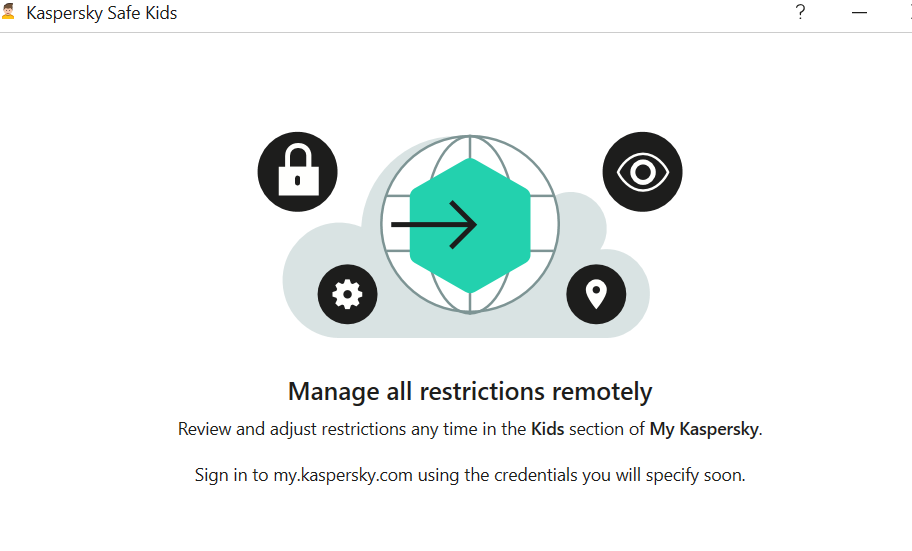
- Third-party apps: Consider security tools like McAfee, Kaspersky, Bark, Qustodio, or Norton Family for advanced features.
Check out what some of the security software apps have on offer:


If you prefer Norton, here are the details:

McAfee Parental Controls suite offers the following features:

McAfee also outlines why Parental Controls matter:

Lastly, let us take a look at what Quick Heal has on offer:

STEP 2: Set up Admin Login
Needless to say, a parent should be the admin login, and it is a wise idea to set up a strong and unique password. You do not want your kids to outsmart you and change their accessibility settings, do you? Remember to create a password you will remember, for children are clever and will soon discover where you have jotted it down.
STEP 3: Create Individual accounts for all users of the device
Let us say two minor kids, a grandparent and you, will be using the device. You will have to create separate accounts for each user. You can allow the children to choose their own passwords, it will give them a sense of privacy. The children or you may (or may not) need to help any Seniors set up their accounts.
Done? Good. Now let us proceed to the next step.
STEP 4: Set up access permissions by age
Let us first get grandparents and other seniors out of the way by giving them full access. when you enter their ages; your device will identify them as adults and guide you accordingly.
Now for each child, follow the instructions to set up filters and blocks. This will again vary with age – more filters for the younger ones, while you can remove controls gradually as they grow older, and hence more mature and responsible. Set up screen Time (daily and weekends), game filtering and playtime, content filtering and blocking by words (e.g. block websites that contain violence/sex/abuse). Ask for activity reports on your device so that you can monitor them remotely This will help you to receive alerts if children connect with strangers or get involved in abusive actions.
Save the data and it has done! Simple, wasn’t it?
Additional Security
For further security, you may want to set up parental controls on the Home Wi-Fi Router, Gaming devices, and online streaming services you subscribe to.
Follow the same steps. Select settings, Admin sign-in, and find out what controls or screen time protection they offer. Choose the ones you wish to activate, especially for the time when adults are not at home.
Conclusion
Congratulations. You have successfully secured your child’s digital space and sanitized it. Discuss unsafe practices as a family, and make any digital rule breaches and irresponsible actions, or concerns, learning points for them. Let their takeaway be that parents will monitor and mentor them, but they too have to take ownership of their actions.
