
#FactCheck-Phishing Scam-LPG dealership of Hindustan Petroleum
Executive Summary:
Our team has come across a recent social media post highlighting a report on fraudulent activities involving deceptive websites and emails impersonating India’s Oil Marketing Companies (OMCs). These phishing scams falsely promise LPG distributorships and retail outlet dealerships, aiming to extract money and personal information from unsuspecting individuals. We strongly urge the public to exercise caution and verify all information exclusively through official OMC channels to avoid falling victim to such fraudulent schemes.

Claim:
It has been reported that fraudsters are impersonating Indian Oil, Bharat Petroleum, and Hindustan Petroleum through fake websites and emails, promising LPG distributorships and seeking money from victims.

Fact Check:
After our research, we came upon more information about this topic and found out that the Press Information Bureau (PIB) has released an official notice confirming that fraudulent websites and emails are impersonating India's Oil Marketing Companies (OMCs), which include Indian Oil Corporation Ltd., Bharat Petroleum Corporation Ltd., and Hindustan Petroleum Corporation Ltd. The scams falsely promise LPG distributorships and retail outlet dealerships while demanding large sums of money from unsuspecting individuals. On June 19, 2019, this was confirmed. The PIB highlighted that OMCs have not allowed any person or organization to charge a fee for dealership selection. All authentic information on these offers is available at the websites of the OMCs: www.iocl.com, www.bharatpetroleum.com, and www.hindustanpetroleum.com. The general public is cautioned to rely only on these sources and report suspicious approaches to the offices of concerned OMCs. If someone finds such an approach, he should immediately contact the cybercrime branch. HPCL has issued alerts on fake websites and emails that promise LPG distributorships and jobs, mimicking official HPCL sites to deceive people.

On the official website of HPCL list down the malicious URLs. They are mentioned below:
- https://kskdealerchayan.com/
- bajajgas.com/index
- hindustanbiofuel.in
- petrolpumpchayanonline.com
- dealerchayanpetrolpump.in
- petrolpumpdealarchayan.com
- petrolpumpsdealerchayan.co.in
- petrolpumpdealershipchayan.org.in
- petrolpumpdealerchayangov.in
- petrolpumpdealership.info
- petrolpumpsdealershipchayan.in
- allindiagasdealership.com
- hindustanpetroleum.online
- hindustanpetroleumcorp.com
- hpcldelership.com
- ujjwalalpgvitarak.org
- ujjwaladealership.com
- lpgvitrakkendra.com
- kissansevakendra.org
- lpgvitarakchayanltd.org
- petrolpumpdelerchayan.in
- petrolpumpdealerschayan.in
- petrolepumpsdelearchayan.in
- kissansevakendra.org
- petrolpumpdealerchayanpro.com
- petrolpumchayanweb.com
- onlinepetrolpumpdealerchayan.com/
HPCL also shared an advisory for their applicants regarding Beware Of Fraudsters.


Conclusion:
It has been proven that fraud offers for LPG distributorships and retail outlet dealerships are being made through fake websites and emails. To avoid such scams, people are advised to be more vigilant, verify all information through official OMC platforms, and immediately report any suspicious activities to the concerned authorities. Being alert and informed is the key to preventing financial loss and protecting personal data from exploitation.
- Claim: Is this HPCL approval letter for an LPG agency dealership legit?
- Claimed On: Social Media
- Fact Check: False and Misleading

Related Blogs

Executive Summary
During the Gau Raksha Yatra of Shankaracharya Swami Avimukteshwaranand Saraswati, bees reportedly attacked a discourse event in Rohania area of Varanasi, Uttar Pradesh. Following the incident, a picture has gone viral on social media showing bees attacking Swami Avimukteshwaranand Saraswati. Several users are sharing the image as genuine while targeting the Shankaracharya online. CyberPeace Research Wing investigated the viral image and found it to be fake. Our research revealed that the picture was created using Artificial Intelligence (AI). While it is true that a bee attack occurred during Swami Avimukteshwaranand Saraswati’s discourse program, the viral image itself is fabricated.
Claim
A Facebook user named “Sanjay Chaudhary” shared the viral image on May 15, 2026, with the caption: “Prakritik kop ka bhajan bana Shukracharya Umashankar alias Avimukteshwaranand… This Kaalnemi was delivering false sermons in Rohania, Varanasi in the name of religion… The bees from a nearby hive did not like it and collectively attacked, creating chaos. Even insects and nature no longer like the opposition’s politics disguised as Sanatan Dharma. Calling Yogi Ji Aurangzeb, Akbar and butcher is not acceptable even to nature and insects.”
Post link and archive link are given below:
- https://www.facebook.com/sanjaychaudhary073/posts/pfbid02kgts8igKDwgctz3MamECMGoGfQR5aWPTdsDgLeux3pD9jwP7ADfgNpoPfHvMb9Zul
- https://perma.cc/E6SE-BAXZ

Fact-Check
To verify the viral claim, we used Google Open Search tools and found reports related to the incident on the YouTube channel of News18 UP Uttarakhand. A report published on May 13, 2026 stated that bees attacked the discourse event during Swami Avimukteshwaranand’s Gau Raksha Yatra in Rohania, Varanasi. The incident created panic at the venue, forcing the Swami to end his discourse midway. The channel also uploaded a YouTube Shorts video related to the incident.

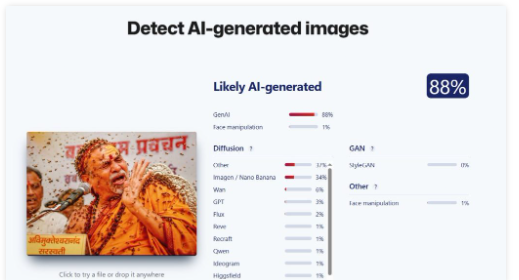
As part of the research, we further analyzed the viral image using AI detection tools. First, we used the tool “Sight Engine,” which indicated an 88 percent probability that the image was AI-generated.
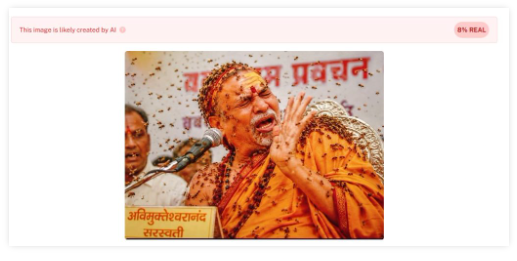
We then examined the image using another AI detection tool called “Undetectable,” which also suggested that the photo was likely created using AI.
Conclusion
Our research found that the viral image is AI-generated. The picture was created using artificial intelligence tools. While bees did attack during Swami Avimukteshwaranand Saraswati’s Gau Raksha Yatra on May 13, 2026, the viral image circulating on social media is fictional and not real.

Introduction
In the labyrinthine world of cybersecurity, a new spectre has emerged from the digital ether, casting a long shadow over the seemingly impregnable orchards of Apple's macOS. This phantom, known as SpectralBlur, is a backdoor so cunningly crafted that it remained shrouded in the obscurity of cyberspace, undetected by the vigilant eyes of antivirus software until its recent unmasking. The discovery of SpectralBlur is not just a tale of technological intrigue but a narrative that weaves together the threads of geopolitical manoeuvring, the relentless pursuit of digital supremacy, and the ever-evolving landscape of cyber warfare.
SpectralBlur, a term that conjures images of ghostly interference and elusive threats, is indeed a fitting moniker for this new macOS backdoor threat. Cybersecurity researchers have peeled back the layers of the digital onion to reveal a moderately capable backdoor that can upload and download files, execute shell commands, update its configuration, delete files, and enter states of hibernation or sleep, all at the behest of a remote command-and-control server. Greg Lesnewich, a security researcher whose name has become synonymous with the relentless pursuit of digital malefactors, has shed light on this new threat that overlaps with a known malware family attributed to the enigmatic North Korean threat actors.
SpectralBlur similar to Lazarus Group’s KANDYKORN
The malware shares its DNA with KANDYKORN, also known as SockRacket, an advanced implant that functions as a remote access trojan capable of taking control of a compromised host. It is a digital puppeteer, pulling the strings of infected systems with a malevolent grace. The KANDYKORN activity also intersects with another campaign orchestrated by the Lazarus sub-group known as BlueNoroff, or TA444, which culminates in the deployment of a backdoor referred to as RustBucket and a late-stage payload dubbed ObjCShellz.
Recently, the threat actor has been observed combining disparate pieces of these two infection chains, leveraging RustBucket droppers to deliver KANDYKORN. This latest finding is another sign that North Korean threat actors are increasingly setting their sights on macOS to infiltrate high-value targets, particularly those within the cryptocurrency and blockchain industries. 'TA444 keeps running fast and furious with these new macOS malware families,' Lesnewich remarked, painting a picture of a relentless adversary in the digital realm.
Patrick Wardle, a security researcher whose insights into the inner workings of SpectralBlur have further illuminated the threat landscape, noted that the Mach-O binary was uploaded to the VirusTotal malware scanning service in August 2023 from Colombia. The functional similarities between KANDYKORN and SpectralBlur have raised the possibility that they may have been built by different developers with the same requirements. What makes the malware stand out are its attempts to hinder analysis and evade detection while using grant to set up a pseudo-terminal and execute shell commands received from the C2 server.
The disclosure comes as 21 new malware families designed to target macOS systems, including ransomware, information stealers, remote access trojans, and nation-state-backed malware, were discovered in 2023, up from 13 identified in 2022. 'With the continued growth and popularity of macOS (especially in the enterprise!), 2024 will surely bring a bevvy of new macOS malware,' Wardle noted, his words a harbinger of the digital storms on the horizon.
Hackers are beefing up their efforts to go after the best MacBooks as security researchers have discovered a brand new macOS backdoor which appears to have ties to another recently identified Mac malware strain. As reported by Security Week, this new Mac malware has been dubbed SpectralBlur and although it was uploaded to VirusTotal back in August of last year, it remained undetected by the best antivirus software until it recently caught the attention of Proofpoint’s Greg Lesnewich.
Lesnewich explained that SpectralBlur has similar capabilities to other backdoors as it can upload and download files, delete files and hibernate or sleep when given commands from a hacker-controlled command-and-control (C2) server. What is surprising about this new Mac malware strain though is that it shares similarities to the KandyKorn macOS backdoor which was created by the infamous North Korean hacking group Lazarus.
Just like SpectralBlur, KandyKorn is designed to evade detection while providing the hackers behind it with the ability to monitor and control infected Macs. Although different, these two Mac malware strains appear to be built based on the same requirements. Once installed on a vulnerable Mac, SpectralBlur executes a function that allows it to decrypt and encrypt network traffic to help it avoid being detected. However, it can also erase files after opening them and then overwrite the data they contain with zeros..
How to keep your Apple computers safe from hackers
As with the best iPhones, keeping your Mac up to date is the easiest and most important way to keep it safe from hackers. Hackers often prey on users who haven’t updated their devices to the latest software as they can exploit unpatched vulnerabilities and security flaws.
Checking to see if you're running the latest macOS version is quite easy. Just click on the Apple Logo in the top right corner of your computer, head to System Preferences and then click on Software Update. If you need a bit more help, check out our guide on how to update a Mac for more detailed instructions with pictures.
Even though your Mac has its own built-in malware scanner from Apple called xProtect, you should consider using one of the best Mac antivirus software solutions for additional protection. Paid antivirus software is often updated more frequently and you often also get access to other extras to help keep you safe online like a password manager or a VPN.
Besides updating your Mac frequently and using antivirus software, you must be careful online. This means sticking to trusted online retailers, carefully checking the URLs of the websites you visit and avoiding opening links and attachments sent to you via email or social media from people you don’t know. Likewise, you should also learn how to spot a phishing scam to know which emails you want to delete right away.
Conclusion
The thing about hackers and other cybercriminals is that they are constantly evolving their tactics and attack methods. This helps them avoid detection and allows them to devise brand-new ways to trick ordinary people. With the surge we saw in Mac malware last year, though, Apple will likely be working on beefing up xProtect and macOS to better defend against these new threats.
References
- https://www.scmagazine.com/news/new-macos-malware-spectralblur-idd-as-north-korean-backdoor
- https://www.tomsguide.com/news/this-new-macos-backdoor-lets-hackers-take-over-your-mac-remotely-how-to-stay-safe
- https://thehackernews.com/2024/01/spectralblur-new-macos-backdoor-threat.html

A Foray into the Digital Labyrinth
In our digital age, the silhouette of truth is often obfuscated by a fog of technological prowess and cunning deception. With each passing moment, the digital expanse sprawls wider, and within it, synthetic media, known most infamously as 'deepfakes', emerge like phantoms from the machine. These adept forgeries, melding authenticity with fabrication, represent a new frontier in the malleable narrative of understood reality. Grappling with the specter of such virtual deceit, social media behemoths Facebook and YouTube have embarked on a prodigious quest. Their mission? To formulate robust bulwarks around the sanctity of fact and fiction, all the while fostering seamless communication across channels that billions consider an inextricable part of their daily lives.
In an exploration of this digital fortress besieged by illusion, we unpeel the layers of strategy that Facebook and YouTube have unfurled in their bid to stymie the proliferation of these insidious technical marvels. Though each platform approaches the issue through markedly different prisms, a shared undercurrent of necessity and urgency harmonizes their efforts.
The Detailing of Facebook's Strategic
Facebook's encampment against these modern-day chimaeras teems with algorithmic sentinels and human overseers alike—a union of steel and soul. The company’s layer upon layer of sophisticated artificial intelligence is designed to scrupulously survey, identify, and flag potential deepfake content with a precision that borders on the prophetic. Employing advanced AI systems, Facebook endeavours to preempt the chaos sown by manipulated media by detecting even the slightest signs of digital tampering.
However, in an expression of profound acumen, Facebook also serves reminder of AI's fallibility by entwining human discernment into its fabric. Each flagged video wages its battle for existence within the realm of these custodians of reality—individuals entrusted with the hefty responsibility of parsing truth from technologically enabled fiction.
Facebook does not rest on the laurels of established defense mechanisms. The platform is in a perpetual state of flux, with policies and AI models adapting to the serpentine nature of the digital threat landscape. By fostering its cyclical metamorphosis, Facebook not only sharpens its detection tools but also weaves a more resilient protective web, one capable of absorbing the shockwaves of an evolving battlefield.
YouTube’s Overture of Transparency and the Exposition of AI
Turning to the amphitheatre of YouTube, the stage is set for an overt commitment to candour. Against the stark backdrop of deepfake dilemmas, YouTube demands the unveiling of the strings that guide the puppets, insisting on full disclosure whenever AI's invisible hands sculpt the content that engages its diverse viewership.
YouTube's doctrine is straightforward: creators must lift the curtains and reveal any artificial manipulation's role behind the scenes. With clarity as its vanguard, this requirement is not just procedural but an ethical invocation to showcase veracity—a beacon to guide viewers through the murky waters of potential deceit.
The iron fist within the velvet glove of YouTube's policy manifests through a graded punitive protocol. Should a creator falter in disclosing the machine's influence, repercussions follow, ensuring that the ecosystem remains vigilant against hidden manipulation.
But YouTube's policy is one that distinguishes between malevolence and benign use. Artistic endeavours, satirical commentary, and other legitimate expositions are spared the policy's wrath, provided they adhere to the overarching principle of transparency.
The Symbiosis of Technology and Policy in a Morphing Domain
YouTube's commitment to refining its coordination between human insight and computerized examination is unwavering. As AI's role in both the generation and moderation of content deepens, YouTube—which, like a skilled cartographer, must redraw its policies increasingly—traverses this ever-mutating landscape with a proactive stance.
In a Comparative Light: Tracing the Convergence of Giants
Although Facebook and YouTube choreograph their steps to different rhythms, together they compose an intricate dance aimed at nurturing trust and authenticity. Facebook leans into the proactive might of their AI algorithms, reinforced by updates and human interjection, while YouTube wields the virtue of transparency as its sword, cutting through masquerades and empowering its users to partake in storylines that are continually rewritten.
Together on the Stage of Our Digital Epoch
The sum of Facebook and YouTube's policies is integral to the pastiche of our digital experience, a multifarious quilt shielding the sanctum of factuality from the interloping specters of deception. As humanity treads the line between the veracious and the fantastic, these platforms stand as vigilant sentinels, guiding us in our pursuit of an old-age treasure within our novel digital bazaar—the treasure of truth. In this labyrinthine quest, it is not merely about unmasking deceivers but nurturing a wisdom that appreciates the shimmering possibilities—and inherent risks—of our evolving connection with the machine.
Conclusion
The struggle against deepfakes is a complex, many-headed challenge that will necessitate a united front spanning technologists, lawmakers, and the public. In this digital epoch, where the veneer of authenticity is perilously thin, the valiant endeavours of these tech goliaths serve as a lighthouse in a storm-tossed sea. These efforts echo the importance of evergreen vigilance in discerning truth from artfully crafted deception.
References
- https://about.fb.com/news/2020/01/enforcing-against-manipulated-media/
- https://indianexpress.com/article/technology/artificial-intelligence/google-sheds-light-on-how-its-fighting-deep-fakes-and-ai-generated-misinformation-in-india-9047211/
- https://techcrunch.com/2023/11/14/youtube-adapts-its-policies-for-the-coming-surge-of-ai-videos/
- https://www.trendmicro.com/vinfo/us/security/news/cybercrime-and-digital-threats/youtube-twitter-hunt-down-deepfakes
