
#FactCheck- Doctored Audio in News18 Video Fuels False ‘Operation Sindoor’ Claim
Executive Summary
A video clip bearing the logo of News18 is being widely shared on social media with the claim that a serving Indian Army brigadier and his son were attacked in Delhi by an RSS-supporting mob for criticising the government over “Operation Sindoor.” The clip features an anchor allegedly explaining the motive behind the assault. However, research by the CyberPeace Research Wing found the claim to be false. The viral video has been digitally manipulated, with its audio altered to include misleading information.
Claim
An X user (@Mohammad776157) shared a video clip from Network18 on April 13, claiming that a serving Indian Army brigadier and his son were attacked in Delhi by an RSS-supporting mob for criticising the government over “Operation Sindoor.”
- https://x.com/Mohammad776157/status/2043691737609347166?s=20
- https://archive.ph/5EpbJ
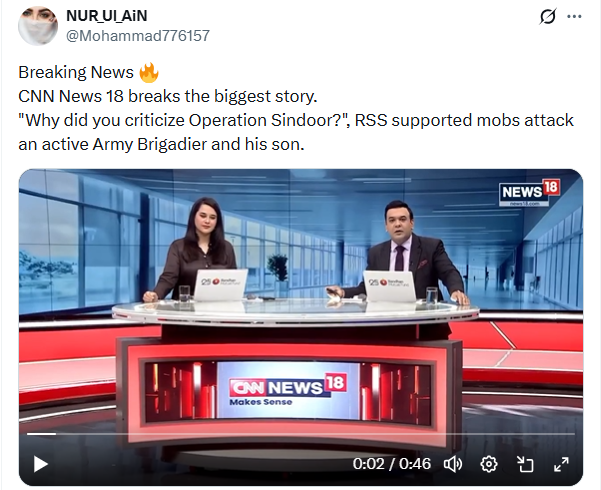
To verify the claim, we extracted multiple keyframes from the viral video using the InVid tool and conducted reverse image searches via Google Lens. The same clip was found circulating across several social media platforms with similar claims.
- https://www.facebook.com/reel/2397972117364665
- https://www.instagram.com/reels/DXE4FFdjcnq/
- https://archive.ph/hjG3b
- https://archive.ph/9IkTY
Fact Check
Since the video carried the News18 logo, we examined the outlet’s official social media handles. We found the original video on its X account, where the visuals matched the viral clip. However, a detailed analysis of the original footage showed that the anchor never stated that the brigadier and his son were attacked for criticising the government over “Operation Sindoor.”
In the authentic version, the anchor reported that the assault took place in Delhi’s Vasant Enclave after the brigadier objected to two individuals consuming alcohol inside a car parked outside his residence. This clearly indicates that the audio in the viral clip was tampered with to insert a false narrative.
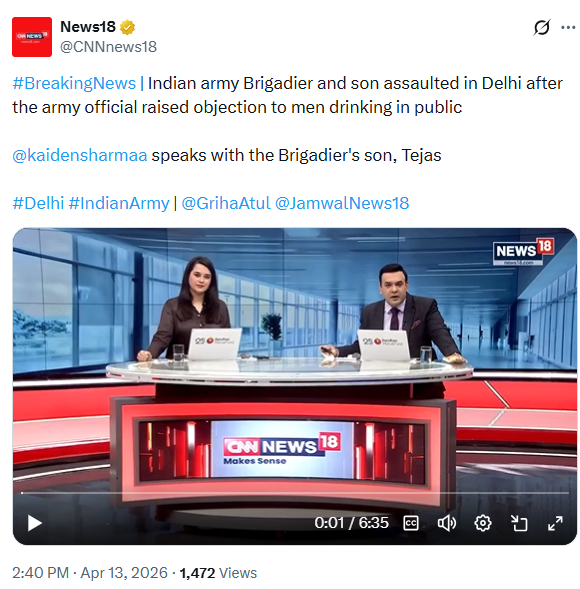
For further verification, we extracted the audio segment from the viral clip and analysed it using Resemble AI. The tool indicated that the portion describing the motive behind the attack had been digitally manipulated.

Conclusion
The viral claim is false. The video has been altered by modifying its audio to mislead viewers. In reality, the assault was not related to “Operation Sindoor” but occurred after the brigadier objected to public drinking near his residence.

Related Blogs

Introduction
Recently the attackers employed the CVE-2017-0199 vulnerability in Microsoft Office to deliver a fileless form of the Remcos RAT. The Remcos RAT makes the attacker have full control of the systems that have been infected by this malware. This research will give a detailed technical description of the identified vulnerability, attack vector, and tactics together with the practical steps to counter the identified risks.
The Targeted Malware: Remcos RAT
Remcos RAT (Remote Control & Surveillance) is a commercially available remote access tool designed for legitimate administrative use. However, it has been widely adopted by cybercriminals for its stealth and extensive control capabilities, enabling:
- System control and monitoring
- Keylogging
- Data exfiltration
- Execution of arbitrary commands
The fileless variant utilised in this campaign makes detection even more challenging by running entirely in system memory, leaving minimal forensic traces.
Attack Vector: Phishing with Malicious Excel Attachments
The phishing email will be sent which appears as legitimate business communication, such as a purchase order or invoice. This email contains an Excel attachment that is weaponized to exploit the CVE-2017-0199 vulnerability.
Technical Analysis: CVE-2017-0199 Exploitation
Vulnerability Assessment
- CVE-2017-0199 is a Remote Code Execution (RCE) vulnerability in Microsoft Office which uses Object Linking and Embedding (OLE) objects.
- Affected Components:some text
- Microsoft Word
- Microsoft Excel
- WordPad
- CVSS Score: 7.8 (High Severity)
Mechanism of Exploitation
The vulnerability enables attackers to craft a malicious document when opened, it fetches and executes an external payload via an HTML Application (HTA) file. The execution process occurs without requiring user interaction beyond opening the document.
Detailed Exploitation Steps
- Phishing Email and Malicious Document some text
- The email contains an Excel file designed to make use of CVE-2017-0199.
- When the email gets opened, the document automatically connects to a remote server (e.g., 192.3.220[.]22) to download an HTA file (cookienetbookinetcache.hta).
- Execution via mshta.exe some text
- The downloaded HTA file is executed using mshta.exe, a legitimate Windows process for running HTML Applications.
- This execution is seamless and does not prompt the user, making the attack stealthy.
- Multi-Layer Obfuscation some text
- The HTA file is wrapped in several layers of scripting, including: some text
- JavaScript
- VBScript
- PowerShell
- This obfuscation helps evade static analysis by traditional antivirus solutions.
- The HTA file is wrapped in several layers of scripting, including: some text
- Fileless Payload Deployment some text
- The downloaded executable leverages process hollowing to inject malicious code into legitimate system processes.
- The Remcos RAT payload is loaded directly into memory, avoiding the creation of files on disk.
Fileless Malware Techniques
1. Process Hollowing
The attack replaces the memory of a legitimate process (e.g., explorer.exe) with the malicious Remcos RAT payload. This allows the malware to:
- Evade detection by blending into normal system activity.
- Run with the privileges of the hijacked process.
2. Anti-Analysis Techniques
- Anti-Debugging: Detects the presence of debugging tools and terminates malicious processes if found.
- Anti-VM and Sandbox Evasion: Ensures execution only on real systems to avoid detection during security analysis.
3. In-Memory Execution
- By running entirely in system memory, the malware avoids leaving artifacts on the disk, making forensic analysis and detection more challenging.
Capabilities of Remcos RAT
Once deployed, Remcos RAT provides attackers with a comprehensive suite of functionalities, including:
- Data Exfiltration: some text
- Stealing system information, files, and credentials.
- Remote Execution: some text
- Running arbitrary commands, scripts, and additional payloads.
- Surveillance: some text
- Enabling the camera and microphone.
- Capturing screen activity and clipboard contents.
- System Manipulation: some text
- Modifying Windows Registry entries.
- Controlling system services and processes.
- Disabling user input devices (keyboard and mouse).
Advanced Phishing Techniques in Parallel Campaigns
1. DocuSign Abuse
Attackers exploit legitimate DocuSign APIs to create authentic-looking phishing invoices. These invoices can trick users into authorising payments or signing malicious documents, bypassing traditional email security systems.
2. ZIP File Concatenation
By appending multiple ZIP archives into a single file, attackers exploit inconsistencies in how different tools handle these files. This allows them to embed malware that evades detection by certain archive managers.
Broader Implications of Fileless Malware
Fileless malware like Remcos RAT poses significant challenges:
- Detection Difficulties: Traditional signature-based antivirus systems struggle to detect fileless malware, as there are no static files to scan.
- Forensic Limitations: The lack of disk artifacts complicates post-incident analysis, making it harder to trace the attack's origin and scope.
- Increased Sophistication: These campaigns demonstrate the growing technical prowess of cybercriminals, leveraging legitimate tools and services for malicious purposes.
Mitigation Strategies
- Patch Management some text
- It is important to regularly update software to address known vulnerabilities like CVE-2017-0199. Microsoft released a patch for this vulnerability in April 2017.
- Advanced Email Security some text
- It is important to implement email filtering solutions that can detect phishing attempts, even those using legitimate services like DocuSign.
- Endpoint Detection and Response (EDR)some text
- Always use EDR solutions to monitor for suspicious behavior, such as unauthorized use of mshta.exe or process hollowing.
- User Awareness and Training some text
- Educate users about phishing techniques and the risks of opening unexpected attachments.
- Behavioral Analysis some text
- Deploy security solutions capable of detecting anomalous activity, even if no malicious files are present.
Conclusion
The attack via CVE-2017-0199 further led to the injection of a new fileless variant of Remcos RAT, proving how threats are getting more and more sophisticated. Thanks to the improved obfuscation and the lack of files, the attackers eliminate all traditional antiviral protection and gain full control over the infected computers. It is real and organisations have to make sure that they apply patches on time, that they build better technologies for detection and that the users themselves are more wary of the threats.
References
- Fortinet FortiGuard Labs: Analysis by Xiaopeng Zhang
- Perception Point: Research on ZIP File Concatenation
- Wallarm: DocuSign Phishing Analysis
- Microsoft Security Advisory: CVE-2017-0199

Introduction
The rapid advancement of artificial intelligence (AI) technology has sparked intense debates and concerns about its potential impact on humanity. Sam Altman, CEO of AI research laboratory OpenAI, and Altman, known as the father of ChatGPT, an AI chatbot, hold a complex position, recognising both the existential risks AI poses and its potential benefits. In a world tour to raise awareness about AI risks, Altman advocates for global cooperation to establish responsible guidelines for AI development. Artificial intelligence has become a topic of increasing interest and concern as technology advances. Developing sophisticated AI systems raises many ethical questions, including whether they will ultimately save or destroy humanity.
Addressing Concerns
Altman engages with various stakeholders, including protesters who voice concerns about the race toward artificial general intelligence (AGI). Critics argue that focusing on safety rather than pushing AGI development would be a more responsible approach. Altman acknowledges the importance of safety progress but believes capability progress is necessary to ensure safety. He advocates for a global regulatory framework similar to the International Atomic Energy Agency, which would coordinate research efforts, establish safety standards, monitor computing power dedicated to AI training, and possibly restrict specific approaches.
Risks of AI Systems
While AI holds tremendous promise, it also presents risks that must be carefully considered. One of the major concerns is the development of artificial general intelligence (AGI) without sufficient safety precautions. AGI systems with unchecked capabilities could potentially pose existential risks to humanity if they surpass human intelligence and become difficult to control. These risks include the concentration of power, misuse of technology, and potential for unintended consequences.
There are also fears surrounding AI systems’ impact on employment. As machines become more intelligent and capable of performing complex tasks, there is a risk that many jobs will become obsolete. This could lead to widespread unemployment and economic instability if steps are not taken to prepare for this shift in the labour market.
While these risks are certainly caused for concern, it is important to remember that AI systems also have tremendous potential to do good in the world. By carefully designing these technologies with ethics and human values in mind, we can mitigate many of the risks while still reaping the benefits of this exciting new frontier in technology.

Open AI Systems and Chatbots
Open AI systems like ChatGPT and chatbots have gained popularity due to their ability to engage in natural language conversations. However, they also come with risks. The reliance on large-scale training data can lead to biases, misinformation, and unethical use of AI. Ensuring open AI systems’ safety and responsible development mitigates potential harm and maintains public trust.
The Need for Global Cooperation
Sam Altman and other tech leaders emphasise the need for global cooperation to address the risks associated with AI development. They advocate for establishing a global regulatory framework for superintelligence. Superintelligence refers to AGI operating at an exceptionally advanced level, capable of solving complex problems that have eluded human comprehension. Such a framework would coordinate research efforts, enforce safety standards, monitor computing power, and potentially restrict specific approaches. International collaboration is essential to ensure responsible and beneficial AI development while minimising the risks of misuse or unintended consequences.
Can AI Systems Make the World a Better Place: Benefits of AI Systems
AI systems hold many benefits that can greatly improve human life. One of the most significant advantages of AI is its ability to process large amounts of data at a rapid pace. In industries such as healthcare, this has allowed for faster diagnoses and more effective treatments. Another benefit of AI systems is their capacity to learn and adapt over time. This allows for more personalised experiences in areas such as customer service, where AI-powered chatbots can provide tailored solutions based on an individual’s needs. Additionally, AI can potentially increase efficiency in various industries, from manufacturing to transportation. By automating repetitive tasks, human workers can focus on higher-level tasks that require creativity and problem-solving skills. Overall, the benefits of AI systems are numerous and promising for improving human life in various ways.
We must remember the impact of AI on education. It has already started to show its potential by providing personalised learning experiences for students at all levels. With the help of AI-driven systems like intelligent tutoring systems (ITS), adaptive learning technologies (ALT), and educational chatbots, students can learn at their own pace without feeling overwhelmed or left behind.
While there are certain risks associated with the development of AI systems, there are also numerous opportunities for them to make our world a better place. By harnessing the power of these technologies for good, we can create a brighter future for ourselves and generations to come.

Conclusion
The AI revolution presents both extraordinary opportunities and significant challenges for humanity. The benefits of AI, when developed responsibly, have the potential to uplift societies, improve quality of life, and address long-standing global issues. However, the risks associated with AGI demand careful attention and international cooperation. Governments, researchers, and industry leaders must work together to establish guidelines, safety measures, and ethical standards to navigate the path toward AI systems that serve humanity’s best interests and safeguard against potential risks. By taking a balanced approach, we can strive for a future where AI systems save humanity rather than destroy it.

Executive Summary
Amid reports that AIIMS Delhi has initiated the process to implement the Supreme Court’s decision allowing passive euthanasia for Harish Rana, a video is being shared on social media claiming to show his emotional farewell. However, research by the CyberPeace found the viral claim to be misleading. Our research revealed that the video has no connection to the Harish Rana case. In reality, the footage is from Surat, Gujarat, where the family of a 45-year-old brain-dead woman donated her organs.
Claim:
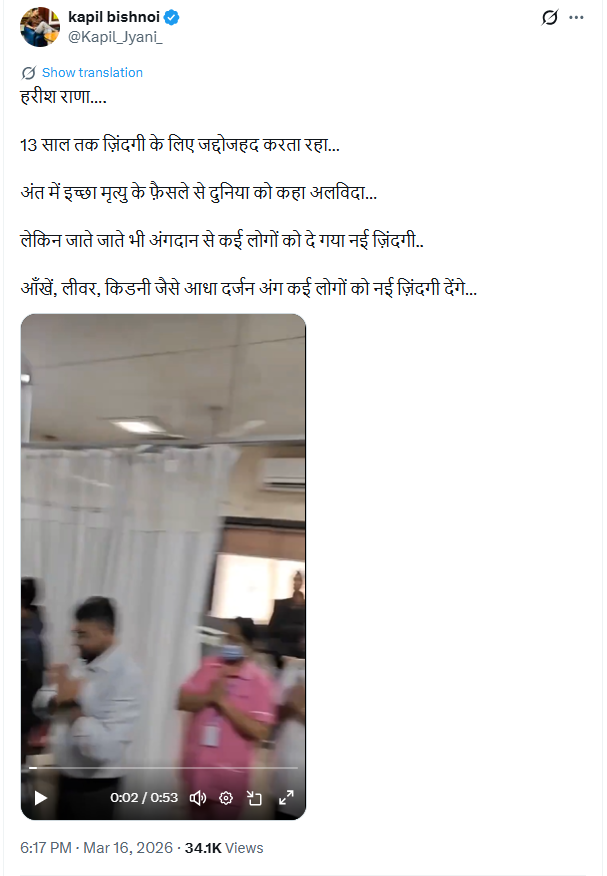
On social media platform X (formerly Twitter), a user shared the viral video on March 16, 2026, with the caption:
“Harish Rana… struggled for life for 13 years… in the end said goodbye to the world through euthanasia… but even while leaving, gave new life to many through organ donation… eyes, liver, kidneys and several other organs will give a new life to many…”
Post link and archive link are given below:
Fact Check
We took screenshots from the viral video and conducted a reverse image search. This led us to an Instagram handle where the same video was uploaded on January 27, 2026.
- https://www.instagram.com/reels/DUAt_42k2ME/

According to the caption on the Instagram post, the video shows a brain-dead woman in Surat whose liver, both kidneys, and eyes were donated. The post also included an image of the woman. Based on clues from the viral video, we conducted a keyword search on Google and found a report on the website of News18 Gujarati.
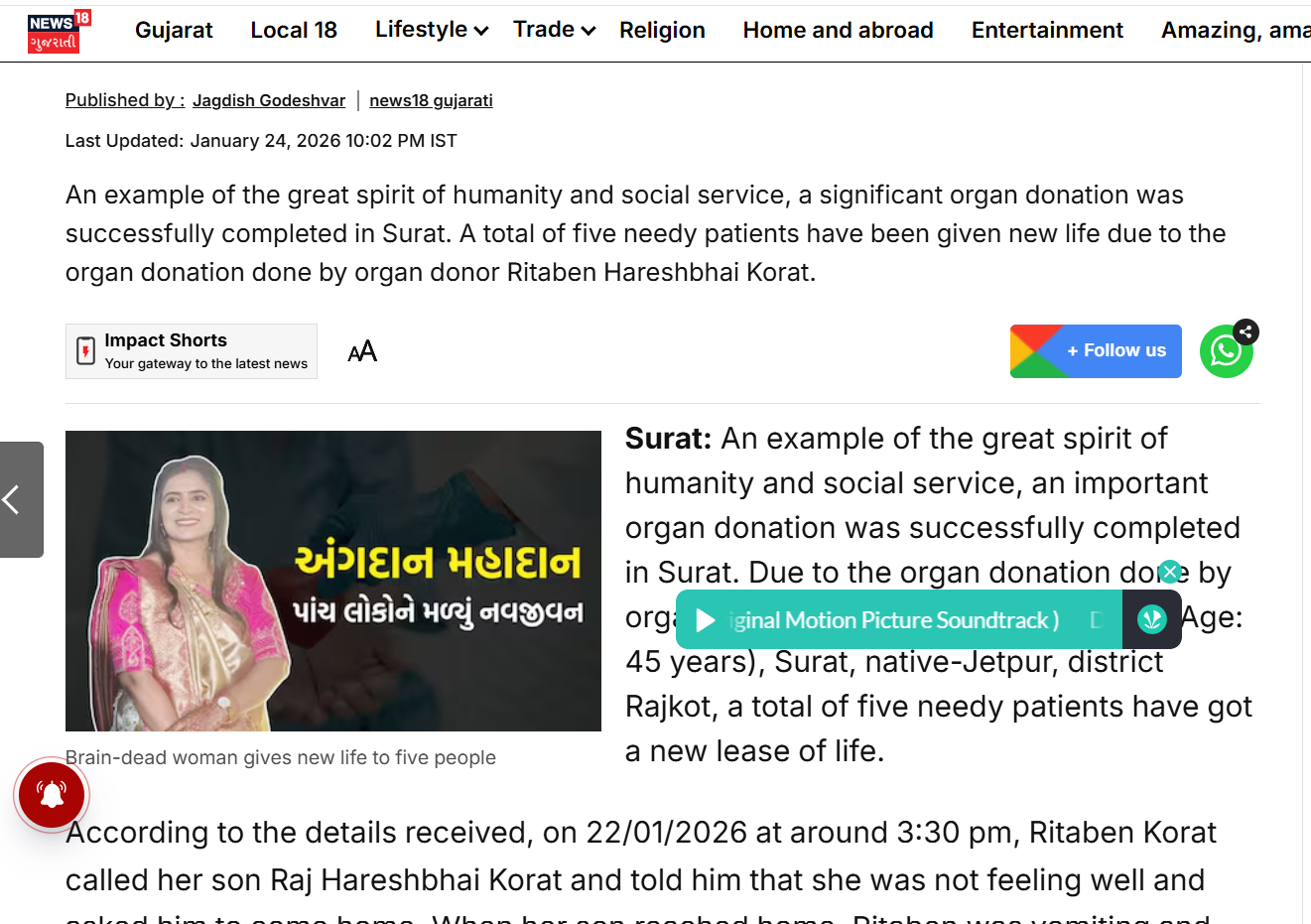
According to the report, organ donation by Ritaben Hareshbhai Korat in Surat gave a new life to five patients. The report also carried her photograph, matching the visuals seen in the viral video.
Conclusion:
Our research found that the viral video has no connection to Harish Rana. It actually shows an incident from Surat, Gujarat, where the family of a 45-year-old brain-dead woman, Ritaben Korat, donated her organs.
