
#FactCheck: 2017 Video of Army Personnel Beating Pulwama College Student Falsely Linked to Delhi Protests
Executive Summary
During the protests against Chief Election Commissioner (CEC) Gyanesh Kumar that began on October 10, the Delhi Police had detained thousands of people. Some of those detained alleged that the police assaulted them while they were in custody. CyberPeace Research found that the viral video dates back to 2017 and shows army personnel thrashing a student of Pulwama Degree College in Kashmir. The video has no connection with the protests held in Delhi.
Claim
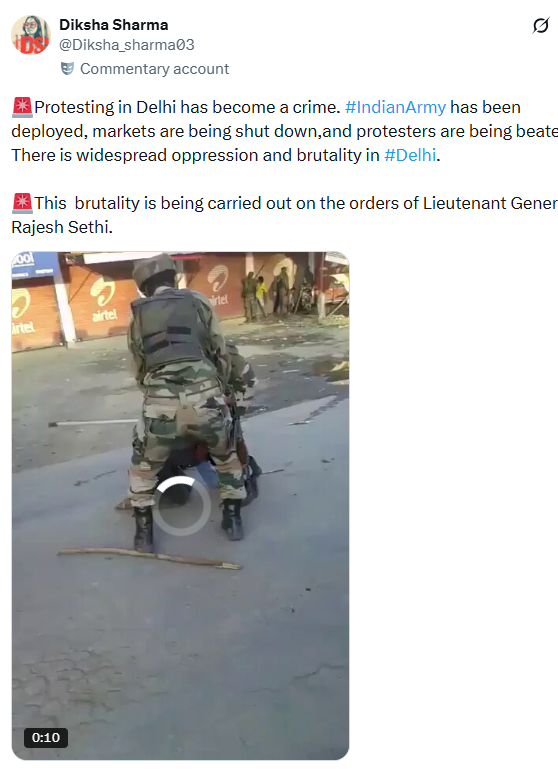
A video is now going viral on social media showing two army personnel thrashing a man pinned to the ground. An X user shared the video with the caption, “Protesting in Delhi has become a crime. The Indian Army has been deployed, markets are being shut down, and protesters are being beaten. There is widespread oppression and brutality in Delhi. This brutality is being carried out on the orders of Lieutenant General Rajesh Sethi.”
https://x.com/Diksha_sharma03/status/2109891097283756401
Fact Check
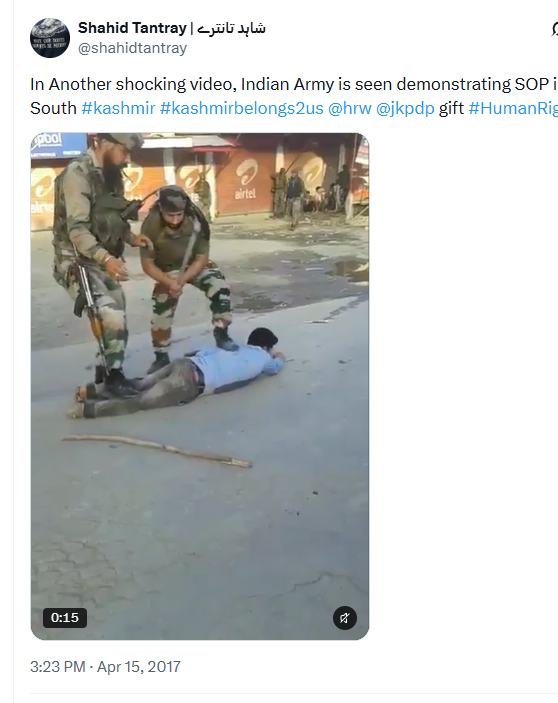
A reverse search of keyframes from the video led us to the account of journalist Shahid Tantray, who shared a longer version of the video on April 15, 2017. The video shows two more army personnel joining the two soldiers who were already thrashing the man. In his post, Tantray claimed that the man had been beaten by Indian Army personnel in South Kashmir.
https://x.com/shahidtantray/status/853184476272144384?s=20
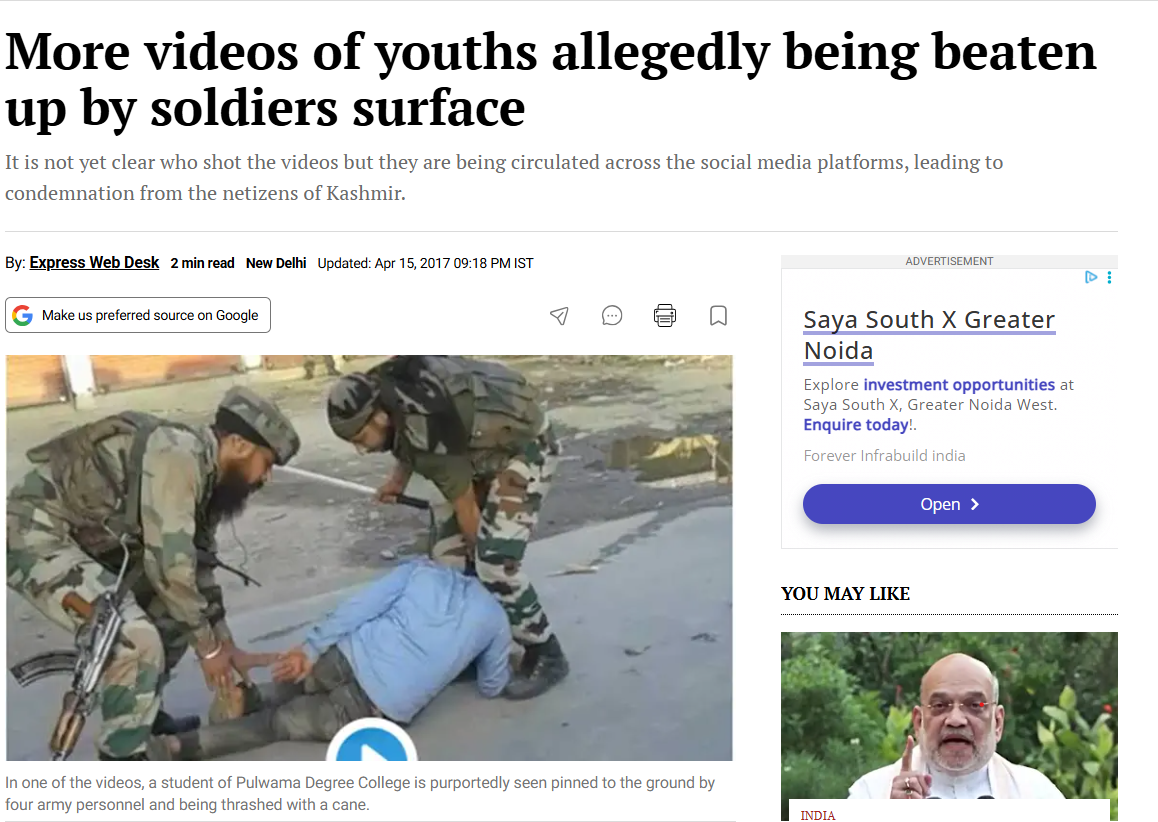
A report published by The Indian Express on April 15, 2017, featured a screenshot from the video. According to the report, four Indian Army personnel allegedly beat up a student of Pulwama Degree College in Jammu and Kashmir.
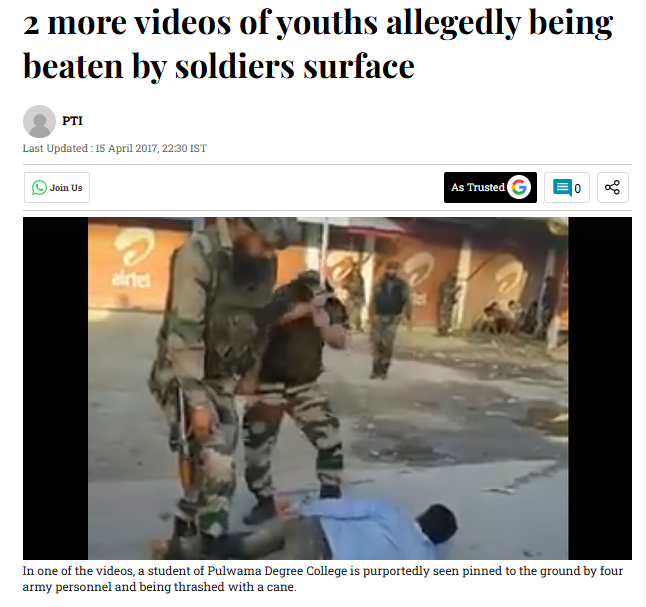
We also found a screenshot from the video in a report published by Deccan Herald on April 15, 2017. The report stated that the person beaten by the four army personnel was a student of Pulwama Degree College.
https://www.deccanherald.com/content/606516/2-more-videos-youths-allegedly.html
Conclusion
Our research found that the viral video dates back to 2017 and shows army personnel thrashing a student of Pulwama Degree College in Kashmir. The video has no connection with the protests held in Delhi.

Related Blogs
.webp)
Introduction
India's broadcasting sector has undergone significant changes in recent years with technological advancements such as the introduction of new platforms like Direct-to-Home (DTH), Internet Protocol television (IPTV), Over-The-Top (OTT), and integrated models. Platform changes, emerging technologies and advancements in the advertising space have all necessitated the need for new governing laws that take these developments into account.
The Union Government and concerned ministry have realised there is a pressing need to develop a robust regulatory framework for the Indian broadcasting sector in the country and consequently, a draft Broadcasting Services (Regulation) Bill, 2023, was released in November 2023 and the Union Ministry of Information and Broadcasting (MIB) had invited feedback and comments from different stakeholders. The draft Bill aims to establish a unified framework for regulating broadcasting services in the country, replacing the current Cable Television Networks (Regulation) Act, 1995 and other policy guidelines governing broadcasting.
Recently a new draft of an updated ‘Broadcasting Services (Regulation) Bill, 2024,’ was shared with selected broadcasters, associations, streaming services, and tech firms, each marked with their identifier to prevent leaks.
Key Highlights of the Updated Broadcasting Bill
As per the recent draft of the Broadcasting Services (Regulation) Bill, 2024, social media accounts could be identified as ‘Digital News Broadcasters’ and can be classified within the ambit of the regulation. Some of the major aspects of the new bill were first reported by Hindustan Times.
The new draft of the Broadcasting Services (Regulation) Bill, 2024, proposes that individuals who regularly upload videos to social media, make podcasts, or write about current affairs online could be classified as Digital News Broadcasters. This entails that YouTubers and Instagrammers who receive a share of advertising revenue or monetize their social media presence through affiliate activities will be regulated as Digital News Broadcasters. This includes channels, podcasts, and blogs that cover news and utilise Google AdSense. They must comply with a Programme Code and Advertising Code.
Online content creators who do not provide news or current affairs but provide programming and curated programs beyond a certain threshold will be treated as OTT broadcasters in case they provide content licensed or live through a website or social media platform.
The new version also introduces new obligations for intermediaries and social media intermediaries related to streaming services and digital news broadcasters, and, in contrast to the last version circulated in 2023, the latest also carries provisions targeting online advertising. In the context of streaming services, OTT broadcasting services are no longer a part of the definition of "internet broadcasting services." The definition of OTT broadcasting service has also been revised, allowing content creators who regularly upload their content to social media to be considered as OTT broadcasting services.
The new definition of an 'intermediary' includes social media intermediaries, advertisement intermediaries, internet service providers, online search engines, and online marketplaces.
The new Bill allows the government to prescribe different due diligence guidelines for social media platforms and online advertisement intermediaries and requires all intermediaries to provide appropriate information, including information pertaining to the OTT broadcasters and Digital News Broadcasters on their platform, to the central government to ensure compliance with the act. This entails the liability provisions for social media intermediaries which do not provide information “pertaining to OTT Broadcasters and Digital News Broadcasters” on its platforms for compliance. This suggests that when information is sought about a YouTube, Instagram or X/Twitter user, the platform will need to provide this information to the Indian government.
A new draft bill contains specific provisions governing ‘Online Advertising’ and to do so it creates the category of 'advertising intermediaries'. These intermediaries enable the buying or selling of advertisement space on the internet or placing advertisements on online platforms without endorsing the advertisement.
Final Words
The Indian Ministry of Information and Broadcasting (MIB) is making efforts to propose robust regulatory changes to the country's new-age broadcast sector, which would cover the specific provisions for Digital News Broadcasters, OTT Broadcasters and Intermediaries. The proposed bill defining the scope and obligation of each.
However, these changes will have significant implications for press and creative freedom. The changes in the new version of the updated bill from its previous draft expanded the applicability of the bill to a larger number of key actors, this move brought ‘content creators’ under the definition of OTT or digital news broadcasters, which raises concerns about overly rigid provisions and might face criticism from media representative perspectives.
According to recent media reports, the Broadcasting Services (Regulation) Bill, 2024 version has been withdrawn by the I&B ministry facing criticism from relevant stakeholders.
The ministry must take due consideration and feedback from concerned stakeholders and place reliance on balancing individual rights while promoting a healthy regulated landscape considering the needs of the new-age broadcasting sector.
References:
- https://www.medianama.com/2024/07/223-india-broadcast-bill-online-creators/#:~:text=Online%20content%20creators%20that%20do,or%20a%20social%20media%20platform.
- https://www.hindustantimes.com/india-news/new-draft-of-broadcasting-bill-news-influencers-may-be-classified-as-broadcasters-101721961764666.html
- https://www.hindustantimes.com/india-news/broadcasting-bill-still-in-drafting-stage-mib-tells-rs-101722058753083.html
- https://www.newslaundry.com/2024/07/29/indias-new-broadcast-bill-now-has-compliance-requirements-for-youtubers-and-instagrammers
- https://m.thewire.in/article/media/social-media-videos-text-digital-news-broadcasting-bill
- https://mib.gov.in/sites/default/files/Public%20Notice_07.12.2023.pdf
- https://news.abplive.com/news/india/centre-withdraws-draft-of-broadcasting-services-regulation-bill-1709770

Executive Summary:
On 20th May, 2024, Iranian President Ebrahim Raisi and several others died in a helicopter crash that occurred northwest of Iran. The images circulated on social media claiming to show the crash site, are found to be false. CyberPeace Research Team’s investigation revealed that these images show the wreckage of a training plane crash in Iran's Mazandaran province in 2019 or 2020. Reverse image searches and confirmations from Tehran-based Rokna Press and Ten News verified that the viral images originated from an incident involving a police force's two-seater training plane, not the recent helicopter crash.
Claims:
The images circulating on social media claim to show the site of Iranian President Ebrahim Raisi's helicopter crash.


Fact Check:
After receiving the posts, we reverse-searched each of the images and found a link to the 2020 Air Crash incident, except for the blue plane that can be seen in the viral image. We found a website where they uploaded the viral plane crash images on April 22, 2020.

According to the website, a police training plane crashed in the forests of Mazandaran, Swan Motel. We also found the images on another Iran News media outlet named, ‘Ten News’.
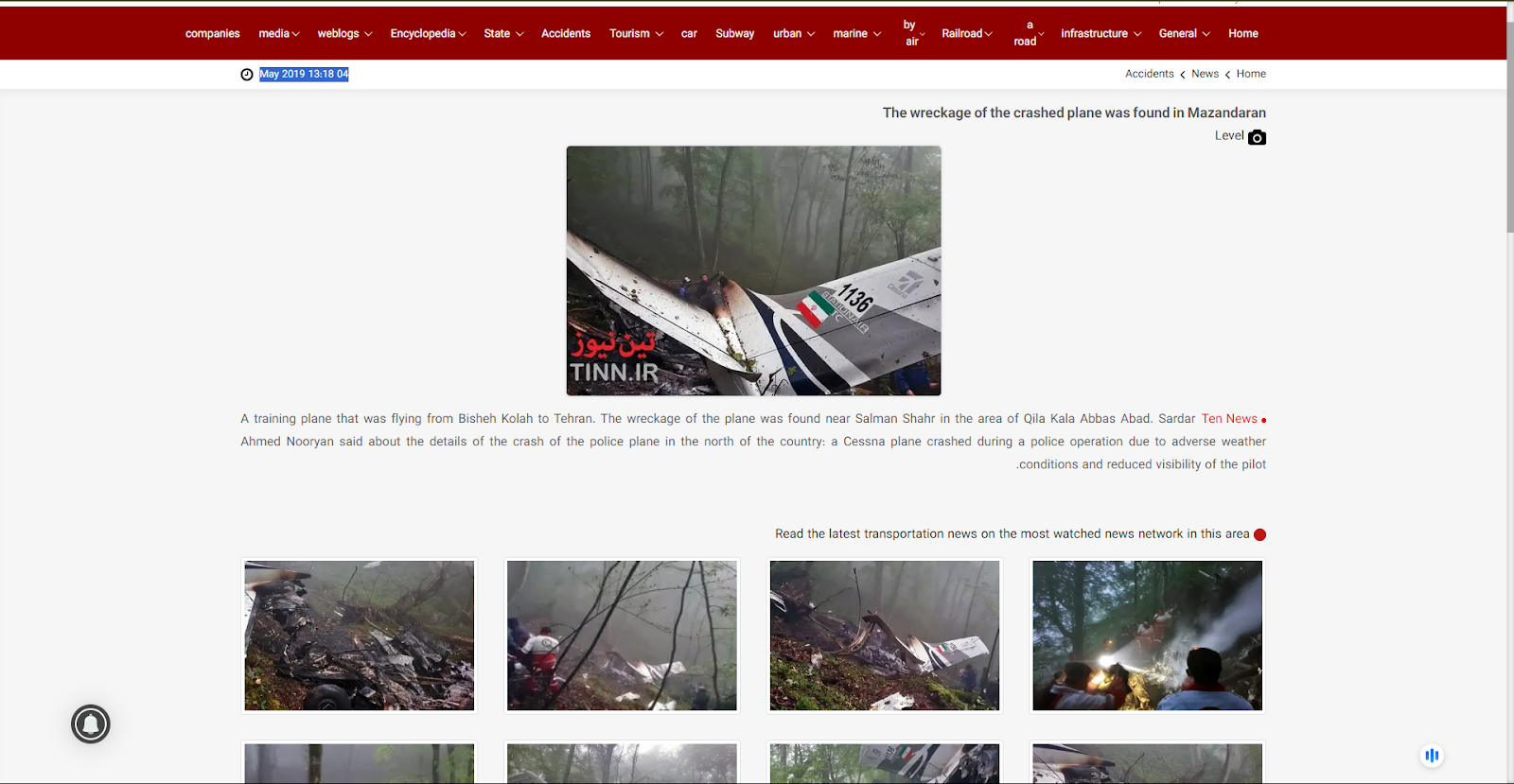
The Photos uploaded on to this website were posted in May 2019. The news reads, “A training plane that was flying from Bisheh Kolah to Tehran. The wreckage of the plane was found near Salman Shahr in the area of Qila Kala Abbas Abad.”
Hence, we concluded that the recent viral photos are not of Iranian President Ebrahim Raisi's Chopper Crash, It’s false and Misleading.
Conclusion:
The images being shared on social media as evidence of the helicopter crash involving Iranian President Ebrahim Raisi are incorrectly shown. They actually show the aftermath of a training plane crash that occurred in Mazandaran province in 2019 or 2020 which is uncertain. This has been confirmed through reverse image searches that traced the images back to their original publication by Rokna Press and Ten News. Consequently, the claim that these images are from the site of President Ebrahim Raisi's helicopter crash is false and Misleading.
- Claim: Viral images of Iranian President Raisi's fatal chopper crash.
- Claimed on: X (Formerly known as Twitter), YouTube, Instagram
- Fact Check: Fake & Misleading

Introduction
Not every major breach begins with a sophisticated new exploit. Sometimes it begins with a device nobody remembered to update, and this one began exactly that way, at scale. Security researchers have disclosed a campaign that compromised more than 14,530 internet connected cameras made by Dahua Technology, (one of the world's largest surveillance equipment manufacturers), using a mix of stolen credentials, two long known authentication flaws, and a peer to peer relay technique that let attackers reach devices tucked behind home and office routers. The operation, tracked by researchers at Hunt.io, has been named Operation CameraSwarm. It ran between June 17 and July 22, 2026, and was reconstructed almost entirely from an exposed 407 megabyte working directory the attackers themselves left accessible, containing over 2,600 files, campaign logs, shell history, and tooling. Confirmed compromises were concentrated in Ukraine and Russia, and researchers described the operators/attackers as Russian speaking based on language artifacts found in the recovered material, suggesting the campaign was most plausibly built around surveillance or access relevant to the ongoing conflict between the two countries, though no formal attribution to a named threat actor or state entity has been established or claimed. What makes this worth understanding in detail is not just the scale, though 14,500 compromised cameras is a serious number, but how mundane the actual break in methods were. None of this depended on the attackers discovering some brand new, unknown flaw, the kind of vulnerability security researchers call a ‘zero day’. It depended on something far more ordinary: thousands of devices running years-old software that had never been patched, combined with cheap automated tools that could try weak passwords and known exploits at scale.
What is Dahua, and why does this matter
Dahua Technology, founded in Hangzhou in 2001, is a publicly traded, partially state owned Chinese company and the world's second largest video surveillance manufacturer by revenue, trailing only fellow Chinese firm Hikvision. Its cameras, digital video recorders, and network video recorders are sold in roughly 180 countries through more than 2,100 partners, and the company has shipped tens of millions of devices into homes, retail stores, offices, and public infrastructure worldwide. That scale is precisely what makes any systemic vulnerability in Dahua's product line consequential well beyond a single country or sector.
How the attackers actually got in
Hunt.io attributed the compromises to three distinct attack paths. The largest, by far, was straightforward credential attacks, essentially automated login guessing using weak, default, or previously leaked passwords, which researchers traced to 12,324 unique IP addresses across more than 13,000 recorded campaign attempts. The second path exploited two authentication bypass flaws, catalogued as CVE-2021-33044 and CVE-2021-33045, both rated a severe 9.8 out of 10 on the current CVSS severity scale used by the US National Vulnerability Database. These are not new vulnerabilities. They were publicly disclosed back in 2021, and Dahua issued fixed firmware for them years ago, yet both remain listed today on the US Cybersecurity and Infrastructure Security Agency's Known Exploited Vulnerabilities catalog, a designation reserved specifically for flaws still being actively exploited in the wild despite available patches. The third and most technically interesting path involved a peer to peer, or P2P, relay mechanism built into Dahua's own Easy4IP cloud infrastructure, a system designed to let users remotely access their camera without manually configuring network settings. Security firm ITRES Labs, which documented this exposure separately in 2025, found that on firmware released before mid-2024, simply knowing a device's serial number was enough to establish a connection route through Dahua's relay servers before the camera's own login check ever kicked in, a design gap that let attackers reach devices even when they sat behind network address translation, the technical barrier that normally shields home devices from direct internet exposure. Hunt.io's recovered operator logs claimed an extraordinary 89.4 percent of live serial numbers tested returned an open channel without any authentication at all, though it is worth noting that figure comes solely from the attackers' own recovered data and has not been independently verified by Dahua, ITRES Labs, or any public incident response body as of this writing. Beyond the initial break in, the campaign also planted 1,923 cameras with a persistent account, essentially a backdoor login the operators could return to later, and researchers found evidence suggesting parts of the toolkit may have been built specifically to hand off access to a third party, though no confirmed link to a named threat actor or state sponsor has been established.
Why cameras remain such a persistent target
Internet connected cameras occupy an unusual position in the broader device ecosystem. Unlike a laptop or phone, they are rarely patched by an end user paying regular attention, they are often installed once and forgotten, and many owners never change the default credentials shipped from the factory. A compromised camera also offers an attacker something more than a foothold, live or recorded video feeds of homes, businesses, and sometimes sensitive facilities, which carries value well beyond the kind of access a compromised laptop typically provides.
CyberPeace Advisory | What device owners should do now
For anyone running Dahua surveillance equipment, or any internet connected camera system, several concrete steps meaningfully reduce exposure.
For Dahua device owners specifically:
Two steps address the exact mechanisms this campaign exploited.
- First, check the device's firmware version against Dahua's official download portal and apply the latest available update immediately, since the fixes for both 2021 authentication bypass vulnerabilities have existed for years and simply have not been applied on thousands of devices.
- Second, disable the P2P or Easy4IP remote access feature entirely unless it is actively required, since this is the exact mechanism the third attack path, the serial number based relay, relied on to reach cameras without any login check at all.
For any internet connected camera system, including in India:
The remaining precautions apply regardless of manufacturer, and are worth following on any brand of camera, DVR, or NVR connected to the internet.
- Replace default or weak passwords with strong, unique credentials on every camera and recorder, and remove any unused or unrecognised accounts, since the persistent account technique this campaign used depends entirely on unnoticed access surviving unchecked.
- Place surveillance devices on a segmented network separate from computers and phones, so that a compromised camera cannot become a stepping stone into more sensitive systems.
- Periodically audit which devices on a home or office network are internet facing at all, since many cameras end up exposed simply because remote access was left switched on by default and nobody thought to check.
- And where a device offers the option, disable any built in peer to peer or cloud relay convenience feature unless genuinely needed, since the underlying design pattern this campaign exploited, a remote access shortcut that runs before proper authentication.Is not unique to Dahua and has shown up across other camera brands in the past.
The view from India
This disclosure lands at a particularly relevant moment for India, which enforced sweeping new restrictions on Chinese origin CCTV equipment earlier this year. Since April 1, 2026, internet connected surveillance cameras sold in India have been required to carry Standardisation Testing and Quality Certification under Essential Requirements norms first introduced by the Ministry of Electronics and Information Technology in April 2024, It's a country-of-origin requirement under the Essential Requirements norms (introduced by India's Ministry of Electronics and Information Technology in April 2024), manufacturers must disclose the origin of key components like the System-on-Chip (SoC), and devices using Chinese-origin chipsets are reportedly not being granted approval by certifying authorities. Since Dahua's cameras, like Hikvision's and TP-Link's, generally rely on Chinese-made chipsets, the practical effect is that their products haven't received STQC certification, which functions as a blanket exclusion without the government needing to name any single company in the rule text itself. The stated rationale for that policy, concerns over hidden backdoor access, transmission of data to foreign servers, and deployment near sensitive locations, reads almost like a preview of exactly the kind of exposure Operation CameraSwarm has now documented in the wild. It is worth being precise here: the restriction applies to new sales, not existing installations, and CameraSwarm's confirmed victims were concentrated in Ukraine and Russia rather than India. But the underlying lesson travels well beyond any one country's borders. A camera manufactured with a convenience feature that bypasses its own login check, sitting unpatched for years despite a fix being publicly available, is a vulnerability that does not respect national boundaries, and India's decision to tighten certification requirements before an incident of this scale surfaced looks, in hindsight, considerably more prudent than reactive.
References
- The Hacker News, "Hackers Compromised 14,500+ Dahua Devices Using Credential Attacks, Auth Bypasses, and P2P." August 19, 2026. https://thehackernews.com/2026/08/hackers-compromised-14500-dahua-devices.html
- Hunt.io, "Operation CameraSwarm: Dahua Cameras Compromised." https://hunt.io/blog/operation-cameraswarm-dahua-cameras-compromised
- ITRES Labs, "Dahua Beyond CVE-2025-31702: P2P Relay Exposure." October 29, 2025. https://labs.itresit.es/2025/10/29/dahua-beyond-cve-2025-31702-p2p-relay-exposure?
- Dahua Security, "DHCC-SA-202106-001: Security Advisory - Identity Authentication Bypass Vulnerability Found in Some Dahua Products." https://www.dahuasecurity.com/about-dahua/trust-center/dahua-psirt/dhcc-sa-202106-001%3Asecurity-advisory---identity-authentication-bypass-vulnerability-found-in-some-dahua-products
- National Vulnerability Database, "CVE-2021-33044 Detail." https://nvd.nist.gov/vuln/detail/CVE-2021-33044
- CISA, "Known Exploited Vulnerabilities Catalog." https://www.cisa.gov/known-exploited-vulnerabilities-catalog
- Business Standard, "India to ban Chinese CCTV from Apr 1 as security concerns reshape market." https://www.business-standard.com/industry/news/india-ban-chinese-cctv-government-security-concerns-hikvision-dahua-market-126033000316_1.html
- PTC News, "India CCTV ban 2026: Hikvision, Dahua face STQC block as new security rules begin." https://www.ptcnews.tv/amp/nation/india-cctv-ban-hikvision-dahua-stqc-rules-2026-4422961
- Uyghur Human Rights Project, "Surveillance Tech Series: Dahua's Links to Human Rights Abuses in East Turkistan." https://uhrp.org/report/dahuas-links-to-human-rights-abuses-in-east-turkistan/
