
#FactCheck- Old Dubai Flood Videos Falsely Shared as Recent Storm Footage
Executive Summary
Amid reports of heavy rainfall and flooding in several cities of the United Arab Emirates, a video is being widely circulated on social media claiming to show recent scenes from Dubai. The clip allegedly depicts severe waterlogging at Dubai Airport and inside shopping malls, with users linking it to a “recent storm.”According to research by CyberPeace, the viral footage is not recent. The video is actually a compilation of three different clips stitched together and dates back to 2024, when Dubai experienced unprecedented flooding following heavy rains.
Claim
The misleading post was shared by an X (formerly Twitter) user named ‘Ruksar Khan’ on March 28, 2026, with a caption suggesting that Dubai had been submerged after just one day of rain. The post attempted to sensationalize the situation by portraying the visuals as current.

Fact Check:
To verify the claim, keyframes from the viral video were extracted using the InVid tool and analyzed through reverse image search. One of the clips was traced to a Facebook post by “9 News,” uploaded on April 17, 2024. The video showed waterlogged runways at Dubai International Airport following intense rainfall and flooding.

Further verification led to a report published by Hindustan Times on April 17, 2024, which featured similar visuals and confirmed that the footage was from the floods that hit Dubai in 2024.

Conclusion:
The viral claim suggesting that the video shows recent flooding in Dubai is false. The footage is nearly two years old and originates from the 2024 floods in Dubai. It is now being reshared with misleading claims to create confusion around current weather events.

Related Blogs
Executive Summary:
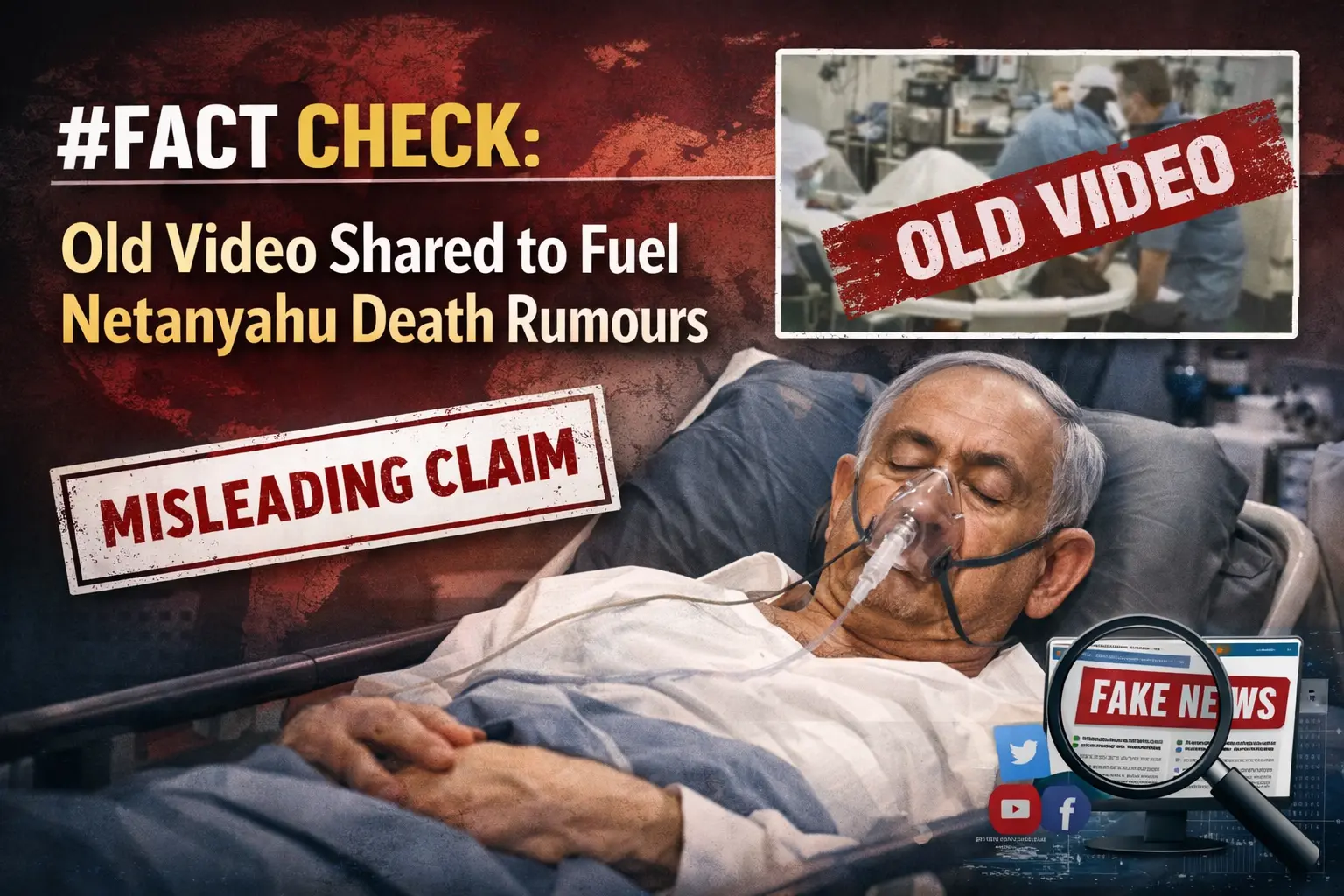
A video featuring Sara Netanyahu, wife of Israeli Prime Minister Benjamin Netanyahu, is being widely circulated on social media. In the clip, she is seen attending an online meeting and repeatedly closing her eyes. The video is being shared with claims that it is recent and shows her under the influence of drugs. Some posts also suggest that Prime Minister Netanyahu has died. However, research by the CyberPeace found that the claim is misleading. The video is not recent and has been online since 2020.
Claim:
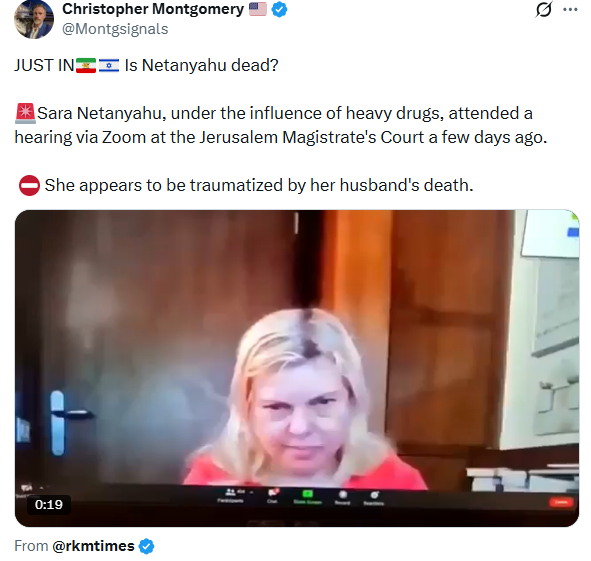
Social media users are sharing the video claiming that Sara Netanyahu appeared intoxicated following the alleged death of Prime Minister Benjamin Netanyahu. The clip is also being falsely presented as a recent development. An X user, Christopher Montgomery (@Montgsignals), shared the video with the caption suggesting that Netanyahu may have died and that his wife appeared in a drug-influenced state during a recent court hearing via Zoom.
Fact Check:
To verify the claim, we first examined reports regarding the alleged death of Benjamin Netanyahu. There is no credible evidence supporting this claim. In fact, on March 20, Netanyahu himself addressed the media and dismissed such rumours, confirming that he is alive.

We then analyzed the viral video by extracting keyframes and conducting a reverse search. This led us to the same video posted on a Facebook account under the name Roni Schneider Malia on November 4, 2020. The Hebrew caption associated with the post translates to: “Filmed during a psychological conference on Zoom.”
This confirms that the video is old and unrelated to any recent developments.

Conclusion:
The viral claim is misleading. The video of Sara Netanyahu is not recent but has been available online since 2020. It is being falsely linked to baseless claims about Prime Minister Benjamin Netanyahu’s death

Introduction
Misinformation regarding health is sensitive and can have far-reaching consequences. These include its effect on personal medical decisions taken by individuals, lack of trust in conventional medicine, delay in seeking treatments, and even loss of life. The fast-paced nature and influx of information on social media can aggravate the situation further. Recently, a report titled Health Misinformation Vectors in India was presented at the Health of India Summit, 2024. It provided certain key insights into health-related misinformation circulating online.
The Health Misinformation Vectors in India Report
The analysis was conducted by the doctors at First Check, a global health fact-checking initiative alongside DataLEADS, a Delhi-based digital media and technology company. The report covers health-related social media content that was posted online from October 2023 to November 2024. It mentions that among all the health scares, misinformation regarding reproductive health, cancer, vaccines, and lifestyle diseases such as diabetes and obesity is the most prominent type that is spread through social media. Misinformation regarding reproductive health includes illegal abortion methods that often go unchecked and even tips on conceiving a male child, among other things.
In order to combat this misinformation, the report encourages stricter regulations regarding health-related content on digital media, inculcating technology for health literacy and misinformation management in public health curricula and recommending tech platforms to work on algorithms that prioritise credible information and fact-checks. Doctors state that people affected by life-threatening diseases are particularly vulnerable to such misinformation, as they are desperate to seek options for treatment for themselves and their family members to have a chance at life. In a diverse society, with the lack of clear and credible information, limited access to or awareness about tools that cross-check content, and low digital literacy, people gravitate towards alternate sources of information which also fosters a sense of disengagement among the public overall. The diseases mentioned in the report, which are prone to misinformation, are life-altering and require attention from healthcare professionals.
CyberPeace Outlook
Globally, there are cases of medically-unqualified social media influencers who disperse false/mis- information regarding various health matters. The topics covered are mostly associated with stigma and are still undergoing research. This gap allows for misinformation to be fostered. An example is misinformation regarding PCOS( Polycystic Ovary Syndrome) which is circulating online.
In the midst of all of this, YouTube has released a new feature that aligns with combating health misinformation, trying to bridge the gap between healthcare professionals and Indians who look for trustworthy health-related information online. The initiative includes a feature that allows doctors, nurses, and other healthcare professionals to sign up for a health information source license. This would help by labeling all their informative videos, as addressed- from a healthcare professional. Earlier, this feature was available only for health organisations including a health source information panel and health content shelves, but this step broadens the scope for verification of licenses of individual healthcare professionals.
As digital literacy continues to grow, methods of seeking credible information, especially regarding sensitive topics such as health, require a combined effort on the part of all the stakeholders involved. We need a robust strategy for battling health-related misinformation online, including more awareness programmes and proactive participation from the consumers as well as medical professionals regarding such content.
References
- https://timesofindia.indiatimes.com/india/misinformation-about-cancer-reproductive-health-is-widespread-in-india-impacting-medical-decisions-says-report/articleshow/115931612.cms
- https://www.ndtv.com/india-news/cancer-misinformation-prevalent-in-india-trust-in-medicine-crucial-report-7165458
- https://www.newindian.in/ai-driven-health-misinformation-poses-threat-to-indias-public-health-report/
- https://www.etvbharat.com/en/!health/youtube-latest-initiative-combat-health-misinformation-india-enn24121002361
- https://blog.google/intl/en-in/products/platforms/new-ways-for-registered-healthcare-professionals-in-india-to-reach-people-on-youtube/
- https://www.bbc.com/news/articles/ckgz2p0999yo

Introduction
For years, Indian companies could get away with vague privacy promises. That window closed on 13 November 2025, when the government notified the Digital Personal Data Protection Rules, giving teeth to the broad principles Parliament had passed back in 2023 under the DPDP Act. The Rules turned soft commitments into specific, auditable duties, and a lot of organisations are only now realising how much that actually changes.
Start with Section 8(4). It requires every Data Fiduciary to put "appropriate technical and organisational measures" in place. Most readers skim past "organisational" and focus on the technical half, but that's a mistake, because the word is doing real work. It's asking for defined roles, written policies, staff training, and someone actually watching whether any of it holds up over time, not just firewalls and encryption keys. Section 8(5) goes further, demanding reasonable security safeguards against breaches, and Rule 6 spells out exactly what that phrase means in practice: encrypt data at rest and in transit, restrict access on a need to know basis, require multi factor authentication, log and monitor activity, run regular vulnerability checks, bind your data processors contractually to the same standard, and keep relevant logs for at least a year.
Then there's Rule 7, and this is where the clock starts running. Once a Data Fiduciary becomes aware of a breach, the Data Protection Board must be told without delay, and a full report has to follow within 72 hours covering what happened, when, why, what's being done about it, and confirmation that affected individuals were notified. Unlike GDPR, there's no minimum severity threshold here. A breach affecting ten people triggers the same obligation as one affecting ten million. And CERT-In's existing six hour reporting window under its 2022 Directions still applies separately, which means a serious incident can trigger two overlapping regulatory clocks running side by side.
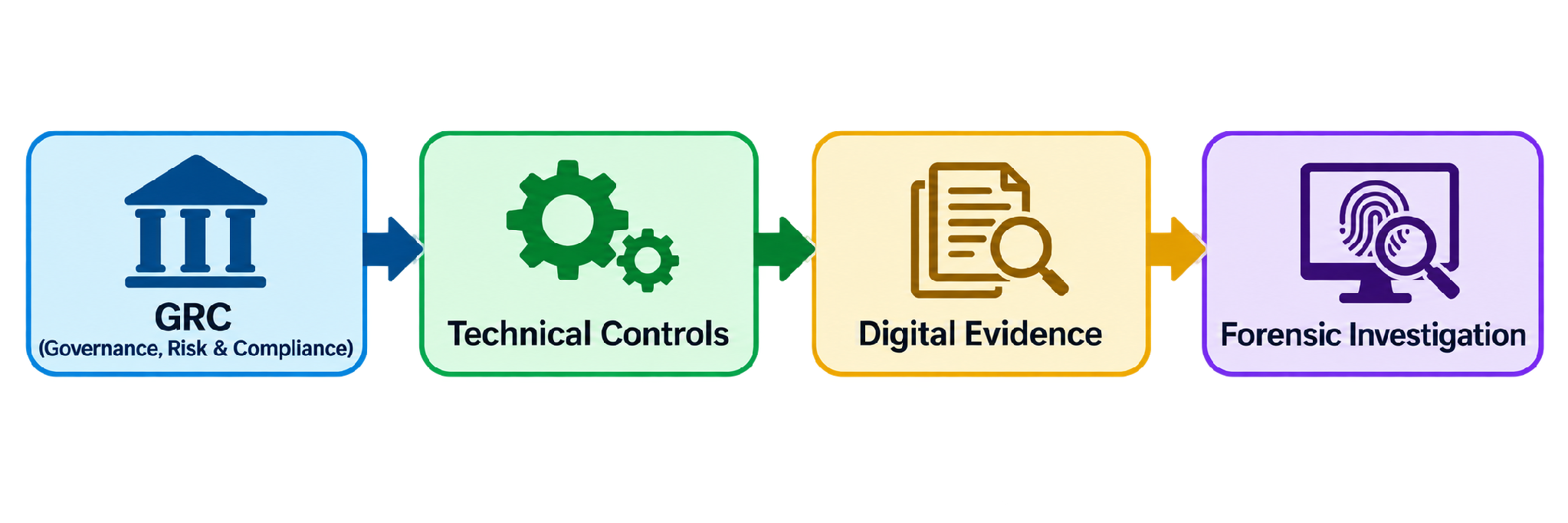
Put all of this together and a pattern emerges. The law assumes an organisation already knows what it's protecting, has actually protected it, kept usable records the whole way through, and can explain clearly what happened the moment something breaks. That coordination job belongs to Governance, Risk and Compliance, or GRC for short. GRC decides who's accountable, which risks actually matter, which controls address them, and how anyone checks whether compliance is real rather than assumed. Skip that structure and security work tends to splinter into a pile of disconnected tasks nobody truly owns.
GRC gives a legal duty somewhere to live. Forensic readiness is what lets an organisation prove, months or years later, that the duty was actually being met.
The Role of Governance, Risk and Compliance
On paper, most cybersecurity programmes look fine. There's an incident response plan somewhere, access control rules exist, logging is "in place," and someone has a title that says they're responsible for security. None of that gets tested until something actually breaks. A phishing compromise, a ransomware infection, a leaked database, a hijacked admin account, whatever the trigger, the questions that follow are always the same, and they're not comfortable ones. What happened, exactly, and when did it start? Which systems, which data, were actually touched? Were the controls the organisation claims to run genuinely functioning at that moment, or just described in a slide deck somewhere? And can anyone produce records solid enough to answer those questions with confidence rather than a shrug?
This is the exact seam where GRC and digital forensics meet. GRC lays out what's expected, who's responsible, and what evidence a control should be generating in the background. Digital forensics is the craft of taking whatever technical traces actually exist and turning them into an account of events that will hold up to scrutiny. Passing an audit was never really the point. Being able to stand in front of a regulator, mid incident, and show that the processes described on paper were real, active, and generating trustworthy evidence, that's the actual bar.
Why Compliance Alone Falls Short
Compliance, in the narrow sense, just means meeting whatever legal, contractual, or internal requirement applies. But a policy sitting in a document repository proves nothing about what actually happens on a Tuesday afternoon when someone requests admin access. A written incident response plan says nothing about whether the team can actually execute it under real pressure, at 2am, with a ransomware note on every screen. A logging policy is close to worthless if the logs it promises were switched off somewhere along the way, or overwritten, or scattered across systems that were never synchronised to the same clock.
NIST's Cybersecurity Framework 2.0 essentially built this concern into its core structure, placing "Govern" alongside Identify, Protect, Detect, Respond, and Recover as one of five equal functions rather than background paperwork sitting off to the side. India's own regulatory posture pushes in the same direction. CERT-In's 2022 Directions require certain incidents to be reported within six hours of discovery, and its guidance for government entities leans heavily on documented incident handling and disciplined evidence practices. The underlying message from both is identical: figure out, before anything goes wrong, whether the evidence you'll eventually need is actually going to exist when someone asks for it.
Where GRC and Forensics Actually Connect
A good GRC programme spells out what's supposed to happen. Forensic readiness is what lets you later prove what actually did.
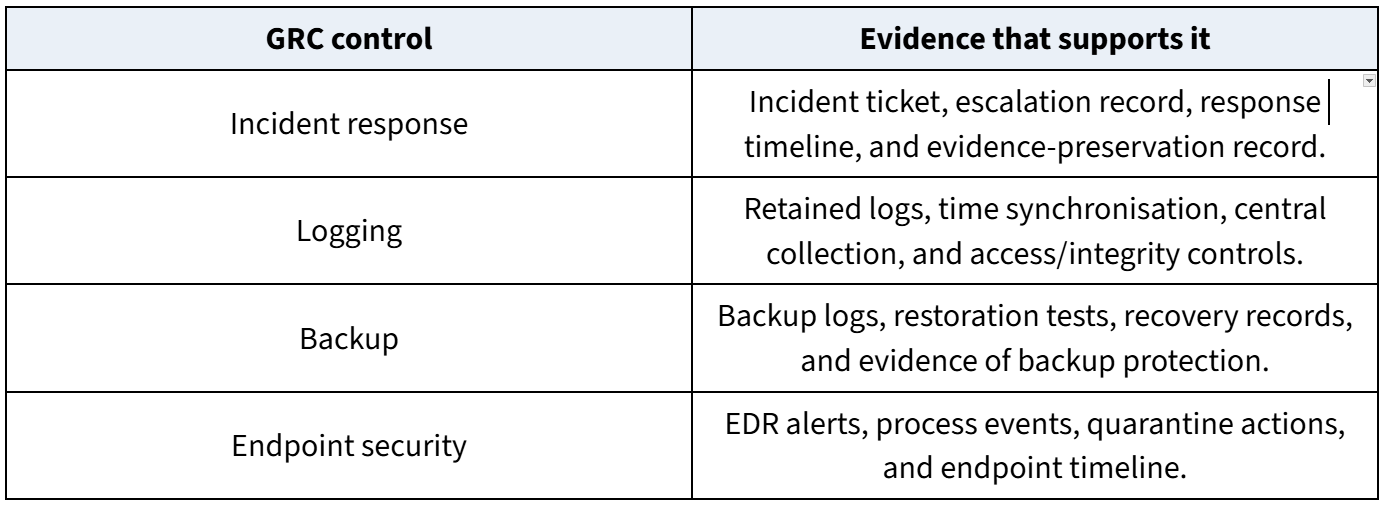
Access control is a useful example here. On the GRC side, an organisation might require least privilege access, multi factor authentication, periodic reviews of who holds privileged accounts, and prompt removal of access once someone leaves or changes roles. On the forensic side, none of that means anything without the underlying records that let investigators actually test it, authentication logs, MFA usage history, privilege change records, and account activity trails. The table below lines up a few common GRC controls against the specific evidence needed to show they were genuinely operating.
A Practical Scenario: After a Ransomware Incident
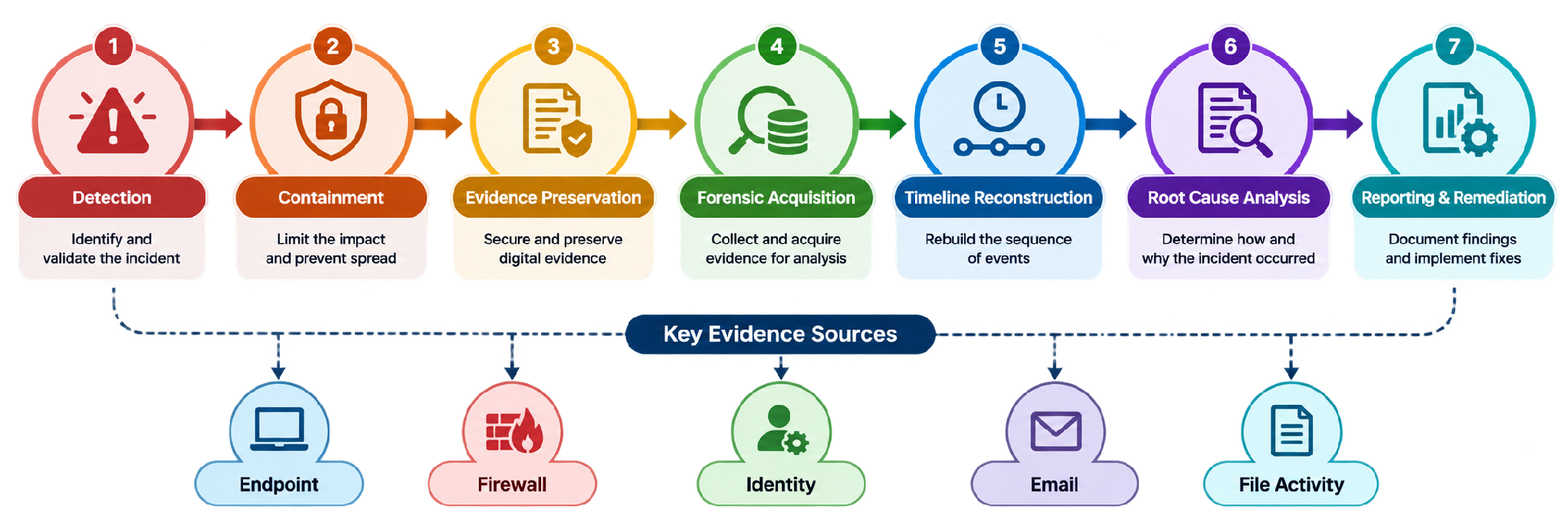
Picture a mid-sized company waking up to find half its file servers encrypted. There's an incident response plan somewhere in the shared drive, technically, but nobody's actually run through it in over a year. The security team isolates the obviously compromised endpoint and starts escalating. Now the forensic side of the house has to reconstruct what happened, working backward through endpoint telemetry, authentication logs, firewall events, email traffic, and file activity, hunting for the original point of entry, how the attacker escalated privileges, how they moved sideways through the network, what data they actually touched, and finally how the ransomware got deployed.
This is where the quality of everything collected beforehand suddenly matters a great deal. If server clocks were never properly synchronised, the timeline investigators build might not line up cleanly enough to trust. If logs only ever lived locally on individual machines rather than being pulled centrally, some of them are probably gone by now. If nobody ever bothered logging administrator actions, there are going to be real, unexplained gaps in the story. And if whatever evidence does exist wasn't collected the right way, its integrity can be challenged later, sometimes fatally, in a legal or regulatory proceeding. CERT-In actually ran a programme on exactly this in July 2026, "Inside the Breach," covering system artefacts, investigative technique, and chain of custody requirements, precisely because this is where real investigations tend to succeed or quietly fall apart.
Building a Forensic Ready GRC Programme
For an organisation starting more or less from scratch, forensic readiness doesn't need to be bolted on as some separate initiative. It can be built straight into the GRC programme that already exists. Start by identifying the systems, applications, cloud services, and privileged accounts that actually matter. Map the real risks and regulatory requirements onto the controls meant to address them. Then get specific about what evidence each control should be generating, and how that evidence gets protected and kept over time. Time synchronisation, centralised logging, tightly controlled access to security records, and clear ownership of preservation, escalation, and investigation all need to exist well before an incident, not be improvised during one. And none of it means much until it's actually been tested, through tabletop exercises and simulated incidents rather than assumed to work because it's written down somewhere. NIST SP 800-61 Revision 3 frames incident response as one continuous loop of preparation, detection, response, recovery, and improvement, rather than a series of separate boxes to check.
There's one question worth asking of every important control an organisation runs: could you actually prove this was working at the moment an incident happened? If the honest answer is no, what you have is a compliance process on paper, and a forensic readiness gap sitting quietly underneath it.
Conclusion
Cyber readiness was never really about how many policies sit in a binder or how many boxes get ticked in an audit. It shows up, or doesn't, in the hours right after something breaks, when an organisation has to move fast, preserve evidence that can actually stand up to scrutiny, explain clearly what happened, and prove that governance and technical controls were genuinely working together rather than just coexisting on paper. GRC sets the direction, the accountability, the risk priorities, and the compliance expectations. Digital forensics does the work of preserving and interpreting the technical evidence once something actually happens. Forensic readiness sits in between the two, making sure they're actually talking to each other long before an incident forces the conversation. The practical task for most organisations comes down to something simple to say, if not always simple to build: design controls that hold up under real incident response, not just an auditor's checklist. The strongest compliance posture was never the one with the thickest binder. It's the one that can back every document up with evidence, on the day it actually matters.
References
- Digital Personal Data Protection Act, 2023, Sections 8(4), 8(5), 8(6). https://www.meity.gov.in/writereaddata/files/Digital%20Personal%20Data%20Protection%20Act%202023.pdf
- Digital Personal Data Protection Rules, 2025, Rules 6 and 7, notified 13 November 2025. https://www.meity.gov.in
- National Institute of Standards and Technology, The NIST Cybersecurity Framework (CSF) 2.0, CSWP 29, 2024. https://csrc.nist.gov/pubs/cswp/29/the-nist-cybersecurity-framework-csf-20/final
- Indian Computer Emergency Response Team (CERT-In), Directions under Section 70B of the Information Technology Act, 2000, dated 28 April 2022. https://www.cert-in.org.in/Directions70B.jsp
- Indian Computer Emergency Response Team (CERT-In), Guidelines on Information Security Practices for Government Entities. https://www.cert-in.org.in/Downloader?fileName=CIPS-2026-0014.pdf&pageid=5&type=2
- National Institute of Standards and Technology, SP 800-86: Guide to Integrating Forensic Techniques into Incident Response, 2006. https://csrc.nist.gov/pubs/sp/800/86/final
- International Organization for Standardization, ISO/IEC 27037:2012, Guidelines for identification, collection, acquisition and preservation of digital evidence. CERT-In, "Inside the Breach: Advanced Cyber Forensics & Incident Investigation," 31 July 2026. https://www.cert-in.org.in/s2cMainServlet?pageid=PRSTNVIEW03&reCode=CIWS-2026-3569
- National Institute of Standards and Technology, SP 800-61 Rev. 3: Incident Response Recommendations and Considerations for Cybersecurity Risk Management, 2025. https://csrc.nist.gov/pubs/sp/800/61/r3/final
- Matters.ai, "DPDP Breach Notification: 72-Hour Rule & ₹200 Cr Penalty." https://www.matters.ai/article/dpdp-breach-notification MediaNama, "Data Breach Reporting Timeline of DPDP Rules 2025 Explained." https://www.medianama.com/2025/11/223-data-breach-reporting-timeline-of-dpdp-rules-2025-explained/
