
#FactCheck- Viral video falsely linked to Bangladeshi infiltrator killed at Tripura border; actually shows militant killed in Kulgam encounter
Executive Summary
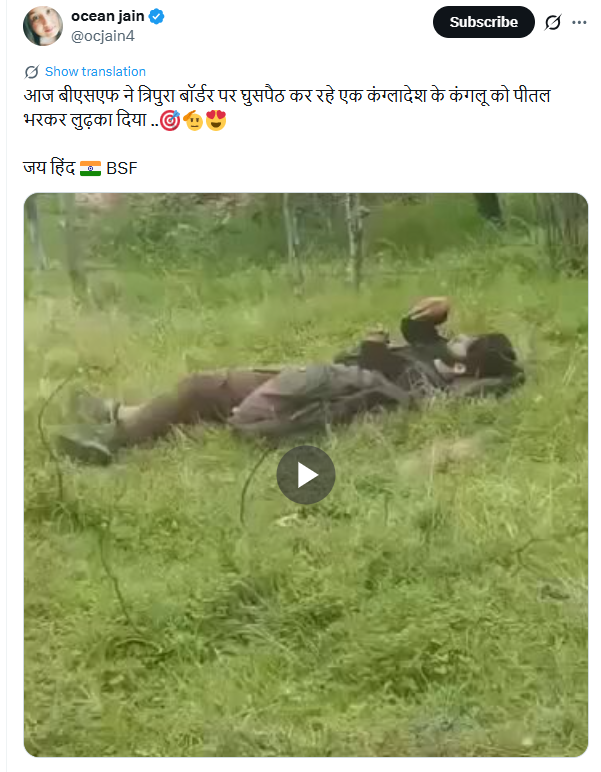
A video circulating on social media is being shared with the claim that the Border Security Force (BSF) shot dead a Bangladeshi national who was attempting to infiltrate India through the Tripura border. CyberPeace Research Wing research found the claim to be misleading. The viral video is not related to any recent incident on the Tripura border. It actually shows Haris Nazir Dar, a militant who was killed during an encounter in Jammu and Kashmir’s Kulgam district last year.
Claim:
The viral clip, which is around eight seconds long, shows a body lying on the ground. It is being shared on X with captions suggesting that the deceased was a Bangladeshi infiltrator who was killed while attempting to cross the India-Bangladesh border in Tripura.
https://x.com/ocjain4/status/2066210317265457298
Fact Check:
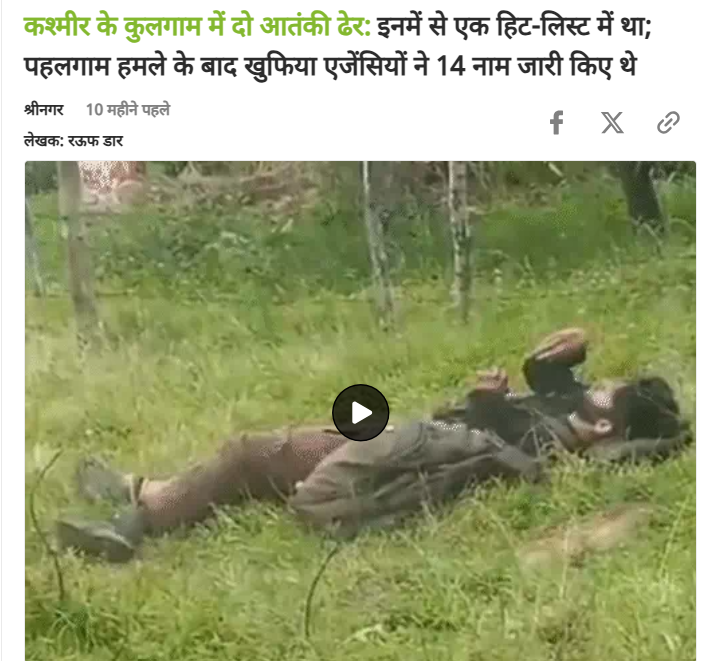
To verify the claim, we extracted keyframes from the viral video and conducted a reverse image search. During the research, we found matching visuals in a report published by Dainik Bhaskar on August 2, 2025. The report was related to an encounter between security forces and militants in the Akhal forest area of Kulgam district in Jammu and Kashmir. Visuals in the report matched those seen in the viral video.
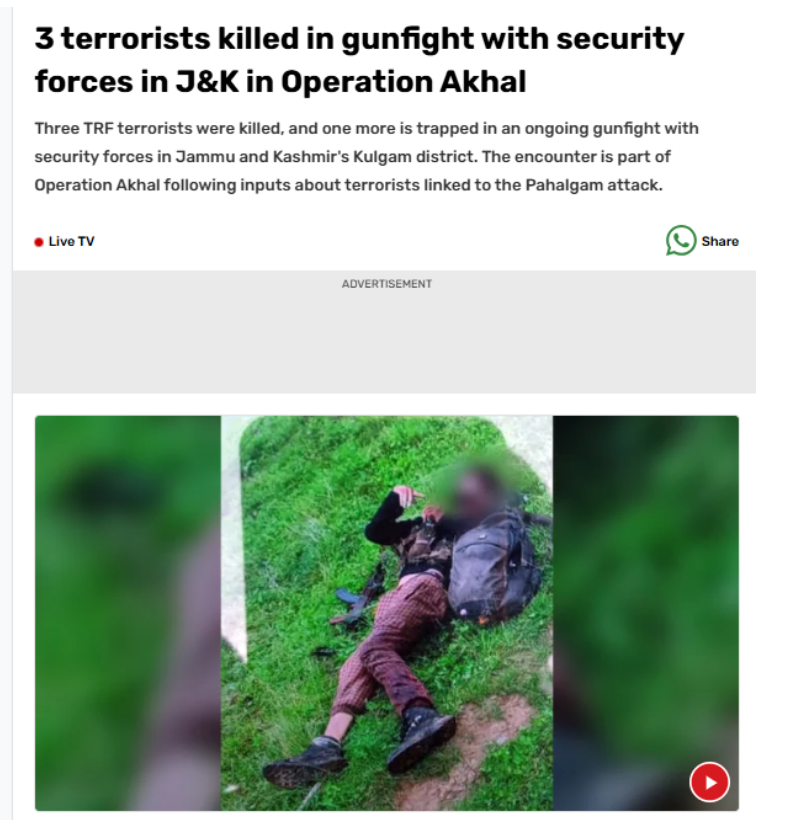
We also found a report published by India Today on August 2, 2025, which carried photographs of slain militant Haris Nazir Dar taken from a different angle. The report stated that security forces had killed three militants during the operation in the Akhal forest area of Kulgam. https://www.indiatoday.in/india/story/gunfight-underway-with-3-lashkar-terrorists-in-jks-kulgam-2764971-2025-08-01
Conclusion:
The evidence gathered during our research makes it clear that the viral video does not show a Bangladeshi infiltrator killed at the Tripura border. The footage is actually from a security operation in Jammu and Kashmir and shows Haris Nazir Dar, a militant who was killed in an encounter in Kulgam last year.

Related Blogs
Executive Summary
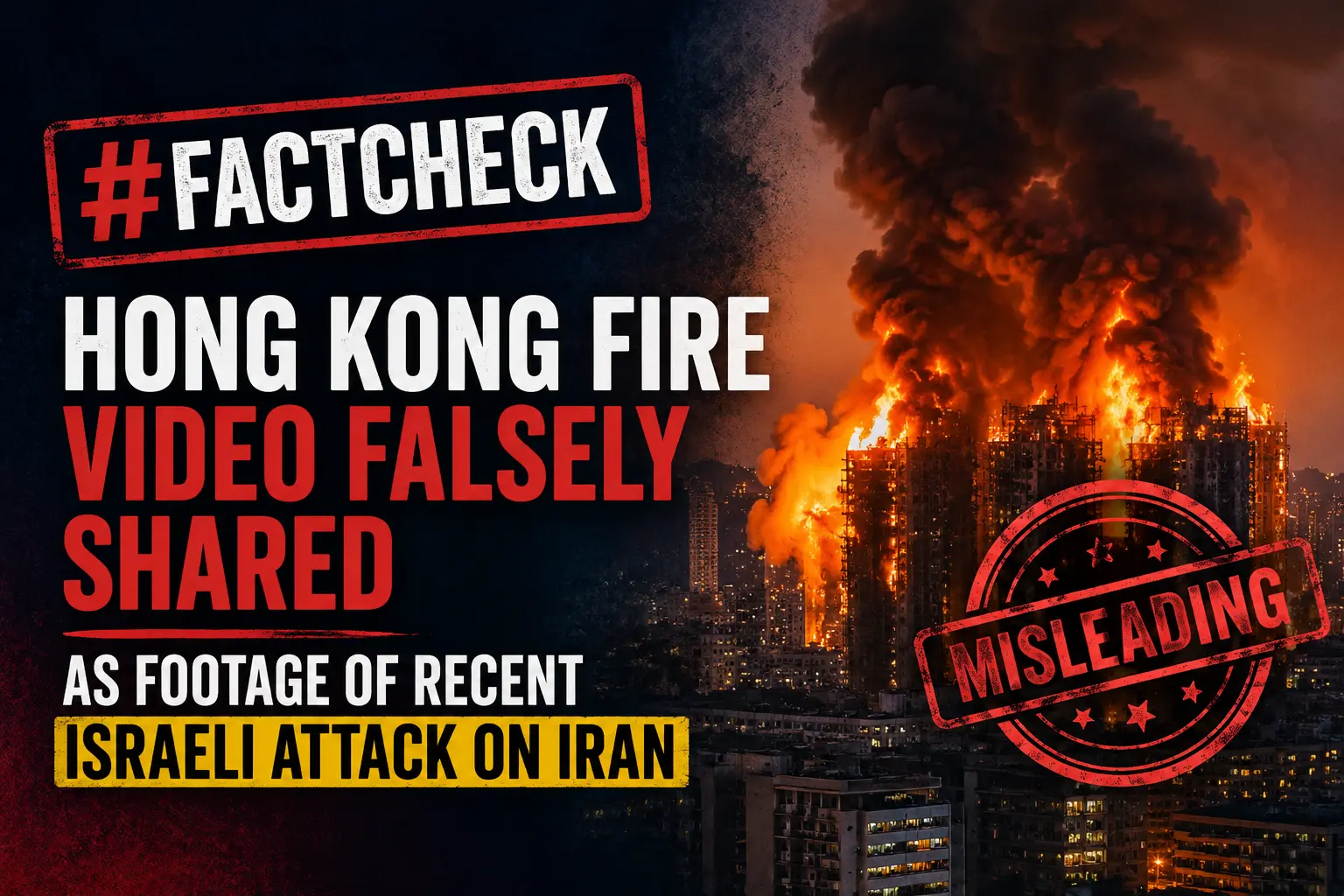
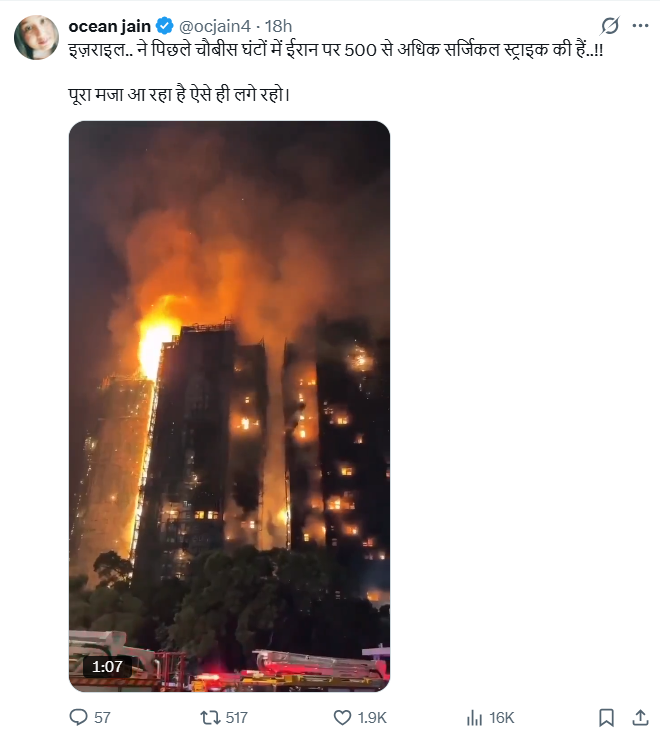
A video is being widely shared on social media with the claim that it shows the aftermath of a recent Israeli attack on Iran. The footage shows multiple residential high-rise buildings engulfed in flames, with thick plumes of smoke rising into the sky. Users sharing the video claim that Israel carried out more than 500 airstrikes on Iran. CyberPeace Research Wingresearch found the claim to be misleading. The viral video is not related to any Israeli attack on Iran. It actually shows a massive fire that broke out in a residential complex in Hong Kong in November 2025.
Claim:
An X user shared the viral video and wrote, “Israel has carried out more than 500 surgical strikes on Iran in the last 24 hours. Enjoying it thoroughly. Keep it up.”
Post link, archive link and screenshot can be seen below:
https://x.com/ocjain4/status/2064715707997413618?s=20
Fact Check:
To verify the authenticity of the viral video, we extracted keyframes and conducted a Google Lens search. During the research, we found the same footage on Reuters’ website, where it had been published on November 26, 2025.
Report link and screenshot can be seen below:
https://www.reuters.com/video/watch/idRW511126112025RP1/
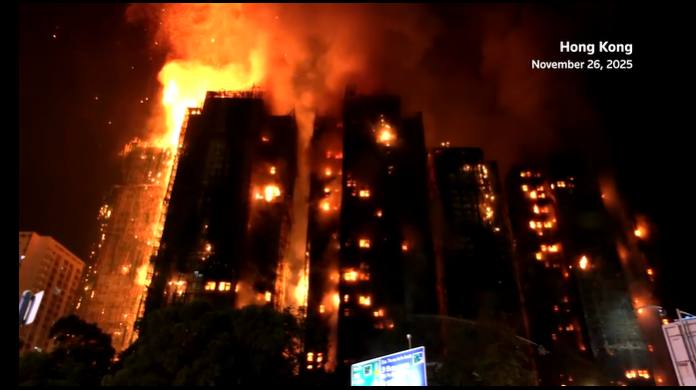
According to Reuters, the video shows a massive fire that engulfed multiple high-rise residential buildings in Hong Kong’s northern Tai Po district. The blaze claimed the lives of at least four people. Thick smoke could be seen billowing from the buildings as firefighters and emergency response teams worked to bring the fire under control.
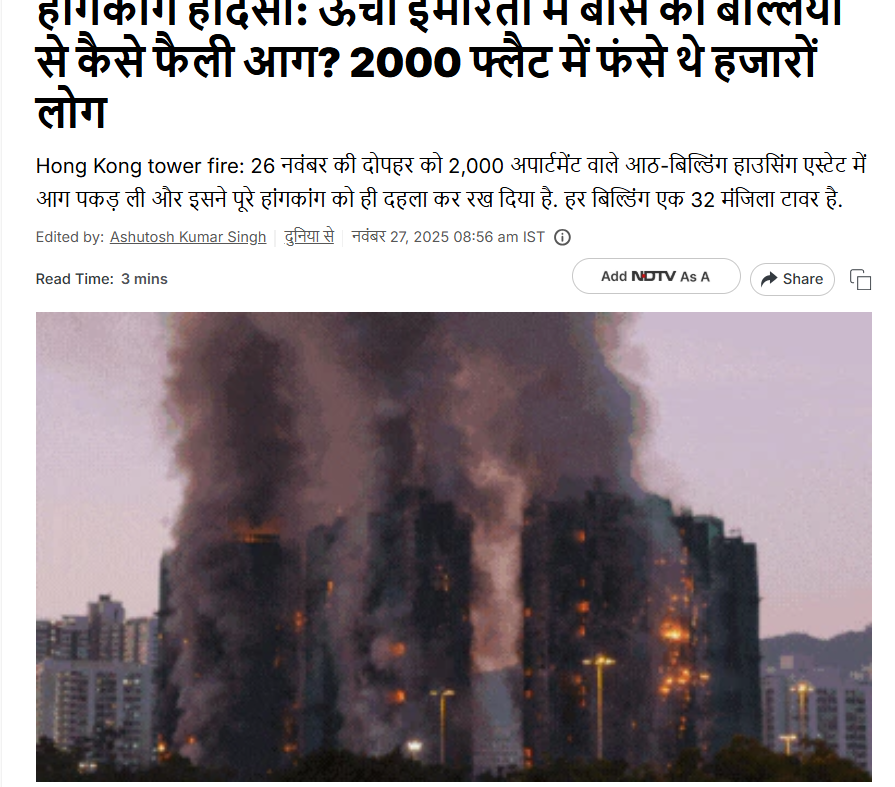
After establishing the source of the video, we conducted a keyword search on Google and found a report published by NDTV on November 27, 2025, which also covered the incident.
Report link and screenshot can be seen below:
Conclusion:
Our research found that the viral video is not related to any Israeli attack on Iran. The footage actually shows a massive fire that broke out in residential buildings in Hong Kong in November 2025. Chinese President Xi Jinping had expressed condolences to the victims, including a firefighter who lost his life while on duty.
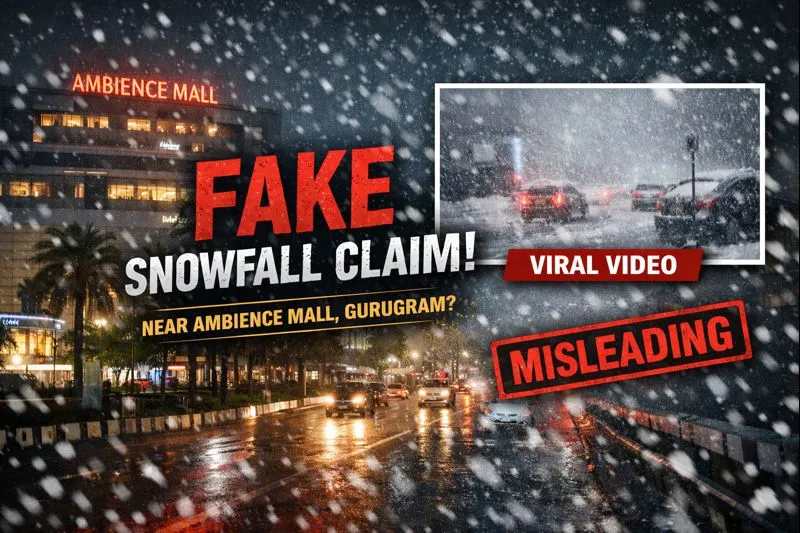
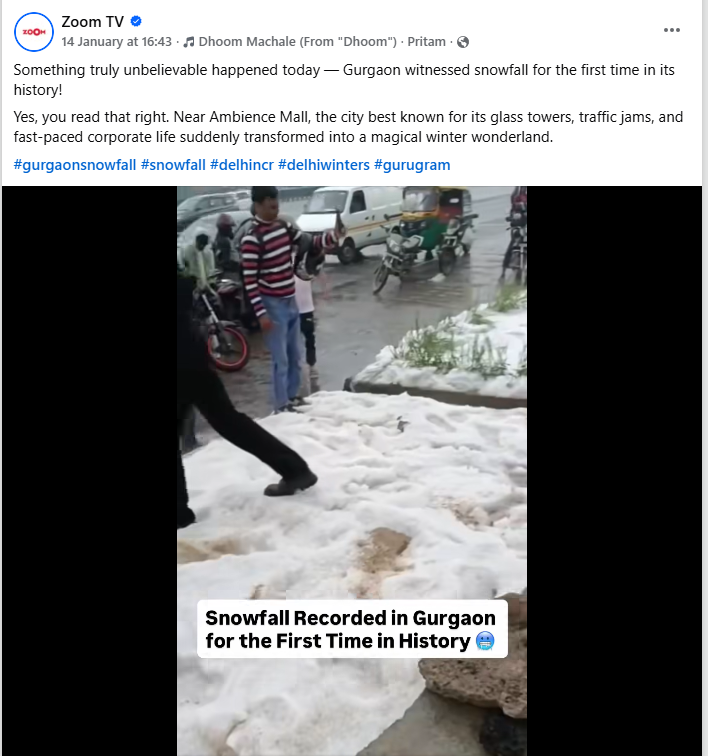
A video circulating widely on social media claims to show snowfall near Ambience Mall in Gurugram, Haryana. The clip is being shared alongside assertions that Gurugram witnessed snowfall for the first time in its history amid a severe cold wave in January 2026. However, an research by Cyber Peace Foundation has found the claim to be misleading. Our verification reveals that the viral video is not recent and has been available online since March 2023.
The Claim
On 14 January 2026, a Facebook user shared the video with the caption,“Something truly unbelievable happened today — Gurgaon witnessed snowfall for the first time in its history!”Through this post, the user implied that the visuals showed snowfall near Ambience Mall during the ongoing cold wave.link and screeshot
- https://www.instagram.com/reel/DTfS9X9DyBo/?utm_source=ig_embed&ig_rid=239ddaf7-ec53-4b1d-8f3b-a5e39540b3ee
- https://archive.ph/JVjHf
Fact Check:
To verify the claim, we conducted a detailed search using relevant keywords but found no credible media reports or official statements to support it. Although Gurugram’s temperature dropped to 0.6 degrees Celsius amid an IMD-issued cold wave warning, there is no evidence to suggest that the city experienced snowfall or hail. As of January 16, 2026, weather records and official sources confirm that no such weather event occurred in Gurugram.
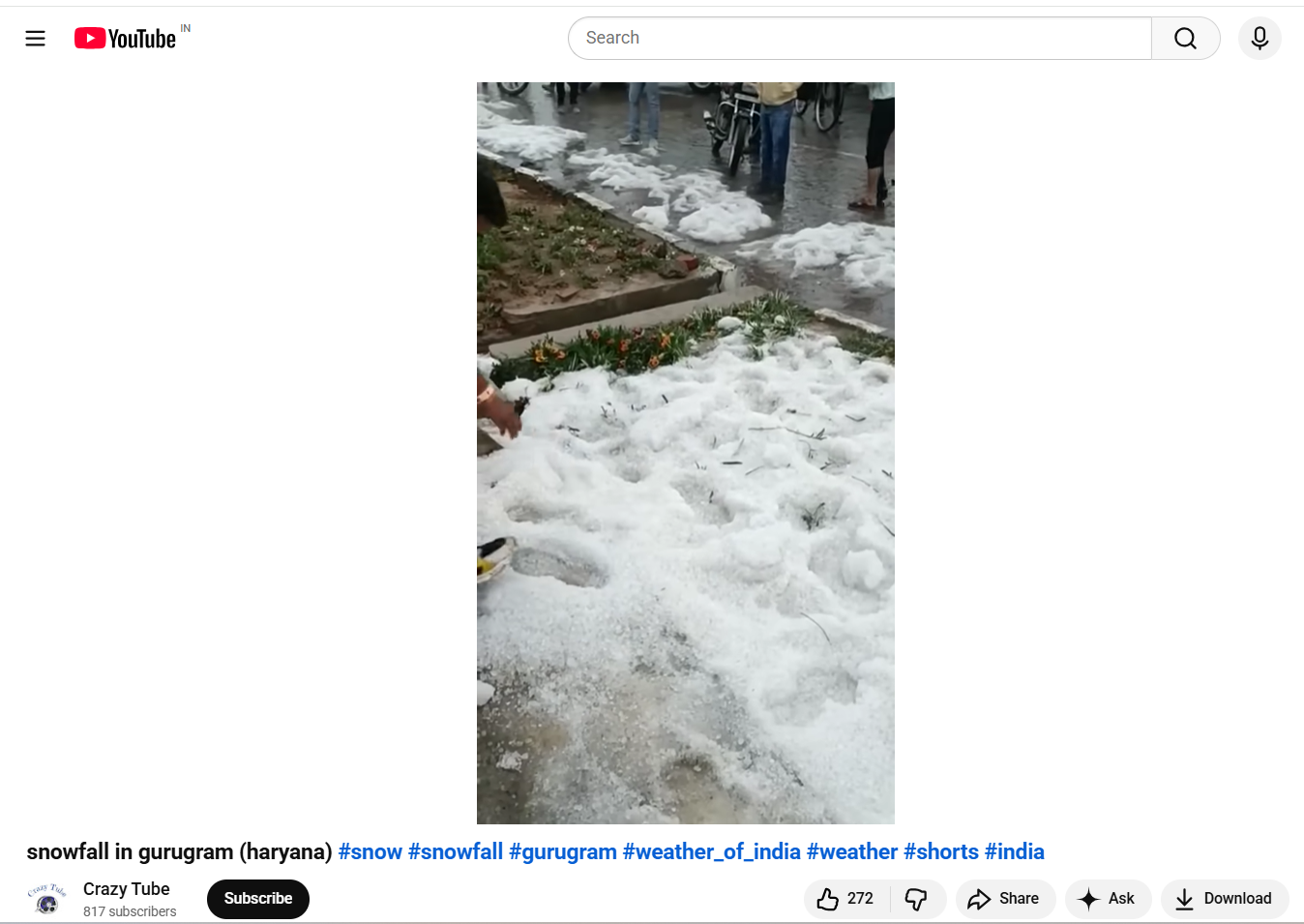
A reverse image search of keyframes extracted from the viral clip traced the same footage to a video uploaded on the YouTube channel Crazy Tube on March 21, 2023. This establishes that the video has been in circulation for nearly three years. In the original upload, the person filming clearly mentions that the visuals were recorded near a toll plaza, further indicating that the clip is unrelated to the recent weather conditions in Gurugram. Link and Screen Shot
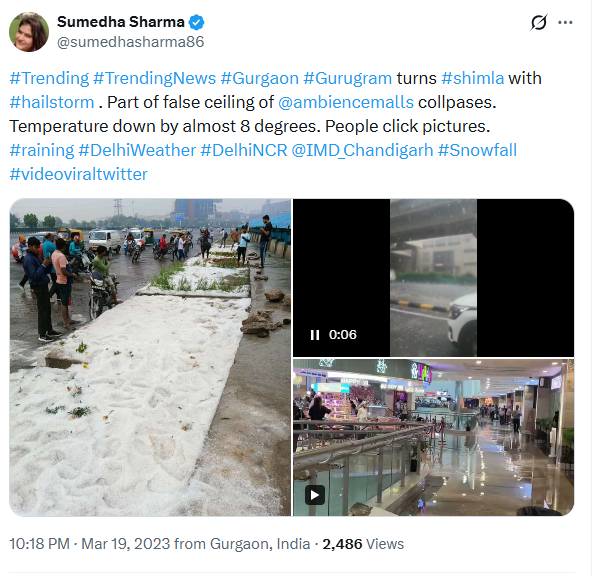
We also came across an X (formerly Twitter) post from March 19, 2023, which featured images similar to those seen in the viral video. The post described the visuals as being from a hailstorm in Gurugram, indicating that the content predates the current weather conditions and is unrelated to the recent cold wave.
Conclusion:
The video is old and predates January 2026, and has been on the internet at least since March 2023. While Gurugram recorded a low of 0.6 degrees Celsius amid an IMD cold wave warning, the city did not experience snowfall or hail as of 16 January 2026. News reports from March 2023 confirm heavy rain and hail in Delhi and adjoining areas, including parts of Gurugram, but there is no evidence of snowfall in January 2026. Hence, the claim made in the post is MISLEADING.

Introduction
The debate between free speech and social responsibility is one of the oldest, long-running debates in history. Free speech is considered to be at the heart of every democracy. It is considered the “mother” of all other freedoms, enshrined in Article 19(1)(a) of the Indian Constitution under Part III: Fundamental Rights. It takes various shapes and forms according to the sociopolitical context of society. Evelyn Beatrice Hall, a prominent English writer of the 19th century, laid the foundation of every democracy when she wrote in her book, "I disapprove of what you say, but I willdefend to the death your right to say it." The drastic misuse of social media to disseminate propaganda and fakenews makes it a marketplace of half-baked truth, becoming the antithesis ofwhat early philosophers dreamed of for a democratic modern age. Losethe ethics, and there you have it, the modern conceptualisation of freedom ofspeech and expression in the digital age. The right to freedom of speech andexpression is one of the most fundamental rights, but its exercise is notunfettered, and certain limits are placed upon this right under Art. 19 (2).Every right comes with a corresponding duty, and the exercise of such freedomalso puts the citizenry under the responsibility not to violate the rights ofothers and not to use the media to demean any other person.
SocialMedia: The New Public Square or a Weaponised Echo Chamber
InIndia, Art. 19(1)(a) of the constitution guarantees the right to freedom ofspeech and expression, but it is not absolute. Under Art. 19(2), this right issubject to reasonable restrictions in the interest of public order, decency,morality, and national security. This is construed as a freedom for everyindividual to freely express their opinions, but not to incite violence, spreadfalsehoods, or harm others’ dignity. Unfortunately, the boundaries betweenthese are increasingly blurred.
Thedissemination of unfiltered media and the strangulation of innocence by pushingoften vulgar and obscene content down the throats of individuals, withoutverifying the age and gender profile of the social media user, is a big farcein the name of free speech and a conscious attempt by the intermediaries andsocial media platforms such as Facebook, Instagram, Threads, etc., to wriggleout of their responsibility. A prime example is when Meta’s Mark Zuckerberg, on7th January 2025, gave a statement asserting less intervention into what peoplefind on its social media platforms as the new “best practice”. While lessinterference would have worked in a generation that merely operated on thediffering, dissenting, and raw ideas bred by the minds of differentindividuals, it is not the case for this day and age. There has been asignificant rise in cases where social media platforms have been used as abattleground for disputes, spreading communal violence, misinformation, anddisinformation.
Thereis no debate about the fact that social media platforms have fostered a globalexpression, making the world a global village, bringing everyone together. Onthe other hand, the platforms have become the epicentre of computer-basedcrimes, where children and teenagers often become prey to these crimes,cyberbullying, and cyberstalking.
Rising Importance of Platform Accountability
Themost pertinent question that is to be asked with a conscious mind is whether anunregulated media is a reflection of Freedom of Speech, a right given to us byour constitution under Article. 19(1)(a), or whether free speech is just a garbby big stakeholders, and we are all victims of an impending infodemic andvictims of AI algorithms, because, as per the reports that surfaced during theCovid-19 pandemic, India saw a dramatic 214% rise in false information. Anotherreport by the UNESCO-Ipsos survey revealed that 85% of Indian respondentsencounter online hate speech, with around 64% pointing to social media as aprimary source.
While the focus on platform accountability is critical, it is equally important to recognise that the right to free speech is not absolute. Therefore, users also bear a constitutional responsibility while exercising this right. Free expression in a democratic society must be accompanied by civic digital behaviour, which includes refraining from spreading hate speech, misinformation, or engaging in harmful conduct online. The most recent example of this is the case of Ranveer Gautam Allahabadia vs. UOI (popularly known as “Latent Case”); the court came down heavily on the hosts and makers of the show and made its position crystal clear by stating, “there is nothinglike a fundamental right on platter...the fundamental rights are all followedby a duty...unless those people understand duty, there is no [...] deal withthat kind of elements...if somebody wants to enjoy fundamental rights, thiscountry gives a guarantee to enjoy, but guarantee is with a duty so thatguarantee will involve performing that duty also” .
The Way Forward: CyberPeace Suggests
In order to realise the benefits and derive the true benefits from the rights we are provided, especially the one in discussion, i.e., Freedom of Speech and Expression, the government and the designated intermediaries and regulators have to prepare both roadmaps, one for “Platform Accountability” and one for "User Accountability”, wherein the regulators with a reasonable foresight should conduct Algorithm Risk Audits which is a technique to make algorithms and there effects on content feeds visible. It can be an effective tool and an objective manner to compare how algorithms are automatically pushing different content to different users in an unfair or unbalanced way. As for user accountability, “Digital Literacy” is the way forward, ensuring that social media remains a marketplace of ideas and does not become a minefield of misfires.
