#FactCheck- Old Ukraine War Video Falsely Shared as Iran Attack on Tel Aviv
Executive Summary
Amid renewed military tensions between Iran and Israel in West Asia, a video is widely circulating on social media showing a multi-storey building being struck, followed by a massive explosion and fire. Several users are sharing this clip with the claim that it shows a recent Iranian attack on Tel Aviv, Israel. However, CyberPeace Research Wing research found that the claim is misleading. The viral video has no connection to the current Iran–Israel conflict. It is actually from a Russian drone strike in Ukraine that took place in September 2025, and is now being falsely linked to the ongoing tensions in West Asia.
Claim
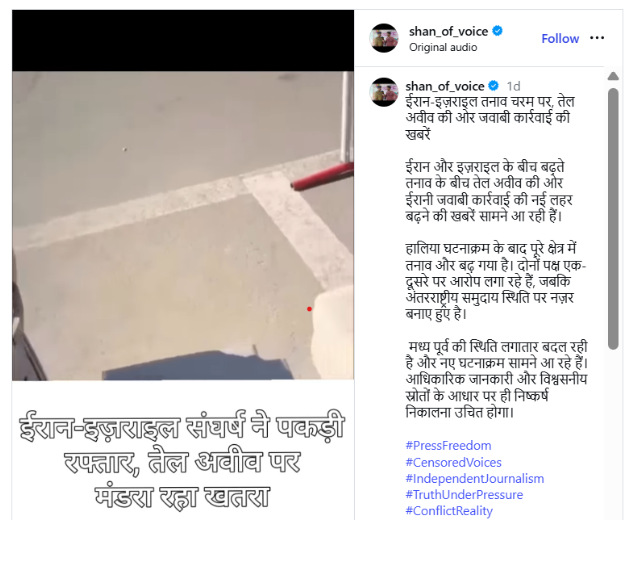
An Instagram user shared the viral video with the caption:“Iran–Israel tensions at peak, reports of retaliatory action towards Tel Aviv… New wave of Iranian response towards Tel Aviv amid escalating tensions between Iran and Israel. The situation in the region continues to intensify as both sides accuse each other, while the international community closely monitors developments. The Middle East situation is rapidly evolving and updates are emerging. It is important to rely only on official information and credible sources.”
https://www.instagram.com/shan_of_voice/reel/DZWRp8vqiM8
https://archive.ph/s26qV
Fact Check
To verify the authenticity of the video, we extracted keyframes and conducted a Google Lens reverse image search. The same footage was found in a report published by The Guardian on 16 September 2025.
According to the report, the video shows a Russian drone strike on a building in Kharkiv, Ukraine, in which three men and one woman were injured.
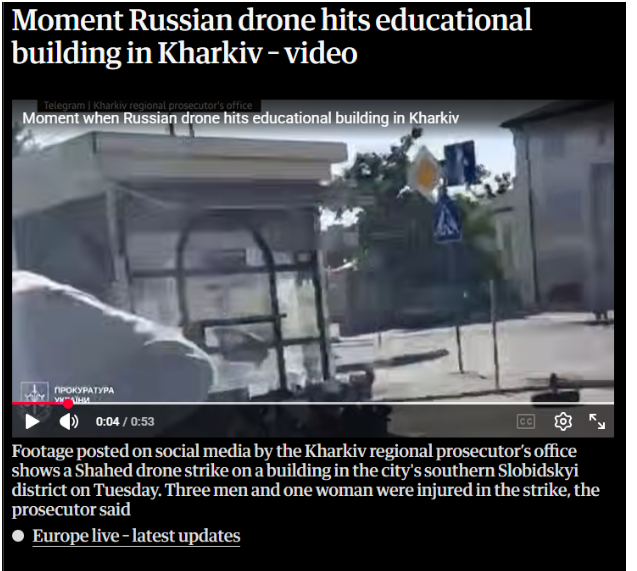
Further verification through keyword search led us to the same footage on the official YouTube channel of Associated Press, published on 17 September 2025.
https://www.youtube.com/watch?v=cAke3aAhPxs
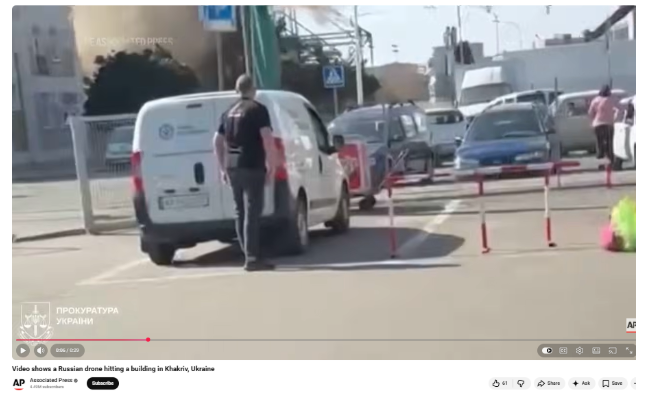
The Associated Press also confirmed that the video shows a Russian drone strike on a building in Kharkiv, Ukraine.
Conclusion
Our research found that the viral video has no connection to the ongoing Iran–Israel tensions or any attack on Tel Aviv. The footage is from a Russian drone strike in Kharkiv, Ukraine (September 2025), and is being misleadingly shared in the context of the West Asia conflict.
Related Blogs

In recent months, conversations around the possible shortage of liquefied petroleum gas (LPG), a basic cooking fuel in Indian households, have quietly resurfaced across the country. From whispers in local markets to viral messages circulating on social media, concerns about LPG availability began to take hold in the public imagination. Though the immediacy of the situation has since faded, its echoes remain, reminding us how quickly uncertainty can spread. Like a ripple across still water, a single rumour can travel far, gathering force as it moves and blurring the line between perception and reality.
Against this backdrop, in April 2026, reports began circulating about a potential LPG shortage. The Union Government moved quickly to counter what it identified as misinformation, emphasising that supply remained stable and urging citizens not to engage in panic buying. A noticeable disconnect emerged between official communication and public perception. Across different regions, signs of anxiety-driven behaviour became evident. Instances of panic buying and hoarding increased, law enforcement agencies conducted raids to address such actions, and opportunistic thefts were reported, often exploiting widespread concern. These incidents highlight how misinformation, even when addressed promptly, can continue to shape public behaviour.
It is worth noting that rising prices also played a role in shaping public response, as increases in LPG rates contributed to a sense of urgency among consumers. Therefore, the surge in panic buying cannot be attributed solely to misinformation, but rather to a combination of economic pressures and perceived scarcity.
Misinformation Ecosystem - From Rumours to Behaviour
The spread of misinformation is occurring at an unprecedented pace and is, in large part, driven by the viral nature of social media. Digital platforms not only enable the rapid dissemination of information but also allow it to be amplified in ways that would not be possible through traditional media outlets. Often, the drive for virality outweighs any concern for accuracy, meaning that many individuals who spread misinformation are motivated more by the pursuit of attention than by any ideological agenda. Recent arrests of individuals involved in spreading misinformation about LPG and petrol shortages, much of which went viral, suggest that misinformation today is frequently driven by the desire for visibility rather than ideological motives. The information being circulated has largely followed a similar pattern, focusing on fears of an LPG shortage, expectations of price increases, and concerns about supply disruptions. Even though this information has not been verified, it has triggered behavioural responses among individuals. In several areas, including parts of Uttar Pradesh and Goa, the spread of misinformation through social media has led to panic buying, despite official assurances that there would be sufficient LPG supply to meet demand.
The impact of panic buying, and its associated misinformation, has already been seen in multiple sectors; these increased demands have placed pressure on the distribution network, leading to disruptions in access, as well as being out of stock of certain products. In many cases, commercial users of products (especially restaurants) have experienced significant disruption, threatening their continued operations, and industry representatives have alerted others about the inconsistent supply of commercial cylinders; likewise, consumers (households) are beginning to switch to alternative products (e.g., induction cooking) as a reflection of the anticipatory mindset to address the uncertainty created through perceptions of Product Scarcity.
State Response: Managing Misinformation or Behaviour?

The government has taken a variety of approaches, from advisories and enforcement actions to communicating with citizens indirectly. For example, State Governments have been directed to combat misinformation, monitor supply chains and take action against hoarding and black market activity. There has been a significant increase in the level of large- scale enforcement activity, with over 3,700 raids carried out to crack down on hoarding and black marketing related to LPG, in addition to confiscating cylinders and issuing penalties to those who break the law. In addition, the authorities have also focused on maintaining regular communication with the public in order to reassure them about the supply of LPG and fuel stability.
Geopolitical Context: Why Rumours Are Believable
Understanding today’s panic requires an understanding of the global environment: i.e., due to the ongoing conflict in West Asia, the energy markets are unstable, and energy supply is uncertain not only in West Asia but across a large part of the world. Even if domestic supply remains stable, public perception is affected by global instability. A clear example of this can be seen in neighbouring countries to India; Pakistan has seen significant increases in the cost of fuel, implemented measures such as reducing the number of days individuals work each week, and has created public support mechanisms; Bangladesh has imposed restrictions on the use of energy, has shortened the number of hours individuals can operate businesses each day, and has restricted the total amount of energy used; Sri Lanka has begun to ration fuel, and to increase the price of petrol; and Nepal has reduced the numbers of days individuals may work each week, and has adjusted supply.
All of these examples are not isolated instances, but are markers of a common regional environment. As we live in a global community that is connected in many ways, these developments will quickly affect public expectations everywhere. Therefore, for consumers in India, seeing evidence of rationing of fuel and shortages of fuel in neighbouring countries increases their belief that these types of problems could occur in their country.
Critical Perspective: Between Panic and Precaution
The LPG incident has brought about questions surrounding the nature of misinformation in terms of its definition & regulation. One of the main concerns is whether or not "misinformation" is being cast too widely. To be sure, false claims need to be addressed; however, not everything that is responded to publicly is based on untrue facts, as many times public responses are based on perceived risk via global and/or local incidents that occur. Perhaps the greatest challenge is the difficulty in differentiating precaution and panic. People’s memories of the COVID-19 pandemic are fresh in their minds and will serve to influence their behaviours moving onward, in that many people are stockpiling or preparing for uncertainty not out of irrational fear, but as an anticipatory response to their prior experiences.
Conclusion
The Indian LPG "crisis" is not so much a problem with actual supply chain breakdown as it is a result of how information and behaviour are connected through perception. This cohabitating environment of panic buying, law enforcement, and government assurance demonstrates an evident disconnect and gap between how governments present a narrative and how the public responds. While there is some role of misinformation within this discourse, the misinformation itself extends beyond any or all false claims about LPG supply and operates within a greater ecosystem of global uncertainty and personal experience. As such, and because of this, perception becomes an incredibly strong force in itself that produces true economic consequences.
Reference
- https://www.pib.gov.in/PressReleasePage.aspx?PRID=2248640&utm_source®=3&lang=2
- https://www.pmindia.gov.in/en/news_updates/pm-addresses-the-lok-sabha-on-the-ongoing-conflict-in-west-asia/
- https://www.ndtv.com/delhi-news/iran-war-middle-east-conflict-why-the-lpg-crisis-is-forcing-migrants-to-quietly-leave-delhi-11313629
- https://timesofindia.indiatimes.com/city/bareilly/thieves-steal-108-lpg-cylinders-from-godown-in-up/articleshow/130035518.cms
- https://indianexpress.com/article/india/arrested-rumours-lpg-petrol-shortage-police-chasing-views-10614193/
- https://www.hindustantimes.com/cities/lucknow-news/social-media-rumours-fuel-panic-buying-in-some-up-districts-situation-normal-in-lucknow-101774465353107.html
- https://timesofindia.indiatimes.com/city/goa/fear-of-shortage-price-rise-fuels-panic-buying-across-goa/articleshow/129810144.cms
- https://www.news18.com/cities/new-delhi-news/online-rumours-offline-rush-panic-buying-sweeps-petrol-pumps-across-cities-whats-the-truth-ws-ln-9995684.html
- https://m.economictimes.com/news/india/3700-raids-conducted-across-country-to-wipe-out-lpg-black-marketing-says-centre/articleshow/130025232.cms
- https://www.reuters.com/business/energy/induction-stoves-fly-off-shelves-india-gas-shortage-fears-spark-panic-buying-2026-03-12/
- https://www.ndtv.com/india-news/restaurant-body-warns-of-closures-over-commercial-lpg-supply-concerns-writes-to-minister-11194418
- https://www.freepressjournal.in/mumbai/fpj-dialogue-we-are-getting-only-1-cylinder-instead-of-10-says-ahar-president-vijay-shetty-on-mumbai-lpg-crisis
- https://www.hindustantimes.com/world-news/fuel-cuts-wfh-and-more-how-indias-neighbours-are-dealing-with-global-energy-crisis-triggered-by-us-iran-war-101775397199941.html
- https://www.abc.net.au/news/2026-03-30/four-step-fuel-supply-plan-national-cabinet-fuel-crisis/106512706
- https://tribune.net.ph/2026/04/07/philippines-scrambles-as-regional-oil-crisis-hits

Introduction
In 2022, Oxfam’s India Inequality report revealed the worsening digital divide, highlighting that only 38% of households in the country are digitally literate. Further, only 31% of the rural population uses the internet, as compared to 67% of the urban population. Over time, with the increasing awareness about the importance of digital privacy globally, the definition of digital divide has translated into a digital privacy divide, whereby different levels of privacy are afforded to different sections of society. This further promotes social inequalities and impedes access to fundamental rights.
Digital Privacy Divide: A by-product of the digital divide
The digital divide has evolved into a multi-level issue from its earlier interpretations; level I implies the lack of physical access to technologies, level II refers to the lack of digital literacy and skills and recently, level III relates to the impacts of digital access. Digital Privacy Divide (DPD) refers to the various gaps in digital privacy protection provided to users based on their socio-demographic patterns. It forms a subset of the digital divide, which involves uneven distribution, access and usage of information and communication technology (ICTs). Typically, DPD exists when ICT users receive distinct levels of digital privacy protection. As such, it forms a part of the conversation on digital inequality.
Contrary to popular perceptions, DPD, which is based on notions of privacy, is not always based on ideas of individualism and collectivism and may constitute internal and external factors at the national level. A study on the impacts of DPD conducted in the U.S., India, Bangladesh and Germany highlighted that respondents in Germany and Bangladesh expressed more concerns about their privacy compared to respondents in the U.S. and India. This suggests that despite the U.S. having a strong tradition of individualistic rights, that is reflected in internal regulatory frameworks such as the Fourth Amendment, the topic of data privacy has not garnered enough interest from the population. Most individuals consider forgoing the right to privacy as a necessary evil to access many services, and schemes and to stay abreast with technological advances. Research shows that 62%- 63% of Americans believe that companies and the government collecting data have become an inescapable necessary evil in modern life. Additionally, 81% believe that they have very little control over what data companies collect and about 81% of Americans believe that the risk of data collection outweighs the benefits. Similarly, in Japan, data privacy is thought to be an adopted concept emerging from international pressure to regulate, rather than as an ascribed right, since collectivism and collective decision-making are more valued in Japan, positioning the concept of privacy as subjective, timeserving and an idea imported from the West.
Regardless, inequality in privacy preservation often reinforces social inequality. Practices like surveillance that are geared towards a specific group highlight that marginalised communities are more likely to have less data privacy. As an example, migrants, labourers, persons with a conviction history and marginalised racial groups are often subject to extremely invasive surveillance under suspicions of posing threats and are thus forced to flee their place of birth or residence. This also highlights the fact that focus on DPD is not limited to those who lack data privacy but also to those who have (either by design or by force) excess privacy. While on one end, excessive surveillance, carried out by both governments and private entities, forces immigrants to wait in deportation centres during the pendency of their case, the other end of the privacy extreme hosts a vast number of undocumented individuals who avoid government contact for fear of deportation, despite noting high rates of crime victimization.
DPD is also noted among groups with differential knowledge and skills in cyber security. For example, in India, data privacy laws mandate that information be provided on order of a court or any enforcement agency. However, individuals with knowledge of advanced encryption are adopting communication channels that have encryption protocols that the provider cannot control (and resultantly able to exercise their right to privacy more effectively), in contrast with individuals who have little knowledge of encryption, implying a security as well as an intellectual divide. While several options for secure communication exist, like Pretty Good Privacy, which enables encrypted emailing, they are complex and not easy to use in addition to having negative reputations, like the Tor Browser. Cost considerations also are a major factor in propelling DPD since users who cannot afford devices like those by Apple, which have privacy by default, are forced to opt for devices that have relatively poor in-built encryption.
Children remain the most vulnerable group. During the pandemic, it was noted that only 24% of Indian households had internet facilities to access e-education and several reported needing to access free internet outside of their homes. These public networks are known for their lack of security and privacy, as traffic can be monitored by the hotspot operator or others on the network if proper encryption measures are not in place. Elsewhere, students without access to devices for remote learning have limited alternatives and are often forced to rely on Chromebooks and associated Google services. In response to this issue, Google provided free Chromebooks and mobile hotspots to students in need during the pandemic, aiming to address the digital divide. However, in 2024, New Mexico was reported to be suing Google for allegedly collecting children’s data through its educational products provided to the state's schools, claiming that it tracks students' activities on their personal devices outside of the classroom. It signified the problems in ensuring the privacy of lower-income students while accessing basic education.
Policy Recommendations
Digital literacy is one of the critical components in bridging the DPD. It enables individuals to gain skills, which in turn effectively addresses privacy violations. Studies show that low-income users remain less confident in their ability to manage their privacy settings as compared to high-income individuals. Thus, emphasis should be placed not only on educating on technology usage but also on privacy practices since it aims to improve people’s Internet skills and take informed control of their digital identities.
In the U.S., scholars have noted the role of libraries and librarians in safeguarding intellectual privacy. The Library Freedom Project, for example, has sought to ensure that the skills and knowledge required to ensure internet freedoms are available to all. The Project channelled one of the core values of the library profession i.e. intellectual freedom, literacy, equity of access to recorded knowledge and information, privacy and democracy. As a result, the Project successfully conducted workshops on internet privacy for the public and also openly objected to the Department of Homeland Security’s attempts to shut down the use of encryption technologies in libraries. The International Federation of Library Association adopted a Statement of Privacy in the Library Environment in 2015 that specified “when libraries and information services provide access to resources, services or technologies that may compromise users’ privacy, libraries should encourage users to be aware of the implications and provide guidance in data protection and privacy.” The above should be used as an indicative case study for setting up similar protocols in inclusive public institutions like Anganwadis, local libraries, skill development centres and non-government/non-profit organisations in India, where free education is disseminated. The workshops conducted must inculcate two critical aspects; firstly, enhancing the know-how of using public digital infrastructure and popular technologies (thereby de-alienating technology) and secondly, shifting the viewpoint of privacy as a right an individual has and not something that they own.
However, digital literacy should not be wholly relied on, since it shifts the responsibility of privacy protection to the individual, who may not either be aware or cannot be controlled. Data literacy also does not address the larger issue of data brokers, consumer profiling, surveillance etc. Resultantly, an obligation on companies to provide simplified privacy summaries, in addition to creating accessible, easy-to-use technical products and privacy tools, should be necessitated. Most notable legislations address this problem by mandating notices and consent for collecting personal data of users, despite slow enforcement. However, the Digital Personal Data Protection Act 2023 in India aims to address DPD by not only mandating valid consent but also ensuring that privacy policies remain accessible in local languages, given the diversity of the population.
References
- https://idronline.org/article/inequality/indias-digital-divide-from-bad-to-worse/
- https://arxiv.org/pdf/2110.02669
- https://arxiv.org/pdf/2201.07936#:~:text=The%20DPD%20index%20is%20a,(33%20years%20and%20over).
- https://www.pewresearch.org/internet/2019/11/15/americans-and-privacy-concerned-confused-and-feeling-lack-of-control-over-their-personal-information/
- https://eprints.lse.ac.uk/67203/1/Internet%20freedom%20for%20all%20Public%20libraries%20have%20to%20get%20serious%20about%20tackling%20the%20digital%20privacy%20divi.pdf
- /https://openscholarship.wustl.edu/cgi/viewcontent.cgi?article=6265&context=law_lawreview
- https://eprints.lse.ac.uk/67203/1/Internet%20freedom%20for%20all%20Public%20libraries%20have%20to%20get%20serious%20about%20tackling%20the%20digital%20privacy%20divi.pdf
- https://bosniaca.nub.ba/index.php/bosniaca/article/view/488/pdf
- https://www.hindustantimes.com/education/just-24-of-indian-households-have-internet-facility-to-access-e-education-unicef/story-a1g7DqjP6lJRSh6D6yLJjL.html
- https://www.forbes.com/councils/forbestechcouncil/2021/05/05/the-pandemic-has-unmasked-the-digital-privacy-divide/
- https://www.meity.gov.in/writereaddata/files/Digital%20Personal%20Data%20Protection%20Act%202023.pdf
- https://www.isc.meiji.ac.jp/~ethicj/Privacy%20protection%20in%20Japan.pdf
- https://socialchangenyu.com/review/the-surveillance-gap-the-harms-of-extreme-privacy-and-data-marginalization/

Executive Summary
A video showing a house collapsing after a massive explosion is being widely shared on social media with the claim that it shows the Indian Armed Forces bombing the house of a minority community in Manipur. CyberPeace Research Wing ’s research found that the claim is false. The viral video dates back to 2023 and shows a house being demolished in Churachandpur during the ethnic violence between the Kuki and Meitei communities in Manipur.
Claim:
An X (formerly Twitter) user shared the video with the caption: “This is Manipur, not Palestine. The Indian Army is destroying minority houses in Manipur.”
The post claimed that the visuals showed the Indian Army carrying out an attack on minority community houses in Manipur.
https://www.facebook.com/reel/1042491035382024

Fact Check:
To verify the claim, CyberPeace Research Wing conducted a reverse image search using keyframes extracted from the viral video. During the search, we found the same video shared by NDTV’s official Instagram account on July 21, 2024.
According to the caption of the post, the video was from 2023, when ethnic clashes broke out between the Kuki and Meitei communities in Manipur. The post stated that the incident took place in Churachandpur, where the house of Naorem Ibomcha Meitei was destroyed by the Kuki community during the violence.
https://www.instagram.com/reels/C9sQWeTSCFx/

Further research revealed that India Today had also shared the same video with similar details
https://www.instagram.com/reels/C9sRq1nSy51/

Conclusion:
The research found that the viral video is being circulated with a misleading claim. The footage does not show the Indian Armed Forces bombing a minority community’s house in Manipur. It is from 2023 and shows the demolition of a house in Churachandpur during the ethnic violence between the Kuki and Meitei communities.