
#FactCheck- Old SCO Summit Video Misrepresented as Pakistan-Iran Meeting
Executive Summary
Amid reports of a two-week ceasefire announced on April 8, 2026, between the United States and Iran, and claims that Pakistan is facilitating peace talks between the two nations, a video showing leaders of Pakistan and Iran meeting has gone viral on social media. The video is being shared with the claim that Pakistani leaders received a grand welcome upon arriving in Iran for the April 11, 2026 talks. However, an research by the CyberPeace found the claim to be misleading. The viral video is not recent but dates back to September 2025.
Claim
An X (formerly Twitter) user shared the video on April 10, 2026, claiming that it shows Pakistani leaders being warmly welcomed in Iran.
Post link:
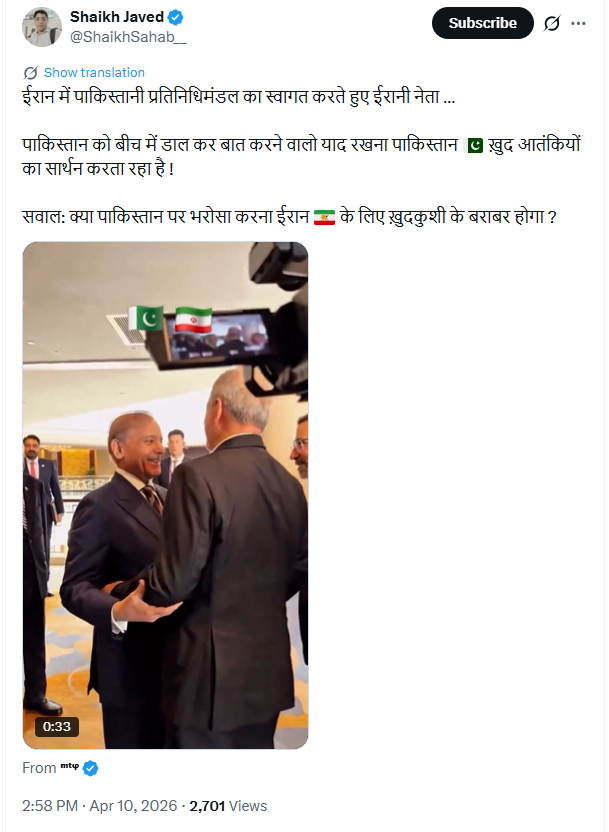
Fact Check
To verify the claim, we extracted keyframes from the viral video and conducted a reverse image search. This led us to the same video posted on a Facebook account named “Bhurgri Siddique” on September 1, 2025.

According to the available information, the video shows a meeting between a Pakistani delegation and Iranian leaders. Further keyword searches helped us locate a longer version of the same video on the official YouTube channel “HT Videos,” also uploaded on September 1, 2025. The video was from the Shanghai Cooperation Organisation Summit 2025 held in China, where leaders from various member countries, including Pakistan and Iran, had met.

Conclusion
The viral claim is misleading. The video does not show any recent meeting or welcome ceremony in Iran linked to the ongoing ceasefire talks. Instead, it is an old clip from September 2025, recorded during the SCO Summit in China. There is no evidence to suggest that the footage is related to current developments between the United States, Iran, and Pakistan. The video has been taken out of context and is being reshared with a false narrative to mislead users.

Related Blogs
.webp)
Introduction
On September 27, 2024, the Indian government took a significant step toward enhancing national security by amending business allocation rules through an extraordinary gazette notification. This amendment, which assigns specific roles to different Union Ministries and Departments regarding telecom network security, cybersecurity, and cybercrime, aims to clarify and streamline efforts in these critical areas. With India's evolving cybersecurity landscape, the need for a structured regulatory framework is pressing, as threats grow in complexity. Recent developments, such as the July 2024 global cyber outage and increasing cyber crimes like SMS scams, highlight the urgency of such reforms. Under Article 77 clause (3), the President amended the Government of India (Allocation of Business) Rules, 1961, to designate clearer responsibilities, reinforcing India's readiness to tackle emerging digital threats.
Key Highlights of the Gazette Notification
- Telecom Networks Security: A new entry ‘1A’ matters relating to the security of telecom networks" has been added under the Department of Telecommunications, highlighting an increased focus on securing the nation's telecom infrastructure.
- Cyber Security Responsibilities: Cyber security responsibilities have been added as a new entry under the Ministry of Electronics and Information Technology (MeitY), "5B. This assigns responsibility to MeitY for cybersecurity issues, concerning the Information Technology Act of 2000, giving the ministry the mandate to support other ministries or departments regarding cybersecurity matters.
- Oversight for Cyber Crime: Under the Ministry of Home Affairs, Department of Internal Security, a new entry "36A Matters relating to Cyber Crime" is introduced. This emphasises that the MHA will handle cybercrime issues, highlighting the government's attention toward enhancing internal security against cyber threats.
- Cyber Security Strategic Coordination: Any matter related to the "overall coordination and strategic direction for Cyber Security," has been given to the National Security Council Secretariat (NSCS). This consolidates the role of the NSCS in guiding cybersecurity strategies at the national level.
Impact on Policy and Governance
The amendments introduced through the notification are poised to significantly enhance the Indian government's cybersecurity framework by clarifying the roles of various ministries. The clear separation of responsibilities, telecom network security to the Department of Telecommunications, cybercrime to the Ministry of Home Affairs, and overall cyber strategy to the National Security Council Secretariat could seen as better coordination between ministries. This clarity is expected to reduce bureaucratic delays, allowing for quicker response times in addressing cyber threats, cybercrimes, and telecom vulnerabilities. Such efficient handling is crucial, especially in the evolving landscape of digital threats. These changes have been largely welcomed as it recognises the potential for improved regulatory oversight and faster policy implementation and a step forward in bolstering India’s cyber resilience.
Conclusion
The Government of India (Allocation of Business) Rules, 1961 amendments mark a critical step in strengthening India's cybersecurity framework. By setting out specific responsibilities for telecom network security, cybercrime, and overall cybersecurity strategy among key ministries, the government seeks to improve coordination and reduce bureaucratic delays. This policy shift is poised to enhance India’s digital resilience, providing a foundation for rapid responses to emerging cyber threats. However, success hinges on effective implementation, resource allocation, and collaboration across ministries. Addressing concerns like potential jurisdictional overlap and ensuring the inclusion of bodies like NCIIPC will be pivotal to ensuring comprehensive cyber protection. The complexity of cyber crimes and threats is evolving every day and the government's ability and preparedness to handle them with regulatory insight is a high priority.
References
- https://egazette.gov.in/(S(4r5oclueuwrjypfvr5b4vtzg))/ViewPDF.aspx
- https://www.ptinews.com/story/national/govt-specifies-roles-on-matters-related-to-security-of-telecom-network-cyber-security-and-cyber-crime/1856627
- https://www.thehindubusinessline.com/economy/centre-to-further-streamline-mechanism-to-deal-with-cyber-security-cyber-crime/article68694330.ece
- https://telecom.economictimes.indiatimes.com/news/policy/govt-specifies-roles-on-matters-related-to-security-of-telecom-network-cyber-security-and-cyber-crime/113754501

Introduction
To combat the problem of annoying calls and SMS, telecom regulator TRAI has urged service providers to create a uniform digital platform in two months that will allow them to request, maintain, and withdraw customers’ approval for promotional calls and messages. In the initial stage, only subscribers will be able to initiate the process of registering their consent to receive promotional calls and SMS, and later, business entities will be able to contact customers to seek their consent to receive promotional messages, according to a statement issued by the Telecom Regulatory Authority of India (TRAI) on Saturday.
TRAI Directs Telecom Providers to Set Up Digital Platform
TRAI has now directed all access providers to develop and deploy the Digital Consent Acquisition (DCA) facility for creating a unified platform and process to digitally register customers’ consent across all service providers and principal entities. Consent is received and maintained under the current system by several key entities such as banks, other financial institutions, insurance firms, trading companies, business entities, real estate businesses, and so on.
The purpose, scope of consent, and the principal entity or brand name shall be clearly mentioned in the consent-seeking message sent over the short code,” according to the statement.
It stated that only approved online or app links, call-back numbers, and so on will be permitted to be used in consent-seeking communications.
TRAI issued guidelines to guarantee that all voice-based Telemarketers are brought under a single Distributed ledger technology (DLT) platform for more efficient monitoring of nuisance calls and unwanted communications. It also instructs operators to actively deploy AI/ML-based anti-phishing systems as well as to integrate tech solutions on the DLT platform to deal with malicious calls and texts.
TRAI has issued two separate Directions to Access Service Providers under TCCCPR-2018 (Telecom Commercial Communications Customer Preference Regulations) to ensure that all promotional messages are sent through Registered Telemarketers (RTMs) using approved Headers and Message Templates on Distributed Ledger Technologies (DLT) platform, and to stop misuse of Headers and Message Templates,” the regulator said in a statement.
Users can already block telemarketing calls and texts by texting 1909 from their registered mobile number. By dialing 1909, customers can opt out of getting advertising calls by activating the do not disturb (DND) feature.

Telecom providers operate DLT platforms, and businesses involved in sending bulk promotional or transactional SMS must register by providing their company information, including sender IDs and SMS templates.
According to the instructions, telecom companies will send consent-seeking messages using the common short code 127. The goal, extent of consent, and primary entity/brand name must be clearly stated in the consent-seeking message delivered via the shortcode.
TRAI stated that only whitelisted URLs/APKs (Android package kits file format)/OTT links/call back numbers, etc., shall be used in consent-seeking messages.
Telcos must “ensure that promotional messages are not transmitted by unregistered telemarketers or telemarketers using telephone numbers (10 digits numbers).” Telecom providers have been urged to act against all erring telemarketers in accordance with the applicable regulations and legal requirements.
Users can, however, refuse to receive any consent-seeking messages launched by any significant Telcos have been urged to create an SMS/IVR (interactive voice response)/online service for this purpose.
According to TRAI’s timeline, the consent-taking process by primary companies will begin on September 1.According to a nationwide survey conducted by a local circle, 66% of mobile users continue to receive three or more bothersome calls per day, the majority of which originate from personal cell numbers.
There are scams surfacing on the internet with new types of scams, like WhatsApp international call scams. The latest scam is targeting Delhi police, the scammers pretend to be police officials of Delhi and ask for the personal details of the users and the calling them from a 9-digit number.
A recent scam
A Twitter user reported receiving an automated call from +91 96681 9555, stating, “This call is from Delhi Police.” It went on to ask her to stay in the queue since some of her documents needed to be picked up. Then he said he is a sub-inspector at New Delhi’s Kirti Nagar police station. He then questioned if she had lately misplaced her Aadhaar card, PAN card, or ATM card, to which she replied ‘no’. The fraudster then claims to be a cop and asks her to validate the final four digits of her card because they have discovered a card with her name on it. And so many other people tweeted about this.
The scams are constantly increasing as earlier these scammers asked for account details and claimed to be Delhi police and used 9-digit numbers for scamming people.
TRAI’s new guidelines regarding the consent to receive any promotional calls and messages to telecommunication providers will be able to curb the scams.
The e- KYC is an essential requirement as e-KYC offers a more secure identity verification process in an increasingly digital age that uses biometric technologies to provide quick results.
Conclusion
The aim is to prevent unwanted calls and communications sent to customers via digital methods without their permission. Once this platform is implemented, an organization can only send promotional calls or messages with the customer’s explicit approval. Companies use a variety of methods to notify clients about their products, including phone calls, text messages, emails, and social media. Customers, however, are constantly assaulted with the same calls and messages as a result of this practice. With the constant increase in scams, the new guideline of TRAI will also curb the calling of Scams. digital KYC prevents SIM fraud and offers a more secure identity verification method.

Introduction
The Telecommunications Act of 2023 was passed by Parliament in December, receiving the President's assent and being published in the official Gazette on December 24, 2023. The act is divided into 11 chapters 62 sections and 3 schedules. Sections 1, 2, 10-30, 42-44, 46, 47, 50-58, 61 and 62 already took effect on June 26, 2024.
On July 04, 2024, the Centre issued a Gazetted Notification and sections 6-8, 48 and 59(b) were notified to be effective from July 05, 2024. The Act aims to amend and consolidate the laws related to telecommunication services, telecommunication networks, and spectrum assignment and it ‘repeals’ certain older colonial-era legislations like the Indian Telegraph Act 1885 and Indian Wireless Telegraph Act 1933. Due to the advancements in technology in the telecom sector, the new law is enacted.
On 18 July 2024 Thursday, the telecom minister while launching the theme of Indian Mobile Congress (IMC), announced that all rules and provisions of the new Telecom Act would be notified within the next 180 days, hence making the Act operational at full capacity.
Important definitions under Telecommunications Act, 2023
- Authorisation: Section 2(d) entails “authorisation” means a permission, by whatever name called, granted under this Act for— (i) providing telecommunication services; (ii) establishing, operating, maintaining or expanding telecommunication networks; or (iii) possessing radio equipment.
- Telecommunication: Section 2(p) entails “Telecommunication” means transmission, emission or reception of any messages, by wire, radio, optical or other electro-magnetic systems, whether or not such messages have been subjected to rearrangement, computation or other processes by any means in the course of their transmission, emission or reception.
- Telecommunication Network: Section 2(s) entails “telecommunication network” means a system or series of systems of telecommunication equipment or infrastructure, including terrestrial or satellite networks or submarine networks, or a combination of such networks, used or intended to be used for providing telecommunication services, but does not include such telecommunication equipment as notified by the Central Government.
- Telecommunication Service: Section 2(t) entails “telecommunication service” means any service for telecommunication.
Measures for Cyber Security for the Telecommunication Network/Services
Section 22 of the Telecommunication Act, 2023 talks about the protection of telecommunication networks and telecommunication services. The section specifies that the centre may provide rules to ensure the cybersecurity of telecommunication networks and telecommunication services. Such measures may include the collection, analysis and dissemination of traffic data that is generated, transmitted, received or stored in telecommunication networks. ‘Traffic data’ can include any data generated, transmitted, received, or stored in telecommunication networks – such as type, duration, or time of a telecommunication.
Section 22 further empowers the central government to declare any telecommunication network, or part thereof, as Critical Telecommunication Infrastructure. It may further provide for standards, security practices, upgradation requirements and procedures to be implemented for such Critical Telecommunication Infrastructure.
CyberPeace Policy Wing Outlook:
The Telecommunication Act, 2023 marks a significant change & growth in the telecom sector by providing a robust regulatory framework, encouraging research and development, promoting infrastructure development, and measures for consumer protection. The Central Government is empowered to authorize individuals for (a) providing telecommunication services, (b) establishing, operating, maintaining, or expanding telecommunication networks, or (c) possessing radio equipment. Section 48 of the act provides no person shall possess or use any equipment that blocks telecommunication unless permitted by the Central Government.
The Central Government will protect users by implementing different measures, such as the requirement of prior consent of users for receiving particular messages, keeping a 'Do Not Disturb' register to stop unwanted messages, the mechanism to enable users to report any malware or specified messages received, the preparation and maintenance of “Do Not Disturb” register, to ensure that users do not receive specified messages or class of specified messages without prior consent. The authorized entity providing telecommunication services will also be required to create an online platform for users for their grievances pertaining to telecommunication services.
In certain limited circumstances such as national security measures, disaster management and public safety, the act contains provisions empowering the Government to take temporary possession of telecom services or networks from authorised entity; direct interception or disclosure of messages, with measures to be specified in rulemaking. This entails that the government gains additional controls in case of emergencies to ensure security and public order. However, this has to be balanced with appropriate measures protecting individual privacy rights and avoiding any unintended arbitrary actions.
Taking into account the cyber security in the telecommunication sector, the government is empowered under the act to introduce standards for cyber security for telecommunication services and telecommunication networks; and encryption and data processing in telecommunication.
The act also promotes the research and development and pilot projects under Digital Bharat Nidhi. The act also promotes the approach of digital by design by bringing online dispute resolution and other frameworks. Overall the approach of the government is noteworthy as they realise the need for updating the colonial era legislation considering the importance of technological advancements and keeping pace with the digital and technical revolution in the telecommunication sector.
References:
- The Telecommunications Act, 2023 https://acrobat.adobe.com/id/urn:aaid:sc:AP:88cb04ff-2cce-4663-ad41-88aafc81a416
- https://pib.gov.in/PressReleasePage.aspx?PRID=2031057
- https://pib.gov.in/PressReleaseIframePage.aspx?PRID=2027941
- https://economictimes.indiatimes.com/industry/telecom/telecom-news/new-telecom-act-will-be-notified-in-180-days-bsnl-4g-rollout-is-monitored-on-a-daily-basis-scindia/articleshow/111851845.cms?from=mdr
- https://www.azbpartners.com/wp-content/uploads/2024/06/Update-Staggered-Enforcement-of-Telecommunications-Act-2023.pdf
- https://telecom.economictimes.indiatimes.com/blog/analysing-the-impact-of-telecommunications-act-2023-on-digital-india-mission/111828226
