
#FactCheck - Fake Navbharat Times Graphic Falsely Attributes Casteist Remark to Devkinandan Thakur
A news graphic bearing the Navbharat Times logo is being widely circulated on social media. The graphic claims that religious preacher Devkinandan Thakur made an extremely offensive and casteist remark targeting the ‘Shudra’ community. Social media users are sharing the graphic and claiming that the statement was actually made by Devkinandan Thakur. Cyber Peace Foundation’s research and verification found that the claim being shared online is misleading. Our research found that the viral news graphic is completely fake and that Devkinandan Thakur did not make any such casteist statement.
Claim
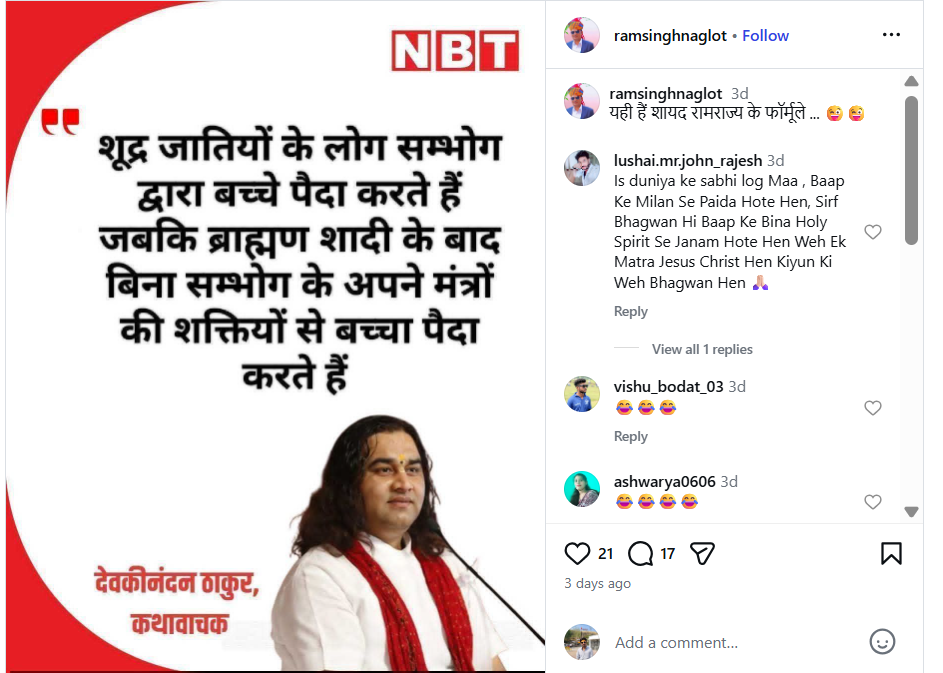
A viral news graphic claims that Devkinandan Thakur made a derogatory and caste-based statement about Shudras.On 17 January 2026, an Instagram user shared the viral graphic with the caption, “This is probably the formula of Ram Rajya.”The text on the graphic reads: “People of Shudra castes reproduce through sexual intercourse, whereas Brahmins give birth to children after marriage through the power of their mantras, without intercourse.” The graphic also carries Devkinandan Thakur’s photograph and identifies him as a ‘Kathavachak’ (religious storyteller).
Fact Check:
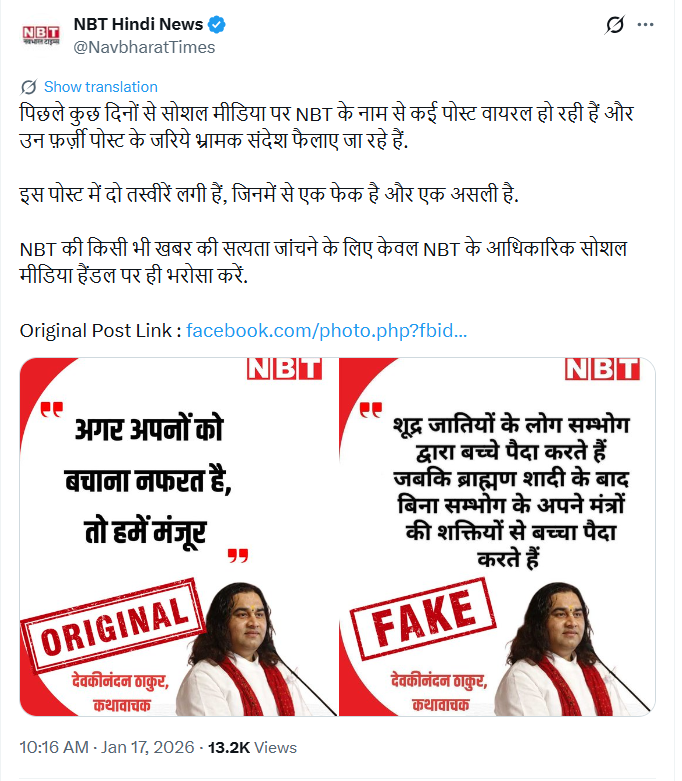
To verify the claim, we first searched for relevant keywords on Google. However, no credible or verified media reports were found supporting the claim. In the next stage of verification, we found a post published by NBT Hindi News (Navbharat Times) on X (formerly Twitter) on 17 January 2026, in which the organisation explicitly debunked the viral graphic. Navbharat Times clarified that the graphic circulating online was fake and also shared the original and authentic post related to the news.
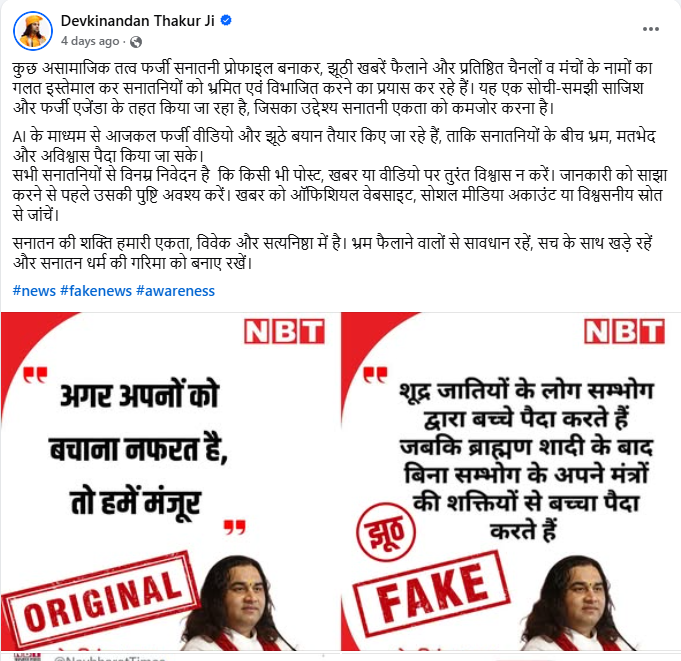
Further research led us to Devkinandan Thakur’s official Facebook account, where he posted a clarification on 17 January 2026. In his post, he stated that anti-social elements are creating fake ‘Sanatani’ profiles and spreading false news, misusing the names of reputed media houses and platforms to mislead and divide people. He described the viral content as part of a deliberate conspiracy and fake agenda aimed at weakening unity. He also warned that AI-generated fake videos and fabricated statements are increasingly being used to create confusion, mistrust and division.
Devkinandan Thakur urged people not to believe or share any post, news or video without verification, and advised checking information through official websites, verified social media accounts or trusted sources.
Conclusion
The viral news graphic attributing a casteist statement to Devkinandan Thakur is completely fake.Devkinandan Thakur did not make the alleged remark, and the graphic circulating with the Navbharat Times logo is fabricated.

Related Blogs
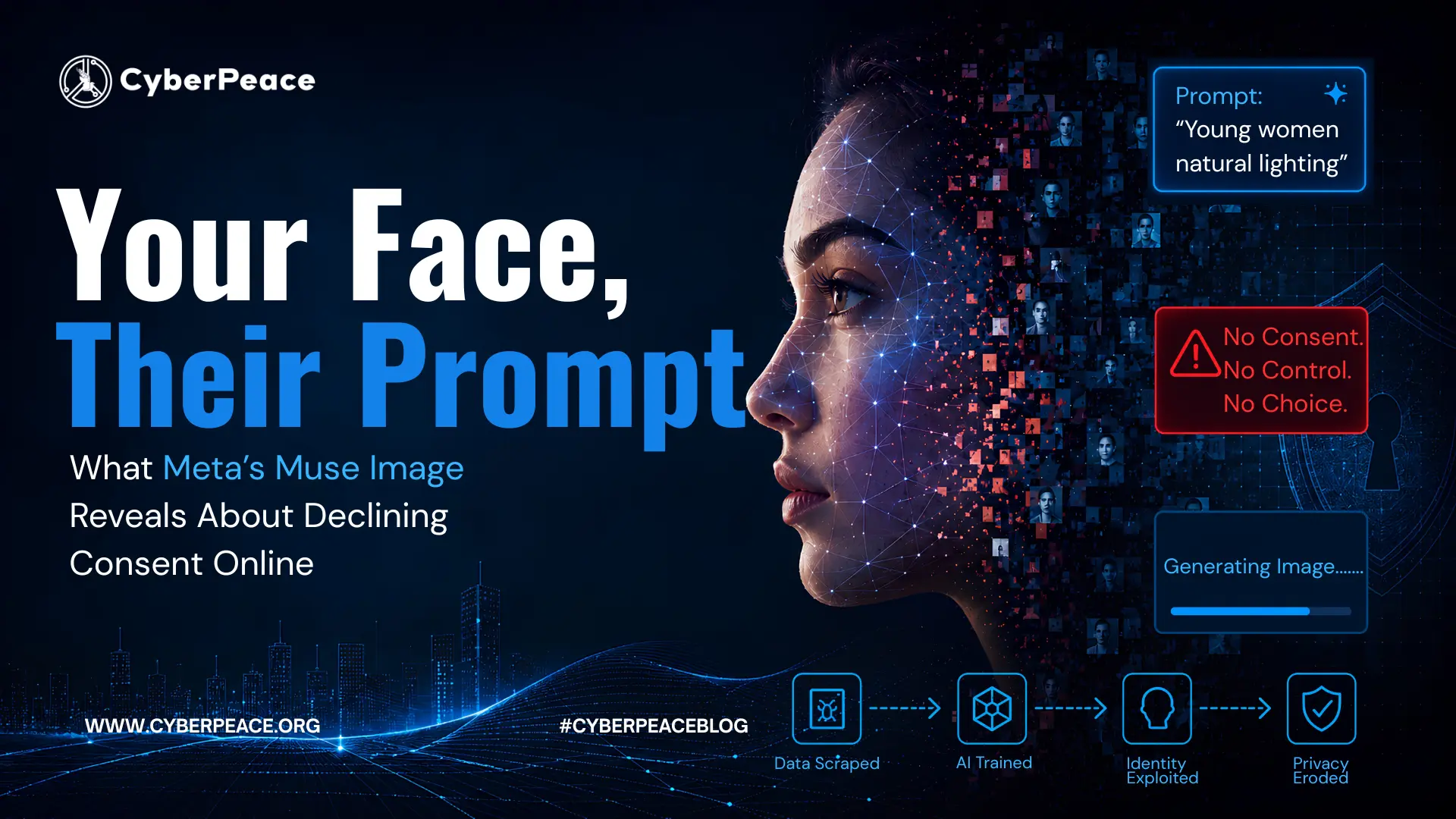
When your digital identity becomes raw material for someone else’s imagination, who really owns your face?
On July 7, 2026, Meta launched Muse Image, the first standalone image-generation model developed by Meta Superintelligence Labs under Alexandr Wang. Positioned as a competitor to OpenAI’s GPT Images 2.0 and Google’s Nano Banana 2, the launch highlights Meta’s growing ambitions in the generative AI race. Yet beneath the technical advancements lies a far more consequential question than what AI can create, but about who gets to decide what it creates with?
That ambition of generative AI comes with a cost, and one of Muse Image's most controversial design choices is its integration with Instagram, which allows public profiles to become creative references for AI-generated images. Users can tag public Instagram accounts in prompts and generate AI images inspired by that person’s publicly available content. Meta presents this as a new form of personalization and creativity. However, critics argue that the feature transforms years of personal photographs into a massive library of AI-ready human identities, where non-action automatically becomes permission. The concern is not just that AI can generate realistic images. The concern is that consent itself is being manipulated in a way.
The opt-out system most users never asked for
Muse Image operates through Meta AI’s integration with Instagram. A user can reference a public Instagram profile in a prompt, allowing the system to generate images influenced by that person’s existing content and likeness. Under the default arrangement, the person whose profile is being referenced may not necessarily approve the generation beforehand.
Meta does provide users with controls to restrict this functionality. The setting exists under Instagram’s “Sharing and reuse” options, where users can disable permissions related to the use of their posts and reels with Meta’s AI features. But the larger issue is the direction in which responsibility flows. Instead of requiring active permission before someone’s likeness becomes available for AI-generated content, the burden is placed on individuals to discover the feature, understand the implications, locate the setting, and disable it. In a digital environment where users already navigate endless privacy menus, cookie banners, and terms of service agreements, expecting meaningful awareness from billions of people becomes unrealistic. Consent that depends on finding the exit door is very different from consent that begins with a choice.
A guide for opting-out
One way of opting out is to have a private account. As verified, Meta does not encroach on private accounts as of now for image-generation.
But if you have a public account, here are the steps that can be followed to secure yourself from Meta’s Muse automatic consent:
On your profile, tap the menu bar which is on the top right (≡), you will enter into ‘setting and activity’, after that you will see an option of ‘sharing and refuse’ and then disable the options under it, namely- Allow people to reuse your content on Instagram and with AI features at Meta. Notably, the changes made will be only for your future content not the already existing content on your public profile.
Why “public” does not mean “available for anything”
The debate around Muse Image highlights a deeper misunderstanding at the center of modern digital platforms: the difference between visibility and reuse. When someone makes an Instagram account public, they are generally making a decision about the audience. They are allowing others to view their photos, discover their profile, or engage with their content. That decision was never traditionally understood as permission for their face, appearance, personal moments, or identity markers to become reusable components in AI-generated media. A photograph posted online has context. It represents a specific moment, purpose, relationship, or expression. Generative AI changes that equation because it separates identity from context. A person’s likeness can be extracted from its original context and placed into entirely new situations created by someone else. Muse Image does not just expand who can see your content. It expands what can be done with it. That distinction is what scales the problem for every public user on the app. The privacy implications become significantly larger because of Instagram’s global reach. With billions of users worldwide, even a small percentage of affected public accounts represents an enormous number of people. Many public profiles do not belong to celebrities, influencers, or creators who intentionally operate as public brands. They belong to students, professionals, small businesses, artists, photographers, and everyday users who simply chose visibility within a social network.
For years, platforms encouraged people to share more, build audiences, and maintain a public digital presence. Now, the meaning of that public presence is changing after the fact. The question becomes: should a decision made years ago to share photos socially automatically extend into permission for generative AI systems built years later?
There is also a catch while opting out. Changing these settings only protects your content from being used in future AI generations, it does not undo anything that has already happened. Any AI images previously created using your public profile will remain unaffected. Essentially, the opt-out works as a shield for what comes next, not a reset button for what has already been created.
A familiar pattern in the AI era
Muse Image reflects a broader pattern emerging across the technology industry. New AI capabilities are introduced at massive scale, participation becomes the default, and individual control arrives afterward through settings that many users may never find. The same debates that once surrounded targeted advertising, data collection, and algorithmic profiling are now moving into a far more personal territory, the human identity itself. Faces are not ordinary data points. Unlike a username, password, or preference setting, a person cannot simply replace their appearance once it has been widely replicated.
Technical solutions such as AI watermarking and content labels may help identify generated material, but they address authenticity after creation. They do not answer the question of whether the generation should have happened in the first place.
Innovation cannot replace consent
The technological progress behind Muse Image is significant. Better image generation, improved text rendering, and more personalized creative tools represent genuine advances in artificial intelligence. But capability alone cannot determine acceptability. The future of AI will not only depend on how realistic images become, how powerful models become, or how quickly companies can deploy new features. It will also depend on whether people feel they have meaningful control over their own digital identities. Muse Image is therefore more than another AI product launch. It represents a defining question for the next phase of the internet: Will our online presence remain something we control, or will it become something others can generate?

Introduction
In a world perpetually in motion, the currents of the information superhighway surge ceaselessly, molding perceptions, shaping realities, and often blurring the lines that tether truth to its moorings. At the heart of this relentless churn lies a conundrum that has become all too familiar, in which veracity is obscured by the shadow-play of misinformation. Emblematic of this dilemma is the narrative of Virat Kohli, a name that has become synonymous not only with cricketing brilliance but with the complexities of a modern era where digital echo chambers amplify half-truths and outright fabrications with alarming efficacy.
It is within this intricate fabric of the digital realm that the saga of Virat Kohli—a titan of cricket whose arsenal of strokes and strategic acumen have captivated audiences worldwide—takes on a dimension that transcends the sport. The speculative murmurs have been converted into roaring waves of misinformation, crafting a narrative that, while devoid of truth, assumes a disconcerting life. This digital osmosis, the transmutation from a quiet inkling to a deafening chorus of credibility, exemplifies the troublesome dynamic that has come to define our interactions with news media in the 21st century.
Fact check: Viral Misinformation
A viral post about Virat Kohli's mother suffering from liver issues has gone viral on social media. The claim came after Kohli withdrew from the India-England test series citing 'personal reasons'. Vikas Kohli, brother of Virat Kohli, clarified on Instagram that the viral news about their mother is false. He clarified that their mother is doing well and the viral claim is false. Vikas Kohli's Instagram page dismissed the viral claim, stating that he noticed the fake news and requested the media not to spread such news without proper information.
Fake Health Crisis
As this virulent strain of rumour regarding the health of Saroj Kohli, Virat Kohli’s mother, began to swell into the digital domain, it brought to the forefront a critical examination of the checks and balances within our networks of communication. Saroj, whose resilience and nurturing presence had been an anchor in the athlete's storied journey, undeservedly became the nucleus of a fictitious tale of despair, giving us pause to reflect on the ethical boundaries of storytelling in the world of clicks and views.
Vikas Kohli—the elder brother of Virat Kohli—took to social media, the very platform from which the falsehood originated, to stand as the bulwark against the spread of this groundless narrative.
The Consequences
The consequences of such falsehoods and their rapid dissemination are manifold, affecting individuals and communities in profound ways. The motivations behind the proliferation of deceitful stories are as labyrinthine as the networks they traverse - from manipulation and economic incentives to the pursuit of sheer sensationalism or cynical entertainment, each strand intertwines to form an intricate web wherein truth struggles to assert itself.
Conclusion
In the ceaseless expanses of the digital cosmos, where one can easily drift into the void of falsities, let the narrative of Virat Kohli stand as a sentinel, a reminder of our duty to navigate these waters with vigilance and to preserve the sanctity of truth. Amidst the vast ocean of content that laps in our consciousness, it is precisely this unwavering dedication to facts that will act as our compass, enabling us to discern the credible beacons from the deceptive mirages and ultimately ensuring that our discourse remains moored in the bedrock of reality.
References
- https://www.thequint.com/news/webqoof/virat-kohli-mother-sick-liver-disease-fact-check
- https://indianexpress.com/article/sports/cricket/ind-vs-eng-virat-kohlis-brother-dismisses-fake-news-circulating-about-their-mother-9136144/
- https://www.outlookindia.com/amp/story/sports/ind-vs-eng-virat-kohlis-brother-slams-fake-news-on-their-mothers-health

Introduction
India envisions reaching its goal of becoming Viksit Bharat by 2047. With a net-zero emissions target by 2070, it has already reduced GDP emission intensity by 36% (from 2005 to 2020) and is working towards a 45% reduction goal by 2030. This will help the country achieve economic growth while minimizing environmental impact, ensuring sustainable development for the future. The 2025 Union Budget prioritises energy security, clean energy expansion, and green tech manufacturing. Furthermore, India’s promotion of sustainability policies in startups, MSMEs, and clean tech shows its commitment to COP28 and SDGs. India’s key policy developments for sustainability and energy efficiency include the Energy Conservation Act (2022), PAT scheme, S&L scheme, and the Energy Conservation Building Code, driving decarbonization, energy efficiency, and a sustainable future.
India’s Policy and Regulatory Landscape
The Indian law of Energy Conservation (Amendment) Act which was enacted in 2022 aims at enhancing energy efficiency while ensuring economic growth. It works on the aim of reducing emission intensity by 2030. The Act tackles regulatory, financial, and awareness barriers to promote energy-saving technologies. Next, the Perform, Achieve, and Trade (PAT) Scheme improves cost-effective energy efficiency in energy-intensive industries through tradable energy-saving certificates. Adding on, the PLI Scheme boosts green manufacturing by attracting investments, both domestically and internationally. The Bureau of Energy Efficiency (BEE) enforces Minimum Energy Performance Standards (MEPS) and star ratings for appliances, guiding consumers toward energy-efficient choices. These initiatives collectively drive carbon reduction and sustainable energy use in India.
Growth of Energy-Efficient Technologies
India has been making massive strides in its integration of renewable energy, such as solar and wind energies, mainly due to improvements in storage technologies. Another key development is the real-time optimization of energy usage through smart grids and AI-driven energy management. The EV and green mobility boom has been charged through by the rapid expansion of charging infrastructure and the policy interventions to support the shift. The building of green building codes and IoT-driven energy management has led to building efficiency, and finally, the efforts for industrial energy optimisation have been met through AI/ML-driven demand-side management in heavy industries.
Market Trends, Investment, and Industry Adoption
The World Energy Investment Report 2024 (IEA) projects global energy investment to surpass $3 trillion, with $2 trillion allocated to clean energy. India’s clean energy investment reached $68 billion in 2023, a 40%+ rise from 2016-2020, with nearly 50% directed toward low-emission power, including solar PV. Investment is set to double by 2030 but needs a 20% further rise to meet climate goals.
India’s ESG push is driven by Net Zero 2070, SEBI’s BRSR mandates, and UN SDGs, with rising scrutiny on corporate governance. ESG-aligned investments are expanding, reinforcing sustainability. Meanwhile, energy efficiency in manufacturing minimizes waste and environmental impact, while digital transformation in energy management boosts renewable integration, grid reliability, and cost efficiency, ensuring a sustainable energy transition.
The Way Forward
There are multiple implementation bottlenecks present for the active policies which include infrastructure paucity, financing issues and even the on-ground implementational challenges of the active policies. To combat these issues India needs to adopt measures for promoting public-private partnerships to scale energy-efficient solutions. Incentives for industries to adopt green technologies should be strengthened (tax exemptions and subsidies for specific periods), with increased R&D support and regulatory sandboxes to encourage adoption. Finally, the role of industries, policymakers and consumers needs to be in tandem to accelerate the efforts made towards a sustainable and green future for India. Emerging technologies play an important in bridging gaps and aim towards the adoption of global best practices for India.
References
- https://instituteofsustainabilitystudies.com/insights/lexicon/green-technologies-innovations-opportunities-challenges/
- https://powermin.gov.in/sites/default/files/The_Energy_Conservation_Amendment_Act_2022_0.pdf
- https://www.ibef.org/blogs/esg-investing-in-india-navigating-environmental-social-and-governance-factors-for-sustainable-growth
