
#FactCheck-Fake Claim Links White House Dinner Shooting Suspect to ‘Indian Wife’; Viral Images Likely AI-Generated
Executive Summary
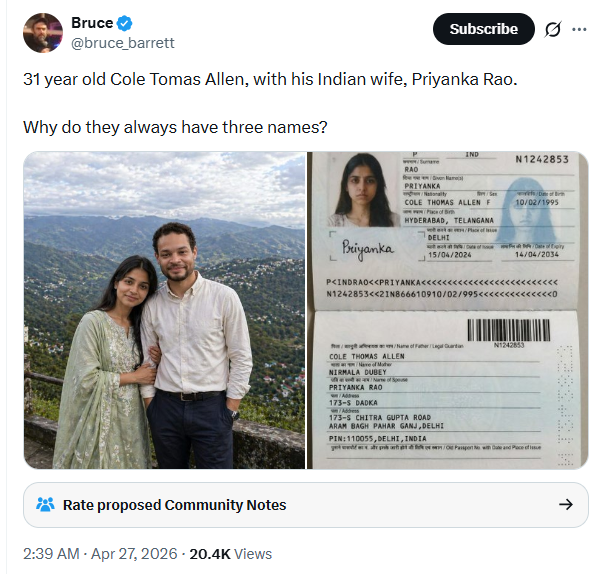
After reports identifying Cole Thomas Allen as the accused in the shooting incident at the White House Correspondents’ Association (WHCA) dinner, several Pakistani propaganda-linked social media accounts began circulating a new claim alleging that the suspect’s wife is an Indian woman named Priyanka Rao. Users shared a photo purportedly showing Cole Thomas Allen with Priyanka Rao, along with an alleged Indian passport in her name. One user posted the image with the caption: “31-year-old Cole Thomas Allen with his Indian wife Priyanka Rao. Why do they always have three names?”
However, research by the CyberPeace Research Wing found the claim to be fake. The viral passport and accompanying image appear to be AI-generated.
Claim:
Social media users claimed that Cole Thomas Allen, accused in the WHCA dinner shooting, is married to an Indian woman named Priyanka Rao.
Fact Check:
During the research, multiple inconsistencies were found in the viral passport image, strongly indicating it is fabricated. A close review of the document revealed several obvious errors commonly seen in AI-generated content. For instance, in the “Nationality” field, the name “Cole Thomas Allen” was written instead of a country name. Such a basic mistake would not appear in any genuine government-issued passport.
The Hindi text on the document was also highly inaccurate and unnatural. Examples included:
- “राष्ट्रीयता” misspelled as “राष्ट्रीयाय”
- “जन्मतिथि” replaced with meaningless text
- “जन्म स्थान” incorrectly written
- “Issue” mistranslated as unrelated wording
- “Date of Expiry” left untranslated in Hindi format
Further analysis using an AI detection tool indicated that the viral passport image had a 69 percent probability of being AI-generated.

Conclusion:
The claim that WHCA dinner shooting accused Cole Thomas Allen has an Indian wife named Priyanka Rao is fake. The viral passport and image being shared online are likely AI-generated and part of a misinformation campaign.

Related Blogs

Introduction
A hacking operation has corrupted data on Madhya Pradesh's e-Nagarpalika portal, a vital online platform for paying civic taxes that serves 413 towns and cities in the state. Due to this serious security violation, the portal has been shut down. The incident occurred in December 2023. This affects citizens' access to vital online services like possessions, water, and municipal tax payments, as well as the issuing of obituaries and certain documents offered via online portal. Ransomware which is a type of malware encodes and conceals a victim's files, and data making it inaccessible and unreachable unless the attacker is paid a ransom. When ransomware initially appeared, encryption was the main method of preventing individuals' data from such threats.
The Intrusion and Database Corruption: Exposing the Breach's Scope
The extent of the assault on the e-Nagarpalika portal was revealed by the Principal Secretary of the Urban Administration and Housing Department of Madhya Pradesh, in a startling revelation. Cybercriminals carried out a highly skilled assault that led to the total destruction of the data infrastructure covering all 413 of the towns for which the website was responsible.
This significant breach represents a thorough infiltration into the core of the electronic civic taxation system, not just an arrangement. Because of the attackers' nefarious intent, the data integrity was compromised, raising questions about the safeguarding of private citizen data. The extent of the penetration reaches vital city services, causing a reassessment of the current cybersecurity safeguards in place.
In addition to raising concerns about the privacy of personal information, the hacked information system casts doubt on the availability of crucial municipal services. Among the vital services affected by this cyberattack are marriage licenses, birth and death documents, and the efficient handling of possessions, water, and municipal taxes.
The weaknesses of electronic systems, which are the foundation of contemporary civic services, are highlighted by this incident. Beyond the attack's immediate interruption, citizens now have to deal with concerns about the security of their information and the availability of essential services. This tragedy is a clear reminder of the urgent need for robust safety safeguards as authorities work hard to control the consequences and begin the process of restoration.
Offline Protections in Place
The concerned authority informed the general population that the offsite data, which has been stored up on recordings every three days, is secure despite the online attack. This preventive action emphasises how crucial offline restores are to lessening the effects of these kinds of cyberattacks. The choice to keep the e-Nagarpalika platform offline until a certain time highlights how serious the matter is and how urgently extensive reconstruction must be done to restore the online services offer
Effect on Civic Services
The e-Nagarpalika website is crucial to providing online municipal services, serving as an invaluable resource for citizens to obtain necessary paperwork and carry out diverse transactions. Civic organisations have been told to function offline while the portal remains unavailable until the infrastructure is fully operational. This interruption prompts worries about possible delays and obstacles citizens face when getting basic amenities during this time.
Examination and Quality Control
Information technology specialists are working diligently to look into the computer virus and recover the website, in coordination with the Madhya Pradesh State Electronic Development Corporation Limited, the state's cyber police, and the Indian Computer Emergency Response Team (CERT-In). Reassuringly for impacted citizens, authorities note that there is currently no proof of data leaks arising from the hack.
Conclusion
The computerised attack on the e-Nagarpalika portal in Madhya Pradesh exposes the weakness of computer networks. It has affected the essential services to public services offered via online portal. The hack, which exposed citizen data and interfered with vital services, emphasises how urgently strong safety precautions are needed. The tragedy is a clear reminder of the need to strengthen technology as authorities investigate and attempt to restore the system. One bright spot is that the offline defenses in place highlight the significance of backup plans in reducing the impact of cyberattacks. The ongoing reconstruction activities demonstrate the commitment to protecting public data and maintaining the confidentiality of essential city operations.
References
- https://government.economictimes.indiatimes.com/tag/cyber+attack
- https://www.techtarget.com/searchsecurity/definition/ransomware#:~:text=Ransomware%20is%20a%20type%20of,accessing%20their%20files%20and%20systems.
- https://www.business-standard.com/india-news/mp-s-e-nagarpalika-portal-suffers-cyber-attack-data-corrupted-officials-123122300519_1.html
- https://www.freepressjournal.in/bhopal/mp-govts-e-nagar-palika-portal-hacked-data-of-over-400-cities-leaked

Introduction
Google Play has announced its new policy which will ensure trust and transparency on google play by providing a new framework for developer verification and app details. The new policy requires that new developer accounts on Google Play will have to provide a D-U-N-S number to verify the business. So when an organisation will create a new Play Console developer account the organisation will need to provide a D-U-N-S number. Which is a nine-digit unique identifier which will be used to verify their business. The new google play policy aims to enhance user trust. And the developer will provide detailed developer details on the app’s listing page. Users will get to know who is behind the app which they are installing.
Verifying Developer Identity with D-U-N-S Numbers
To boost security the google play new policy requires the developer account to provide the D-U-N-S number when creating a new Play Console developer account. The D-U-N-S number assigned by Dun & Bradstreet will be used to verify the business. Once the developer creates his new Play Console developer account by providing a D-U-N-S number, Google Play will verify the developer’s details, and he will be able to start publishing the apps. Through this step, Google Play aims to validate the business information in a more authentic way.
If your organisation does not have a D-U-N-S number, you may check on or request for it for free on this website (https://www.dnb.com/duns-number/lookup.html). The request process for D-U-N-S can take up to 30 days. Developers are also required to keep the information up to date.
Building User Trust with Enhanced App Details
In addition to verifying developer identities in a more efficient way, google play also requires that developer provides sufficient app details to the users. There will be an “App Support” section on the app’s store listing page, where the developer will display the app’s support email address and even can include their website and phone number for support.
The new section “About the developer” will also be introduced to provide users with verified identity information, including the developer’s name, address, and contact details. Which will make the users more informed about the valuable information of the app developers.
Key highlights of the Google Play Polic
- Google Play came up with the policy to keep the platform safe by verifying the developers’ identity and it will also help to reduce the spread of malware apps and help the users to make confident informed decisions about the apps they download. Google Play announced the policy by expanding its developer verification requirement to strengthen Google Play as a platform and build user trust. When you create a new Play Console Developer account and choose organisation as your account type you will now need to provide a D-U-N-S number.
- Users will get detailed information about the developers’ identities and contact information, building more transparency and encouraging responsible app development practices.
- This policy will enable the users to make informed choices about the apps they download.
- The new “App support” section will provide enhanced communication between users and developers by displaying support email addresses, website and support phone numbers, streamlining the support process and user satisfaction.
Timeline and Implementation
The new policy requirements for D-U-N-S numbers will start rolling out on 31 August 2023 for all new Play Console developer accounts. The “About the developer” section will be visible to users as soon as a new app is published. and In October 2023, existing developers will also be required to update and verify their existing accounts to comply with the new verification policy.
Conclusion
Google Play’s new policy will aim to enhance the more transparent app ecosystem. This new policy will provide the users with more information about the developers. Google Play aims to establish a platform where users can confidently discover and download apps. This new policy will enhance the user experience on google play in terms of a reliable and trustworthy platform.
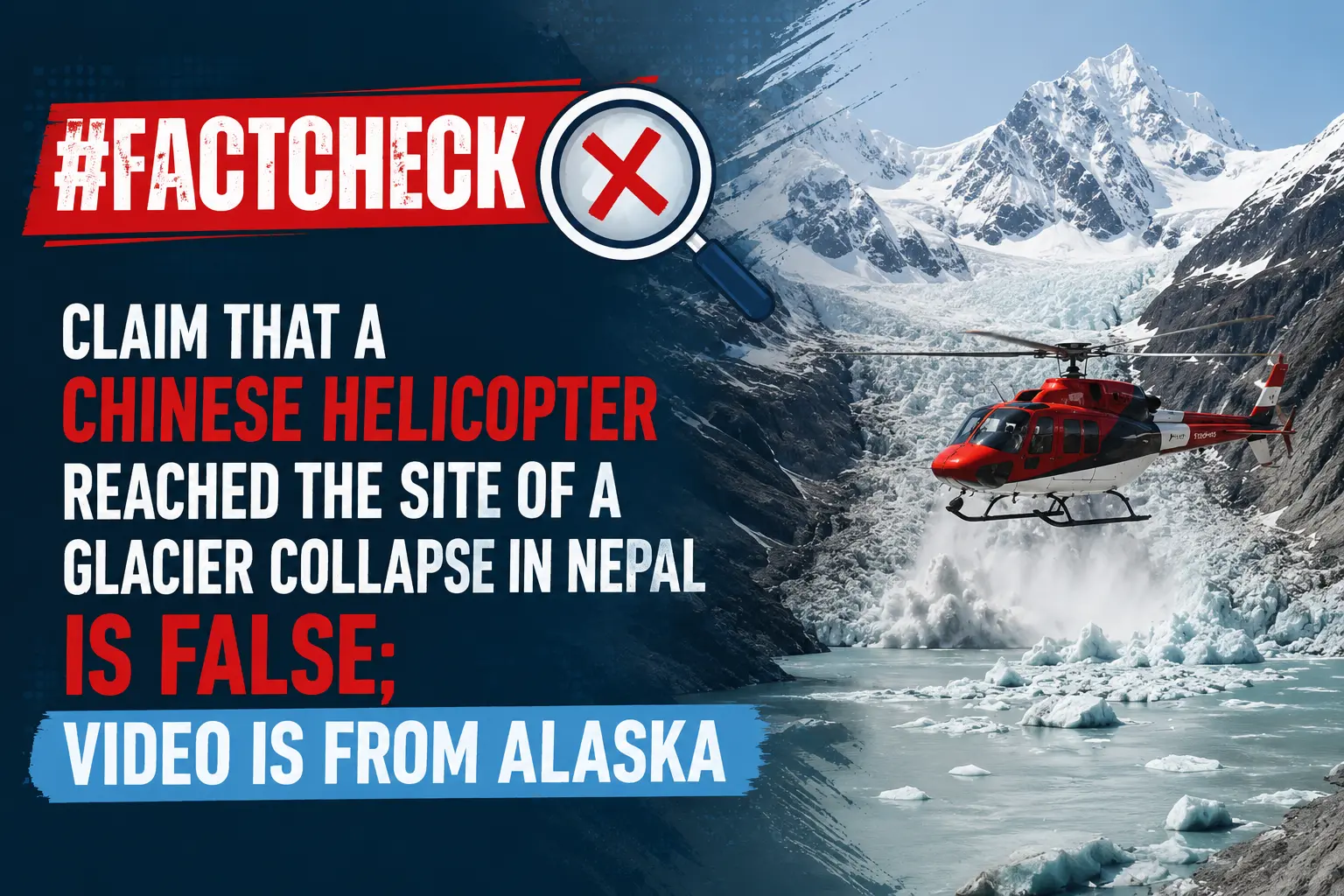
Executive Summary
A video purportedly showing a glacier breaking apart while being filmed from a helicopter is being shared on social media with the claim that a Chinese helicopter has reached the site where a glacier broke apart, triggering floods in Nepal. A research by the Research Wing of the CyberPeace found that the video is actually from Alaska, USA. It was uploaded on Instagram and YouTube by an American pilot, Leigh Kotes, before the recent floods in Nepal, and is unrelated to the incident.
Claim
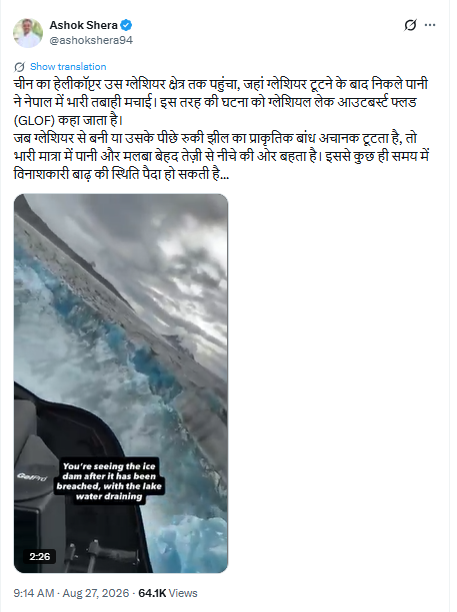
The video is being shared on X with a caption claiming: “A Chinese helicopter reached the glacier region where water released after the glacier broke apart caused massive destruction in Nepal. Such an event is known as a Glacial Lake Outburst Flood (GLOF).”
https://x.com/ashokshera94/status/2092820484811538681
Fact Check
To verify the viral video claiming that a Chinese helicopter reached the site of the glacier break after the floods in Nepal, we conducted a reverse image search using keyframes from the clip. During the search, we found a video featuring the same visuals uploaded on a YouTube account named “Heli Pilot Leigh” on January 16, 2025. The location mentioned with the video identified it as Alaska, USA.
https://www.youtube.com/shorts/floh1LkZT7o

We also found several videos featuring scenes similar to those in the viral video on Ligh Kotes’ YouTube account. Among them, a nearly two-minute-long video uploaded on January 16, 2025, also contains visuals similar to those seen in the viral clip. Recorded from a helicopter, the video shows Ligh extending her mobile phone outside the helicopter to capture footage of water rushing out at high speed following the breaking of a glacier. https://www.youtube.com/watch?v=5vQP5HlyMMY
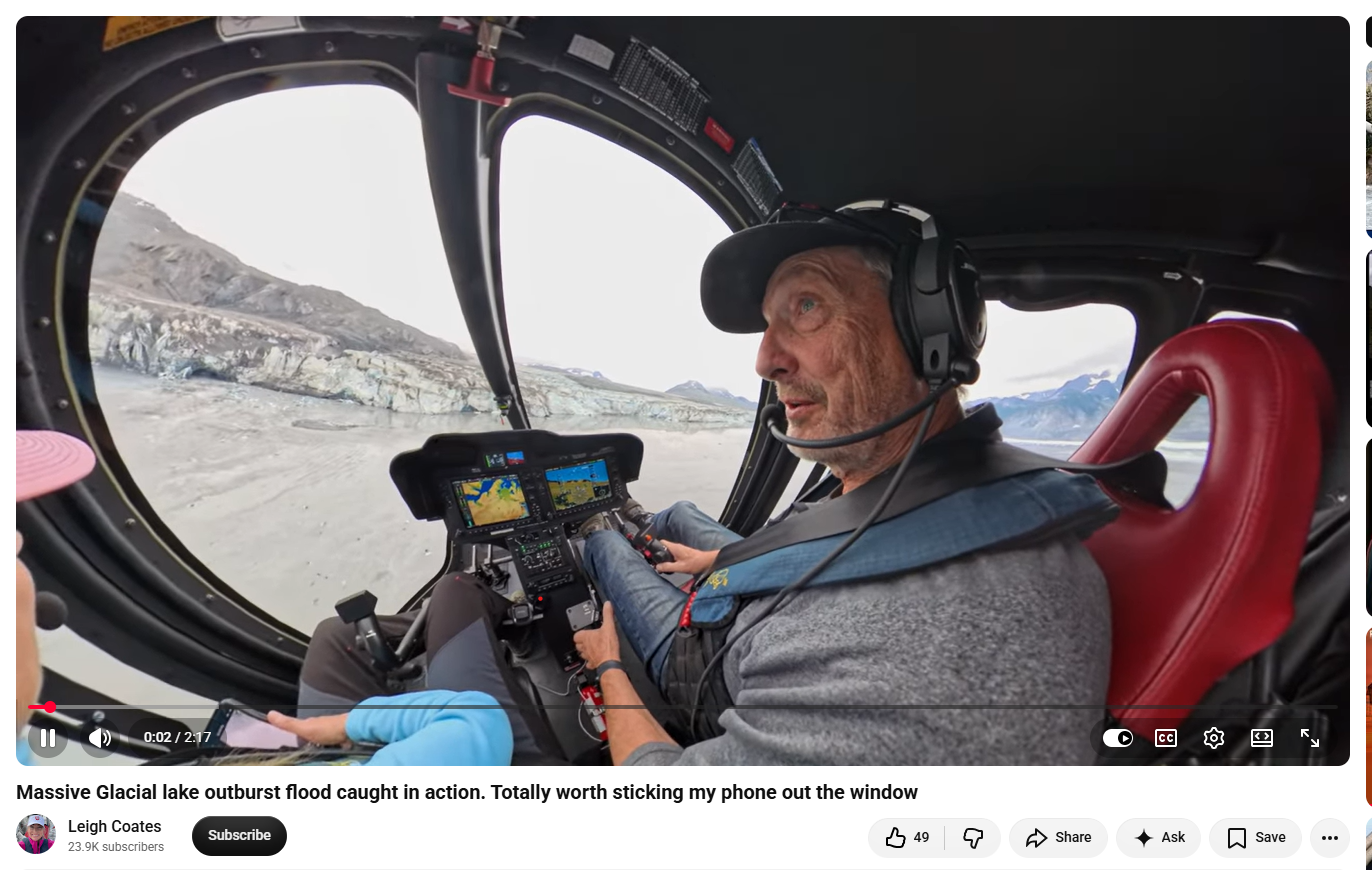
Additionally, our research found that the Columbia Glacier featured in Ligh’s video is located near Valdez, Alaska.
https://www.alaska.org/detail/columbia-glacier

Conclusion
The evidence gathered during our research makes it clear that the viral video, which is being shared with the claim that a Chinese helicopter reached the site of a glacier collapse following floods in Nepal, is actually from the Columbia Glacier in Alaska, USA. The video was recorded by an American pilot, Ligh Kotes.
