
#FactCheck -Social Media Claim of ICC’s One-Year Ban on Pakistan Cricket Is Misleading
Executive Summary:
A purported media release allegedly issued in the name of the International Cricket Council (ICC) is being widely circulated on social media. The release claims that the ICC has decided to impose a one-year ban on Pakistan cricket. CyberPeace’s research found this claim to be false.The research revealed that the media release circulating on social media is fake, and no such letter or official statement has been issued by the ICC.
Claim:
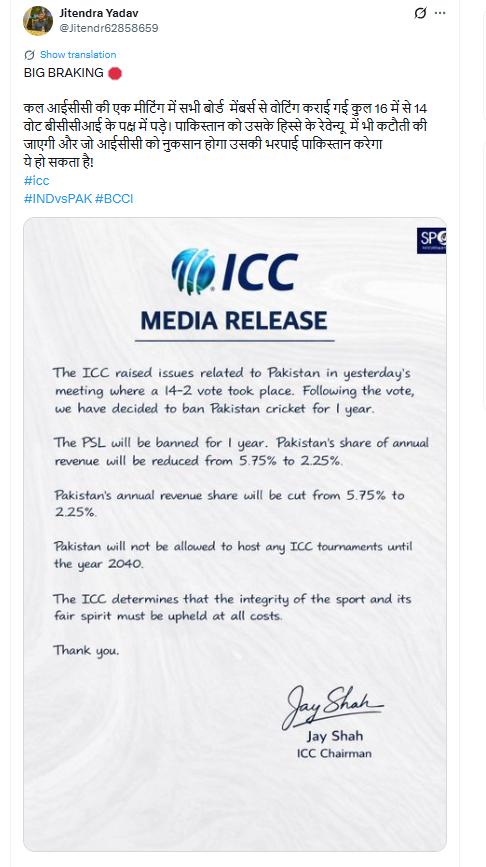
On social media platform X (formerly Twitter), a user shared the viral letter on February 3, 2026, claiming that an ICC meeting was held in which board members voted on issues related to Pakistan. The post alleged that 14 out of 16 votes were cast in favour of the BCCI. The user further claimed that Pakistan’s share of ICC revenue would be reduced and that Pakistan might be asked to compensate for losses incurred by the ICC.
The viral letter, written in English, stated that matters related to Pakistan were discussed in an ICC meeting and that a 14–2 majority vote led to the decision to impose a one-year ban on Pakistan cricket. It further claimed that the Pakistan Super League (PSL) would be suspended for one year, Pakistan’s annual revenue share would be reduced from 5.75 percent to 2.25 percent, and Pakistan would not be allowed to host any ICC tournaments until 2040. The letter also claimed that these decisions were taken to safeguard the integrity and spirit of the game. Links to the viral post, archive link, and screenshots can be seen below.
Fact Check:
To verify the viral claim, CyberPeace conducted a Google search using relevant keywords. However, no credible or reliable media reports supporting the claim were found. In the next step of the research , an official press release uploaded on DD Sports’ Facebook page on February 2, 2026, was found. The press release responded to Pakistan’s decision not to play against India in a Group A match. The DD Sports statement said that the Pakistan Cricket Board should consider the long-term and serious implications of such a decision, as it could impact the global cricket ecosystem—of which Pakistan is itself a member and beneficiary.
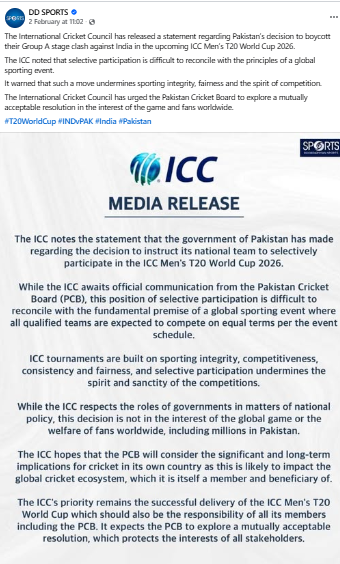
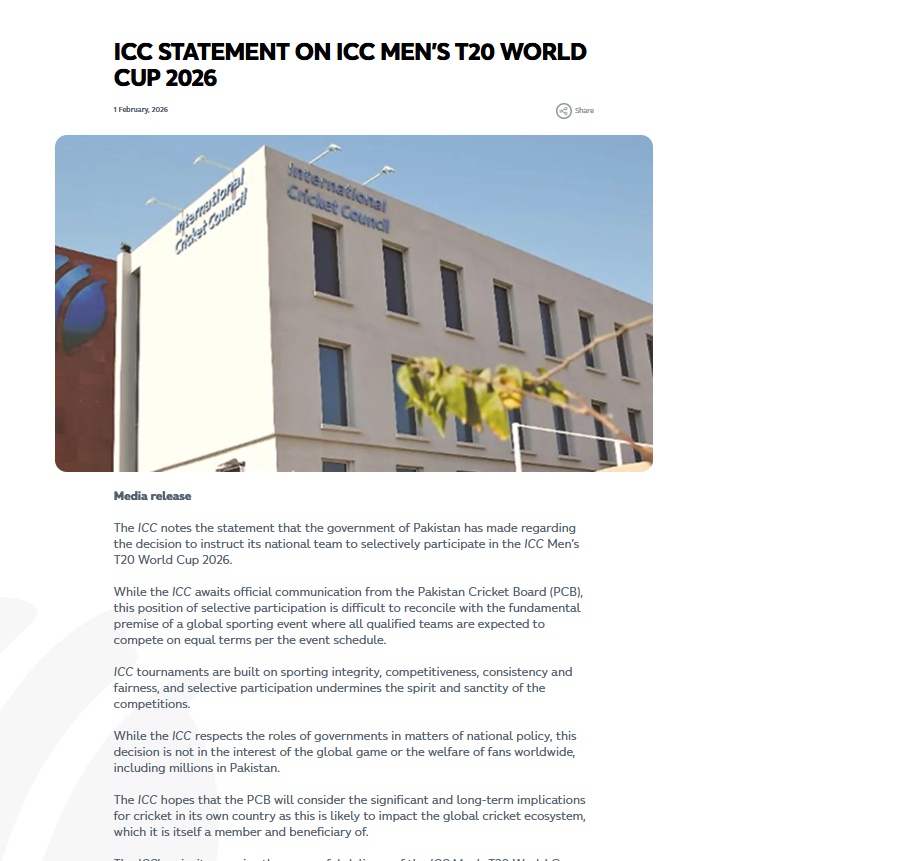
Notably, the official press release made no mention of any ban on Pakistan cricket, reduction in revenue share, suspension of the PSL, or restrictions on hosting ICC tournaments, contrary to the claims made in the viral letter. Further, the same official statement was found published on the ICC’s website on February 1, 2026. This release also did not mention any decision related to banning Pakistan cricket or barring the country from hosting ICC tournaments for the next 40 years.
Conclusion
CyberPeace concludes that the media release circulating on social media is fake. The ICC has not issued any official letter or statement announcing a one-year ban on Pakistan cricket, revenue cuts, or restrictions on hosting ICC tournaments.

Related Blogs
Introduction
In an extensive order of 144 pages passed on May 29, 2026, Justice Sachin Datta of the Delhi High Court inter alia affirmed the right of an acquitted or discharged person to reinstate their digital identity. In a batch of more than 30 petitions relating to acquittals, family dispute cases, quashed criminal cases, and parties to proceedings, the petitioners argued that court documents and accusations, having lost their purpose, have kept occupying the search engine, leading to infringement of dignity, privacy, and career and personal life of these individuals. Citing Article 21 of the Indian Constitution as its foundation, the court affirmed that a right to life and personal liberty also includes a right to privacy and to leave behind failed proceedings and adopted wide de-indexing policies, including, where necessary, global de-indexing, thereby ushering in India's "right to be forgotten."
The Constitutional Argument: Article 21 and the Digital Self
The constitutional basis of the right to be forgotten in India rests on the landmark nine-judge bench ruling in Justice K.S. Puttaswamy v. Union of India. In 2017, the Supreme Court ruled privacy to be a fundamental right under Article 21 of the Constitution and stated informational privacy is a facet of personal liberty. The Supreme Court observed that individuals have an interest in determining how the information concerning them is gathered, disseminated, and accessed.
Building upon this precedent, Justice Sachin Datta held that the right to be forgotten flows naturally from the constitutional guarantee of informational privacy. The judgment represents one of the most significant judicial applications of the Puttaswamy principles, particularly in the context of search engines and online judicial records. Noting the absence of a fully operational statutory framework despite the enactment of the Digital Personal Data Protection Act, 2023, the court exercised its constitutional jurisdiction to protect individuals from enduring digital harm caused by continued public accessibility of outdated or irrelevant personal information.
INDIAN APPLICATION OF THE GLOBAL PRECEDENT
Tracing back the genesis of this right, it lies in the worldwide jurisdiction on privacy, especially the European Court of Justice's landmark ruling of 2014 in Google Spain SL v. AEPD and Mario Costeja Gonzlez, where it ruled that it is within one's power to ask search engines to de-list links that show personal information that is found to be outdated or irrelevant. This led to a legislated right to erasure by the inclusion of Article 17 in the General Data Protection Regulation (GDPR), creating the right throughout the EU. India, on the other hand, saw a slow process of evolution when it came to this right. The Madras High Court acknowledged the right to be forgotten partially in 2021 when it directed a petitioner's name to be deleted from an acquittal judgment, which was affirmed by a Division Bench in 2024. Nevertheless, the above were merely judgments confined to the facts of a particular case. However, the decision of the Delhi High Court dated May 2026 proves to be the benchmark in laying down a comprehensive constitutional framework under Article 21 with guiding principles on when a request for de-linking would be entertained and, if warranted, would be extended throughout the world.
Anatomy of the Framework by the Delhi High Court
While Justice Sachin Datta’s ruling recognizes the right to be forgotten, its actual import lies in devising an operative framework. The Court noted that it would maintain judicial records indefinitely in keeping with open justice principles, but an individual's name may not act as a perennial search key with respect to private entities' search engines. Thus, courts will be allowed to de-index judicial records (except their legal reasoning, findings, and ratio decidendi, which will continue to be accessible) from the names appearing therein from search engines and legal databases. While personally identifying data will be obfuscated, the underlying legal reasoning will not be rendered unusable, as access to unredacted records will continue to be available to courts, parties, and authorities. Such orders are also possible to be effective internationally, rendering avoidance difficult. However, the right cannot be absolute, as it is largely unavailable for convicted individuals (particularly if convicted of offenses against women or children or crimes of breach of trust). Courts must pass a proportionality test in considering the balance between privacy and the public right to know. By stating that masking information has an impact on discoverability, not access, it achieves a reconciliation between informational privacy and open justice so that acquitted accused are not held hostage to past accusations forever in the online age.
The Road to Implementation
However, the judgment presents a thick knot of practical issues, the solution to which may take considerable time to untangle. How will petitions for masking orders be filed by those who need them? Will there be a prescribed form? How will legal database systems such as Indian Kanoon and SCC Online operationalize name-based de-indexing while keeping their vast archives usable for lawyers? More significantly, what kind of legal force will global directions for de-indexing hold over those search engines whose main servers lie outside of Indian territory?
This is not to say the judgment isn't important. It simply presents a predictable, almost mundane set of issues that all ambitious pronouncements on constitutional rights face when translated into the world of administration issues that came up even when the EU was first struggling with enforcing the GDPR in 2018. India now has its framework, and the details of its implementation will undoubtedly come through future rounds of litigation, guidelines, and perhaps even legislation.
What remains abundantly clear, though, is the message conveyed by the Delhi High Court that digital permanency is a crime, especially when it causes the most incriminating of a person's legal actions to follow them perpetually, even long after they have been given due process by the system. As Justice Datta eloquently put it, privacy in the digital age is 'not about secrecy but about an individual's control over the dissemination of personal information.' "Now an element of constitutional law in India, the verdict is a declaration that will resonate long beyond the thirty-odd petitions that called it into being.
Conclusion
The ultimate finding of the 2026 right-to-be-forgotten judgment in Delhi High Court reinforces human dignity in the digital era. The Court has acknowledged the need for acquittals and exonerations to have meaningful implications offline, ensuring an individual is not eternally punished through online searches for alleged wrongdoing. Building on the right to privacy established by K.S. Puttaswamy v. Union of India, informational privacy now stands at the core of constitutional guarantees, and India joins the nations establishing precedents to balance openness with dignity.

In the vast, uncharted territories of the digital world, a sinister phenomenon is proliferating at an alarming rate. It's a world where artificial intelligence (AI) and human vulnerability intertwine in a disturbing combination, creating a shadowy realm of non-consensual pornography. This is the world of deepfake pornography, a burgeoning industry that is as lucrative as it is unsettling.
According to a recent assessment, at least 100,000 deepfake porn videos are readily available on the internet, with hundreds, if not thousands, being uploaded daily. This staggering statistic prompts a chilling question: what is driving the creation of such a vast number of fakes? Is it merely for amusement, or is there a more sinister motive at play?
Recent Trends and Developments
An investigation by India Today’s Open-Source Intelligence (OSINT) team reveals that deepfake pornography is rapidly morphing into a thriving business. AI enthusiasts, creators, and experts are extending their expertise, investors are injecting money, and even small financial companies to tech giants like Google, VISA, Mastercard, and PayPal are being misused in this dark trade. Synthetic porn has existed for years, but advances in AI and the increasing availability of technology have made it easier—and more profitable—to create and distribute non-consensual sexually explicit material. The 2023 State of Deepfake report by Home Security Heroes reveals a staggering 550% increase in the number of deepfakes compared to 2019.
What’s the Matter with Fakes?
But why should we be concerned about these fakes? The answer lies in the real-world harm they cause. India has already seen cases of extortion carried out by exploiting deepfake technology. An elderly man in UP’s Ghaziabad, for instance, was tricked into paying Rs 74,000 after receiving a deep fake video of a police officer. The situation could have been even more serious if the perpetrators had decided to create deepfake porn of the victim.
The danger is particularly severe for women. The 2023 State of Deepfake Report estimates that at least 98 percent of all deepfakes is porn and 99 percent of its victims are women. A study by Harvard University refrained from using the term “pornography” for creating, sharing, or threatening to create/share sexually explicit images and videos of a person without their consent. “It is abuse and should be understood as such,” it states.
Based on interviews of victims of deepfake porn last year, the study said 63 percent of participants talked about experiences of “sexual deepfake abuse” and reported that their sexual deepfakes had been monetised online. It also found “sexual deepfake abuse to be particularly harmful because of the fluidity and co-occurrence of online offline experiences of abuse, resulting in endless reverberations of abuse in which every aspect of the victim’s life is permanently disrupted”.
Creating deepfake porn is disturbingly easy. There are largely two types of deepfakes: one featuring faces of humans and another featuring computer-generated hyper-realistic faces of non-existing people. The first category is particularly concerning and is created by superimposing faces of real people on existing pornographic images and videos—a task made simple and easy by AI tools.
During the investigation, platforms hosting deepfake porn of stars like Jennifer Lawrence, Emma Stone, Jennifer Aniston, Aishwarya Rai, Rashmika Mandanna to TV actors and influencers like Aanchal Khurana, Ahsaas Channa, and Sonam Bajwa and Anveshi Jain were encountered. It takes a few minutes and as little as Rs 40 for a user to create a high-quality fake porn video of 15 seconds on platforms like FakeApp and FaceSwap.
The Modus Operandi
These platforms brazenly flaunt their business association and hide behind frivolous declarations such as: the content is “meant solely for entertainment” and “not intended to harm or humiliate anyone”. However, the irony of these disclaimers is not lost on anyone, especially when they host thousands of non-consensual deepfake pornography.
As fake porn content and its consumers surge, deepfake porn sites are rushing to forge collaborations with generative AI service providers and have integrated their interfaces for enhanced interoperability. The promise and potential of making quick bucks have given birth to step-by-step guides, video tutorials, and websites that offer tools and programs, recommendations, and ratings.
Nearly 90 per cent of all deepfake porn is hosted by dedicated platforms that charge for long-duration premium fake content and for creating porn—of whoever a user wants, and take requests for celebrities. To encourage them further, they enable creators to monetize their content.
One such website, Civitai, has a system in place that pays “rewards” to creators of AI models that generate “images of real people'', including ordinary people. It also enables users to post AI images, prompts, model data, and LoRA (low-rank adaptation of large language models) files used in generating the images. Model data designed for adult content is gaining great popularity on the platform, and they are not only targeting celebrities. Common people are equally susceptible.
Access to premium fake porn, like any other content, requires payment. But how can a gateway process payment for sexual content that lacks consent? It seems financial institutes and banks are not paying much attention to this legal question. During the investigation, many such websites accepting payments through services like VISA, Mastercard, and Stripe were found.
Those who have failed to register/partner with these fintech giants have found a way out. While some direct users to third-party sites, others use personal PayPal accounts to manually collect money in the personal accounts of their employees/stakeholders, which potentially violates the platform's terms of use that ban the sale of “sexually oriented digital goods or content delivered through a digital medium.”
Among others, the MakeNude.ai web app – which lets users “view any girl without clothing” in “just a single click” – has an interesting method of circumventing restrictions around the sale of non-consensual pornography. The platform has partnered with Ukraine-based Monobank and Dublin’s BetaTransfer Kassa which operates in “high-risk markets”.
BetaTransfer Kassa admits to serving “clients who have already contacted payment aggregators and received a refusal to accept payments, or aggregators stopped payments altogether after the resource was approved or completely freeze your funds”. To make payment processing easy, MakeNude.ai seems to be exploiting the donation ‘jar’ facility of Monobank, which is often used by people to donate money to Ukraine to support it in the war against Russia.
The Indian Scenario
India currently is on its way to design dedicated legislation to address issues arising out of deepfakes. Though existing general laws requiring such platforms to remove offensive content also apply to deepfake porn. However, persecution of the offender and their conviction is extremely difficult for law enforcement agencies as it is a boundaryless crime and sometimes involves several countries in the process.
A victim can register a police complaint under provisions of Section 66E and Section 66D of the IT Act, 2000. Recently enacted Digital Personal Data Protection Act, 2023 aims to protect the digital personal data of users. Recently Union Government issued an advisory to social media intermediaries to identify misinformation and deepfakes. Comprehensive law promised by Union IT minister Ashwini Vaishnav will be able to address these challenges.
Conclusion
In the end, the unsettling dance of AI and human vulnerability continues in the dark web of deepfake pornography. It's a dance that is as disturbing as it is fascinating, a dance that raises questions about the ethical use of technology, the protection of individual rights, and the responsibility of financial institutions. It's a dance that we must all be aware of, for it is a dance that affects us all.
References
- https://www.indiatoday.in/india/story/deepfake-porn-artificial-intelligence-women-fake-photos-2471855-2023-12-04
- https://www.hindustantimes.com/opinion/the-legal-net-to-trap-peddlers-of-deepfakes-101701520933515.html
- https://indianexpress.com/article/opinion/columns/with-deepfakes-getting-better-and-more-alarming-seeing-is-no-longer-believing/
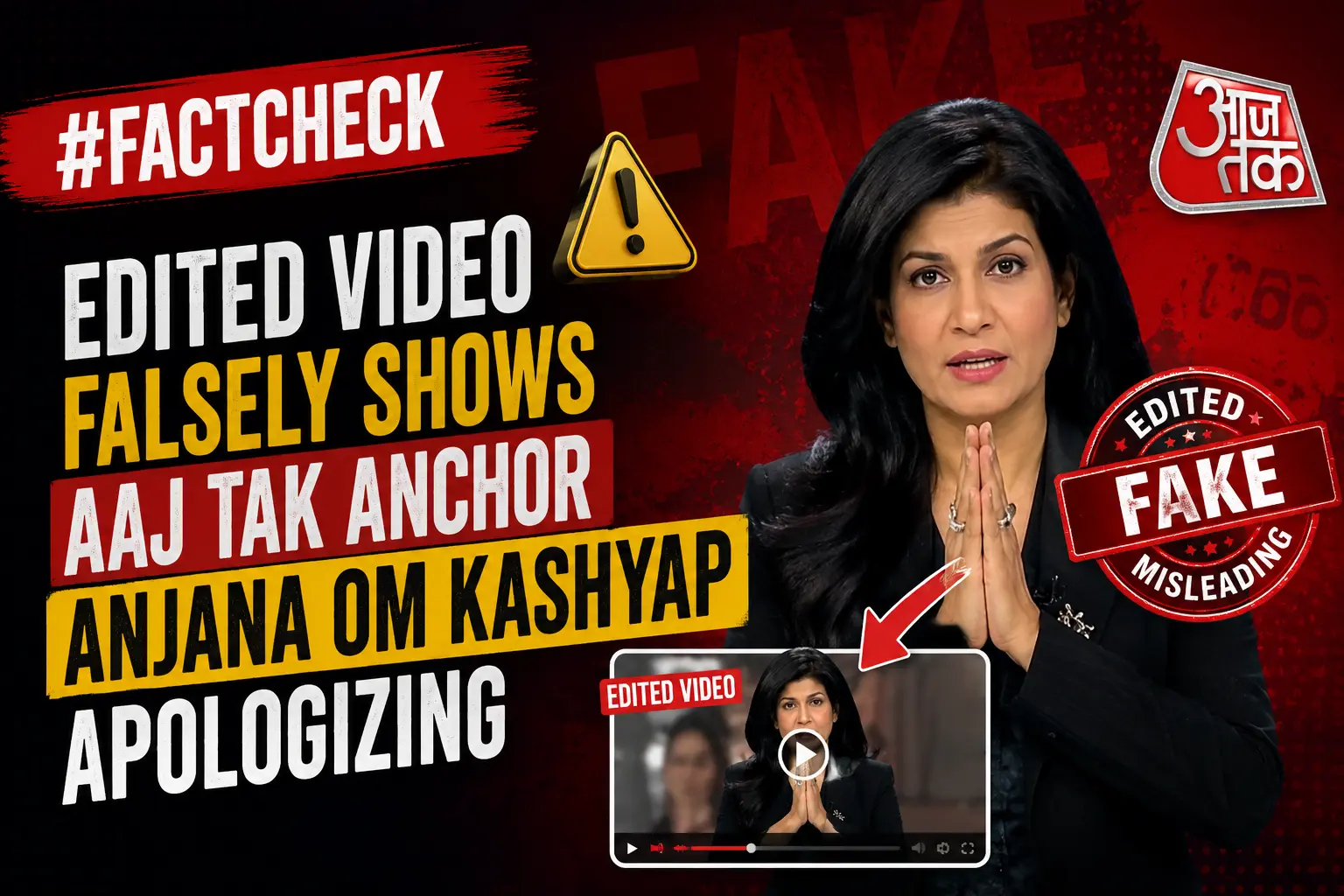
Executive Summary
A purported video of Hindi news channel Aaj Tak anchor Anjana Om Kashyap is being widely shared on social media. In the viral clip, Kashyap appears to be apologising and questioning her own journalistic credibility. The CyberPeace Research Wing research found the claim to be false. The probe revealed that the viral video was created by manipulating an original video of Anjana Om Kashyap. Her voice and statements were altered to falsely portray her as issuing an apology, whereas she made no such remarks in the original footage.
Claim:
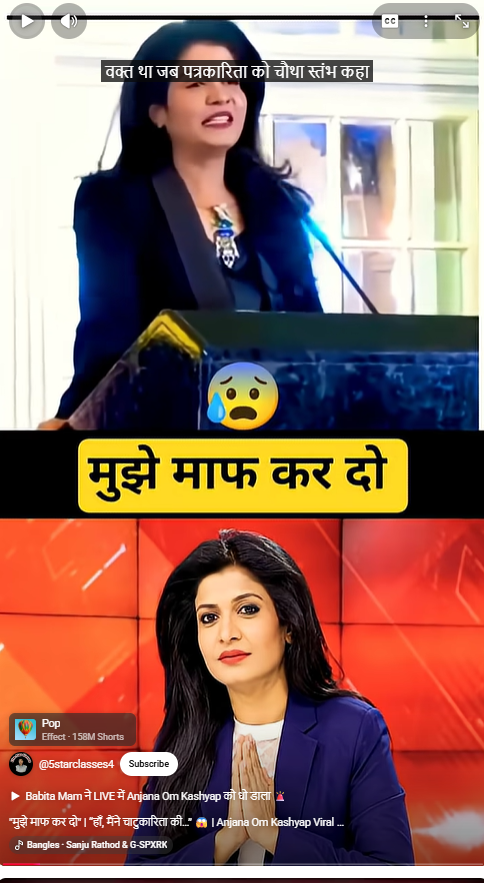
A YouTube user shared the viral video claiming that Anjana Om Kashyap was apologising. The post can be seen here:
Fact Check
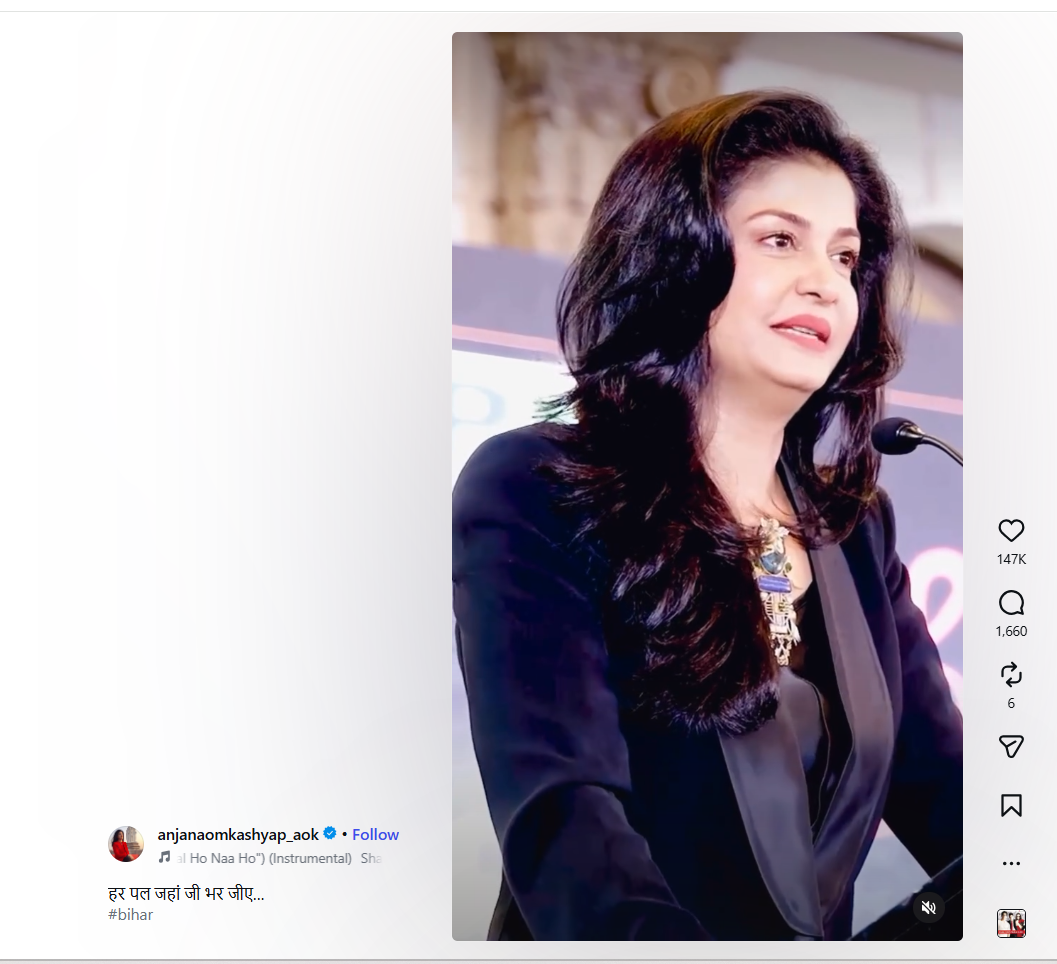
The keyframes of the viral video were analysed using reverse image search. During the research , the original reel was found on Anjana Om Kashyap’s Instagram account, where it was posted on December 26, 2023. In the original reel, Kashyap is seen praising Bihar. At no point does she apologise or make any statements similar to those heard in the viral clip.
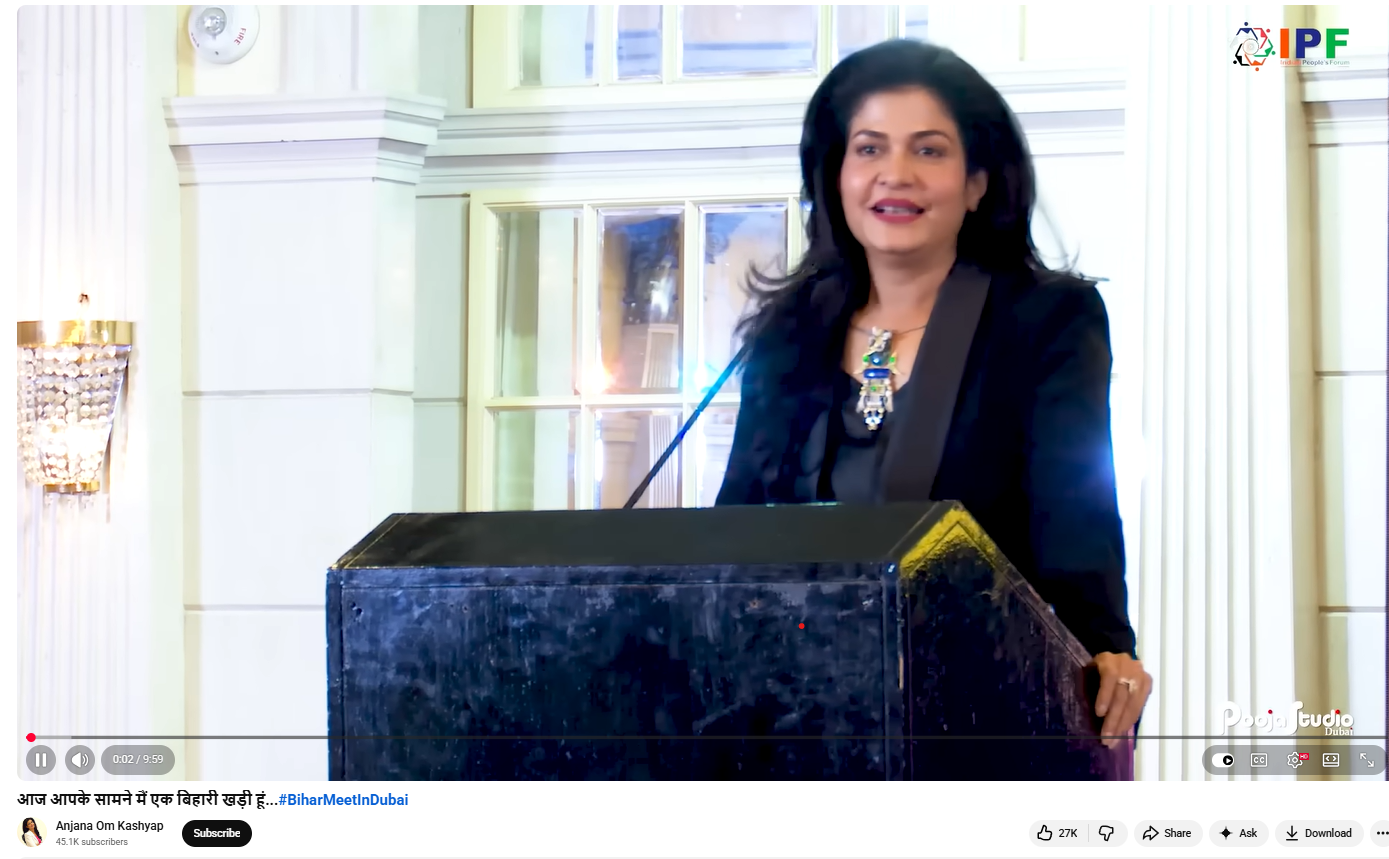
Further research led to the original version of the video on Anjana Om Kashyap’s YouTube channel, uploaded on October 17, 2023. According to the video description, the speech was delivered during the ‘Bihar Meet’ event organised by the Indian People Forum in the UAE. Notably, none of the statements heard in the viral clip appear in the original speech.
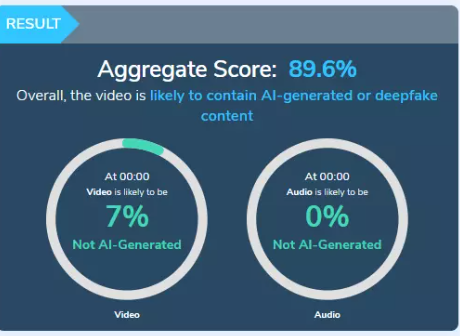
The viral video was also analysed using the AI-detection tool Hive Moderation, which indicated a high likelihood of AI-generated or deepfake manipulation.
Conclusion
The research found that the viral video has been digitally altered and falsely shared on social media. The original video of Anjana Om Kashyap was edited, and the audio was manipulated to create the misleading impression that she was apologising. No such statement was made by her in the authentic video.
