
#FactCheck -AI-Generated Image Misused to Spread False Claim of Assault on Seema Haider by Sachin Meena
Executive Summary
A photo allegedly showing injuries to Seema Haider has been widely circulated on social media. Users are claiming that her husband Sachin Meena assaulted her. However, a fact-check by CyberPeace Research Wing has found the claim to be false. The research reveals that the viral image is AI-generated and is being shared with a misleading narrative.
Claim
On X (formerly Twitter), a user shared the image on May 14, 2026, claiming that Sachin Meena assaulted Seema Haider.

Fact Check
A keyword-based search on Google did not return any credible media reports supporting the viral claim.
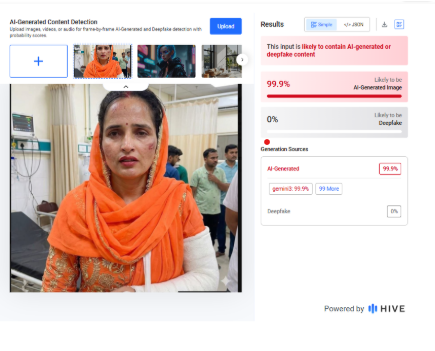
A closer visual examination of the image raised suspicions of AI generation. The image was first analysed using the AI detection tool Hive Moderation, which indicated a 99% probability that the image is AI-generated.
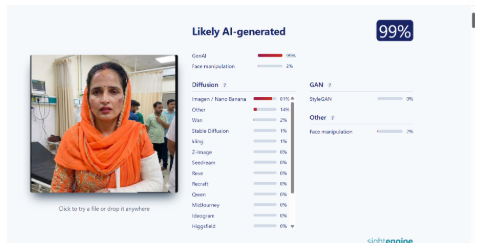
Further analysis using another AI detection tool, Sightengine, also produced similar results, confirming a 99% likelihood that the image was generated using AI tools.
Conclusion
The viral image is AI-generated and misleading. The claim that Sachin Meena assaulted Seema Haider is false and has no factual basis.

Related Blogs

Overview:
It is worth stating that millions of Windows users around the world are facing the Blue Screen of Death (BSOD) problem that makes systems shutdown or restart. This has been attributed to a CrowdStrike update that was released recently and has impacted many organizations, financial institutions, and government agencies across the globe. Indian airlines have also reported disruptions on X (formerly Twitter), informing passengers about the issue.
Understanding Blue Screen of Death:
Blue Screen errors, also known as black screen errors or STOP code errors, can occur due to critical issues forcing Windows to shut down or restart. You may encounter messages like "Windows has been shut down to prevent damage to your computer." These errors can be caused by hardware or software problems.
Impact on Industries
Some of the large U. S. airlines such as American Airlines, Delta Airlines, and United Airlines had to issue ground stops because of communication problems. Also, several airports on Friday suffered a massive technical issue in check-in kiosks for IndiGo, Akasa Air, SpiceJet, and Air India Express.
The Widespread Issue
The issue seems widespread and is causing disruption across the board as Windows PCs are deployed at workplaces and other public entities like airlines, banks, and even media companies. It has been pointed out that Windows PCs use a special cybersecurity solution from a company called CrowdStrike that seems to be the culprit for this outage, affecting most Windows PC users out there.
Microsoft's Response
The issue was acknowledged by Microsoft and the mitigations are underway. The company in its verified X handle Microsoft 365 status has shared a series information on the latest outage and they are looking into the matter. The issue is under investigation.
In one of the posts from Microsoft Azure, it is mentioned that they have become aware of an issue affecting Virtual Machines (VMs) running Windows Client and Windows Server with the CrowdStrike Falcon agent installed. These VMs may encounter a bug check (BSOD) and become stuck in a restarting state. Their analysis indicates that this issue started approximately at 19:00 UTC on July 18th. They have provided recommendations as follows:
Restore from Backup: In case customers have available backups prior to 19:00 UTC on July 18th, they should recover VM data from the backups. If the customer is using Azure Backup, they can get exact steps on how to restore VM data in the Azure portal. here.
Offline OS Disk Repair: Alternatively, customers can attempt offline repair of the OS disk by attaching an unmanaged disk to the affected VM. Encrypted disks may require additional steps to unlock before repair. Once attached, delete the following file:
Windows/System/System32/Drivers/CrowdStrike/C00000291*.sys
After deletion, reattach the disk to the original VM.
Microsoft Azure is actively investigating additional mitigation options for affected customers. We will provide updates as we gather more information.
Resolving Blue Screen Errors in Windows
Windows 11 & Windows 10:
Blue Screen errors can stem from both hardware and software issues. If new hardware was added before the error, try removing it and restarting your PC. If restarting is difficult, start your PC in Safe Mode.
To Start in Safe Mode:
From Settings:
Open Settings > Update & Security > Recovery.
Under "Advanced startup," select Restart now.
After your PC restarts to the Choose an option screen, select Troubleshoot > Advanced options > Startup Settings > Restart.
After your PC restarts, you'll see a list of options. Select 4 or press F4 to start in Safe Mode. If you need to use the internet, select 5 or press F5 for Safe Mode with Networking.
From the Sign-in Screen:
Restart your PC. When you get to the sign-in screen, hold the Shift key down while you select Power > Restart.
After your PC restarts, follow the steps above.
From a Black or Blank Screen:
Press the power button to turn off your device, then turn it back on. Repeat this two more times.
After the third time, your device will start in the Windows Recovery Environment (WinRE).
From the Choose an option screen, follow the steps to enter Safe Mode.
Additional Help:
Windows Update: Ensure your system has the latest patches.
Blue Screen Troubleshooter: In Windows, open Get Help, type Troubleshoot BSOD error, and follow the guided walkthrough.
Online Troubleshooting: Visit Microsoft's support page and follow the recommendations under "Recommended Help."
If none of those steps help to resolve your Blue Screen error, please try the Blue Screen Troubleshooter in the Get Help app:
- In Windows, open Get Help.
- In the Get Help app, type Troubleshoot BSOD error.
- Follow the guided walkthrough in the Get Help app.
[Note: If you're not on a Windows device, you can run the Blue Screen Troubleshooter on your browser by going to Contact Microsoft Support and typing Troubleshoot BSOD error. Then follow the guided walkthrough under "Recommended Help."]
For detailed steps and further assistance, please refer to the Microsoft support portal or contact their support team.
CrowdStrike’s Response:
In the statement given by CrowdStrike, they have clearly mentioned it is not any cyberattack and their resources are working to fix the issue on Windows. Further, they have identified the deployment issue and fixed the same. Crowdstrike mentions about their problematic versions as follows:
- “Channel file "C-00000291*.sys" with timestamp of 0527 UTC or later is the reverted (good) version.
- Channel file "C-00000291*.sys" with timestamp of 0409 UTC is the problematic version.
Note: It is normal for multiple "C-00000291*.sys files to be present in the CrowdStrike directory - as long as one of the files in the folder has a timestamp of 0527 UTC or later, that will be the active content.”
The CrowdStrike will be providing latest updates on the same and advises their customers and organizations to contact their officials officially to get latest updates and accurate information. It is encouraged to refer to customer’s support portal for further help.
Stay safe and ensure regular backups to mitigate the impact of such issues.
References:
https://status.cloud.microsoft/
https://www.crowdstrike.com/blog/statement-on-falcon-content-update-for-windows-hosts/

Introduction
In April 2026, a class action suit in a federal court in California rejuvenated one of the most basic assertions in digital communication: that private messages are private. The suit claims that Meta Platforms, its subsidiary WhatsApp, and third-party contractors such as Accenture could have accessed user messages even though it had long promised end-to-end encryption.
This case is not merely about a single company or a single platform. It poses more profound questions regarding the definition, communication and regulation of privacy in an age when digital infrastructure is becoming more and more incomprehensible or unprovable to regular users.
What the Lawsuit Actually Says
The suit was filed by plaintiffs Brian Y. Shirazi and Nida Samson, who alleged that WhatsApp, Meta and contractors had intercepted and shared private messages with third parties without their consent. The complaint states that the federal investigators were notified by the whistleblowers that employees of Meta and external contractors had access to the content of WhatsApp messages that were expected to be encrypted and inaccessible.
This directly puts into question the main privacy promise of WhatsApp. The platform has been promoting itself as an end-to-end encrypted service in which not even WhatsApp can read your messages. The case asserts that this assertion was deceptive in its application and that no one ever gave any consent prior to their messages being intercepted, stored, or read.
The plaintiffs are proposing to represent a nationwide class of users of WhatsApp who sent or received messages between April 5, 2016, and the current time and subclasses in California and Pennsylvania. The claims involve breach of contract, California laws on privacy and data violations, false advertising and the Pennsylvania Wiretapping and Electronic Surveillance Act.
It should be mentioned that they are allegations. Similar assertions have been refuted by Metacomet in the past, with the company asserting that its encryption frameworks ensure that the company cannot access the messages. The case is in progress, and no facts have been found.
The Grey Area No One Talks About
In order to see the significance of this lawsuit outside the court, it is useful to consider the way modern messaging platforms actually work. In principle, end-to-end encryption means that only the sender and receiver can decipher a message. Even the service provider should not be able to access the content.
However, there is a grey space that is seldom publicly discussed: content moderation. User reports, metadata analysis or restricted message review processes are common methods used by platforms to identify harmful content, like fraud, child exploitation, or spam. The complaint indicates that such moderation procedures might have opened avenues to the content of messages to human reviewers or automated systems more than users were made to think.
This is not the first time that privacy and safety are at odds. Many jurisdictions have also advocated access to encrypted communications through legal means in the name of national security or criminal investigations. What this suit does is put that tension into even more stark relief by asking whether platforms are really open with users about these trade-offs.
The Consent Problem
The emphasis on consent is one of the most significant implications of this case. The plaintiffs claim that the users were never warned that their messages would be accessed by the employees or third parties and were never provided with any meaningful option on the same.
This is where the case turns into a data governance issue, rather than a legal one. Most data protection models consider the legality of data processing to be based on whether the users know how their data is being processed or not. When the accusations are found to be true, then the matter is not technical. It would be a contractual and ethical failure, a disjuncture between what platforms promise and what they do.
The implications are huge to the billions of users who use WhatsApp to communicate, both personally and professionally, and even politically.
What This Means Going Forward
An effective attack on the encryption assertions of WhatsApp might have actual implications for the rest of the digital ecosystem. Users might start doubting that any platform can be really considered to guarantee privacy. The regulators can advocate more stringent disclosure policies and compulsory independent audits of encryption systems. Social networks might have to re-architect their moderation frameworks to make sure that safety features do not silently compromise privacy guarantees that they claim.
Meanwhile, there is a real policy dilemma in this case that cannot be disregarded. Complete privacy may preclude the capacity to identify abuse or hateful material. The manner in which that balance is achieved and, more to the point, the manner in which it is made transparent to users is an issue that has yet to be addressed by policymakers, civil society and the tech industry.
Other technical experts have also questioned the plausibility of the claims in the lawsuit at scale, noting that it would be an extraordinary undertaking to systematically bypass end-to-end encryption. This further supports the argument of independent verification mechanisms. The problem is that users should not be forced to decide what they should believe in more: corporate guarantees or legal charges. There must be rules that can be enforced which are above the two.
Conclusion: Beyond One Lawsuit
The WhatsApp class action is eventually concerning a structural issue within the digital economy. Users are expected to have faith in systems that they cannot observe, on the assertions that they cannot test themselves.
This case is a warning, regardless of whether the allegations are proved or not. Privacy cannot be based on marketing language. It needs legally binding norms, actual transparency in the treatment of data, and external control that will provide users with something more to hang on than a tagline.
References
- https://www.bitdefender.com/en-us/blog/hotforsecurity/lawsuit-claims-meta-can-access-whatsapp-messages-despite-end-to-end-encryption-2
- https://blog.cryptographyengineering.com/2026/02/02/whatsapp-encryption-a-lawsuit-and-a-lot-of-noise/
- https://www.bloomberg.com/news/articles/2026-01-25/lawsuit-claims-meta-can-see-whatsapp-chats-in-breach-of-privacy
- https://www.classaction.org/blog/despite-privacy-promises-meta-third-parties-read-and-store-whatsapp-messages-class-action-lawsuit-alleges

Introduction
The pervasive issue of misinformation in India is a multifaceted challenge with profound implications for democratic processes, public awareness, and social harmony. The Election Commission of India (ECI) has taken measures to counter misinformation during the 2024 elections. ECI has launched campaigns to educate people and urge them to verify election-related content and share responsibly on social media. In response to the proliferation of fake news and misinformation online, the ECI has introduced initiatives such as ‘Myth vs. Reality’ and 'VerifyBeforeYouAmplify' to clear the air around fake news being spread on social media. EC measures aim to ensure that the spread of misinformation is curbed, especially during election time, when voters consume a lot of information from social media. It is of the utmost importance that voters take in facts and reliable information and avoid any manipulative or fake information that can negatively impact the election process.
EC Collaboration with Tech Platforms
In this new age of technology, the Internet and social media continue to witness a surge in the spread of misinformation, disinformation, synthetic media content, and deepfake videos. This has rightly raised serious concerns. The responsible use of social media is instrumental in maintaining the accuracy of information and curbing misinformation incidents.
The ECI has collaborated with Google to empower the citizenry by making it easy to find critical voting information on Google Search and YouTube. In this way, Google supports the 2024 Indian General Election by providing high-quality information to voters, safeguarding platforms from abuse, and helping people navigate AI-generated content. The company connects voters to helpful information through product features that show data from trusted organisations across its portfolio. YouTube showcases election information panels, including how to register to vote, how to vote, and candidate information. YouTube's recommendation system prominently features content from authority sources on the homepage, in search results, and in the "Up Next" panel. YouTube highlights high-quality content from authoritative news sources during key moments through its Top News and Breaking News shelves, as well as the news watch page.
Google has also implemented strict policies and restrictions regarding who can run election-related advertising campaigns on its platforms. They require all advertisers who wish to run election ads to undergo an identity verification process, provide a pre-certificate issued by the ECI or anyone authorised by the ECI for each election ad they want to run where necessary, and have in-ad disclosures that clearly show who paid for the ad. Additionally, they have long-standing ad policies that prohibit ads from promoting demonstrably false claims that could undermine trust or participation in elections.
CyberPeace Countering Misinformation
CyberPeace Foundation, a leading organisation in the field of cybersecurity works to promote digital peace for all. CyberPeace is working on the wider ecosystem to counter misinformation and develop a safer and more responsible Internet. CyberPeace has collaborated with Google.org to run a pan-India awareness-building program and comprehensive multilingual digital resource hub with content available in up to 15 Indian languages to empower over 40 million netizens in building resilience against misinformation and practising responsible online behaviour. This step is crucial in creating a strong foundation for a trustworthy Internet and secure digital landscape.
Myth vs Reality Register by ECI
The Election Commission of India (ECI) has launched the 'Myth vs Reality Register' to combat misinformation and ensure the integrity of the electoral process during the general elections 2024. The 'Myth vs Reality Register' can be accessed through the Election Commission's official website (https://mythvsreality.eci.gov.in/). All stakeholders are urged to verify and corroborate any dubious information they receive through any channel with the information provided in the register. The register provides a one-stop platform for credible and authenticated election-related information, with the factual matrix regularly updated to include the latest busted fakes and fresh FAQs. The ECI has identified misinformation as one of the challenges, along with money, muscle, and Model Code of Conduct violations, for electoral integrity. The platform can be used to verify information, prevent the spread of misinformation, debunk myths, and stay informed about key issues during the General Elections 2024.
The ECI has taken proactive steps to combat the challenge of misinformation which could cripple the democratic process. EC has issued directives urging vigilance and responsibility from all stakeholders, including political parties, to verify information before amplifying it. The EC has also urged responsible behaviour on social media platforms and discourse that inspires unity rather than division. The commission has stated that originators of false information will face severe consequences, and nodal officers across states will remove unlawful content. Parties are encouraged to engage in issue-based campaigning and refrain from disseminating unverified or misleading advertisements.
Conclusion
The steps taken by the ECI have been designed to empower citizens and help them affirm the accuracy and authenticity of content before amplifying it. All citizens must be well-educated about the entire election process in India. This includes information on how the electoral rolls are made, how candidates are monitored, a complete database of candidates and candidate backgrounds, party manifestos, etc. For informed decision-making, active reading and seeking information from authentic sources is imperative. The partnership between government agencies, tech platforms and civil societies helps develop strategies to counter the widespread misinformation and promote online safety in general, and electoral integrity in particular.
References
- https://pib.gov.in/PressReleaseIframePage.aspx?PRID=2016941#:~:text=To%20combat%20the%20spread%20of,the%20ongoing%20General%20Elections%202024
- https://www.business-standard.com/elections/lok-sabha-election/ls-elections-2024-ec-uses-social-media-to-nudge-electors-to-vote-124040700429_1.html
- https://blog.google/intl/en-in/company-news/outreach-initiatives/supporting-the-2024-indian-general-election/
- https://blog.google/intl/en-in/partnering-indias-success-in-a-new-digital-paradigm/
