
#Fact Check: AI Video Falsely Shows Afghanistan Downing Pakistani Fighter Jet
Executive Summary:
Amid escalating tensions between Afghanistan and Pakistan, a video is being widely shared on social media claiming that Afghanistan has shot down a Pakistani fighter jet. The posts further allege that the incident marks the formal beginning of a war between the two countries. However, research conducted by the CyberPeace found the viral claim to be false and the research revealed that the circulating video is not authentic but AI-generated.
Claim
On February 24, 2026, a user on X (formerly Twitter) shared the viral video with the caption: “Afghanistan has shot down a Pakistani fighter jet! Afghanistan announces that war with Pakistan has begun.”
- Original post link: https://x.com/JyotiDevSpeaks/status/2026348257186545914
- Archived link: https://ghostarchive.org/archive/7l00Y
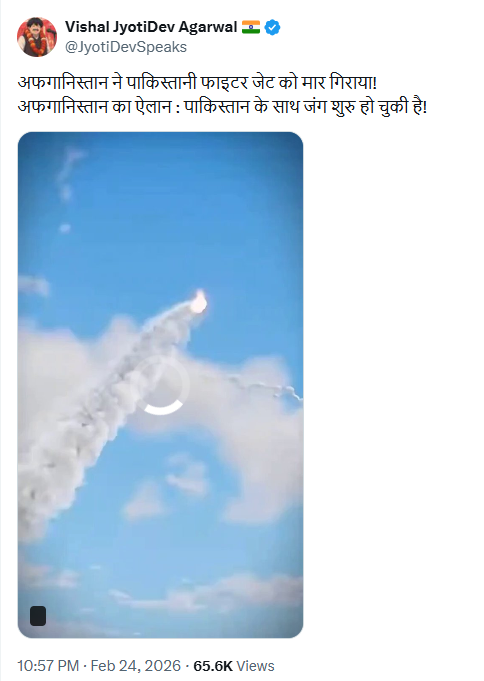
Fact Check:
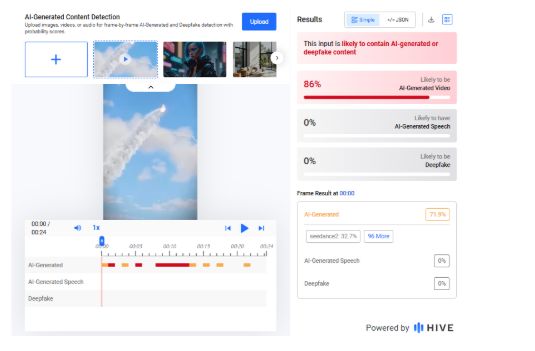
A careful review of the viral video revealed unusual visual patterns and artificial-looking effects, raising suspicions that it may have been created using artificial intelligence.We analyzed the video using the AI detection tool Hive Moderation, which indicated an 86 percent probability that the video was AI-generated.
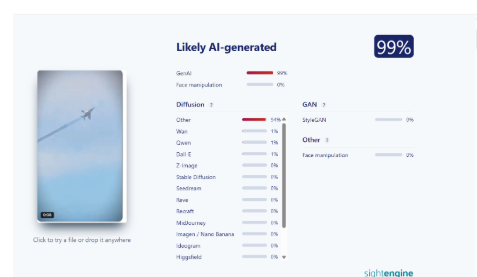
To further verify the findings, we scanned the footage using another AI detection platform, Sightengine. The results showed a 99 percent likelihood that the video was AI-generated.
To understand the broader context of the ongoing tensions, we conducted a keyword search and found a report published on February 22, 2026, by BBC Hindi. According to the report, Pakistan claimed it had targeted “seven terrorist hideouts and camps” along the Pakistan–Afghanistan border based on intelligence inputs. Meanwhile, a spokesperson for the Taliban government in Afghanistan stated that Pakistani airstrikes in Nangarhar and Paktika provinces resulted in the deaths of dozens of people, including women and children.
- https://www.bbc.com/hindi/articles/clyz8141397o
Conclusion
Our research confirms that the viral video claiming Afghanistan shot down a Pakistani fighter jet and formally declared war on Pakistan is fake. The footage is AI-generated and is being circulated with a false and misleading narrative.

Related Blogs

Introduction:
Former Egyptian MP Ahmed Eltantawy was targeted with Cytrox’s predator spyware through links sent via SMS and WhatsApp. Former Egyptian MP Ahmed Eltantawy has been targeted with Cytrox’s Predator spyware in a campaign believed to be state-sponsored cyber espionage. After Eltantawy made his intention to run for president in the 2024 elections known, the targeting took place between May and September 2023. The spyware was distributed using links sent via SMS and WhatsApp, network injection, and visits to certain websites by Eltantawy. The Citizen Lab examined the assaults with the help of Google's Threat Analysis Group (TAG), and they were able to acquire an iPhone zero-day exploit chain that was designed to be used to install spyware on iOS versions up to 16.6.1.
Investigation: The Ahmed Eltantawy Incident
Eltantawy's device was forensically examined by The Citizen Lab, which uncovered several efforts to use Cytrox's Predator spyware to target him. In the investigation, The Citizen Lab and TAG discovered an iOS exploit chain utilised in the attacks against Eltantawy. They started a responsible disclosure procedure with Apple, and as a consequence, it resulted in the release of updates patching the vulnerabilities used by the exploit chain. Mobile zero-day exploit chains may be quite expensive, with black market values for them exceeding millions of dollars. The Citizen Lab also identified several domain names and IP addresses associated with Cytrox’s Predator spyware. Additionally, a network injection method was also utilised to get the malware onto Eltantawy's phone, according to the study. He would be discreetly routed to a malicious website using network injection when he went to certain websites that weren't HTTPS.
What is Cyber Espionage?
Cyber espionage, also referred to as cyber spying, is a sort of cyberattack in which an unauthorised user tries to obtain confidential or sensitive information or intellectual property (IP) for financial gain, business benefit, or political objectives.
Apple's Response: A Look at iOS Vulnerability Patching
Users are advised to keep their devices up-to-date and enable lockdown Mode on iPhones. Former Egyptian MP targeted with predator spyware ahead of 2024 presidential run hence Update your macOS Ventura, iOS, and iPadOS devices, as Apple has released emergency updates to address the flaws. Apple has Released Emergency Updates Amid Citizen Lab’s Disclosure. Apple has issued three emergency updates for iOS, iPadOS (1), and macOS Ventura (2).
The updates address the following vulnerabilities:
CVE-2023-41991,
CVE-2023-41992,
CVE-2023-41993.
Apple customers are advised to immediately install these emergency security updates to protect themselves against potential targeted spyware attacks. By updating promptly, users will ensure that their devices are secure and cannot be compromised by such attacks exploiting these particular zero-day vulnerabilities. Hence it is advisable to maintain up-to-date software and enable security features in your Apple devices.
Conclusion:
Ahmed Eltantawy, a former Egyptian MP and presidential candidate, was targeted with Cytrox’s Predator spyware after announcing his bid for the presidency. He was targeted by Cytrox Predator Spyware Campaign. Such an incident is believed to be State-Sponsored Cyber Espionage. The incident raises the question of loss of privacy and shows the mala fide intention of the political opponents. The investigation Findings reveal that Ahmed Eltantawy was the victim of a sophisticated cyber espionage campaign that leveraged Cytrox’s Predator spyware. Apple advised that all users are urged to update their Apple devices. This case raises alarming concerns about the lack of controls on the export of spyware technologies and underscores the importance of security updates and lockdown modes on Apple devices.
References:
- https://uksnackattack.co.uk/predator-in-the-wires-ahmed-eltantawy-targeted-by-predator-spyware-upon-presidential-ambitions-announcement
- https://citizenlab.ca/2023/09/predator-in-the-wires-ahmed-eltantawy-targeted-with-predator-spyware-after-announcing-presidential-ambitions/#:~:text=Between%20May%20and%20September%202023,in%20the%202024%20Egyptian%20elections.
- https://thehackernews.com/2023/09/latest-apple-zero-days-used-to-hack.html
- https://www.hackread.com/zero-day-ios-exploit-chain-predator-spyware/
.webp)
What is Deepfake
Deepfakes have been, a fascinating but unsettling phenomenon that is now prominent in this digital age. These incredibly convincing films have drawn attention and blended in well with our high-tech surroundings. The lifelike but completely manufactured quality of deepfake videos has become an essential component of our digital environment as we traverse the broad reaches of our digital society. While these works have an undoubtedly captivating charm, they have important ramifications. Come along as we examine the deep effects that misuse of deepfakes can have on our globalized digital culture. After many actors now business tycoon Ratan Tata has become the latest victim of deepfake. Tata called out a post from a user that used a fake interview of him in a video recommending Investments.
Case Study
The nuisance of deep fake is sparing none from actors politicians to entrepreneurs everyone is getting caught in the Trap. Soon after the actresses Rashmika Mandana, Katrina Kaif, Kajol and other actresses fell prey to the rising scenario of deepfake, a new case from the industry emerged, which took Mr. Ratan Tata on storm. Business tycoon Ratan Tata has become the latest victim of deepfake. He took to his social media sharing an image of the interview that asked people to invest money in a project in a post on Instagram. Ratan Tata called out a post from a user that used a fake interview of him in a video recommending these Investments.
This nuisance that has been created because of the deepfake is sparing nobody from actors to politicians to entrepreneurs now everyone is getting caught in the trap the latest victim being Ratan Tata. Tech magnate Ratan Tata is the most recent victim of this deepfake phenomenon. The millionaire was seen in the video, which was posted by the Instagram user, giving his followers a once-in-a-million opportunity to "exaggerate investments risk-free."
In the stated video, Ratan Tata was seen giving everyone in India advice mentioning to the public regarding the opportunity to increase their money with no risk and a 100% guarantee. The caption of the video clip stated, "Go to the channel right now."
Tata annotated both the video and the screenshot of the caption with the word "FAKE."
Ongoing Deepfake Assaults in India
Deepfake videos continue to target celebrities, and Priyanka Chopra is also a recent victim of this unsettling trend. Priyanka's deepfake adopts a different strategy than other examples, including actresses like Rashmika Mandanna, Katrina Kaif, Kajol, and Alia Bhatt. Rather than editing her face in contentious situations, the misleading film keeps her looking the same but modifies her voice and replaces real interview quotes with made-up commercial phrases. The deceptive video shows Priyanka promoting a product and talking about her yearly salary, highlighting the worrying development of deepfake technology and its possible effects on prominent personalities.
Prevention and Detection
In order to effectively combat the growing threat posed by deepfake technology, people and institutions should place a high priority on developing critical thinking abilities, carefully examining visual and auditory cues for discrepancies, making use of tools like reverse image searches, keeping up with the latest developments in deepfake trends, and rigorously fact-check reputable media sources. Important actions to improve resistance against deepfake threats include putting in place strong security policies, integrating cutting-edge deepfake detection technologies, supporting the development of ethical AI, and encouraging candid communication and cooperation. We can all work together to effectively and mindfully manage the problems presented by deepfake technology by combining these tactics and making adjustments to the constantly changing terrain.
Conclusion
The current instance involving Ratan Tata serves as an example of how the emergence of counterfeit technology poses an imminent danger to our digital civilization. The fake video, which was posted to Instagram, showed the business tycoon giving financial advice and luring followers with low-risk investment options. Tata quickly called out the footage as "FAKE," highlighting the need for careful media consumption. The Tata incident serves as a reminder of the possible damage deepfakes can do to prominent people's reputations. The issue, in Ratan Tata's instance specifically, demands that public personalities be more mindful of the possible misuse of their virtual identities. We can all work together to strengthen our defenses against this sneaky phenomenon and maintain the trustworthiness of our internet-based culture in the face of ever-changing technological challenges by emphasizing preventive measures like strict safety regulations and the implementation of state-of-the-art deepfake detection technologies.
References
- https://economictimes.indiatimes.com/magazines/panache/ratan-tata-slams-deepfake-video-that-features-him-giving-risk-free-investment-advice/articleshow/105805223.cms
- https://www.ndtv.com/india-news/ratan-tata-flags-deepfake-video-of-his-interview-recommending-investments-4640515
- https://www.businesstoday.in/bt-tv/short-video/viralvideo-business-tycoon-ratan-tata-falls-victim-to-deepfake-408557-2023-12-07
- https://www.livemint.com/news/india/false-ratan-tata-calls-out-a-deepfake-video-of-him-giving-investment-advice-11701926766285.html

A video circulating widely on social media claims to show snowfall near Ambience Mall in Gurugram, Haryana. The clip is being shared alongside assertions that Gurugram witnessed snowfall for the first time in its history amid a severe cold wave in January 2026. However, an research by Cyber Peace Foundation has found the claim to be misleading. Our verification reveals that the viral video is not recent and has been available online since March 2023.
The Claim
On 14 January 2026, a Facebook user shared the video with the caption,“Something truly unbelievable happened today — Gurgaon witnessed snowfall for the first time in its history!”Through this post, the user implied that the visuals showed snowfall near Ambience Mall during the ongoing cold wave.link and screeshot
- https://www.instagram.com/reel/DTfS9X9DyBo/?utm_source=ig_embed&ig_rid=239ddaf7-ec53-4b1d-8f3b-a5e39540b3ee
- https://archive.ph/JVjHf

Fact Check:
To verify the claim, we conducted a detailed search using relevant keywords but found no credible media reports or official statements to support it. Although Gurugram’s temperature dropped to 0.6 degrees Celsius amid an IMD-issued cold wave warning, there is no evidence to suggest that the city experienced snowfall or hail. As of January 16, 2026, weather records and official sources confirm that no such weather event occurred in Gurugram.
A reverse image search of keyframes extracted from the viral clip traced the same footage to a video uploaded on the YouTube channel Crazy Tube on March 21, 2023. This establishes that the video has been in circulation for nearly three years. In the original upload, the person filming clearly mentions that the visuals were recorded near a toll plaza, further indicating that the clip is unrelated to the recent weather conditions in Gurugram. Link and Screen Shot
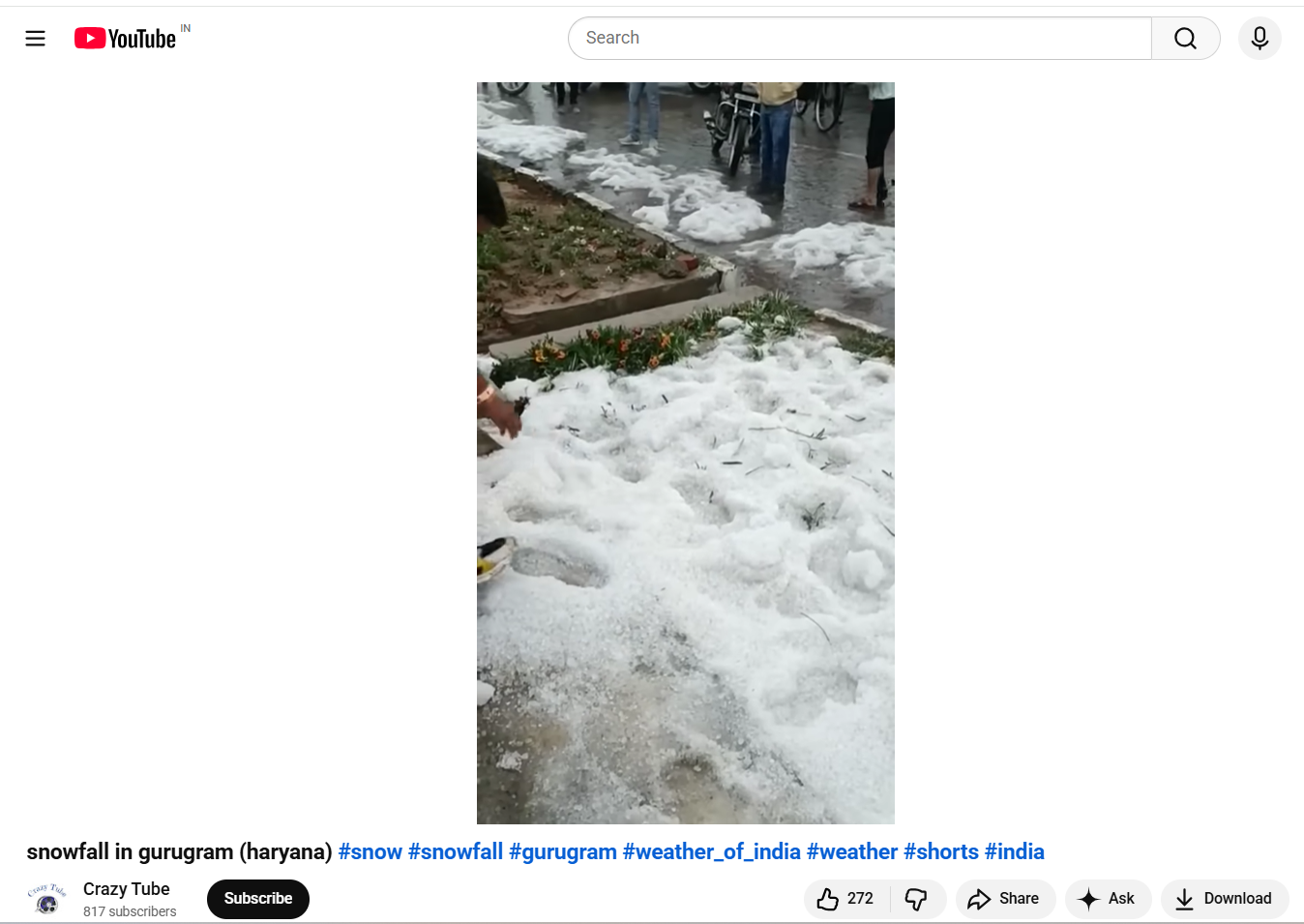
We also came across an X (formerly Twitter) post from March 19, 2023, which featured images similar to those seen in the viral video. The post described the visuals as being from a hailstorm in Gurugram, indicating that the content predates the current weather conditions and is unrelated to the recent cold wave.
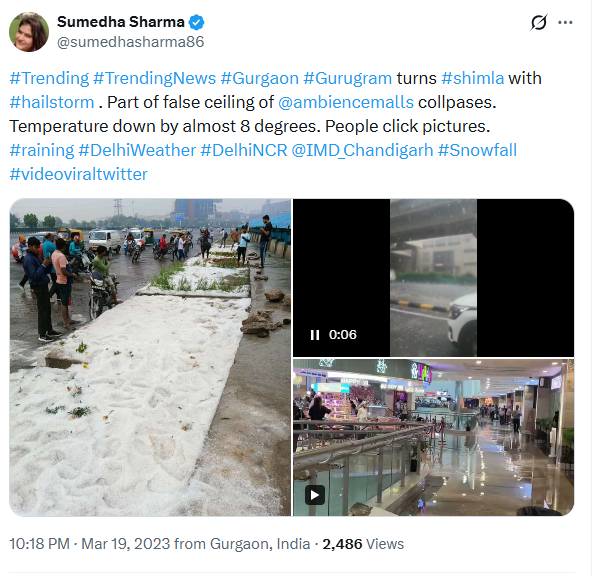
Conclusion:
The video is old and predates January 2026, and has been on the internet at least since March 2023. While Gurugram recorded a low of 0.6 degrees Celsius amid an IMD cold wave warning, the city did not experience snowfall or hail as of 16 January 2026. News reports from March 2023 confirm heavy rain and hail in Delhi and adjoining areas, including parts of Gurugram, but there is no evidence of snowfall in January 2026. Hence, the claim made in the post is MISLEADING.
