
#FactCheck - Viral Video Falsely Claims Rajnath Singh Compared RSS With Afghan Taliban
A video circulating widely on social media claims that Defence Minister Rajnath Singh compared the Rashtriya Swayamsevak Sangh (RSS) with the Afghan Taliban. The clip allegedly shows Singh stating that both organisations share a common ideology and belief system and therefore “must walk together.” However, a research by the CyberPeace found that the video is digitally manipulated, and the audio attributed to Rajnath Singh has been fabricated using artificial intelligence.
Claim
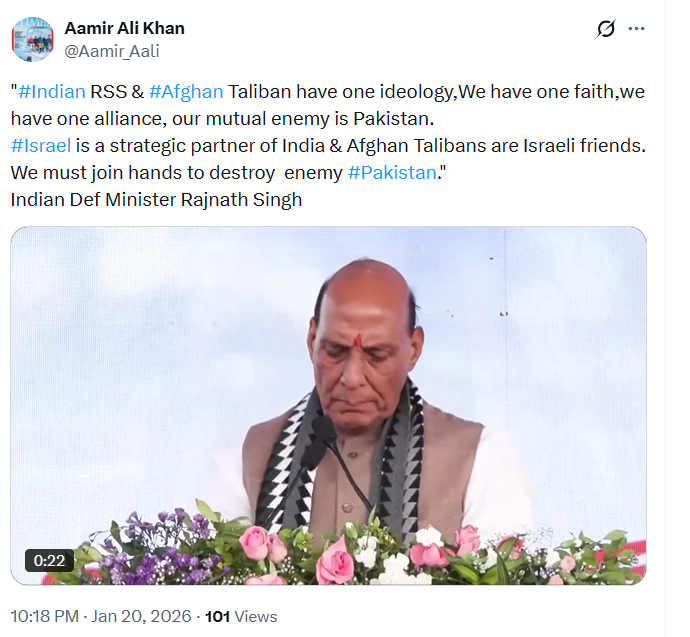
An X user, Aamir Ali Khan (@Aamir_Aali), on January 20 shared a video of Defence Minister Rajnath Singh, claiming that he drew parallels between the Rashtriya Swayamsevak Sangh (RSS) and the Afghan Taliban. The user alleged that Singh stated both organisations follow a similar ideology and belief system and therefore must “walk together.” The post further quoted Singh as allegedly saying: “Indian RSS & Afghan Taliban have one ideology, we have one faith, we have one alliance, our mutual enemy is Pakistan. Israel is a strategic partner of India & Afghan Taliban are Israeli friends. We must join hands to destroy the enemy Pakistan.” Here is the link and archive link to the post, along with a screenshot.
Fact Check:
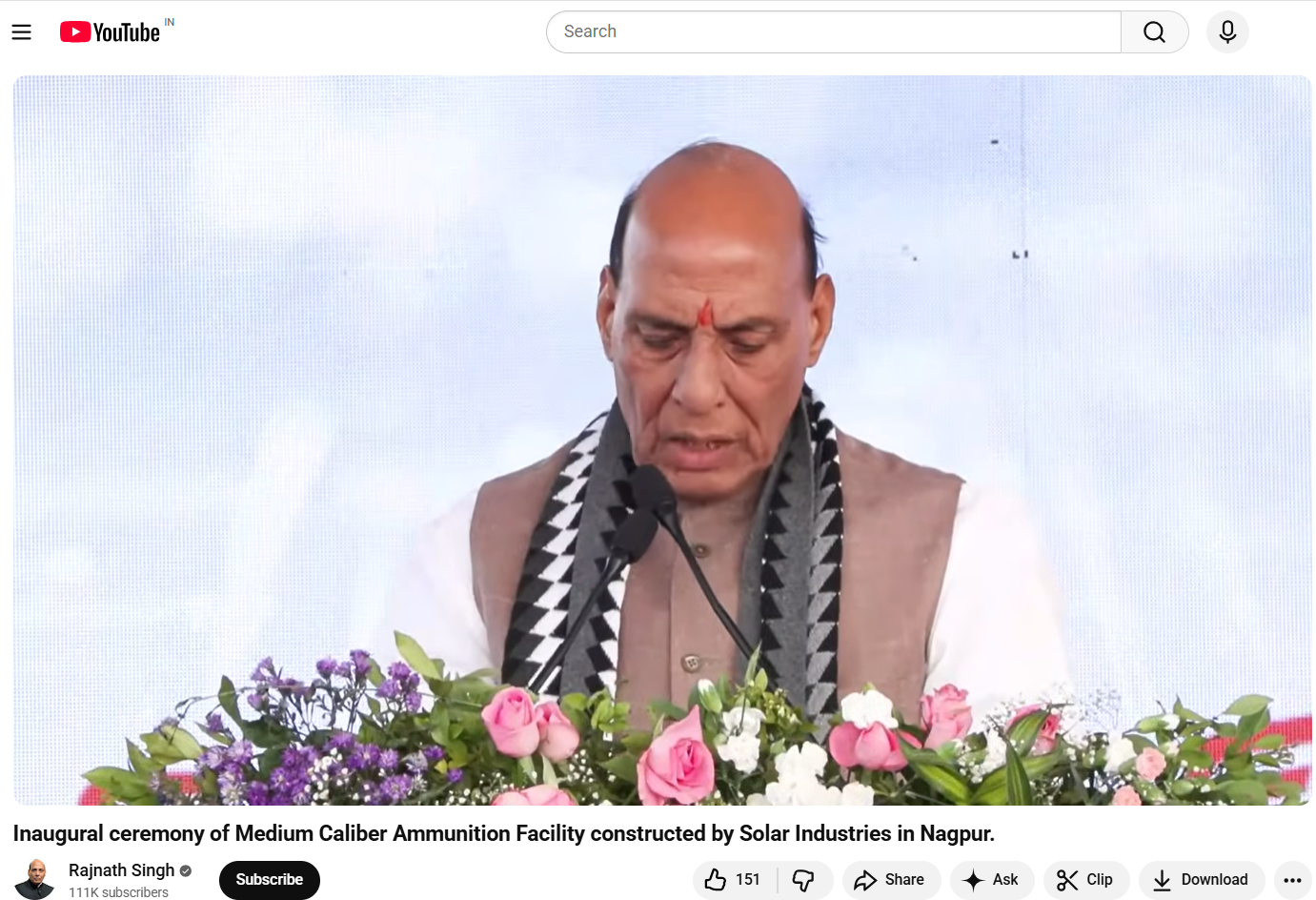
To verify the claim, the CyberPeace conducted a Google Lens search using keyframes extracted from the viral video. This search led to an extended version of the same footage uploaded on the official YouTube channel of Rajnath Singh. The original video was traced back to the inaugural ceremony of the Medium Calibre Ammunition Facility, constructed by Solar Industries in Nagpur. Upon reviewing the complete, unedited speech, the Desk found no instance where Rajnath Singh made any remarks comparing the RSS with the Afghan Taliban or spoke about shared ideology, alliances, or Pakistan in the manner claimed.
In the authentic footage, the Defence Minister spoke about:
" India’s push for Aatmanirbharta (self-reliance) in defence manufacturing
Strengthening domestic ammunition production
Positioning India as a global hub for defence exports "
The statements attributed to him in the viral clip were entirely absent from the original speech.
Here is the link to the original video, along with a screenshot.
In the next stage of the research , the audio track from the viral video was extracted and analysed using the AI voice detection tool Aurigin. This confirmed that the original visuals were misused and overlaid with a synthetic voice track to create a misleading narrative.

Conclusion
The CyberPeace concluded that the viral video claiming Defence Minister Rajnath Singh compared the RSS with the Afghan Taliban is false and misleading. The video has been digitally manipulated, with an AI-generated audio track falsely attributed to Singh. The Defence Minister made no such remarks during the Nagpur event, and the claim circulating online is fabricated.

Related Blogs
Introduction
India’s new Policy for Data Sharing from the National Transport Repository (NTR) released by the Ministry of Road Transport and Highways (MoRTH) in August, 2025, can be seen as a constitutional turning point and a milestone in administrative efficiency. The state has established an unprecedentedly large unified infrastructure by combining the records of 390 million vehicles, 220 million driver’s licenses, and the streams from the e-challan, e-DAR, and FASTag systems. Its supporters hail its promise of private-sector innovation, data-driven research, and smooth governance. However, there is a troubling paradox beneath this facade of advancement: the very structures intended to improve citizen mobility may simultaneously strengthen widespread surveillance. Without strict protections, the NTR runs the risk of violating the constitutional trifecta of need, proportionality, and legality as stated in Puttaswamy v. UOI, which brings to light important issues at the nexus of liberty, law, and data.
The other pertinent question to be addressed is as India unifies one of its comprehensive datasets on citizen mobility the question becomes more pressing: while motorised citizens are now in the spotlight for accountability, what about the millions of other datasets that are still dispersed, unregulated, and shared inconsistently in the areas of health, education, telecom, and welfare?
The Legal Backdrop
MoRTH grounds its new policy in Sections 25A and 62B of the Motor Vehicles Act, 1988. Data is consolidated into a single repository since states are required by Section 136A to electronically monitor road safety. According to the policy, it complies with the Digital Personal Data Protection Act, 2023.
The DPDP Act itself, however, is rife with state exclusions, particularly Sections 7 and 17, which give government organisations access to personal information for “any function under any law” or for law enforcement purposes. This is where the constitutional issue lies. Prior judicial supervision, warrants, or independent checks are not necessary. With legislative approval, MoRTH is essentially creating a national vehicle database without any constitutional protections.
Data, Domination and the New Privacy Paradigm
As an efficiency and governance reform, VAHAN, SARATHI, e-challan, eDAR, and FASTag are being consolidated into a single National Transport Repository (NTR). However, centralising extensive mobility and identity-linked records on a large scale is more than just a technical advancement; it also changes how the state and private life interact. The NTR must therefore be interpreted through a more comprehensive privacy paradigm, one that acknowledges that data aggregation is a means of enhancing administrative capacity and has the potential to develop into a long-lasting tool of social control and surveillance unless both technological and constitutional restrictions are placed at the same time.
Two recent doctrinal developments sharpen this concern. First, the Supreme Court’s foundational ruling that privacy is a fundamental right remains the constitutional lodestar, any state interference must satisfy legality, necessity and proportionality (KS Puttaswamy & Anr. vs UOI). Second, as seen by the court’s most recent refusals to normalise ongoing, warrantless location monitoring, such as the ruling overturning bail requirements that required accused individuals to provide a Google maps pin, as movement tracking necessitates closer examination (Frank Vitus v. Narcotics Control Bureau & Ors.,).When taken as a whole, these authorities maintain that unrestricted, ongoing access to mobility and toll-transaction records is a constitutional issue and cannot be handled as an administrative convenience.
Structural Fault Lines in the NTR Framework
Fundamentally, the NTR policy generates structural vulnerabilities by providing nearly unrestricted access through APIs and even mass transfers on physical media to a broad range of parties, including insurance companies, law enforcement, and intelligence services. This design undermines constitutional protections in three ways: first, it makes it possible to draw conclusions about private life patterns that the Supreme Court has identified as one of the most sensitive data categories by exposing rich mobility trails like FASTag logs and vehicle-linked identities; Second, it allows bulk datasets to circulate outside the ministry’s custodial boundary, which creates the possibility of function creep, secondary use, and monetisation risks reminiscent of the bulk sharing regime that the government itself once abandoned; and third, it introduces coercive exclusion by tying private sector access to Aadhaar-based OTP consent.
Reference

Executive Summary:
A fake photo claiming to show the cricketer Virat Kohli watching a press conference by Rahul Gandhi before a match, has been widely shared on social media. The original photo shows Kohli on his phone with no trace of Gandhi. The incident is claimed to have happened on March 21, 2024, before Kohli's team, Royal Challengers Bangalore (RCB), played Chennai Super Kings (CSK) in the Indian Premier League (IPL). Many Social Media accounts spread the false image and made it viral.

Claims:
The viral photo falsely claims Indian cricketer Virat Kohli was watching a press conference by Congress leader Rahul Gandhi on his phone before an IPL match. Many Social media handlers shared it to suggest Kohli's interest in politics. The photo was shared on various platforms including some online news websites.


Fact Check:
After we came across the viral image posted by social media users, we ran a reverse image search of the viral image. Then we landed on the original image posted by an Instagram account named virat__.forever_ on 21 March.

The caption of the Instagram post reads, “VIRAT KOHLI CHILLING BEFORE THE SHOOT FOR JIO ADVERTISEMENT COMMENCE.❤️”

Evidently, there is no image of Congress Leader Rahul Gandhi on the Phone of Virat Kohli. Moreover, the viral image was published after the original image, which was posted on March 21.

Therefore, it’s apparent that the viral image has been altered, borrowing the original image which was shared on March 21.
Conclusion:
To sum up, the Viral Image is altered from the original image, the original image caption tells Cricketer Virat Kohli chilling Before the Jio Advertisement commences but not watching any politician Interview. This shows that in the age of social media, where false information can spread quickly, critical thinking and fact-checking are more important than ever. It is crucial to check if something is real before sharing it, to avoid spreading false stories.

Executive Summary
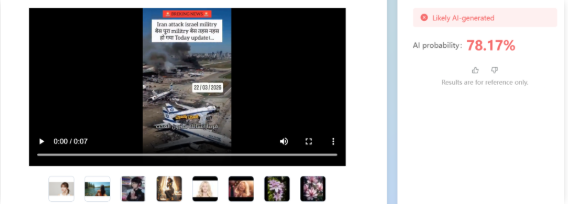
Amid the ongoing conflict involving the US-Israel and Iran in West Asia, a video showing destroyed aircraft at an airport is going viral on social media. The clip is being shared with the claim that it shows an Israeli military base destroyed in an Iranian attack. However, an research by the CyberPeacen found that the viral video is not real but AI-generated.
Claim:
An Instagram user “sakirali8064” shared the video on March 22, 2026, claiming that Iran had demonstrated its military strength by deploying advanced missiles capable of long-range precision strikes.The video also carries a “Breaking News” overlay stating:“Iran attack Israel military base… the entire base destroyed.
Post link and archive link:

Fact Check:
To verify the claim, we extracted keyframes from the viral clip and conducted a reverse image search using Google Lens. We found a longer version of the same video posted on March 5, 2026, by a Facebook user named “With INC,” where it was also falsely linked to an Iranian attack on Israel’s Ben Gurion Airport.

Upon closely examining the video, we observed inconsistencies such as fire changing positions unnaturally, which raised suspicion of AI manipulation. We then analyzed the video using Hive Moderation, which indicated a probability of over 99% that the content is AI-generated.
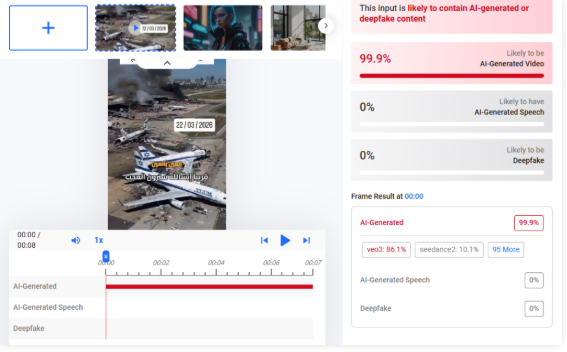
Additionally, analysis using Tencent’s “Zhuque AI” detection tool suggested more than 78% likelihood of the video being AI-generated.
Conclusion:
The viral video claiming that an Iranian attack destroyed an Israeli military base is AI-generated and misleading. While Iran has claimed to have targeted Israel’s Ben Gurion International Airport using drones, the viral footage does not depict a real event.
