#FactCheck -AI-Generated Image Falsely Shows Kavya Maran Hugging Young Cricketer Vaibhav Suryavanshi
Executive Summary
A picture allegedly showing Sunrisers Hyderabad (SRH) owner Kavya Maran emotionally hugging young cricketer Vaibhav Suryavanshi has gone viral on social media. The image is being shared as a genuine photograph from a cricket-related event, with users claiming that Kavya Maran was seen embracing Vaibhav Suryavanshi. However, CyberPeace Research Wing research found the claim to be false. No credible news reports, official statements, or authentic photographs support the incident depicted in the viral image.
Claim
A Facebook user shared the viral image with the caption: “Kavya Maran Hug Vaibhav Suryavanshi 🥰🔥 #cricketnews #RRvsSRH” The link to the post and its screenshot are provided below.

Fact Check
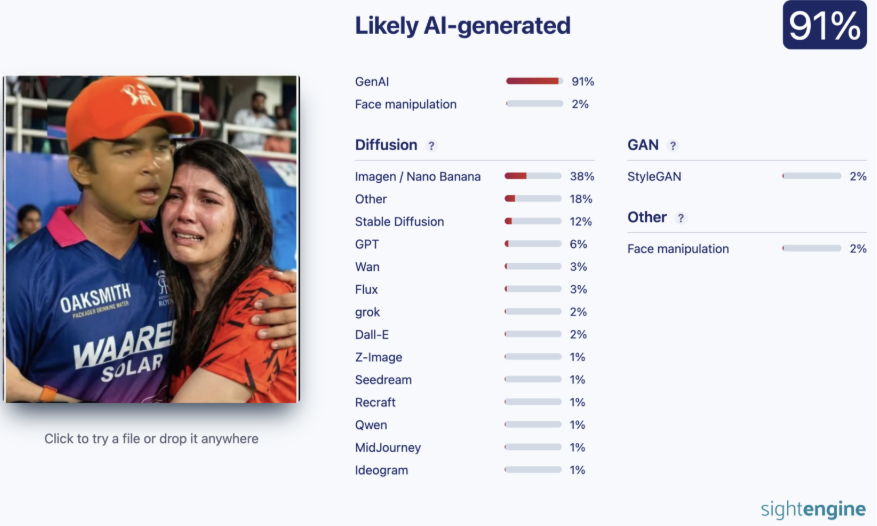
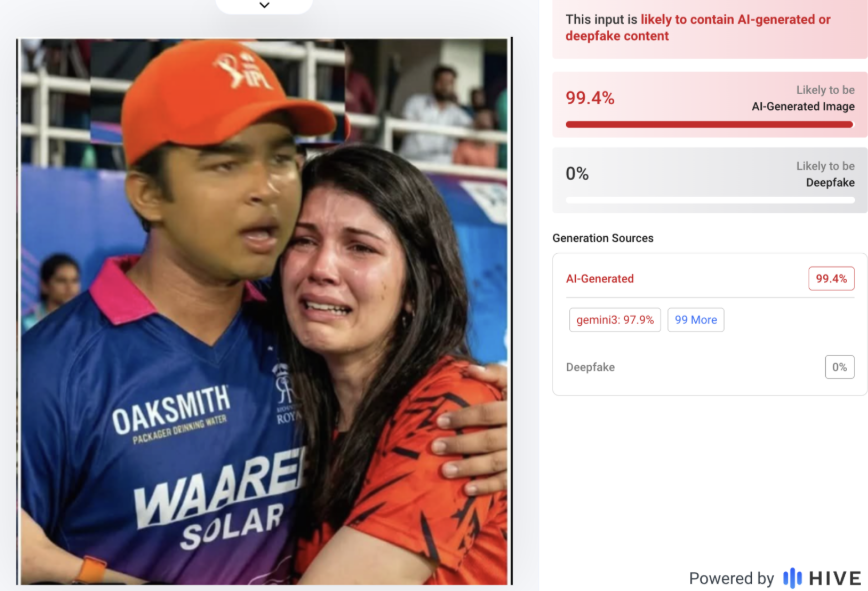
During the research, we found no credible news reports, official statements, or authentic images confirming that Kavya Maran hugged Vaibhav Suryavanshi as shown in the viral picture. To further verify the image, it was analysed using AI detection tools, including Sightengine and Hive Moderation. Both tools indicated a high probability that the image was generated using Artificial Intelligence. The findings suggest that the viral photograph is not a genuine image captured at a real event but a digitally created visual.
Conclusion
Our research found that the viral image showing Kavya Maran emotionally hugging Vaibhav Suryavanshi is not authentic. The picture was generated using AI and does not depict a real incident.
Related Blogs

Introduction
We are living in the digital age, where from ordering food to floating into a relationship everything is preferred to be digitized. It has been quite evident that in the past few years, online dating has become immensely popular due to its potential success stories. Since it has become a medium to find potential partners. Among the string of successes and pros of online dating, there seems to be a corner which is curtained that contains scams and treachery. A very recent case in Delhi puts light into the dark side of online dating where a 25-year-old journalist was trapped in an online dating scam. It portrays the threat of meeting an unknown person through an online dating app and how a person gets involved in the vicious cycle. Since the concept of online dating is all about meeting a new person and getting indulged. This incident talks about a man who met a woman through a dating app Bumble and got scammed for Rs 15000.
Unveiling the scam
It started like a fairy tale where a 25-year-old Delhi resident met with a girl on a dating app Bumble, where they spoke and found each other compatible. Followed by it the girl approaches the boy to meet at a specific restaurant situated in Delhi. The boy was away from the idea that the first meetup would turn into a nightmare which horrifying experience he would share on social media. It is not only about the financial loss but also about the emotional distress one goes through. Every coin has two sides and when surfing in the digital world one needs to keep in mind that along with the pros, there are certain cons. In the eagerness to meet someone, we should not lose our presence of mind. Continuing the incident once both reached the specified restaurant the girl made an order of various food items including beverages, shots of vodka, glasses of wine, different cuisines and hookah. Which not so surprisingly culminated in an inflated bill of Rs 15,886. After paying the hefty amount the boy went to the washroom once he came back the bill vanished followed by the girl being eager to leave the place. Till that very moment, the victim was in his dreamland where he did not get the hint that he had been scammed. Once he reached home and tried contacting the lady her account was deleted from the platform and was not reachable through calls. This incident shook the victim and pushed him to melancholy. Since he did not expect this to happen. Devastated by the fraud and treachery the man wrote about his disappointing experience on his Twitter handle addressing Delhi police to look into this.
It has been brought to the notice that similar incidents have been reported in the past as well. The trend remains the same in which the culprit insists the victim meet at a specific location decided by them, it is done with such conviction that it becomes difficult for the victim to deny. Once they accept to meet in the decided location it is followed by making the victim order expensive food and alcohol and at the time of payment giving excuses or pretending to pay. Once the payment is done the culprit rushes to leave the location or disappears without any head up. Not to be perplexed once they leave they will not leave any trace of them.
How to stay safe in the online dating world?
Online dating can bring butterflies in the stomach, and indeed it is a beautiful experience to meet someone new and fall in love but with this beauty, there comes the baggage of falling into the trap of cyber scams. While surfing online dating sites one needs to be very careful and vigilant since the highlighted incidents are relevant enough to showcase the negative impact on it.
Best practices
- Use reliable platforms: With the growing digitalization, there are infinite platforms available for online dating. But here is the catch one needs to be very finicky in choosing an appropriate platform among the countless options. It is best to use authentic platforms or apps and read reviews and ratings before installing any such applications or platforms.
- Cross-verify the profiles: Once you receive a profile compatible enough to talk about it is recommended to have elaborative conversations. It is not about doubting someone but being calculative and cross-checking all the information given. Before meeting the person it is best to have a detailed conversation but not reveal much about you.
- Have control in your pocket: When it comes to paying the bill be proactive in dividing the bill. It is advisable to do so that the liability of paying a hefty bill does not come from one party. This will make sure that even if one of the people has the intention to exploit the other person they will become alarmed.
- Go with the flow: Since meeting an unknown person is all flowery and spontaneous, it is also good to follow your instinct and go with the flow if you find anything weird during the conversation or while in person. It is advisable to back off or to leave the place as soon as possible.
- Be cautious in sharing your personal information with strangers: While conversing with an unknown person online, it is very important to keep a hold on our emotions and not share any personal information which can be misused by cyber crooks. Also, it is very important that we do not discuss anything about our financial capabilities and transactions. It is imperative to note that cyber crooks exploit the many new ways to commit online fraud by targeting innocent individuals.
- Catching up in public places: When meeting for the first time it is advisable to meet a person in a public place such as a park, museums etc. It is the best way to avoid going to a place decided or being insisted. Since meeting in a public place gives a sense of security that people are around you.
- Keep your near people in Loop: No matter how private you are while meeting an unknown person keep your friends and near one aware of it.
What to do if you fall into such dating scams
- While one can be emotionally drained, it is very important to keep track of all the information shared, save all your messages, take pictures of the scammer's profile and document every small detail which can be relevant.
- Report on the platform: There would be a section called “Contact us” or “Report” on the platform where you can report against the scammer. Most dating apps have this section where you can mention your issue so that they can take action against such profiles.
- National Cyber Crime Reporting Portal, 1930 Helpline: The Cybercrime reporting portal http://www.cybercrime.gov.in/ equipped with 24x7 helpline 1930 is a powerful resource available to the victims of cybercrimes to report their cases.
Conclusion
Online dating can become the gush of winds for someone but it is very important to keep in mind that with the potential of falling in love, there comes a threat of being trapped and getting into cyber frauds or scams. So many cases are being reported, and the recent case also highlights that not everyone on online sites is genuine. So be aware of such scams and stay informed and safe in the evolving digital environment.
References
- https://www.moneycontrol.com/news/trends/delhi-cafes-hiring-girls-to-scam-customers-says-bumble-user-conned-out-of-rs-15000-11724701.html
- https://www.ndtv.com/delhi-news/delhi-man-falls-victim-to-scam-as-bumble-date-costs-him-15-000-4566680/amp/1
- https://services.india.gov.in/service/detail/national-cyber-crime-reporting-portal#:~:text=This%20portal%20is%20an%20initiative,crimes%20against%20women%20and%20children.

Introduction
The advent of Electronic Vehicles (EVs) represents a transformative leap towards a more sustainable and environmentally conscious transportation future by nations. However, as these vehicles become increasingly connected and reliant on advanced technological systems, a parallel concern emerges—data privacy. Integrating sophisticated technologies in EVs, such as GPS tracking, biometric authentication, and in-car connectivity, raises substantial questions about the collection, storage, and potential misuse of sensitive personal information. This intersection of automotive innovation and data privacy underscores the need for comprehensive solutions and regulatory frameworks to ensure that the benefits of electric vehicles are realised without compromising the privacy and security of their users.
Electronic vehicles primarily record three types of data;
- Driving behaviour and patterns: The e-vehicle records braking and driving patterns, including acceleration, speed, and swerve. Some vehicles even track air conditioning usage and airbag deployment to determine the point of failure in the event of a crash.
- Location data: The e-vehicles also track GPS systems to gauge the speed and direction of the vehicle.
- EV functions and use of telematic services: Monitoring of EV functions includes battery use management, battery charging history, battery deterioration, electrical system functions and software version information.
Data Privacy requirements of companies
Companies manufacturing e-vehicles are saddled with several data privacy requirements as concerns about consumer safety. Data collected by e-vehicles may be sensitive in nature. Location tracking is a key issue that has garnered attention. The constant recording of a driver's whereabouts can lead to the creation of detailed profiles, raising questions about the potential misuse or unauthorised access to this sensitive information. The risk of surveillance, stalking, or even theft of valuable personal data is a genuine concern for EV owners.
Moreover, integrating smart features, such as voice recognition, biometric authentication, and in-car personal assistants, adds another layer of complexity. These features require the collection and processing of personal data. If not handled securely, they may become vulnerable to hacking or unauthorised access, leading to identity theft or other malicious activities. Additionally, Smart charging systems offer convenience by allowing remote monitoring and control of charging, but they also gather extensive data. The geographical data collected during charging may raise concerns about location privacy.
Striking a delicate balance between leveraging this data for enhancing vehicle performance and user experience while safeguarding the privacy of EV owners is paramount. Transparent privacy policies, secure data storage practices, and stringent encryption protocols are essential components of a comprehensive approach to data protection. If a company is eyeing the international market or utilising cloud-based software with decentralised global data storage, it must also navigate international privacy and data protection laws. A prime example is the General Data Protection Regulation (GDPR), a globally recognised and stringent data protection law applicable to both European-based companies and international entities providing goods, services, or monitoring activities of residents within Europe.
Manufacturers of these vehicles are subjected to compliance with this comprehensive legal framework. Obligations on companies are levied by them being data fiduciaries; dual liability may also emanate since some data fiduciaries may also qualify as data processors. Special care must be taken when data is being transferred to third parties.
Further, compliance with consumer safety laws is also an important consideration. In India, the Consumer Protection Act of 2019 safeguards the rights of consumers, holding manufacturers, sellers, and service providers responsible for any harm resulting from faulty or defective products. This extends the Act's coverage to include manufacturers and sellers of internet and technology-based products. When read with the Digital Personal Data Protection Act of 2023 (DPDP Act), the Consumer Protection Act of 2019 takes on additional significance. The DPDP Act, focusing on the security of an individual's digital personal data, introduces provisions such as mandatory consent, purpose limitation, data minimisation, obligatory security measures by organisations, data localisation, and enforcing accountability and compliance. These provisions apply to information generated by and for consumers, offering a comprehensive framework for protecting digital personal data.
Conclusion
The intersection of e-vehicles and data privacy necessitates a careful and comprehensive approach to ensure the coexistence of automotive innovation and user security. As electric vehicles record intricate data related to driving behaviour, location, and telematic services, companies manufacturing these vehicles must navigate a complex landscape of data privacy requirements. The potential risks associated with location tracking, smart features, and the extensive data collected during charging underscore the importance of transparent privacy policies, secure data storage practices, and stringent encryption protocols. Moreover, as companies expand globally, compliance with international privacy laws like the GDPR becomes imperative. Balancing the enhancement of vehicle performance and user experience with the safeguarding of privacy is paramount. Manufacturers, deemed as data fiduciaries, must exercise diligence, especially when transferring data to third parties. Additionally, adherence to consumer safety laws, such as the Consumer Protection Act of 2019, further emphasises the need for a holistic and vigilant approach to ensure the responsible use of data in the evolving landscape of e-vehicles.
References
- https://digitalcommons.law.scu.edu/cgi/viewcontent.cgi?article=1556&context=chtlj
- https://cyberswitching.com/electric-car-charging-and-data-privacy/#:~:text=Smart%20charging%20systems%20provide%20convenience,in%20safeguarding%20EV%20user%20privacy

India’s Rapid Digital Expansion

Over the past decade, India has experienced a rapid digitalisation process. The rise of digital financial services, affordable internet costs, and the penetration of smartphones have transformed the way people communicate, transact and do business online.
Online payment systems, including Unified Payments Interface (UPI), have enabled real-time transactions between banks and financial systems. As much as these systems have enhanced access to finance and efficiency, they have also created new opportunities for cybercriminals.
Cybercrime has evolved alongside the shift of financial and social interactions to digital platforms. The fraud attacks on online payments, online banking, and personal information have become common and increasingly costly.
To analyse the scale and trend of cybercrime in India, this analysis will use the datasets released by the National Crime Records Bureau (NCRB) and financial fraud data released by the Indian Cyber Crime Coordination Centre (I4C) under the Ministry of Home Affairs.
The Rise of Cybercrime in India


The Rise of Cybercrime in India
Source: National Crime Records Bureau – Crime in India Reports
The data released by the NCRB documents cybercrime incidents registered by the police at the national level under the Information Technology Act, 2000 (IT Act) and criminal provisions covering offences such as cheating, impersonation, and digital fraud. In the past, the offences were listed in the provisions of the Indian Penal Code (IPC). Following criminal law reforms in India, on 1 July 2024, the Bharatiya Nyaya Sanhita (BNS), which replaced the IPC, came into force. Section 419 (cheating by impersonation), IPC, would be related to BNS Section 319 and Section 420 (cheating and dishonestly inducing delivery of property), which would be related to BNS Section 318(4). Similarly, crimes involving forgery and use of forged documents or electronic documents, which were previously contained in the IPC Sections 465-471, are dealt with in BNS Sections 335-340.
The data published by the NCRB represent the number of crimes that reached the point of the First Information Report (FIR) registration, meaning they reflect only cybercrime cases that were formally presented to the law enforcement system to investigate, rather than all complaints reported. The data shows that cybercrime cases increased from 27,248 in 2018 to 86,420 in 2023, a 3.17-fold increase in 5 years.
Two structural shifts are visible: the post-pandemic jump and subsequent acceleration.

However, these figures likely underestimate the true scale of cybercrime because many incidents are reported only through online complaint portals and may not result in FIR registration.
The Financial Scale of Digital Fraud


The Financial Scale of Digital Fraud
This dataset tracks financial fraud complaints reported through the National Cyber Crime Reporting Portal (NCRP) and the estimated financial losses associated with those complaints.
The financial losses reported between 2021 and 2024 increased by 41 times over four years, compared to 2021, from 551 crore to 22,848 crore. At the same time, the number of complaints rose from 262,846 to over 1.9 million, an increase of ~623%, indicating both rising victimisation and greater public awareness of reporting mechanisms.
The contrast between these two trends is striking:

While complaints increased by around 7 times, financial losses increased by over 40 times.

Distribution of Cyber-Fraud Complaints and Financial Losses by Fraud Type
This divergence implies an uneven relationship between the number of incidents and the financial damage that they inflict. Most cyber fraud incidents involve relatively small transaction values; however, a smaller group of fraud categories result in disproportionate numbers of financial losses.

Distribution of Financial Losses Across Major Cyber-Fraud Categories in India
As reported by The Indian Express, based on the data compiled by the I4C, investment-related scams alone account for roughly 77% of reported cyber-fraud losses, followed by smaller shares from “digital arrest” scams (8%), credit card fraud (7%), sextortion (4%), e-commerce fraud (3%), and malware or app-based fraud (1%). This distribution means that even though scams with lower values, like phishing, OTP fraud, and small payment fraud, produce a high proportion of complaints, few categories of fraud produce most of the financial losses.
Analysis
1. Cybercrime is expanding faster than most traditional crimes: The fact that cybercrime cases have tripled in five years shows that cyber offences are presently becoming a significant element of Indian crime. Unlike conventional crimes that require physical proximity, cybercrime can be conducted remotely and at scale, enabling perpetrators to target large numbers of victims simultaneously.
2. Financial losses are concentrated in a small set of fraud categories: As cases of cybercrimes have been on the increase, the monetary losses of digital fraud cases have been increasing at a higher rate. The fact that the number of reported financial losses has increased 40 times in 4 years indicates that cybercrime has a very high economic impact.
3. Complaint volumes and financial damage follow different patterns: When comparing complaints and financial losses, it is evident that cyber fraud losses are unevenly distributed across types of incidents. Most of the prevalent scams reported, including phishing or OTP fraud, involve relatively small transaction values but yield a high portion of complaints. Conversely, fewer categories of fraud, especially investment-based schemes, contribute a significantly higher percentage of total financial losses.
4. Digital financial infrastructure has expanded the attack surface: India’s rapid adoption of digital payment systems, mobile banking and digital financial systems has dramatically increased the number of potential victims of cybercriminals. The scale of online transactions creates new vulnerabilities that organised cybercrime networks take advantage of.
5. Reporting improvements reveal previously hidden crime: The expansion of national reporting systems has enhanced the transparency in the trends of cybercrime. The increase in the number of complaints recorded is partially due to improved reporting systems and not necessarily to the increased criminal activity, meaning that previous data might have understated the magnitude of cyber fraud.
Recommendations
1. Move from reactive policing to proactive cyber-risk monitoring: The conventional models of policing focus on investigation of crimes that have already taken place. With such a magnitude and pace of cyber fraud, India should have systems that are designed to detect and prevent the fraud at its early stages, such as real-time observation of suspicious patterns in transactions by financial institutions.
2. Strengthen financial intelligence sharing across institutions: There are a lot of instances of cyber fraud that use more than one bank, payment system, and telecommunication provider. To detect new networks of fraud sooner, it can be suggested to establish more information-sharing measures between the financial institution and law enforcement agencies.
3. Target organised cyber fraud networks rather than individual incidents: Many digital scams operate through organised networks that coordinate phishing, mule accounts, and fake payment channels. The solution in regard to this involves dismantling these networks through investigative procedures instead of treating incidents on a case-by-case basis.
4. Improve recovery mechanisms for stolen funds: The recovery of the funds lost is one of the most difficult issues in cases of cyber fraud. Expanding systems such as the Citizen Financial Cyber Fraud Reporting and Management System (CFCFRMS) can improve the speed at which fraudulent transactions are frozen or reversed.
5. Strengthen digital financial literacy: A significant percentage of cyber frauds are based on social engineering methods that take advantage of user behaviour as opposed to technical weaknesses. Victimisation can be greatly reduced through specific public awareness efforts on typical scam schemes.
Conclusion
India’s experience illustrates a broader global trend: as economies digitise, crime increasingly follows the flow of digital money. While cybercrime incidents are rising steadily, the much faster growth in financial losses suggests that cybercriminals are becoming more organised, technologically sophisticated, and economically motivated.
References:
- https://indianexpress.com/article/india/indians-lost-rs-53000-crore-fraud-cheating-cases-six-years-maharashtra-2025-10452185/
- https://www.pib.gov.in/PressReleasePage.aspx?PRID=2226441®=3&lang=2 -
- https://www.ncrb.gov.in/crime-in-india.html
- https://i4c.mha.gov.in/index.aspx