
#FactCheck- AI-generated deepfake video falsely attributes remarks to Lt Gen P.R. Shankar on Army Chief designate Lt Gen Dhiraj Seth
Executive Summary: A video circulating on social media claims that retired Lieutenant General P.R. Shankar questioned the capability of newly appointed Army Chief Lt Gen Dhiraj Seth, suggesting he may not be able to effectively counter Pakistan or China. The clip further alleges that the appointment involved political influence and favoritism. CyberPeace Research Wing research found the claim to be false and misleading. The original video contains no such remarks regarding the new Army Chief or his appointment.
Claim: An X user shared the viral video on June 16, 2026, alleging that Lt Gen P.R. Shankar raised concerns over the appointment of the new Army Chief and questioned his competence in handling threats from Pakistan and China. https://x.com/indiain24hr/status/2066916021982908502 , https://archive.ph/vAnjo

Fact Check: A Google search using relevant keywords did not yield any credible media reports supporting the claim, raising initial doubts about its authenticity. A reverse image search of keyframes from the viral video led to a YouTube livestream uploaded on June 13, 2026. The original video showed Lt Gen P.R. Shankar discussing modern military concepts such as drone warfare, rocket systems, artillery and missile warfare (DRaM Warfare), with no reference to Lt Gen Dhiraj Seth or his appointment.
https://www.youtube.com/live/60JMMlHRmjA
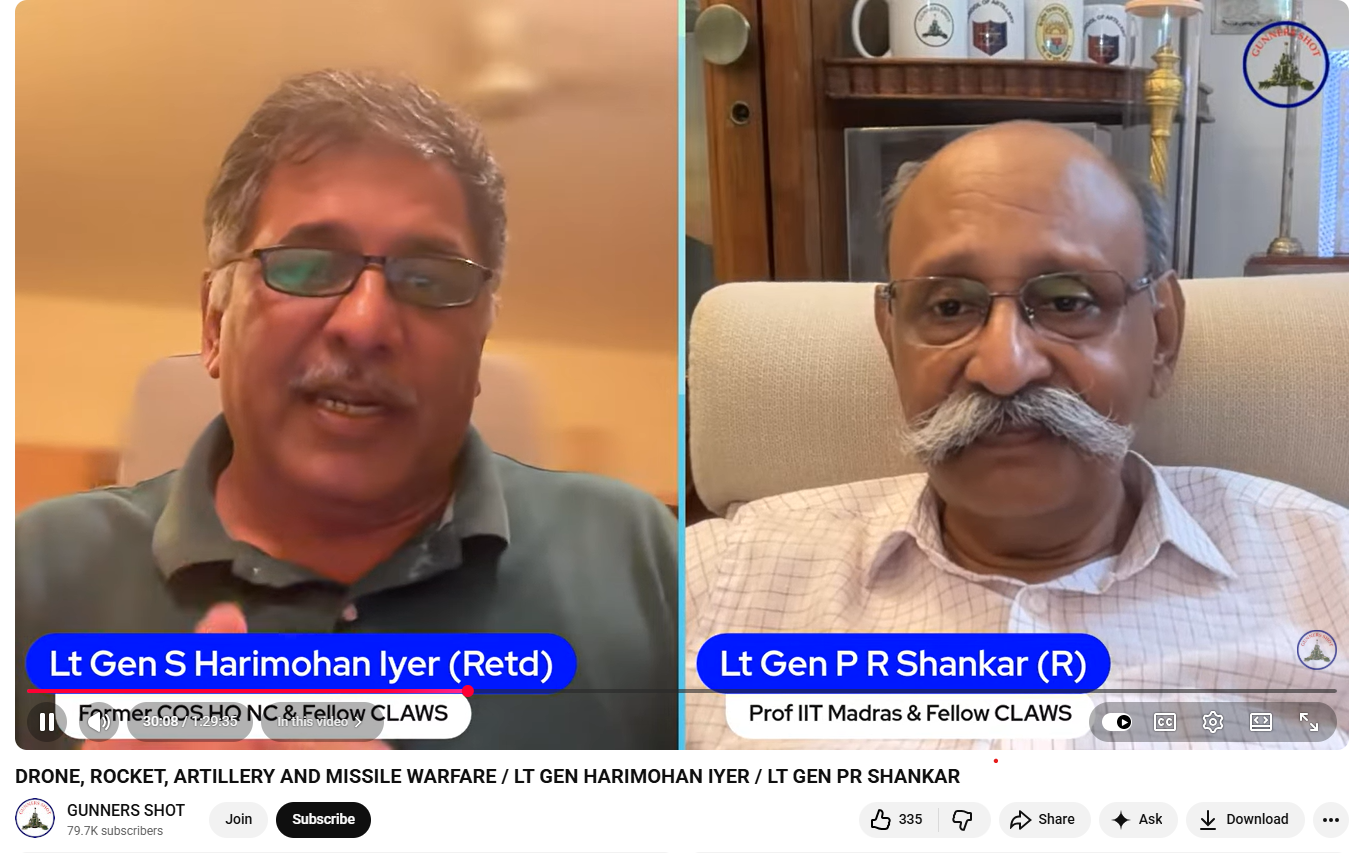
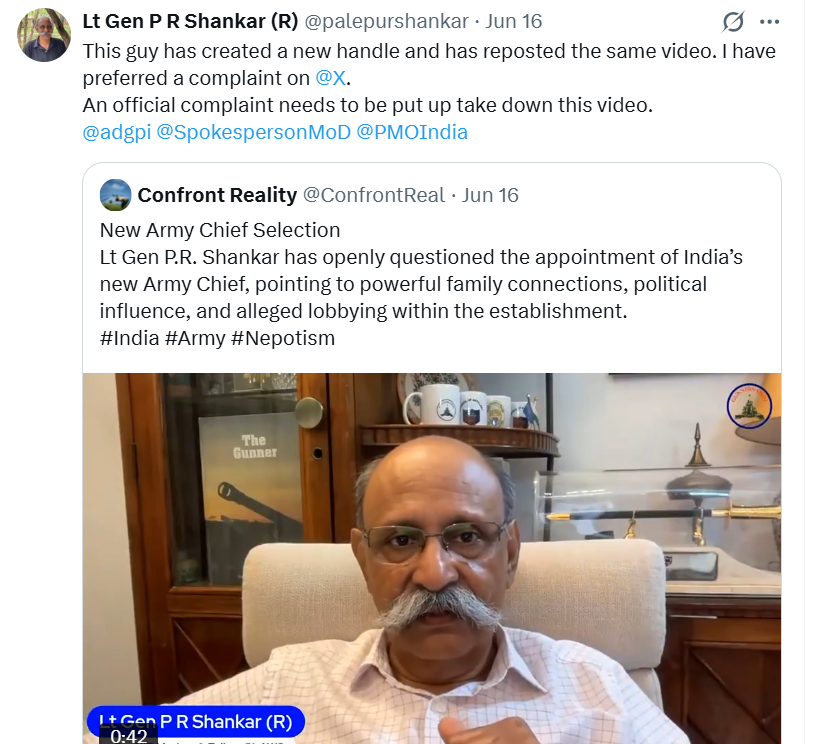
Further verification revealed that Lt Gen P.R. Shankar himself has labelled the circulating clip as fake on his official X account and has stated that a formal complaint has been filed against such manipulated content.
https://x.com/palepurshankar/status/2066826145707024778
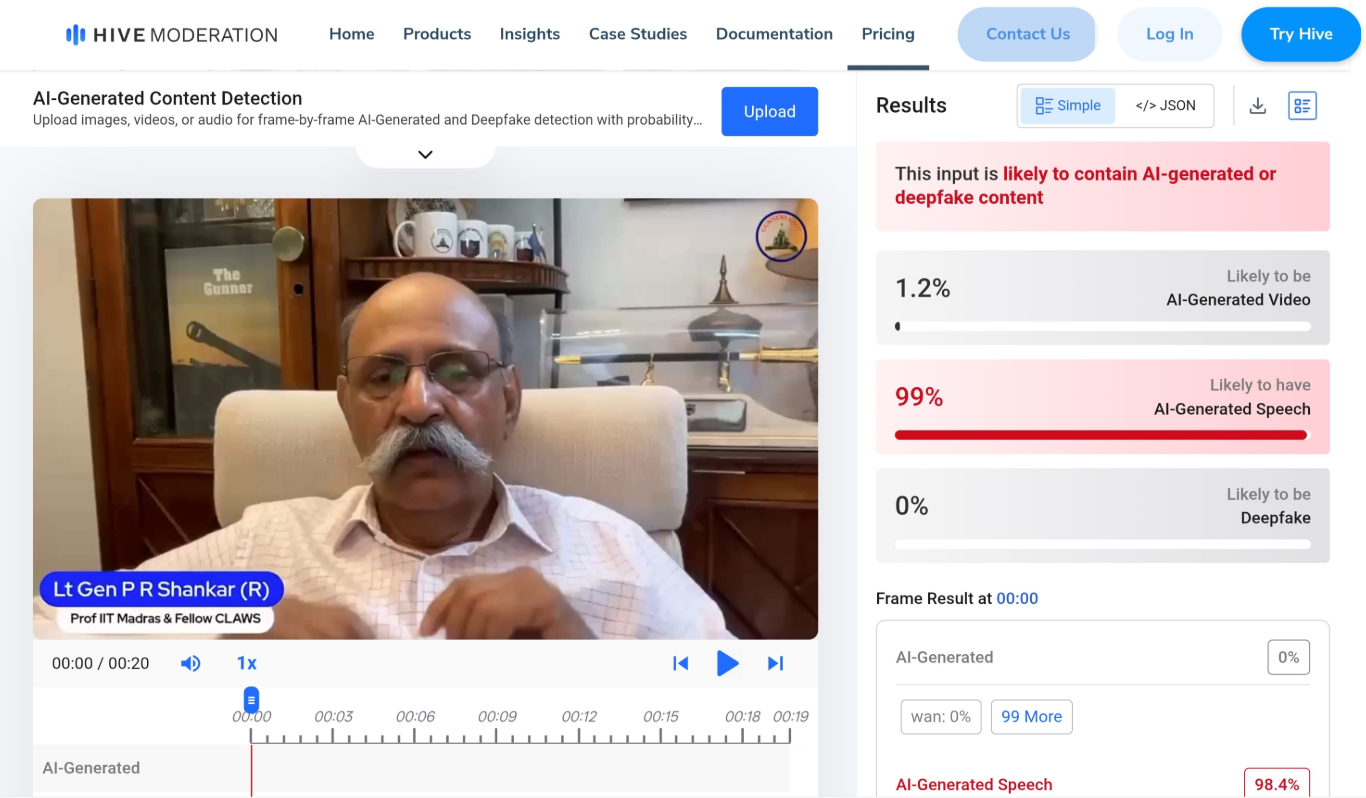
Additionally, AI detection analysis using Hive Moderation indicated that the audio in the viral video has a 99% probability of being AI-generated.
Conclusion: The research confirms that the viral video is an AI-generated deepfake. The original video does not contain any remarks about Lt Gen Dhiraj Seth or his appointment. The content has been digitally manipulated and is being circulated with a misleading narrative.

Related Blogs

Executive Summary:
A viral online video claims Canadian Prime Minister Justin Trudeau promotes an investment project. However, the CyberPeace Research Team has confirmed that the video is a deepfake, created using AI technology to manipulate Trudeau's facial expressions and voice. The original footage has no connection to any investment project. The claim that Justin Trudeau endorses this project is false and misleading.

Claims:
A viral video falsely claims that Canadian Prime Minister Justin Trudeau is endorsing an investment project.

Fact Check:
Upon receiving the viral posts, we conducted a Google Lens search on the keyframes of the video. The search led us to various legitimate sources featuring Prime Minister Justin Trudeau, none of which included promotion of any investment projects. The viral video exhibited signs of digital manipulation, prompting a deeper investigation.

We used AI detection tools, such as TrueMedia, to analyze the video. The analysis confirmed with 99.8% confidence that the video was a deepfake. The tools identified "substantial evidence of manipulation," particularly in the facial movements and voice, which were found to be artificially generated.


Additionally, an extensive review of official statements and interviews with Prime Minister Trudeau revealed no mention of any such investment project. No credible reports were found linking Trudeau to this promotion, further confirming the video’s inauthenticity.
Conclusion:
The viral video claiming that Justin Trudeau promotes an investment project is a deepfake. The research using various tools such as Google Lens, AI detection tool confirms that the video is manipulated using AI technology. Additionally, there is no information in any official sources. Thus, the CyberPeace Research Team confirms that the video was manipulated using AI technology, making the claim false and misleading.
- Claim: Justin Trudeau promotes an investment project viral on social media.
- Claimed on: Facebook
- Fact Check: False & Misleading

Introduction
Indian Cybercrime Coordination Centre (I4C) was established by the Ministry of Home Affairs (MHA) to provide a framework and eco-system for law enforcement agencies (LEAs) to deal with cybercrime in a coordinated and comprehensive manner. The Indian Ministry of Home Affairs approved a scheme for the establishment of the Indian Cyber Crime Coordination Centre (I4C) in October2018, which was inaugurated by Home Minister Amit Shah in January 2020. I4C is envisaged to act as the nodal point to curb Cybercrime in the country. Recently, on 13th March2024, the Centre designated the Indian Cyber Crime Coordination Centre (I4C) as an agency of the Ministry of Home Affairs (MHA) to perform the functions under the Information Technology Act, 2000, to inform about unlawful cyber activities.
The gazetted notification dated 13th March 2024 read as follows:
“In exercise of the powers conferred by clause (b) of sub-section (3) of section 79 of the Information Technology Act 2000, Central Government being the appropriate government hereby designate the Indian Cybercrime Coordination Centre (I4C), to be the agency of the Ministry of Home Affairs to perform the functions under clause (b) of sub-section (3) of section79 of Information Technology Act, 2000 and to notify the instances of information, data or communication link residing in or connected to a computer resource controlled by the intermediary being used to commit the unlawful act.”
Impact
Now, the Indian Cyber Crime Coordination Centre (I4C) is empowered to issue direct takedown orders under 79(b)(3) of the IT Act, 2000. Any information, data or communication link residing in or connected to a computer resource controlled by any intermediary being used to commit unlawful acts can be notified by the I4C to the intermediary. If an intermediary fails to expeditiously remove or disable access to a material after being notified, it will no longer be eligible for protection under Section 79 of the IT Act, 2000.
Safe Harbour Provision
Section79 of the IT Act also serves as a safe harbour provision for the Intermediaries. The safe harbour provision under Section 79 of the IT Act states that "an intermediary shall not be liable for any third-party information, data, or communication link made available or hosted by him". However, it is notable that this legal immunity cannot be granted if the intermediary "fails to expeditiously" take down a post or remove a particular content after the government or its agencies flag that the information is being used to commit something unlawful. Furthermore, Intermediaries are also obliged to perform due diligence on their platforms and comply with the rules & regulations and maintain and promote a safe digital environment on the respective platforms.
Under the Information Technology (Intermediary Guidelines and Digital Media Ethics Code) Rules, 2021, The government has also mandated that a ‘significant social media intermediary’ must appoint a Chief Compliance Officer (CCO), Resident Grievance Officer (RGO), and Nodal Contact Person and publish periodic compliance report every month mentioning the details of complaints received and action taken thereon.
I4C's Role in Safeguarding Cyberspace
The Indian Cyber Crime Coordination Centre (I4C) is actively working towards initiatives to combat the emerging threats in cyberspace. I4C is one of the crucial extensions of the Ministry of Home Affairs, Government of India, working extensively to combat cyber crimes and ensure the overall safety of netizens. The ‘National Cyber Crime Reporting Portal’ equipped with a 24x7 helpline number 1930, is one of the key component of the I4C.
Components Of The I4C
- National Cyber Crime Threat Analytics Unit
- National Cyber Crime Reporting Portal
- National Cyber Crime Training Centre
- Cyber Crime Ecosystem Management Unit
- National Cyber Crime Research and Innovation Centre
- National Cyber Crime Forensic Laboratory Ecosystem
- Platform for Joint Cyber Crime Investigation Team.
Conclusion
I4C, through its initiatives and collaborative efforts, plays a pivotal role in safeguarding cyberspace and ensuring the safety of netizens. I4C reinforces India's commitment to combatting cybercrime and promoting a secure digital environment. The recent development by designating the I4C as an agency to notify the instances of unlawful activities in cyberspace serves as a significant step to counter cybercrime and promote an ethical and safe digital environment for netizens.
References
- https://www.deccanherald.com/india/centre-designates-i4c-as-agency-of-mha-to-notify-unlawful-activities-in-cyber-world-2936976
- https://www.business-standard.com/india-news/home-ministry-authorises-i4c-to-issue-takedown-notices-under-it-act-124031500844_1.html
- https://www.hindustantimes.com/india-news/it-ministry-empowers-i4c-to-notify-instances-of-cybercrime-101710443217873.html
- https://i4c.mha.gov.in/about.aspx#:~:text=Objectives%20of%20I4C,identifying%20Cybercrime%20trends%20and%20patterns
.webp)
Introduction
MEITY’s Indian Computer Emergency Response Team (CERT-In) in collaboration with SISA, a global leader in forensics-driven cyber security company, launched the ‘Certified Security Professional for Artificial Intelligence’ (CSPAI) program on 23rd September. This initiative marks the first of its kind ANAB-accredited AI security certification. The CSPAI also complements global AI governance efforts. International efforts like the OECD AI Principles and the European Union's AI Act, which aim to regulate AI technologies to ensure fairness, transparency, and accountability in AI systems are the sounding board for this initiative.
About the Initiative
The Certified Security Professional for Artificial Intelligence (CSPAI) is the world’s first ANAB-accredited certification program that focuses on Cyber Security for AI. The collaboration between CERT-In and SISA plays a pivotal role in shaping AI security policies. Such partnerships between the public and private players bridge the gap between government regulatory needs and the technological expertise of private players, creating comprehensive and enforceable AI security policies. The CSPAI has been specifically designed to integrate AI and GenAI into business applications while aligning security measures to meet the unique challenges that AI systems pose. The program emphasises the strategic application of Generative AI and Large Language Models in future AI deployments. It also highlights the significant advantages of integrating LLMs into business applications.
The program is tailored for security professionals to understand the do’s and don’ts of AI integration into business applications, with a comprehensive focus on sustainable practices for securing AI-based applications. This is achieved through comprehensive risk identification and assessment frameworks recommended by ISO and NIST. The program also emphasises continuous assessment and conformance to AI laws across various nations, ensuring that AI applications adhere to standards for trustworthy and ethical AI practices.
Aim of the Initiative
As AI technology integrates itself to become an intrinsic part of business operations, a growing need for AI security expertise across industries is visible. Keeping this thought in the focal point, the accreditation program has been created to equip professionals with the knowledge and tools to secure AI systems. The CSPAI program aims to make a safer digital future while creating an environment that fosters innovation and responsibility in the evolving cybersecurity landscape focusing on Generative AI (GenAI) and Large Language Models (LLMs).
Conclusion
This Public-Private Partnership between the CERT-In and SISA, which led to the creation of the Certified Security Professional for Artificial Intelligence (CSPAI) represents a groundbreaking initiative towards AI and its responsible usage. CSPAI can be seen as an initiative addressing the growing demand for cybersecurity expertise in AI technologies. As AI becomes more embedded in business operations, the program aims to equip security professionals with the knowledge to assess, manage, and mitigate risks associated with AI applications. CSPAI as a programme aims to promote trustworthy and ethical AI usage by aligning with frameworks from ISO and NIST and ensuring adherence to AI laws globally. The approach is a significant step towards creating a safer digital ecosystem while fostering responsible AI innovation. This certification will significantly impact the healthcare, finance, and defence sectors, where AI is rapidly becoming indispensable. By ensuring that AI applications meet the requirements of security and ethical standards in these sectors, CSPAI can help build public trust and encourage broader AI adoption.
References
- https://pib.gov.in/PressReleasePage.aspx?PRID=2057868
- https://www.sisainfosec.com/training/payment-data-security-programs/cspai/
- https://timesofindia.indiatimes.com/business/india-business/cert-in-and-sisa-launch-ai-security-certification-program-to-integrate-ai-into-business-applications/articleshow/113622067.cms
