
#FactCheck- AI-generated “Beauty in Black” video falsely linked to FIFA World Cup 2026
Executive Summary
Amid ongoing FIFA World Cup 2026 festivities, a video is being widely circulated on social media platforms claiming that a female football fan became the centre of attraction during a match due to her striking beauty. The clip is being shared with the caption “Beauty in Black,” suggesting that beauty transcends colour and became the highlight of the stadium crowd. CyberPeace Research Wing research, however, found the claim to be misleading. The viral video is AI-generated and does not depict any real incident from the FIFA World Cup 2026.
Claim:
Social media user Bal Mukund Joshi shared the video on X on June 14, 2026, claiming that a beautiful woman captured everyone’s attention inside a World Cup stadium. The post has been widely circulated across platforms.
https://x.com/balmukundjoshi/status/2066033100208095452?s=20

Fact Check:
A close visual analysis of the clip revealed inconsistencies, including a mismatch in skin tone between different frames, raising suspicion of digital manipulation or AI generation. The video was further examined using multiple AI detection tools. Google’s SynthID analysis indicated no direct trace of Google AI generation, but Gemini’s assessment highlighted anomalies suggesting possible AI or heavy digital editing, particularly in facial features and skin texture. The video was then analysed using Hive Moderation, which indicated a 100% probability of the content being AI-generated.
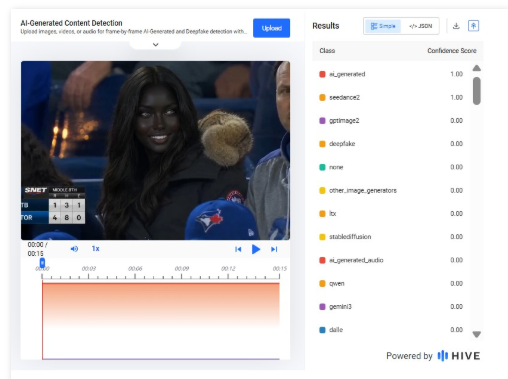
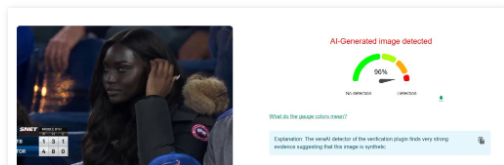
Additionally, frame-by-frame analysis using Vera AI Detector showed a high likelihood (92%) of AI-generated visuals. The research also revealed that the video originates from an Instagram-based virtual influencer account that shares AI-created content.
Conclusion:
The viral video claiming that a female fan became the centre of attention during a FIFA World Cup 2026 match is not real. The clip is AI-generated and originates from a virtual influencer account on Instagram, shared with a misleading narrative.

Related Blogs

Introduction
Whatsapp is one of the leading OTT messaging platforms, which has been owned by the tech giant Meta since 2013. WhatsApp enjoys a user base of nearly 2.24 billion people globally, with almost 487 million users in India. Since the advent of Whatsapp, it has been the most commonly used messaging app, and it has made an impact to such an extent that it is used for professional as well as personal purposes. Meta powers the platform and follows similar guidelines and policies as its parent company.
The New Feature
Users of WhatsApp on the web and desktop can now access one account from various devices. One WhatsApp account may now be used on up to four handsets thanks to a new update from Meta. Be aware that the multi-device capability has been planned for some time and is finally being made available to stable WhatsApp users. Each linked device (up to four devices can be linked) will function independently, and the independent devices will continue to receive messages even if the central device’s network connection is lost. Remember that WhatsApp will automatically log out of all the companion devices if the primary smartphone is dormant for an extended period. Four more gadgets may be a mix of four PCs and smartphones or four smartphones. This feature is now available for updates and downloads on Android as well as iOS platforms.
Potential issues
As we go deeper into the digital age, it is the responsibility of the tech giants to pilot innovation with features of security by design. Thus such new features should be accompanied by coherent safety and security policies or advisories to ensure the users understand the implications of the new features. Convenience over conditions is an essential part of cyberspace. It points to the civic duty of netizens to go through the conditions of any app rather than only focus on the convenience it creates. The following potential issues may arise from the new features on Whatsapp –
- Increased cybercrime- The bad actors now do not need to access SIM cards to commit frauds over the platforms as now on a single number 4 devices can be used hence the cybercriminal activity can increase over the platform. It is also pertinent for the platform to create SoPs for fake accounts which use multiple devices, as they pose a direct threat to the users and their interests.
- Difficulty in identifying and tracing- The LEAs will face a significant issue in identifying the bad actors and tracing them as the individual’s involvement through a linked device needs to be given legal validity and scope for investigation. This may also cause issues in evidence handling and analysis.
- Surge in Misinformation and Disinformation- With access to multiple devices, the screen time of an individual is also bound to increase. This leads to more time spent online, thus causing a rise in instances of misinformation and disinformation by bad actors. Thus the aspect of fack checking is of prime importance.
- Potential Oversharing of Personal Data- With the increased accessibility on different devices, it is very easy for the app to seek data from all devices on which the app is running, thus leading to a bigger reservoir of personal data for the platforms and data fiduciaries.
- Higher risk of Phishing, Ransomware and Malware Attacks- As the devices under the same login credentials and mobile number will increase, the message can be viewed on all the devices, thus increasing the risk of widespread embedded ransomware and malware in multiple devices is and ever-present threat.
- One number, more criminals- This feature will allow cybercriminals to operate using one device only, earlier they used to forge Adhaar cards to get new sims, but this feature will enable the bad actors to commit crimes and attacks from one single SIM using 4 different devices.
- Rise in Digital Footprint- As the number of devices increases, the users will generate more digital footprints. As a tech giant, Meta will have access to a bigger database, which increases the risk of data breaches by third-party actors.
Conclusion
In the fast-paced digital world, it is important to remain updated about new software, technologies and policies for our applications or forms of tech. This was a long-awaited feature from WhatsApp, and its value of it doesn’t lie in technological advancement only but also in the formulation of policies to govern this technology towards the trust and safety aspect of users. The platforms, in synergy with the policy makers, need to create a robust framework to accommodate the new features and add-ons on apps vehicle, staying in compliance with the laws of the land. Awareness about new features and vulnerabilities is a must for all netizens, and it is a shared responsibility for all netizens to spread the word about safety and security mechanisms.

Introduction
Most people who lose money to an online scam do the same thing first. They stare at the bank message and try to work out whether it can still be undone. Sometimes it can, but only if the right people move within hours. In Delhi, once the amount crosses ₹50 lakh, those people sit in a unit most residents have never heard of: the Intelligence Fusion and Strategic Operations unit, known as IFSO.
The scale explains why it exists. Delhi residents lost close to ₹1,000 crore to cyber fraud in 2025, after roughly ₹1,100 crore in 2024, and police counted at least 376 cases in 2025 in which a single victim lost more than ₹50 lakh. Investment scams, boss impersonation and "digital arrest" calls, in which fraudsters pose as police, CBI or courier officials and convince a victim that they are under investigation, topped the list.
Where IFSO came from
IFSO's roots go back to February 2019, when the then Union Home Minister inaugurated the National Cyber Forensic Lab alongside a Delhi Police cybercrime unit called CyPAD. CyPAD was later renamed IFSO, and for years it worked inside the Special Cell, the force's counter-terror and organised crime wing. On 3 December 2025, an order approved by the Commissioner of Police made it a standalone unit, with all its personnel reporting directly to a Deputy Commissioner of Police (IFSO). By then the city also had dedicated cyber police stations in all 15 districts, which matters for what follows.
Who takes which case
Delhi Police sorts cyber fraud by the amount lost.

The split came with a change that matters to ordinary victims. From 1 November 2025, anyone who has lost ₹1 lakh or more can have an e-FIR registered at the Integrated Help Desk of any police station in the capital, down from a ₹10 lakh threshold earlier. Smaller losses still go through the 1930 helpline and the national portal. In practice, then, the amount decides who takes the case after you report, not which door you walk through.
What IFSO actually does
It chases the money, fast. Stolen funds rarely stay put. They hop through chains of "mule" accounts within minutes. When a victim reports and supplies transaction details, IFSO starts what police call lien marking, asking banks to put a hold on the money. According to the unit's DCP, Delhi Police managed to hold nearly 20 per cent of defrauded funds in 2025, almost double the share in 2024.
It works across state lines and borders. In October 2026, IFSO was reported to have broken a syndicate with handlers in Cambodia and other Southeast Asian countries, arresting 11 people. In the same operation, working with Andhra Pradesh Police, it helped secure ₹7.25 crore from the ₹10.25 crore taken from a 79-year-old man in Vijayawada, and put a hold on a further ₹1.96 crore. The network was linked to 78 complaints on the National Cyber Crime Reporting Portal, across several states, involving about ₹73 crore.
It tries to intervene before the money is gone. Reports describe a financial monitoring wing that identifies potential victims while a scam is still unfolding. In one round of interventions it reportedly helped prevent about ₹1.53 crore in losses across five states, including an elderly man held in fear by a "digital arrest" for 14 days.
It brings the forensic muscle. Reporting describes IFSO as home to a cybercrime lab whose services are available to police forces in other states, which is part of why complex, multi-state cases land with it.
If it happens to you or someone you know
Time is the one thing you cannot get back, so the order matters.
- Call the national cyber helpline, 1930, immediately, and tell your bank at the same time.
- File the complaint on cybercrime.gov.in. In Delhi, if the loss is ₹1 lakh or more, you can also have an e-FIR registered at any police station's help desk.
- Keep everything: transaction IDs, account numbers, the scammer's phone numbers, screenshots, chats, call logs. Do not delete the app or the conversation.
- Do not pay anyone who offers to recover your money for a fee. Delhi Police advice is blunt: do not join online investment groups, do not install unknown .apk files, and do not transfer money without verification.
Why the First Hour Counts
Picture the money after a scam. It rarely sits in one place. Within hours it is usually split across several “mule” accounts, then withdrawn or pushed onward, sometimes into crypto. That is the whole reason 1930 exists.
The helpline is run by the Indian Cyber Crime Coordination Centre under the Home Ministry, around the clock. When you call, the details go into a system called CFCFRMS, which alerts whichever bank or wallet is holding the money at that moment and asks it to freeze the amount before it moves again. Under a procedure issued on 2 January 2026, the call itself is handled by the police of your own state.
The numbers are large. By 30 June 2026, the Home Ministry told the Lok Sabha, more than ₹11,158 crore had been “saved” across over 32.80 lakh complaints. Read that word carefully, though: “saved” means held by banks, not handed back. Getting it back is a separate step, and a Money Restoration Module, live since April 2026, was built to speed that up.
A change to watch: D4C
On Tuesday, 25 August 2026, the Delhi Government approved a new body, the Delhi Cyber Crime Coordination Centre (D4C), meant to be the nodal agency for cyber fraud under the Commissioner of Police, with a command centre at Police Headquarters on Jai Singh Road working around the clock. Hindi reporting at the time said IFSO would be merged into it. IFSO's investigation wing, the digital investigation lab, the training and awareness centre, the 1930 helpline control room in Haiderpur and a Fraud Mitigation Centre, where bank representatives are to sit alongside police, would all come under D4C, and the 15 district cyber stations would work to its directions. English coverage noted that how the two bodies relate had not been fully explained.
For a victim the advice does not change: report first through 1930 or the portal, and let the system route the case. What may change is the name on the door.
The takeaway
Policing can claw money back only while it is still traceable, and that window is measured in hours. IFSO's record shows what a specialist unit can do inside it. The rest of the work belongs to the rest of us: verify before paying, report early, and never be embarrassed to call 1930.
References
- https://www.tribuneindia.com/news/delhi/delhi-police-lowers-e-fir-threshold-for-cyber-fraud-cases-to-1-lakh/
- https://www.tribuneindia.com/news/delhi/delhiites-lose-rs-1000-crore-to-cyber-frauds-in-2025/amp
- https://thepatriot.in/crime/over-7000-arrested-in-delhi-polices-biggest-cybercrime-crackdown-86937
- https://www.theweek.in/wire-updates/national/2025/12/04/des90-dl-ifso-separation.html
- https://www.thestatesman.com/cities/delhi/delhi-police-busts-digital-arrest-syndicate-with-foreign-links-11-arrested-rs-7-25-crore-saved-1503650650.html
- https://www.newshubonline.com/delhi-police-foil-cyber-fraud-attempts-worth-%E2%82%B91-53-crore-across-five-states-rescue-senior-citizens-from-digital-arrest-scams/
- https://www.bwpoliceworld.com/article/delhi-police-will-now-host-d4c-instead-of-ifso-to-tackle-cybercrime-621038
- https://www.saahassamachar.in/big-action-on-cyber-fraud-in-delhi-new-d4c-center-will-work-24-hours
- https://aninews.in/news/national/general-news/delhi-police-d4c-to-have-dedicated-unit-for-school-bomb-threat-emails-online-crimes-against-women-and-children20260831103631/
Introduction
One of the biggest gaming populations in the world today is found in India. Every day, hundreds of millions of young Indians engage with streaming services, immersive digital content, mobile games and e-sports ecosystems. Yet, despite this massive scale of participation, India remains largely absent from the global conversation on original gaming intellectual property. Although the nation produces very few globally significant gaming worlds of its own, it consumes games on an astonishing scale. This paradox highlights a more serious structural issue with the gaming discourse in India. Our national conversation around gaming often begins and ends with regulation i.e., online betting, taxation, fantasy gaming legality, addiction and compliance. Although these worries are valid they have inadvertently obscured a much more crucial query: is India creating a gaming industry or is it just regulating a gaming market? Various subject-matter experts have expressed their views on this issue, like Shailendra Vikram Singh Former Deputy Secretary (Cyber & Information Security), Ministry of Home Affairs who is of the opinion,
“I believe India’s gaming story presents a unique paradox. While we are one of the world’s largest gaming markets, we have yet to fully realize gaming’s potential as a strategic pillar of the AVGC vision. Much of the conversation remains focused on regulation and consumption, whereas the larger opportunity lies in creation, innovation, and global competitiveness.
In my view, gaming should be recognized as a strategic creative and digital industry. It has the potential to generate high-value employment, foster indigenous intellectual property, and strengthen capabilities in design, storytelling, animation, immersive technologies, and emerging digital skills. Beyond its economic value, gaming can also serve as a powerful platform for education, skilling, and public engagement.
I also see gaming as an important medium for bringing India’s rich cultural heritage, historical narratives, and diverse traditions to global audiences through interactive storytelling. As digital experiences increasingly shape how younger generations learn, engage, and understand the world, culturally rooted content can become a source of both creative expression and national soft power.
At the same time, sustainable growth must be built on trust. Strong safeguards for cybersecurity, child protection, user safety, responsible gaming, and data governance are essential to creating a resilient and trusted ecosystem.
To realize the full promise of the AVGC vision, I believe India must aspire to be more than a large gaming market. A nation of gamers must ultimately become a nation of game creators.”
The Misplaced Focus of Regulating Bodies
A country with one of the world’s oldest storytelling civilizations should not remain from the world’s most influential storytelling medium. Examining how other nations viewed gaming as a strategic cultural enterprise highlights the disparity even further. Japan turned gaming into a tool of soft power by exporting global icons like Mario, Pokémon and Zelda. Along with K-pop and digital culture, South Korea incorporated gaming into its larger cultural export sector. With businesses like Tencent and games like Genshin Impact and Black Myth: Wukong, China is now aggressively marketing gaming as a geopolitical and technological impact ecosystem.
Through The Witcher, Poland even showed how local folklore based storytelling may achieve cultural relevance on a worldwide scale. In contrast, India contributes very little to the global gaming imagination despite having one of the strongest civilisational storytelling traditions in human history, including the Mahabharata, Ramayana, Buddhist Narratives, tribal folklore, Indic mythology and regional legends.
Artificial Intelligence and Lore of Lost Opportunities
The arrival of artificial intelligence now changes this equation dramatically. AI is lowering the barriers to creativity in ways previously unimaginable. For character design, procedural storytelling, localisation, environment creation, NPC interactions, voice synthesis and animation pipelines, independent producers and small studios can now use generative AI. Agile creative ecosystems are increasingly able to accomplish what formerly required enormous infrastructure and production teams. This offers India a once-in-a-lifetime chance to overcome conventional developmental barriers in the gaming sector. India may become a global center for AI-assisted storytelling, culturally grounded gaming storylines and scalable independent game production instead of competing just through capital-intensive AAA ecosystems.
The AVGC Promotion Task Force for India’s Digital future explicitly highlighted the significance of intellectual property development, academic integration, skilling and incubation systems. However, India still views gaming more as a compliance industry than as a significant creative economy. Economists use revenue forecasts to discuss gaming. Taxation frameworks are used by policymakers to discuss it. However, narrative ownership, digital culture, creative sovereignty and gaming as a long-term civilisational export are not sufficiently discussed.
Playing Everyone Else’s Game
The actual danger does not lie in the fact India won’t grow into a sizable gaming industry. The change has already taken place. The bigger risk is that, in a global market that is becoming more and more controlled by foreign narratives, foreign engines and foreign platforms, India may permanently remain a consumer ecosystem. Processors and graphic engines won’t be the only factors influencing gaming in the future, cultures that can emotionally engage worlds will also play a significant role. India possesses the depth of civilisation, creative heritage, technical prowess and population size necessary to develop into such a creator economy. It does not, however, have a consistent institutional focus on supporting studios, storytellers, animators and original intellectual property ecosystems.
References
- AVGC Promotion Task Force Report, Government of India
- KPMG India Media & Entertainment Reports
- EY-FICCI Media & Entertainment Industry Reports
- Newzoo Global Games Market Reports
- Lumikai “State of India Gaming” Reports
- UNESCO Reports on Cultural & Creative Industries
- World Economic Forum reports on AI and Creative Economies
