
MeitY Issued an Advisory Regulating AI
Introduction
The Ministry of Electronics and Information Technology (MeitY) issued an advisory on March 1 2024, urging platforms to prevent bias, discrimination, and threats to electoral integrity by using AI, generative AI, LLMs, or other algorithms. The advisory requires that AI models deemed unreliable or under-tested in India must obtain explicit government permission before deployment. While leveraging Artificial Intelligence models, Generative AI, software, or algorithms in their computer resources, Intermediaries and platforms need to ensure that they prevent bias, discrimination, and threats to electoral integrity. As Intermediaries are required to follow due diligence obligations outlined under “Information Technology (Intermediary Guidelines and Digital Media Ethics Code)Rules, 2021, updated as of 06.04.2023”. This advisory is issued to urge the intermediaries to abide by the IT rules and regulations and compliance therein.
Key Highlights of the Advisories
- Intermediaries and platforms must ensure that users of Artificial Intelligence models/LLM/Generative AI, software, or algorithms do not allow users to host, display, upload, modify, publish, transmit, store, update, or share unlawful content, as per Rule 3(1)(b) of the IT Rules.
- The government emphasises intermediaries and platforms to prevent bias or discrimination in their use of Artificial Intelligence models, LLMs, and Generative AI, software, or algorithms, ensuring they do not threaten the integrity of the electoral process.
- The government requires explicit permission to use deemed under-testing or unreliable AI models, LLMs, or algorithms on the Indian internet. Further, it must be deployed with proper labelling of potential fallibility or unreliability. Further, users can be informed through a consent popup mechanism.
- The advisory specifies that all users should be well informed about the consequences of dealing with unlawful information on platforms, including disabling access, removing non-compliant information, suspension or termination of access or usage rights of the user to their user account and imposing punishment under applicable law. It entails that users are clearly informed, through terms of services and user agreements, about the consequences of engaging with unlawful information on the platform.
- The advisory also indicates measures advocating to combat deepfakes or misinformation. The advisory necessitates identifying synthetically created content across various formats, advising platforms to employ labels, unique identifiers, or metadata to ensure transparency. Furthermore, the advisory mandates the disclosure of software details and tracing the first originator of such synthetically created content.
Rajeev Chandrasekhar, Union Minister of State for IT, specified that
“Advisory is aimed at the Significant platforms, and permission seeking from Meity is only for large platforms and will not apply to startups. Advisory is aimed at untested AI platforms from deploying on the Indian Internet. Process of seeking permission , labelling & consent based disclosure to user about untested platforms is insurance policy to platforms who can otherwise be sued by consumers. Safety & Trust of India's Internet is a shared and common goal for Govt, users and Platforms.”
Conclusion
MeitY's advisory sets the stage for a more regulated Al landscape. The Indian government requires explicit permission for the deployment of under-testing or unreliable Artificial Intelligence models on the Indian Internet. Alongside intermediaries, the advisory also applies to digital platforms that incorporate Al elements. Advisory is aimed at significant platforms and will not apply to startups. This move safeguards users and fosters innovation by promoting responsible AI practices, paving the way for a more secure and inclusive digital environment.
References
- https://regmedia.co.uk/2024/03/04/meity_ai_advisory_1_march.pdf
- https://economictimes.indiatimes.com/tech/technology/govts-ai-advisory-will-not-apply-to-startups-mos-it-rajeev-chandrasekhar/articleshow/108197797.cms?from=mdr
- https://www.meity.gov.in/writereaddata/files/Advisory%2015March%202024.pdf

Related Blogs
Introduction
In recent years, the online gaming sector has seen tremendous growth and is one of the fastest-growing components of the creative economy, contributing significantly to innovation, employment generation and export earnings. India possesses a large pool of skilled young professionals, strong technological capabilities and a rapidly growing domestic market, which together provide an opportunity for the country to assume a leadership role in the global value chain of online gaming. With this, the online gaming industry has also faced an environment of exploitation, abuse, with notable cases of fraud, money laundering, and other emerging cybercrimes. In order to protect the interests of players, ensure fair play and competition, safe and secure online gaming environment, the need for introducing and establishing dedicated gaming regulation was a need of the hour.
On 20 August 2025, the Union government introduced a new bill, ‘Promotion and Regulation of Online Gaming Bill, 2025’ in Lok Sabha that seeks to prohibit online money gaming, including advertisements and financial transactions related to such platforms. From the introduction, the said bill was passed at 5 PM on the same date. Further, the upper house of parliament (Rajya Sabha) passed the bill on 21st August 2025. The bill can be seen as a progressive step towards building safer online gaming spaces for everyone, especially for our youth and combating the emerging cybercrime threats present in the online gaming landscape.
Key Highlights of the Bill
The Bill extends to the whole of India. It also applies to any online money gaming service offered within India or operated from outside the country but accessible in India.
- Definition of E-sports:
Section 2(1)(c) of the Bill defines e-sports as:-
(i) is played as part of multi-sports events;
(ii) involves organised competitive events between individuals or teams, conducted in multiplayer formats governed by predefined rules;
(iii) is duly recognised under the National Sports Governance Act, 2025, and registered with the Authority or agency under section 3;
(iv) has outcome determined solely by factors such as physical dexterity, mental agility, strategic thinking or other similar skills of users as players;
(v) may include payment of registration or participation fees solely for the purpose of entering the competition or covering administrative costs and may include performance-based prize money by the player; and
(vi)shall not involve the placing of bets, wagers or any other stakes by any person, whether or not such person is a participant, including any winning out of such bets, wagers or any other stakes;
- Prohibition of Online Money Gaming and Advertisement thereof
The Bill prohibits the offering of online money games and online money gaming services. It also bans all forms of advertisements or promotions connected to online money games. This includes endorsements by individuals or entities. - Financial Transactions
Banks, financial institutions, and other intermediaries are barred from facilitating transactions related to online money gaming services. - Criminal Liability
Violation of the provisions on online money gaming can result in imprisonment for up to three years, or a fine of up to ₹1 crore, or both. Repeat offenders face stricter punishment with higher fines and longer jail terms. - Cognizable and Non-Bailable Offences
Offences relating to offering online money gaming services and facilitating financial transactions for such games are categorised as cognizable and non-bailable. This gives law enforcement agencies greater power to act without requiring prior approval.
In conversation with CyberPeace ~
Shailendra Vikram Singh, Former Deputy Secretary (Cyber & Information Security), Ministry of Home Affairs, GOI . He highlighted that
"The passage of the Promotion and Regulation of Online Gaming Bill, 2025 in the Lok Sabha highlights the government’s growing priority on national security, public safety, and health in digital regulation. Unfortunately, the real money gaming industry, despite its growth and promise, did not take proactive steps to address these concerns. The absence of safeguards and engagement left the government with no choice but to adopt a blanket ban."Having worked on this issue from both the government and industry side, the clear lesson is that in sensitive digital sectors, early regulatory alignment and constructive dialogue are not optional but essential. Going forward, collaboration is the only way to achieve a balance between innovation and responsibility.”
CyberPeace Outlook
The Promotion and Regulation of Online Gaming Bill, 2025, marks a decisive policy shift by simultaneously fostering the growth of e-sports, educational and social gaming, and imposing an absolute prohibition on online money games. By recognising e-sports as legitimate, skill-based competitive sports under the National Sports Governance Act, 2025, and establishing a central Authority for oversight, registration, and regulation, the Bill creates an institutional framework for safe and responsible development of the sector. The Bill completely bans real money games (RMGs), regardless of whether they are skill-based or chance-based or both, hence it poses significant questions on RMG companies' legal standing, upon which the gaming industry has raised its conundrum. Further, it addresses urgent threats such as cybercrime, gaming addiction, online betting, money laundering, and the misuse of gaming platforms for illicit activities. The move reflects a balanced approach, encouraging innovation and digital skill-building, while safeguarding public order, consumer interests, and financial integrity.
References
- https://prsindia.org/files/bills_acts/bills_parliament/2025/Bill_Text-Online_Gaming_Bill_2025.pdf
- https://prsindia.org/billtrack/the-promotion-and-regulation-of-online-gaming-bill-2025
- https://www.hindustantimes.com/india-news/rajya-sabha-clears-online-gaming-bill-a-day-after-lok-sabha-approval-101755766847840.html
Executive Summary
A video circulating on social media claims to show the Deputy Chief of Army Staff and former DGMO of the Indian Army, Lieutenant General Rajiv Ghai, dancing with a young woman at a party. Users sharing the clip further allege that other junior military officers were also present at the event. CyberPeace Research Wing research found the claim to be misleading. The viral video has no connection with the Indian Army, Lt Gen Rajiv Ghai, or any official military function. The person seen in the video is actually the father of content creator Akanksha Sehgal, who has featured him in multiple videos on her social media accounts.
Claim:
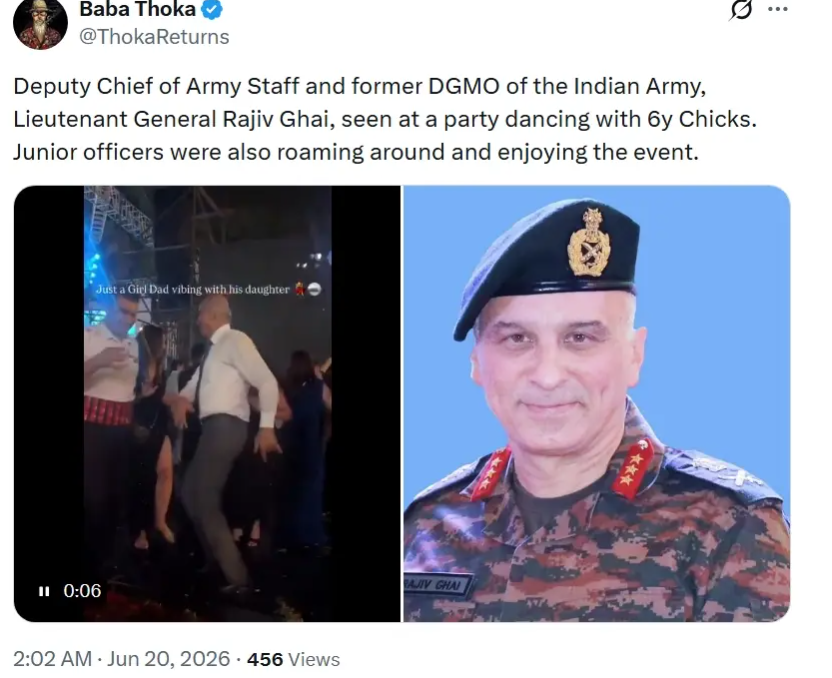
A Pakistani handle ‘Baba Thoka’ shared the video on X, alleging that Lt Gen Rajiv Ghai was seen dancing with young women at a party and that junior officers were also present.
- https://x.com/ThokaReturns/status/2068069535715147896?s=20
- https://archive.ph/H9EA0
Fact Check:
A reverse image search of keyframes from the viral video led to the same clip being found on Instagram handle ‘akku_sehgal_’, posted on December 14, 2025. The video caption read: “POV – when your dad and your music taste match.”

Further examination of the content creator Akanksha Sehgal’s Instagram profile showed multiple videos featuring the same father-daughter duo, confirming that the man in the viral clip frequently appears in her content.

Conclusion:
The viral video claiming to show Lieutenant General Rajiv Ghai dancing at a party is misleading. The individual seen in the video is not the senior Indian Army officer but the father of content creator Akanksha Sehgal.
Executive Summary
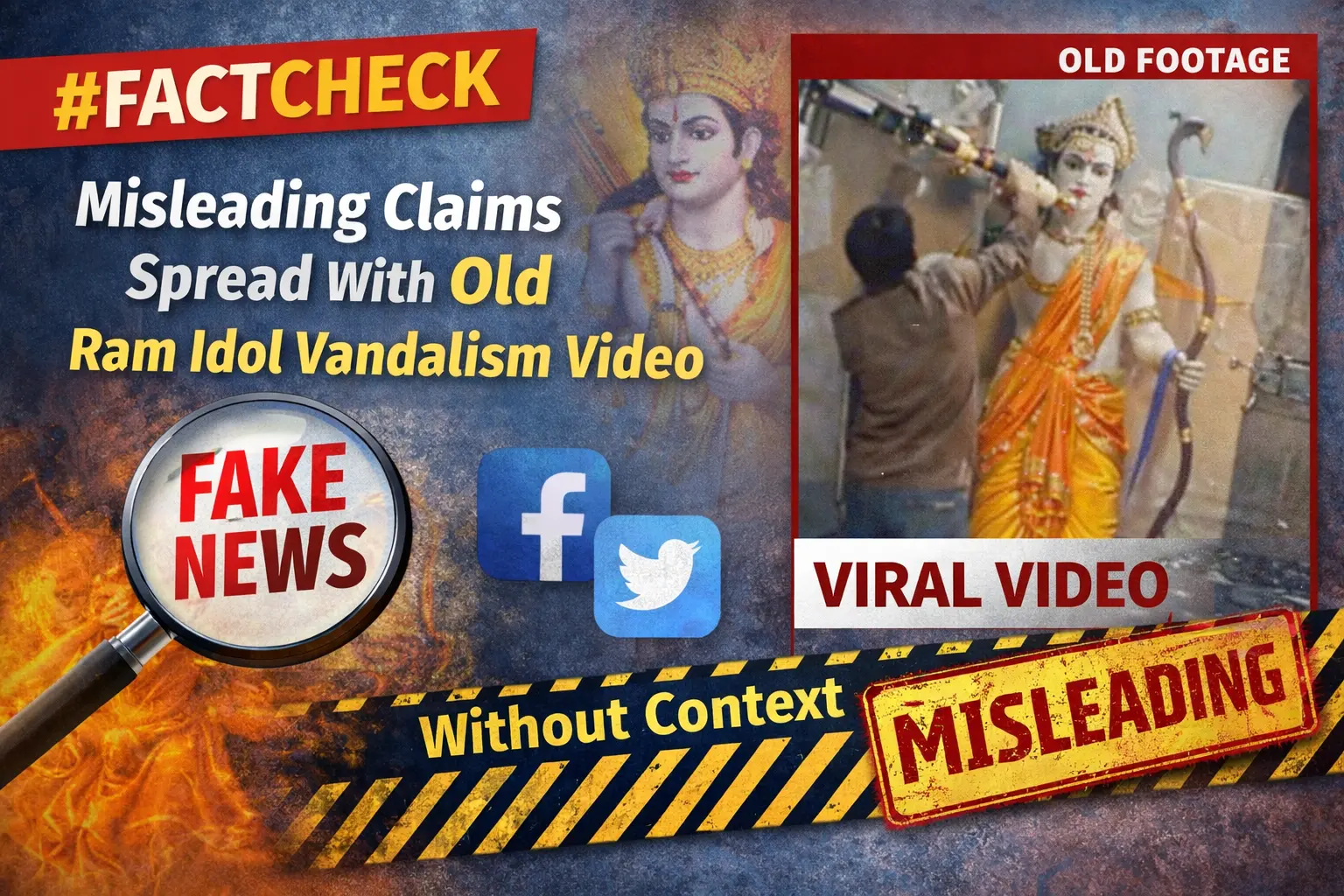
A video circulating on social media has sparked controversy, showing a man allegedly vandalising an idol of Lord Ram. Users sharing the clip claim that the incident recently took place in Ayodhya, Uttar Pradesh. The posts further allege that a Muslim individual climbed the idol and attempted to damage it. However, research by the CyberPeace found the viral claim to be misleading. The research revealed that the video is not recent but nearly three years old. At the time of the incident, the police had already arrested the accused. Social media users are now resharing the old video with false claims that it is a recent event.
Claim:
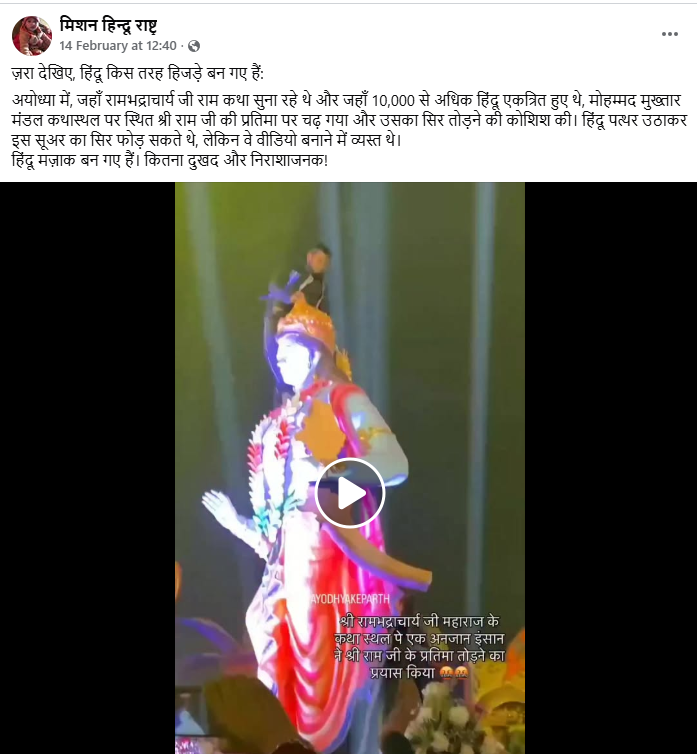
On February 14, 2026, a Facebook user shared the viral video claiming that the incident occurred in Ayodhya, where a large religious gathering was underway. The post alleged that a man identified as Mohammad Mukhtar Mandal climbed the idol of Lord Ram and attempted to break it. The post was widely circulated with inflammatory remarks. (Link and archived version of the post were provided along with a screenshot.)
Fact Check
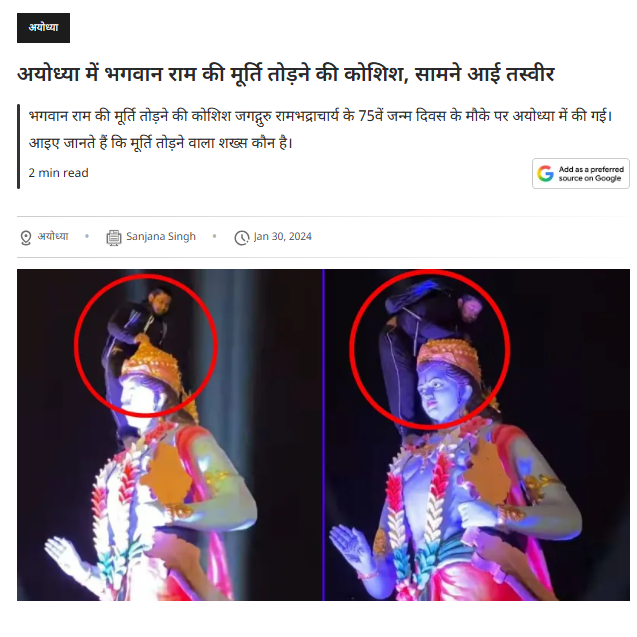
To verify the authenticity of the claim, we extracted key frames from the viral video and conducted a reverse image search using Google Lens. During the search, we found a report published on January 30, 2024, on the Hindi website of Patrika, which carried visuals matching the viral footage. According to the report, a video had surfaced showing a man climbing an idol of Lord Ram in Ayodhya and attempting to damage it. The video had gone viral at the time, following which police registered a case against the accused, Mukhtar Ali Mandal, and arrested him.
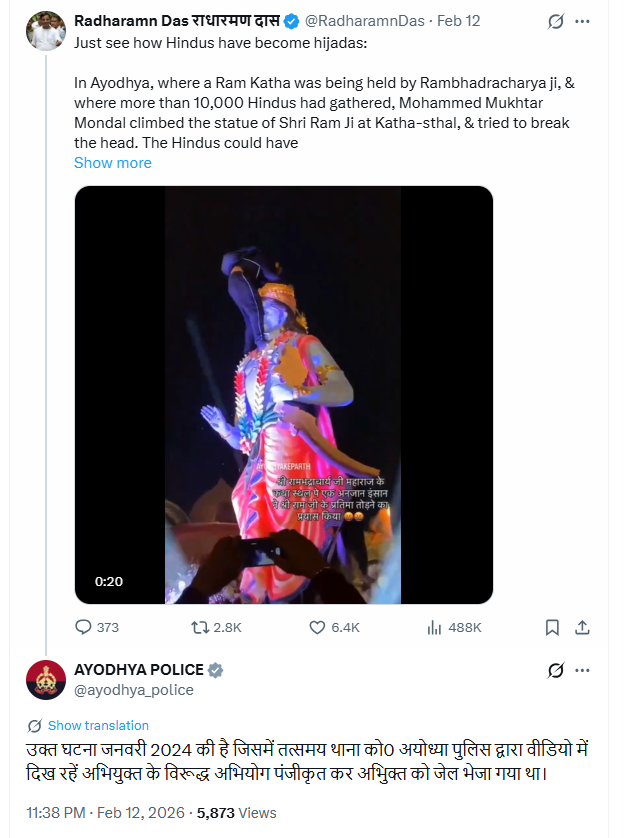
Further research led us to another Facebook post featuring the same video. In the comment section of that post, Uttar Pradesh Police clarified that the incident dated back to January 2024. The Ayodhya police had registered a case against the accused shown in the video and sent him to jail.
Conclusion:
The research confirms that the viral video is not recent but an old incident from January 2024. The accused was arrested at the time. The video is being reshared with misleading claims falsely presenting it as a recent event.
