
#FactCheck - Old Video of Khamenei Manipulated With AI Voice, Viral Claim Misleading
Executive Summary
Claims are circulating that Iran’s Supreme Leader Ayatollah Ali Khamenei was killed in a major attack allegedly carried out by Israel and the United States. Amid these claims, a video is being widely shared on social media in which Khamenei can be heard saying, “Beware of fake news, I am alive.” Research conducted by CyberPeace has found the viral claim to be false. Our research revealed that the video being shared is old and that Khamenei’s voice has been altered using artificial intelligence to support a misleading narrative.
Claim
On March 1, 2026, an Instagram user shared the viral video in which Ayatollah Ali Khamenei is heard saying, “Beware of fake news, I am alive.” The link to the post and its archived version are provided above along with a screenshot.

Fact Check:
To verify the authenticity of the claim, we extracted key frames from the viral video and conducted a reverse image search using Google Lens. During the research, we found the same video on the YouTube channel of Sky News Australia, published on June 19, 2025. In the approximately 43-minute-long video, the portion used in the viral clip appears around the 10-minute mark.

According to Sky News Australia’s report, Iran’s Supreme Leader Ayatollah Ali Khamenei had rejected US President Donald Trump’s demand for unconditional surrender. The Ayatollah regime also warned that any American military intervention would be accompanied by “irreparable damage.” Upon closely listening to the viral clip, we noticed that Khamenei’s voice sounded robotic, raising suspicion that it may have been AI-generated. We then analyzed the video using the AI detection tool AURGIN AI. The results indicated that the viral clip had been generated using artificial intelligence.

Conclusion
Our research establishes that the viral video is old and has been digitally manipulated. Ayatollah Ali Khamenei’s voice has been altered using artificial intelligence and the clip is being shared with a misleading claim.

Related Blogs

Executive Summary
A viral image claims that an Israeli helicopter shot down in South Lebanon. This investigation evaluates the possible authenticity of the picture, concluding that it was an old photograph, taken out of context for a more modern setting.

Claims
The viral image circulating online claims to depict an Israeli helicopter recently shot down in South Lebanon during the ongoing conflict between Israel and militant groups in the region.


Factcheck:
Upon Reverse Image Searching, we found a post from 2019 on Arab48.com with the exact viral picture.


Thus, reverse image searches led fact-checkers to the original source of the image, thus putting an end to the false claim.
There are no official reports from the main news agencies and the Israeli Defense Forces that confirm a helicopter shot down in southern Lebanon during the current hostilities.
Conclusion
Cyber Peace Research Team has concluded that the viral image claiming an Israeli helicopter shot down in South Lebanon is misleading and has no relevance to the ongoing news. It is an old photograph which has been widely shared using a different context, fueling the conflict. It is advised to verify claims from credible sources and not spread false narratives.
- Claim: Israeli helicopter recently shot down in South Lebanon
- Claimed On: Facebook
- Fact Check: Misleading, Original Image found by Google Reverse Image Search
.webp)
The Digital Covenant: Aligning Communication with SDG Goals
“Rethinking Communication, Cyber Responsibility, and Sustainability in a Connected World”
Introduction
It is rightly said by Antonio Guterres, United Nations Secretary General, “Everyone should be able to express themselves freely without fear of attack. Everyone should be able to access a range of views and information sources.” In 2024, when the Global Alliance for PR and Communication Management asserted that it aligns with the era of digital transformation, where technology is moving at terminal velocity and bringing various risks and threats, it called on the global leaders and stakeholders to proclaim ‘Responsible Communication’ as the 18th Sustainable Development Goal (SDG). On May 17th, as we celebrate World Telecommunication and Information Society Day (WTISD) 2025, we must align our personal, professional, and virtual spaces with a safe and sustainable information age.
In terms of digital growth, it is indubitable that India is growing at a brisk pace consistently in alignment with its South Asian and Western counterparts and has incorporated international covenants on digital personal data and cyber crimes within its domestic regime.
UN Global Principles for Information Integrity
The United Nations has displayed its constant commitment to the achievement of the seventeen SDGs that were adopted at the United Nations Conference in 2012 in Rio de Janeiro. It recognises that you cannot isolate the digital transformation, technology, and digitisation from other areas that are included within the SDGs, such as health, education, and poverty. The UN released Policy Brief 8 in June 2023 by the UN Secretary-General that seeks to empirically derive data on the threats posed to information integrity and then come up with norms that help guide the member states, the digital platforms, and other stakeholders. The norms must be in conformity with the right to freedom of opinion and expression and the right to information access.
In line with its agenda, it has formulated Global Principles of Information Integrity, which include “Societal Trust and Resilience”, “Healthy Incentives”, “Public Empowerment”, “Independent, Free and Pluralistic Media” and “Transparency and Research”. The principles recognise the harm caused by hatred, misinformation, and disinformation propagated by the misuse of advances in Artificial Intelligence Technology (AI).
Breaking the Binary: Bridging the Gender Digital Divide
The reflection of how far we have come and how far we have to go can be deciphered with a single sentence, i.e., using digital technologies to promote gender equality. This can be seen both as a paradox and a pressing call to action. As we celebrate WTISD 2025, the day highlights the fundamental role of Information and Communication Technologies (ICTs) in accelerating progress and bringing those not included in this digital transformation to become a part of this change, especially the female population that remains isolated from mainstream growth. As per the data given by ITU, “Out of the world population, 70 per cent of men are using the internet, compared with 65 per cent of women.”
This exclusion is not merely a technical gap but a societal and economic chasm, reinforcing existing inequalities. By including such an important goal in the theme of this day, it marks a critical moment towards the formation of gender-sensitive digital policies, promoting digital literacy among women and girls, and ensuring safe, affordable, and meaningful connectivity. We can explore the future potential where technology is the true instrument for gender parity, not a mirror of old hierarchies.
India and its courts have time and again proven their commitment to cultivating digital transformation as an inherent strength to bridge this digital divide, and the recent judgement where the court declared the right to digital access an intrinsic part of the right to life and liberty is a single instance among many.
CyberPeace Resolution on World Telecommunication and Information Society Day
CyberPeace is actively bridging the gap between digital safety and sustainable development through its initiatives, aligning with the principles of the Sustainable Development Goals (SDGs). The ‘CyberPeace Corps’ empowers communities by fostering cyber hygiene awareness and building digital resilience. The ‘CyberPeace Initiative’, a project with Google.org, tackles digital misinformation, promoting informed online engagement. Additionally, Digital Shakti, now in its fifth phase, empowers women by enhancing their digital literacy and safety. These are just a few of the many impactful initiatives by CyberPeace, aimed at creating a safer and more inclusive digital future. Together, we are spreading awareness and strengthening the foundation for a safer and more inclusive digital future and promoting responsible tech use. Let us be resolute on this World Telecommunication and Information Society Day for “Clean Data. Safe Clicks. Stronger Future. Pledge to Cyber Hygiene Today!”
References

A video circulating widely on social media claims to show snowfall near Ambience Mall in Gurugram, Haryana. The clip is being shared alongside assertions that Gurugram witnessed snowfall for the first time in its history amid a severe cold wave in January 2026. However, an research by Cyber Peace Foundation has found the claim to be misleading. Our verification reveals that the viral video is not recent and has been available online since March 2023.
The Claim
On 14 January 2026, a Facebook user shared the video with the caption,“Something truly unbelievable happened today — Gurgaon witnessed snowfall for the first time in its history!”Through this post, the user implied that the visuals showed snowfall near Ambience Mall during the ongoing cold wave.link and screeshot
- https://www.instagram.com/reel/DTfS9X9DyBo/?utm_source=ig_embed&ig_rid=239ddaf7-ec53-4b1d-8f3b-a5e39540b3ee
- https://archive.ph/JVjHf

Fact Check:
To verify the claim, we conducted a detailed search using relevant keywords but found no credible media reports or official statements to support it. Although Gurugram’s temperature dropped to 0.6 degrees Celsius amid an IMD-issued cold wave warning, there is no evidence to suggest that the city experienced snowfall or hail. As of January 16, 2026, weather records and official sources confirm that no such weather event occurred in Gurugram.
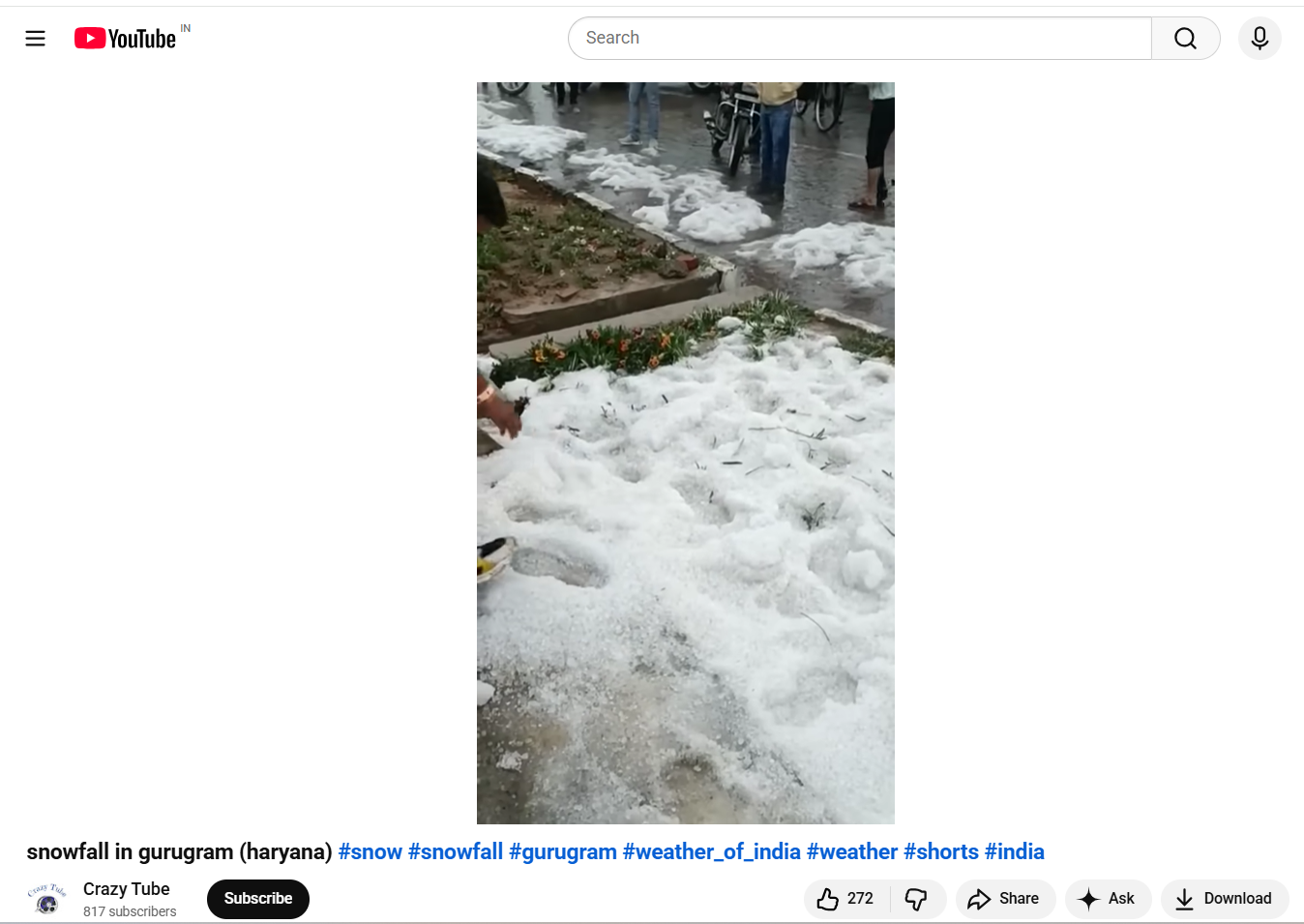
A reverse image search of keyframes extracted from the viral clip traced the same footage to a video uploaded on the YouTube channel Crazy Tube on March 21, 2023. This establishes that the video has been in circulation for nearly three years. In the original upload, the person filming clearly mentions that the visuals were recorded near a toll plaza, further indicating that the clip is unrelated to the recent weather conditions in Gurugram. Link and Screen Shot
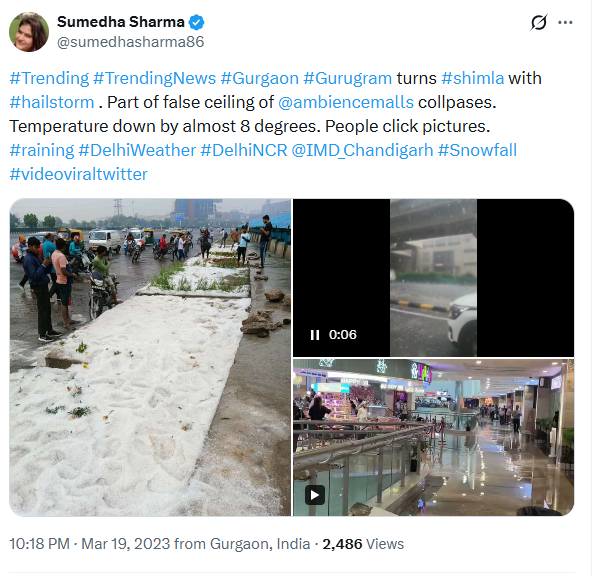
We also came across an X (formerly Twitter) post from March 19, 2023, which featured images similar to those seen in the viral video. The post described the visuals as being from a hailstorm in Gurugram, indicating that the content predates the current weather conditions and is unrelated to the recent cold wave.
Conclusion:
The video is old and predates January 2026, and has been on the internet at least since March 2023. While Gurugram recorded a low of 0.6 degrees Celsius amid an IMD cold wave warning, the city did not experience snowfall or hail as of 16 January 2026. News reports from March 2023 confirm heavy rain and hail in Delhi and adjoining areas, including parts of Gurugram, but there is no evidence of snowfall in January 2026. Hence, the claim made in the post is MISLEADING.
