
#FactCheck- Old Earthquake Images Falsely Linked to April 2026 Indonesia Quake
Executive Summary
Images showing collapsed buildings are being widely shared on social media following a powerful earthquake in Indonesia, with users claiming they depict the aftermath of the recent 7.4-magnitude quake. However, research by the CyberPeace Research Wing found the claim to be misleading. The viral images are not from the recent earthquake but from past tremors, and were published by major international news agencies in 2018, 2021 and 2022.
- https://perma.cc/6BTK-2V6T
- https://www.facebook.com/reel/1272067278357847%20no%20other%20snapshots%20from%20this%20url

Fact Check
The posts surfaced after a 7.4-magnitude earthquake struck off the coast of Kota Ternate in eastern Indonesia in the early hours of April 2, 2026, killing one person after a building collapse, as reported by international media.

To verify the authenticity of the images, we conducted reverse image and keyword searches on Google. The first image was found to be part of a wider photograph published by The Associated Press on January 15, 2021.

The third image was traced to Getty Images, which published it on October 2, 2018. According to its description, the image shows rubble and debris around a mosque in Palu, Central Sulawesi, following a 7.5-magnitude earthquake.

These findings confirm that the viral images are unrelated to the recent earthquake and have been taken from older incidents.
Conclusion
The viral claim is misleading. The images circulating online do not show the aftermath of the April 2026 earthquake in Indonesia. Instead, they are old visuals from previous earthquakes, reused with a false and misleading context.

Related Blogs

Executive Summary:
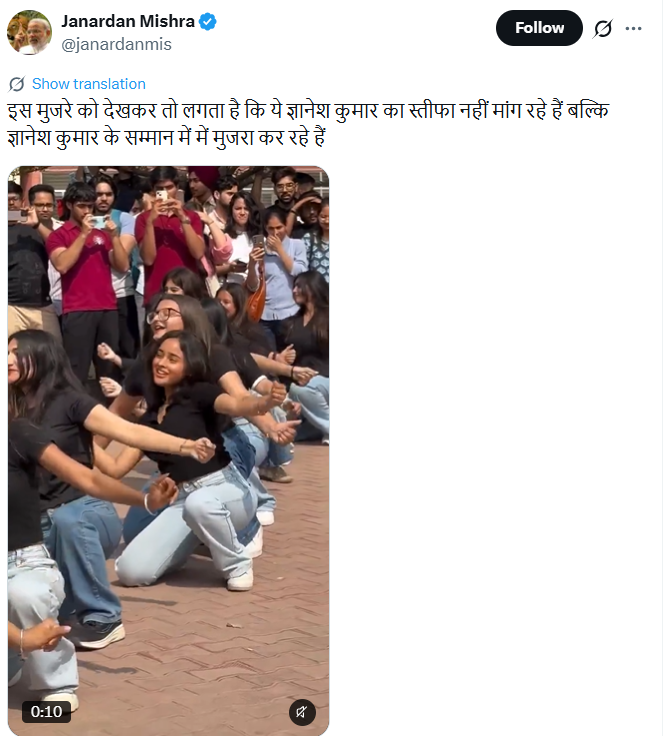
A video of girls dancing is being shared on social media. The video is being circulated with the claim that it shows a recent protest against Chief Election Commissioner Gyanesh Kumar. Social media users are sharing the video as footage from the protest and attempting to link it to the ongoing developments. However, CyberPeace Research found the viral claim to be false. Our research found that the video is not recent. The viral video is from an event organised at a college under Panjab University and has no connection with the ongoing protests against Chief Election Commissioner Gyanesh Kumar.
Claim:
A user on the social media platform X (formerly Twitter) shared the viral video on October 5, 2026, with the caption: “Looking at this mujra, it seems they are not demanding Gyanesh Kumar’s resignation, but rather performing a mujra in his honour.” The post link, archive link, and screenshot are provided below.
https://x.com/janardanmis/status/2107092458731614355
Fact Check
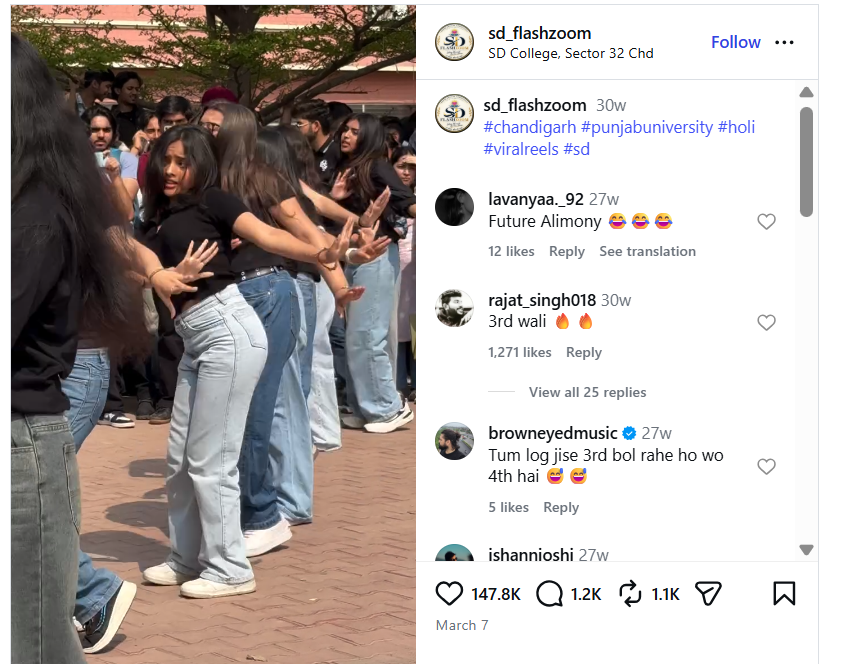
To verify the authenticity of the viral claim, we conducted a reverse image search using keyframes from the video. During the search, we found the same video uploaded on the Instagram account named “SD Flash Zoom” on March 7, 2026. Upon examining the Instagram account, we found that the page posts videos related to dance programmes organised at Goswami Ganesh Dutta Sanatan Dharma College (GGDSD College), affiliated with Panjab University. The post link and screenshot are provided below.
https://www.instagram.com/p/DVkLftuCW_G/
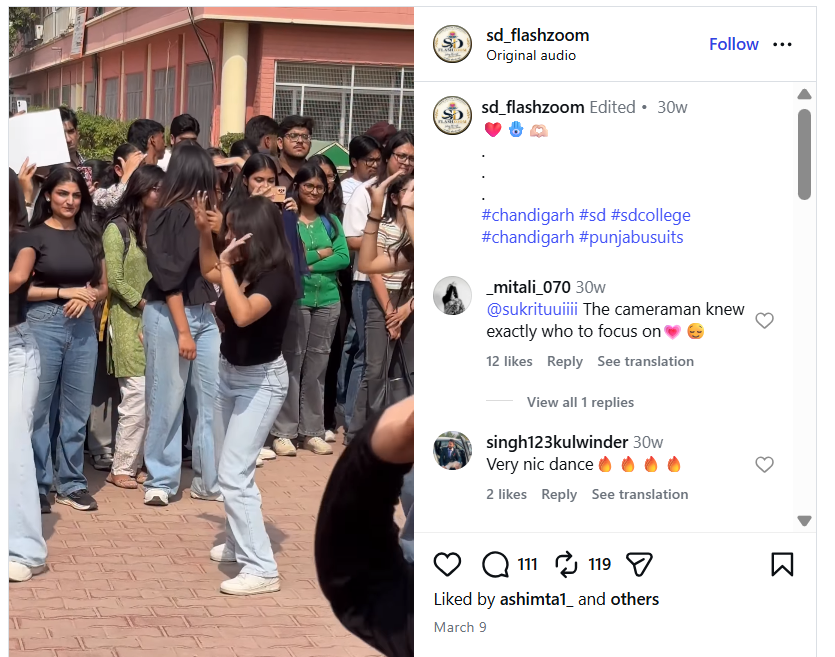
During our research, we found another video uploaded on the same account on March 9, 2026. Watch the video. The visuals seen in this video match those in the viral video, confirming that both videos are from the same event. The post link and screenshot are provided below.
https://www.instagram.com/p/DVqRuIdiQ7t/
Conclusion
The evidence gathered during our research makes it clear that the video being shared on social media as footage of a protest against Chief Election Commissioner Gyanesh Kumar is not recent. The viral video is actually from an event held at SD College in Punjab in March 2026. Therefore, the claim that the video shows a protest against Chief Election Commissioner Gyanesh Kumar is misleading.

Executive Summary
A video circulating on social media allegedly shows an Indian Army Air Defence JCO, identified as “Anurag Thakur,” criticising the Central government and announcing his resignation. In the clip, the individual is purportedly heard expressing disappointment with the government’s support for soldiers and claiming heavy casualties within his unit. However, an investigation by the CyberPeace Research Wing has found the claim to be false and the video manipulated.
Claim:
The viral post alleges that an Indian Army Air Defence JCO criticised the Centre and resigned, citing lack of support for soldiers and unacknowledged casualties.

Fact Check:
A keyword search using terms such as “Indian Army Air Defence JCO,” “Anurag Thakur,” and “resignation” did not yield any credible news reports supporting the claim. A reverse image search of the viral clip led to an original video posted by ANI on April 22, 2026. The ANI watermark is also visible in the viral footage, confirming that the clip has been sourced from this original video.

In the authentic version, the same personnel appears in the same setting, but he is speaking in Hindi about operations against adversary drones during “Operation Sindoor” in May 2025. He explains how his unit detected and neutralised multiple drones, successfully safeguarding a critical installation. Importantly, the original video does not identify the individual as Anurag Thakur, nor does it contain any reference to resignation, casualties, or criticism of the government.
Further technical analysis using the AI detection tool Hive Moderation indicated that the audio in the viral clip has an 86 percent likelihood of being artificially generated.

Conclusion:
The viral video has been altered with fabricated audio to falsely claim that an Indian Army officer criticised the government and resigned. The claim is baseless and the clip is a clear case of a deepfake created to mislead viewers.

Executive Summary
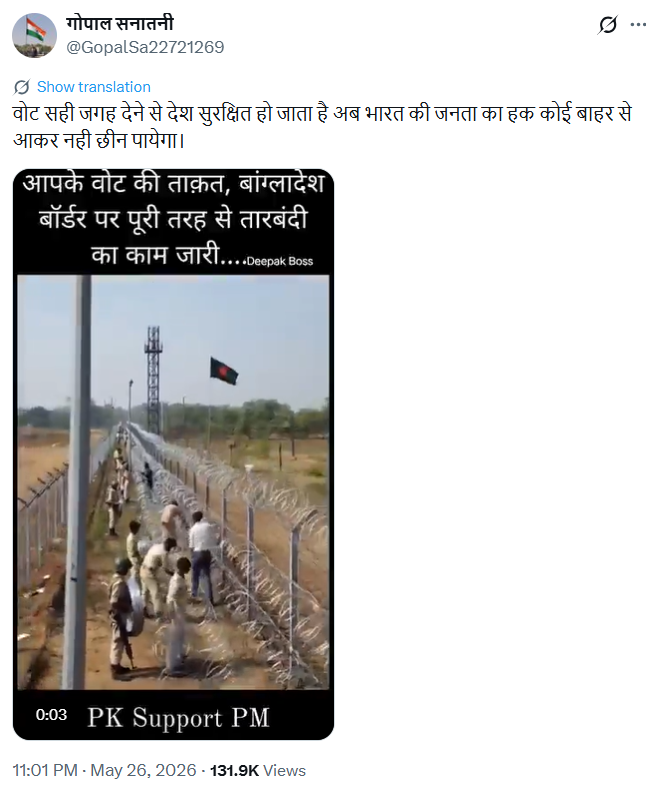
A video showing people installing fencing along a border has gone viral on social media. In the clip, several individuals along with security personnel can be seen laying barbed wire fencing near a border area. The video is being shared with the claim that it shows fencing work underway on the India-Bangladesh border in West Bengal after the Bharatiya Janata Party (BJP) allegedly came to power in the state.
However, CyberPeace Research Wing investigation found the viral claim to be false. The video is not from a real incident and has been created using Artificial Intelligence (AI).
Claim
An X user named “Gopal Sanatani” shared the viral video on May 26, 2026, with the caption:“Voting in the right place keeps the country secure. Now no outsider will be able to snatch the rights of Indian citizens.”The archived link to the post is provided below.
Fact Check
To verify the authenticity of the viral claim, we extracted several key frames from the video and conducted reverse image searches using Google. However, we could not find any credible information or authentic reports related to the visuals shown in the clip. We also searched using relevant keywords on Google, but no trustworthy news reports connected to the claim were found.
Upon closely examining the video, several visual inconsistencies became noticeable. At one point, an object resembling a piece of paper suddenly appears in a soldier’s hand and then disappears moments later. In another scene, a man installing the fencing appears to pass directly through the barbed wire and emerges unharmed, despite the sharp wires visible in the video. These irregularities raised suspicion that the clip had been artificially generated. To further investigate, we analysed the video using AI detection tools. The analysis conducted through Hive Moderation indicated a high probability — around 80 percent — that the video was AI-generated.
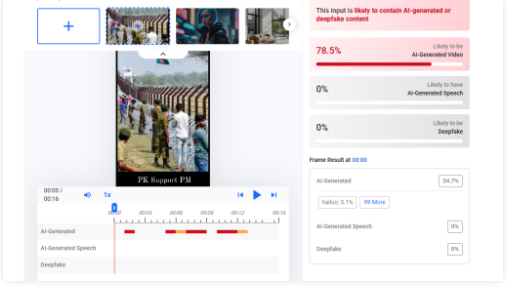
Additionally, the video was examined using another AI detection platform, “AI or Not,” which indicated nearly a 99 percent likelihood that the clip had been created using artificial intelligence.

Conclusion
Our investigation found that the viral video claiming to show fencing work along the West Bengal-Bangladesh border is fake. The footage does not depict a real incident and was generated using Artificial Intelligence (AI).
