
#FactCheck - Debunked: AI-Edited Video Falsely Depicts Hon'ble President of India Endorsing Diabetes Medication
Executive Summary:
A video clip being circulated on social media allegedly shows the Hon’ble President of India, Smt. Droupadi Murmu, the TV anchor Anjana Om Kashyap and the Hon’ble Chief Minister of Uttar Pradesh, Shri Yogi Adityanath promoting a medicine for diabetes. While The CyberPeace Research Team did a thorough investigation, the claim was found to be not true. The video was digitally edited, with original footage of the heavy weight persons being altered to falsely suggest their endorsement of the medication. Specific discrepancies were found in the lip movements and context of the clips which indicated AI Manipulation. Additionally, the distinguished persons featured in the video were actually discussing unrelated topics in their original footage. Therefore, the claim that the video shows endorsements of a diabetes drug by such heavy weights is debunked. The conclusion drawn from the analysis is that the video is an AI creation and does not reflect any genuine promotion. Furthermore, it's also detected by AI voice detection tools.

Claims:
A video making the rounds on social media purporting to show the Hon'ble President of India, Smt. Draupadi Murmu, TV anchor Anjana Om Kashyap, and Hon'ble Chief Minister of Uttar Pradesh Shri Yogi Adityanath giving their endorsement to a diabetes medicine.

Fact Check:
Upon receiving the post we carefully watched the video and certainly found some discrepancies between lip synchronization and the word that we can hear. Also the voice of Chief Minister of Uttar Pradesh Shri Yogi Adityanath seems to be suspicious which clearly indicates some sign of fabrication. In the video, we can hear Hon'ble President of India Smt. Droupadi Murmu endorses a medicine that cured her diabetes. We then divided the video into keyframes, and reverse-searched one of the frames of the video. We landed on a video uploaded by Aaj Tak on their official YouTube Channel.

We found something similar to the same viral video, we can see the courtesy written as Sansad TV. Taking a cue from this we did some keyword searches and found another video uploaded by the YouTube Channel Sansad TV. In this video, we found no mention of any diabetes medicine. It was actually the Swearing in Ceremony of the Hon’ble President of India, Smt. Droupadi Murmu.

In the second part, there was a man addressed as Dr. Abhinash Mishra who allegedly invented the medicine that cures diabetes. We reverse-searched the image of that person and landed at a CNBC news website where the same face was identified as Dr Atul Gawande who is a professor at Harvard School of Public Health. We watched the video and found no sign of endorsing or talking about any diabetes medicine he invented.

We also extracted the audio from the viral video and analyzed it using the AI audio detection tool named Eleven Labs, which found the audio very likely to be created using the AI Voice generation tool with the probability of 98%.

Hence, the Claim made in the viral video is false and misleading. The Video is digitally edited using different clips and the audio is generated using the AI Voice creation tool to mislead netizens. It is worth noting that we have previously debunked such voice-altered news with bogus claims.
Conclusion:
In conclusion, the viral video claiming that Hon'ble President of India, Smt. Droupadi Murmu and Chief Minister of Uttar Pradesh Shri Yogi Adityanath promoted a diabetes medicine that cured their diabetes, is found to be false. Upon thorough investigation it was found that the video is digitally edited from different clips, the clip of Hon'ble President of India, Smt. Droupadi Murmu is taken from the clip of Oath Taking Ceremony of 15th President of India and the claimed doctor Abhinash Mishra whose video was found in CNBC News Outlet. The real name of the person is Dr. Atul Gawande who is a professor at Harvard School of Public Health. Online users must be careful while receiving such posts and should verify before sharing them with others.
Claim: A video is being circulated on social media claiming to show distinguished individuals promoting a particular medicine for diabetes treatment.
Claimed on: Facebook
Fact Check: Fake & Misleading

Related Blogs
.webp)
Introduction
As the 2024 Diwali festive season approaches, netizens eagerly embrace the spirit of celebration with online shopping, gifting, and searching for the best festive deals on online platforms. Historical web data from India shows that netizens' online activity spikes at this time as people shop online to upgrade their homes, buy unique presents for loved ones and look for services and products to make their celebrations more joyful.
However, with the increase in online transactions and digital interactions, cybercriminals take advantage of the festive rush by enticing users with fake schemes, fake coupons offering freebies, fake offers of discounted jewellery, counterfeit product sales, festival lotteries, fake lucky draws and charity appeals, malicious websites and more. Cybercrimes, especially phishing attempts, also spike in proportion to user activity and shopping trends at this time.
Hence, it becomes important for all netizens to stay alert, making sure their personal information and financial data is protected and ensure that they exercise due care and caution before clicking on any suspicious links or offers. Additionally, brands and platforms also must make strong cybersecurity a top priority to safeguard their customers and build trust.
Diwali Season and Phishing Attempts
Last year's report from CloudSEK's research team noted an uptick in cyber threats during the Diwali period, where cybercriminals leveraged the festive mood to launch phishing, betting and crypto scams. The report revealed that phishing attempts target the e-commerce industries and seek to damage the image of reputable brands. An astounding 828 distinct domains devoted to phishing activities were found in the Facebook Ads Library by CloudSEK's investigators. The report also highlighted the use of typosquatting techniques to create phony-but-plausible domains that trick users into believing they are legitimate websites, by exploiting common typing errors or misspellings of popular domain names. As fraudsters are increasingly misusing AI and deepfake technologies to their advantage, we expect even more of these dangers to surface this year over the festive season.
CyberPeace Advisory
It is important that netizens exercise caution, especially during the festive period and follow cyber safety practices to avoid cybercrimes and phishing attempts. Some of the cyber hygiene best practices suggested by CyberPeace are as follows:
- Netizens must verify the sender’s email, address, and domain with the official site for the brand/ entity the sender claims to be affiliated with.
- Netizens must avoid clicking links received through email, messages or shared on social media and consider visiting the official website directly.
- Beware of urgent, time-sensitive offers pressuring immediate action.
- Spot phishing signs like spelling errors and suspicious URLs to avoid typosquatting tactics used by cybercriminals.
- Netizens must enable two-factor authentication (2FA) for an additional layer of security.
- Have authenticated antivirus software and malware detection software installed on your devices.
- Be wary of unsolicited festive deals, gifts and offers.
- Stay informed on common tactics used by cybercriminals to launch phishing attacks and recognise the red flags of any phishing attempts.
- To report cybercrimes, file a complaint at cybercrime.gov.in or helpline number 1930. You can also seek assistance from the CyberPeace helpline at +91 9570000066.
References
- https://www.outlookmoney.com/plan/financial-plan/this-diwali-beware-of-these-financial-scams
- https://www.businesstoday.in/technology/news/story/diwali-and-pooja-domains-being-exploited-by-online-scams-see-tips-to-help-you-stay-safe-405323-2023-11-10
- https://www.abplive.com/states/bihar/bihar-crime-news-15-cyber-fraud-arrested-in-nawada-before-diwali-2024-ann-2805088
- https://economictimes.indiatimes.com/tech/technology/phishing-you-a-happy-diwali-ai-advancements-pave-way-for-cybercriminals/articleshow/113966675.cms?from=mdr

Introduction
Today, on the International Day of UN Peacekeepers, we honour the brave individuals who risk their lives to uphold peace in the world’s most fragile and conflict-ridden regions. These peacekeepers are symbols of hope, diplomacy, and resilience. But as the world changes, so do the arenas of conflict. In today’s interconnected age, peace and safety are no longer confined to physical spaces—they extend to the digital realm. As we commemorate their service, we must also reflect on the new frontlines of peacekeeping: the internet, where misinformation, cyberattacks, and digital hate threaten stability every day.
The Legacy of UN Peacekeepers
Since 1948, UN Peacekeepers have served in over 70 missions, protecting civilians, facilitating political processes, and rebuilding societies. From conflict zones in Africa to the Balkans, they’ve worked in the toughest terrains to keep the peace. Their role is built on neutrality, integrity, and international cooperation. But as hybrid warfare becomes more prominent and digital threats increasingly influence real-world violence, the peacekeeping mandate must evolve. Traditional missions are now accompanied by the need to understand and respond to digital disruptions that can escalate local tensions or undermine democratic institutions.
The Digital Battlefield
In recent years, we’ve seen how misinformation, deepfakes, online radicalisation, and coordinated cyberattacks can destabilise peace processes. Disinformation campaigns can polarise communities, hinder humanitarian efforts, and provoke violence. Peacekeepers now face the added challenge of navigating conflict zones where digital tools are weaponised. The line between physical and virtual conflict is blurring. Cybersecurity has gone beyond being just a technical issue and is now a peace and security issue as well. From securing communication systems to monitoring digital hate speech that could incite violence, peacekeeping must now include digital vigilance and strategic digital diplomacy.
Building a Culture of Peace Online
Safeguarding peace today also means protecting people from harm in the digital space. Governments, tech companies, civil society, and international organisations must come together to build digital resilience. This includes investing in digital literacy, combating online misinformation, and protecting human rights in cyberspace. Peacekeepers may not wear blue helmets online, but their spirit lives on in every effort to make the internet a safer, kinder, and more truthful place. The role of youth, educators, and responsible digital citizens has never been more crucial. A culture of peace must be cultivated both offline and online.
Conclusion: A Renewed Pledge for Peace
On this UN Peacekeepers’ Day, let us not only honour those who have served and sacrificed but also renew our commitment to peace in all its dimensions. The world’s conflicts are evolving, and so must our response. As we support peacekeepers on the ground, let’s also become peacebuilders in the digital world, amplifying truth, rejecting hate, and building safer, inclusive communities online. Peace today is not just about silencing guns but also silencing disinformation. The call for peace is louder than ever. Let’s answer it, both offline and online.
.webp)
Executive Summary
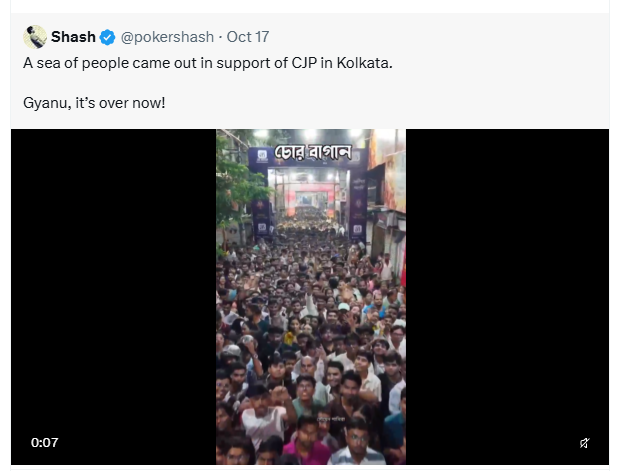
A social media post is going viral, claiming that a large number of people took to the streets in Kolkata in support of CJP. The post targets Chief Election Commissioner Gyanesh Kumar, stating, “Gyanesh Kumar, your game is over now!”
CyberPeace Research found that the viral video is not related to any protest against Chief Election Commissioner Gyanesh Kumar. The video shows a public Durga Puja celebration at Chorbagan in Kolkata, where a large number of people had gathered.
Claim:
A large number of people took to the streets in Kolkata in support of CJP. The protesters targeted Chief Election Commissioner Gyanesh Kumar, saying, “Gyanu, your game is over now!”
https://x.com/pokershash/status/2111337300848415032
Fact Check
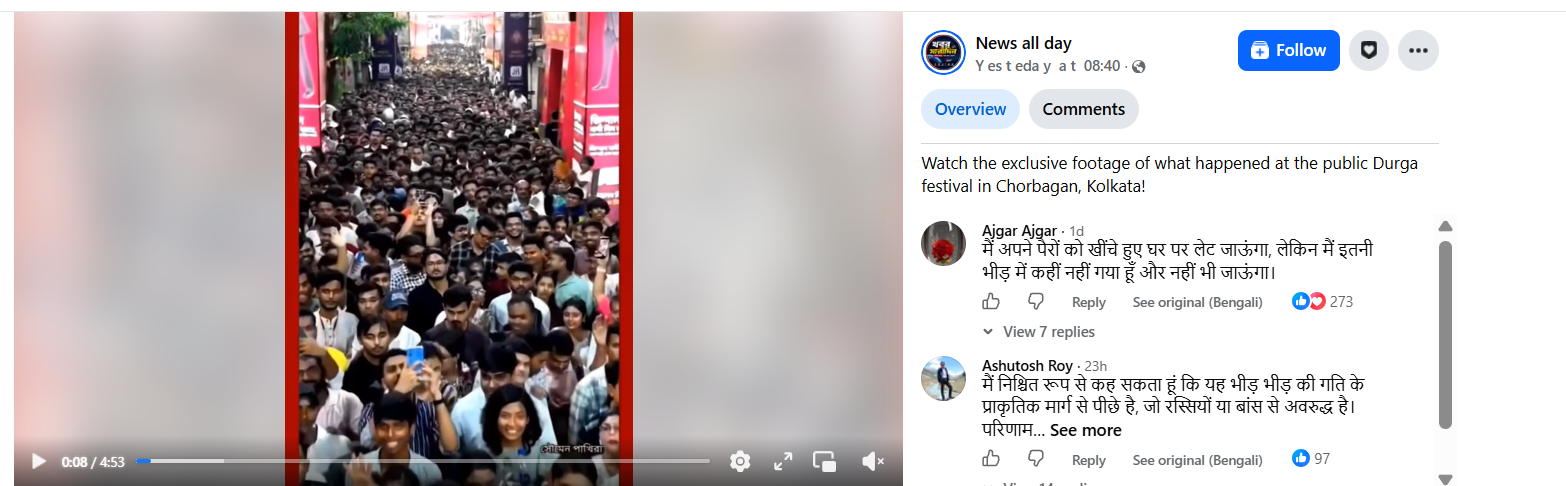
We conducted a reverse image search using keyframes from the viral video. During our research, we found the video on Facebook, where it was identified as footage from a public Durga Puja celebration organised at Chorbagan in Kolkata, which saw a large gathering of people.
https://www.facebook.com/watch/?v=29115417811386049
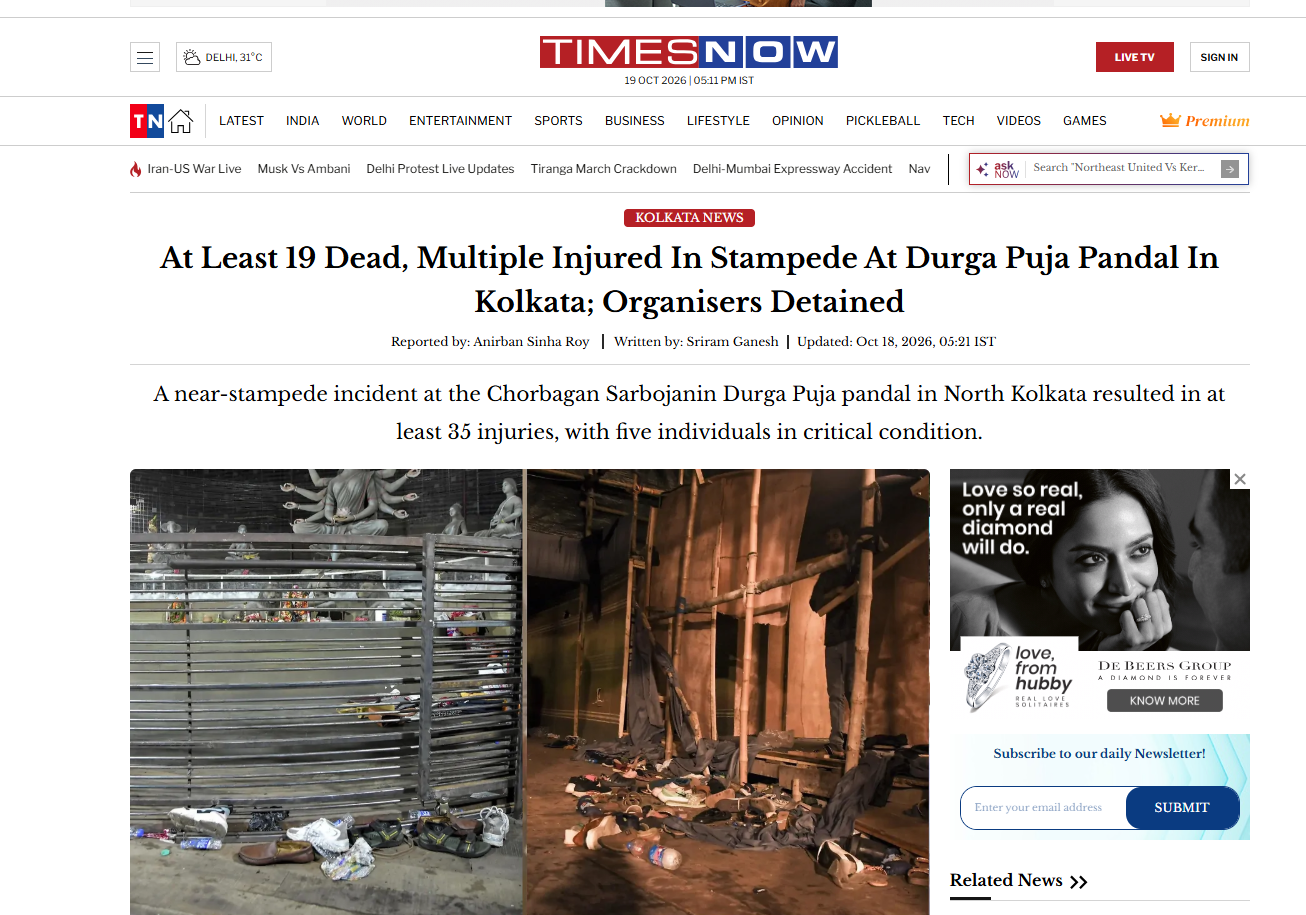
During our research, we found a video published by Times Now Bharat on October 17, 2026. According to the report, the footage shows a large crowd gathered at the Chorbagan Sarbojanin Durga Puja pandal in Kolkata. A near-stampede occurred at the venue, leaving 25 people injured, five of whom were reported to be in critical condition. This confirms that the video is unrelated to any gathering in support of CJP.
Conclusion
Our research found that the viral video is not related to any protest against Chief Election Commissioner Gyanesh Kumar. The video shows a public Durga Puja celebration at Chorbagan in Kolkata, where a large number of people had gathered.
