
#FactCheck- AI-Generated Video Falsely Claims Iran Attack on Apple, Microsoft in Israel
Executive Summary:
Amid the ongoing conflict in West Asia involving the United States, Israel and Iran, a video is being widely circulated on social media with the claim that Iran attacked the headquarters of tech giants Apple and Microsoft in Israel. The clip shows a building engulfed in flames, with firefighters attempting to douse the fire. However, research by the CyberPeace found that the viral video is AI-generated and is being falsely linked to the ongoing conflict to spread misinformation.
Claim:
An Instagram user ‘bharat_updatenews’ shared the video on March 19, 2026, claiming that Iran had launched an attack on major tech company headquarters, including Apple and Microsoft, in Israel. The post suggested that the incident had raised serious security concerns and was being widely reported by international media.
Link: https://www.instagram.com/bharat_updatenews/reel/DWEUhLEAKaw

Fact Check:
To verify the claim, we extracted keyframes from the viral video and conducted a reverse search using Google Lens. During this process, we found the same video on a TikTok account named ‘dailyupdate122’, where it had been uploaded on March 15, 2026.

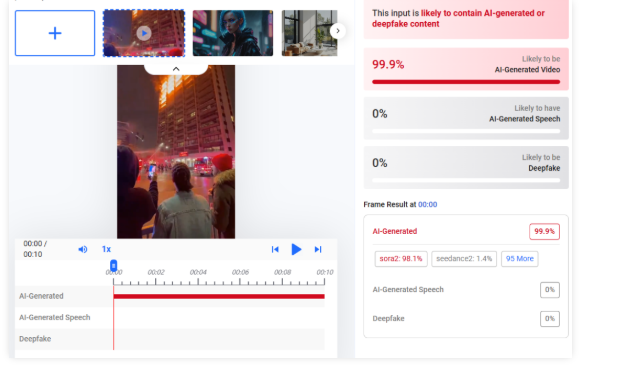
The video on this account was clearly labelled as “AI-generated media.” The account also featured several other AI-generated videos, raising doubts about the authenticity of the viral clip. Following this, we analysed the video using the AI detection tool Hive Moderation. The results indicated that the video is nearly 100 percent AI-generated. The tool further suggested with over 98 percent probability that the clip may have been created using OpenAI’s Sora or a similar AI video generation model.
Conclusion:
The viral claim that Iran attacked Apple and Microsoft headquarters in Israel is false. The video circulating online is AI-generated and has no connection to the ongoing conflict in West Asia.

Related Blogs

Introduction
In the hyper-connected era, something as mundane as charging your phone can become a gateway to cyberattacks. A recent experience of Assam Chief Minister Himanta Biswa Sarma has reignited fears of an emerging digital menace called juice jacking. Sarma, who was taking an Emirates flight from Delhi to Dubai, used an international charger and cable provided by another passenger on board. As he afterwards reported on X (formerly Twitter), the passenger got off while he slept and so could not return the borrowed items. Though most people admired the CM's humility and openness, cybersecurity experts and citizens were quick to point out a possible red flag, that it could be a juice-jacking attempt. Whether by design or not, the scene calls out to the concealed risks of using unfamiliar charging equipment, particularly for those who hold sensitive roles.
What Is Juice Jacking?
Juice jacking takes advantage of the multi-purpose nature of USB connectors, which can carry both electrical energy and information. Attackers hack USB ports or cables to either:
- Insert harmful payloads (malware, spyware, ransomware) during power transfer, or
- Create unauthorised data pathways for silent information exfiltration.
Types of Juice Jacking Attacks
- Data Theft (Exfiltration Attack): The USB cable or port is rigged to silently extract files, media, contacts, keystrokes, or login information from the attached phone.
- Malware Injection (Payload Attack): The USB device is set to impersonate a Human Interface Device (HID), such as a keyboard. It sends pre-defined commands (shell scripts, command-line inputs) to the host, loading backdoors or spying tools.
- Firmware Tampering: In more sophisticated cases, attackers implement persistent malware at the bootloader or firmware level, bypassing antivirus protection and living through factory resets.
- Remote Command-and-Control Installation: Certain strains of malware initiate backdoors to enable remote access to the device over the internet upon reconnection to a live network.
Why the Assam CM’s Incident Raised Flags
Whereas CM Sarma's experience was one of thanks, the digital repercussions of this scenario are immense:
- High-value targets like government officials, diplomats, and corporate executives tend to have sensitive information.
- A hacked cable can be used as a spy tool, sending information or providing remote access.
- With the USB On-The-Go (OTG) feature in contemporary Android and iOS devices, an attacker can run autorun scripts and deploy payloads at device connect/disconnect.
- If device encryption is poor or security settings are incorrectly configured, attackers may gain access to location, communication history, and app credentials.
Technical Juice Jacking Indicators
The following are indications that a device could have been attacked:
- Unsolicited request for USB file access or data syncing on attaching.
- Faster battery consumption (from background activities).
- The device is acting strangely, launching apps or entering commands without user control.
- Installation of new apps without authorisation.
- Data consumption increases even if no browsing is ongoing.
CyberPeace Tech-Policy Advisory: Preventing Juice Jacking
- Hardware-Level Mitigation
- Utilise USB Data Blockers: Commonly referred to as "USB condoms," such devices plug the data pins (D+ and D-), letting only power (Vcc and GND) pass through. This blocks all data communication over USB.
- Charge-Only Cables: Make use of cables that physically do not have data lines. These are specifically meant to provide power only.
- Carry a Power Bank: Use your own power source, if possible, for charging, particularly in airports, conferences, or flights.
- Operating System(OS) Level Protections
- iOS Devices:
Enable USB Restricted Mode:
Keep USB accessories from being able to connect when your iPhone is locked.
Settings → Face ID & Passcode → USB Accessories → Off
- Android Devices:
Disable USB Debugging:
Debugging makes device access available for development, but it can be taken advantage of. If USB Debugging is turned on, and someone connects your phone to a computer, they might be able to access your data, install apps, or even control your phone, especially if your phone is unlocked. Hence, it should be kept off.
Settings → Developer Options → USB Debugging → Off
- Set USB Default to 'Charge Only'
Settings → Connected Devices → USB Preferences → Default USB Configuration → Charge Only
3) Behavioural Recommendations
- Never take chargers or USB cables from strangers.
- Don't use public USB charging points, particularly at airports or coffee shops.
- Turn full-disk encryption on on your device. It is supported by most Android and all iOS devices.
- Deploy endpoint security software that can identify rogue USB commands and report suspicious behaviour.
- Check cables or ports physically, many attack cables are indistinguishable from legitimate ones (e.g., O.MG cables).
Conclusion
"Juice jacking is no longer just a theoretical or obscure threat. In the age of highly mobile, USB-charged devices, physical-layer attacks are becoming increasingly common, and their targets are growing more strategic. The recent case involving the Assam Chief Minister was perhaps harmless, but it did serve to underscore a fundamental vulnerability in daily digital life. As mobile security becomes more relevant to individuals and organisations worldwide, knowing about hardware-based attacks like juice jacking is essential. Security never needs to be sacrificed for convenience, particularly when an entire digital identity might be at risk with just a single USB cable.
References
- https://www.indiatoday.in/trending-news/story/assam-chief-minister-himanta-biswa-sarma-x-post-on-emirates-passenger-sparks-juice-jacking-concerns-2706349-2025-04-09
- https://www.cert-in.org.in/s2cMainServlet?pageid=PUBVLNOTES02&VLCODE=CIAD-2016-0085
- https://www.fcc.gov/juice-jacking-tips-to-avoid-it
- https://www.cyberpeace.org/resources/blogs/juice-jacking
- https://support.apple.com/en-in/HT208857
- https://developer.android.com/studio/debug/dev-options

Overview of the India-UK Joint Tech Security Initiative
India and the UK have been deepening their technological and security ties through various initiatives and agreements. One of the key developments in this partnership is the India-UK Joint Tech Security Initiative, which focuses on enhancing collaboration in areas like cybersecurity, artificial intelligence (AI),telecommunications, and critical technologies. Building upon the bilateral cooperation agenda set out in the India-UK Roadmap 2030, which seeks to bolster cooperation across various sectors, including trade, climate change, antidefense, the UK and India launched the Joint Tech Security Initiative (TSI) on July 24, 2024. This initiative will priorities collaboration in critical and emerging technologies across priority sectors. Coordinating with the national security agencies of both countries, the TSI will set priority areas and identify interdependencies for cooperation on critical and emerging technologies. This, in turn, will help build meaningful technology value chain partnerships between India & the UK.
The TSI will be coordinated by the National Security Advisors (NSAs) of both countries through existing and new dialogues. The NSAswill set priority areas and identify interdependencies for cooperation on critical and emerging tech, helping build meaningful technology value chain partnerships between the two countries. Progress made on the initiative will be reviewed on a half-yearly basis at the Deputy NSA level. A bilateral mechanism will be established led by India's Ministry of External Affairs and the UK government for promotion of trade in critical and emerging technologies, including resolution of relevant licensing or regulatory issues. Both countries view this TSI as a platform and a strong signal of intent to build and grow sustainable and tangible partnerships across priority tech sectors. They will explore how to build a deeper strategic partnership between UK and Indian research and technology centres and Incubators, enhance cooperation across UK and India tech and innovation ecosystems, and create a channel for industry and academia to help shape the TSI.
The UK and India are launching new bilateral initiatives to expand and deepen their technology security partnership. These initiatives will focus on various domains, including telecoms, critical minerals, semiconductors, and energy security.
In telecoms, the UK and India will build a new Future Telecoms Partnership, focusing on joint research on future telecoms, open RAN systems, testbed linkups, telecoms security, spectrum innovation, software and systems architecture. This will include collaboration between UK's SONIC Labs, India's Centre for Development of Telematics (C-DOT), and Dot's Telecoms Startup Mission.
In critical minerals, the UK and India will expand their collaboration on critical minerals, working together to improve supply chain resilience, explore possible research and development and technology partnerships along the complete critical minerals value chain, and share best practices on ESG standards. They will establish a roadmap for cooperation and establish a UK-India ‘critical minerals’ community of academics, innovators, and industry.
Key Areas of Collaboration:
- Strengthening cybersecurity defense and enhancing resilience through joint cybersecurity exercises and information-sharing and developing common standards and best practices while collaborating with their respective organisations, ie, CERT-In and NCSC.
- Promotion of ethical AI development and deployment with AI ethics guidelines and frameworks, and efforts encouraging academic collaborations. Support for new partnerships between UK and Indian research organizations alongside existing joint programmes using AI to tackle global challenges.
- Building secure and resilient telecom infrastructure with a focus on security and exchange of expertise and regulatory cooperation. Collaboration on Open Radio Access Networks tech to name as an example.
- Critical and emerging technologies development by advancing research and innovation in the quantum, semiconductors and biotechnology niches. Promoting and investing in tech startups and innovation ecosystems. Engaging in policy dialogues on tech governance and standards.
- Digital economy and trade facilitation to promote economic growth by enhancing frameworks and agreements for it. Collaborating on digital payment systems and fintech solutions and most importantly promoting data protection and privacy standards.
Outlook and Impact on the Industry
The initiative sets out a new approach for how the UK and India work together on the defining technologies of this decade. These include areas such as telecoms, critical minerals, AI, quantum, health/biotechnology, advanced materials and semiconductors. While the initiative looks promising, several challenges need to be addressed such as the need to put robust regulatory frameworks in place, and develop a balanced approach for data privacy and information exchange in the cross-border data flows. It is imperative to install mechanisms that ensure that intellectual property is protected while the facilitation of technology transfer is not hampered. Above all, geopolitical risks need to be navigated in a manner that the tensions are reduced and a stable partnership grows. The Initiative builds on a series of partnerships between India and the UK, as well as between industry and academia. Abilateral mechanism, led by India’s Ministry of External Affairs and the UK government, will promote trade in critical and emerging technologies, including the resolution of relevant licensing or regulatory issues.
Conclusion
This initiative, at its core, will drive forward a bilateral partnership that is framed on boosting economic growth and deepening cooperation across key issues including trade, technology, education, culture and climate. By combining their strengths, the UK and India are poised to create a robust framework for technological innovation and security that could serve as a model for international cooperation in tech.
References
- https://www.hindustantimes.com/india-news/india-uk-launch-joint-tech-security-initiative-101721876539784.html
- https://www.gov.uk/government/publications/uk-india-technology-security-initiative-factsheet/uk-india-technology-security-initiative-factsheet
- https://www.business-standard.com/economy/news/india-uk-unveil-futuristic-technology-security-initiative-to-seal-fta-soon-124072500014_1.htm
- https://bharatshakti.in/india-uk-technology-security-initiative/

Executive Summary:
A video of former Army Chief General Manoj Pande is going viral on social media with the claim that he attacked the Modi government, saying that supporting Israel is causing significant harm to the Indian Army. The research by CyberPeace revealed that the audio present in the viral video is AI-generated. No such statement was made in the original video.
Claim:
On social media platform X, while sharing the viral video, users wrote, “Delhi: Former Army Chief General Manoj Pande (Retd.) said, ‘Do you know what the biggest loss of supporting Israel is? Our Indian Army was always trained as a moral force, but the current situation is turning it into an ethnic force. Remember my words, this situation is moving towards a complete rebellion. We have all seen what is happening in Assam.’ ‘The Israeli army stands against humanity, and brutality has become its identity. Our army is becoming like them due to its association. The Modi government and the Sangh Parivar are responsible for this. For both, Israel is an ideal country, and they are running an agenda to turn India into Israel.’”

Fact Check:
In the research of the viral video claiming that former Army Chief General Manoj Pande attacked the Modi government, we conducted a reverse image search with the help of keyframes. During this process, we found a video uploaded on March 14 on the X account of the news agency Press Trust of India (PTI).
The visuals present in the video matched those in the viral video.
In this video, former Army Chief General Manoj Pande was seen delivering a speech in Marathi and English. However, during this, he was talking about increasing new kinds of capabilities in view of the current situation and not mentioning Israel, as claimed in the viral video. In the approximately 1 minute 15 seconds long video, he did not give any such statement as present in the viral video.

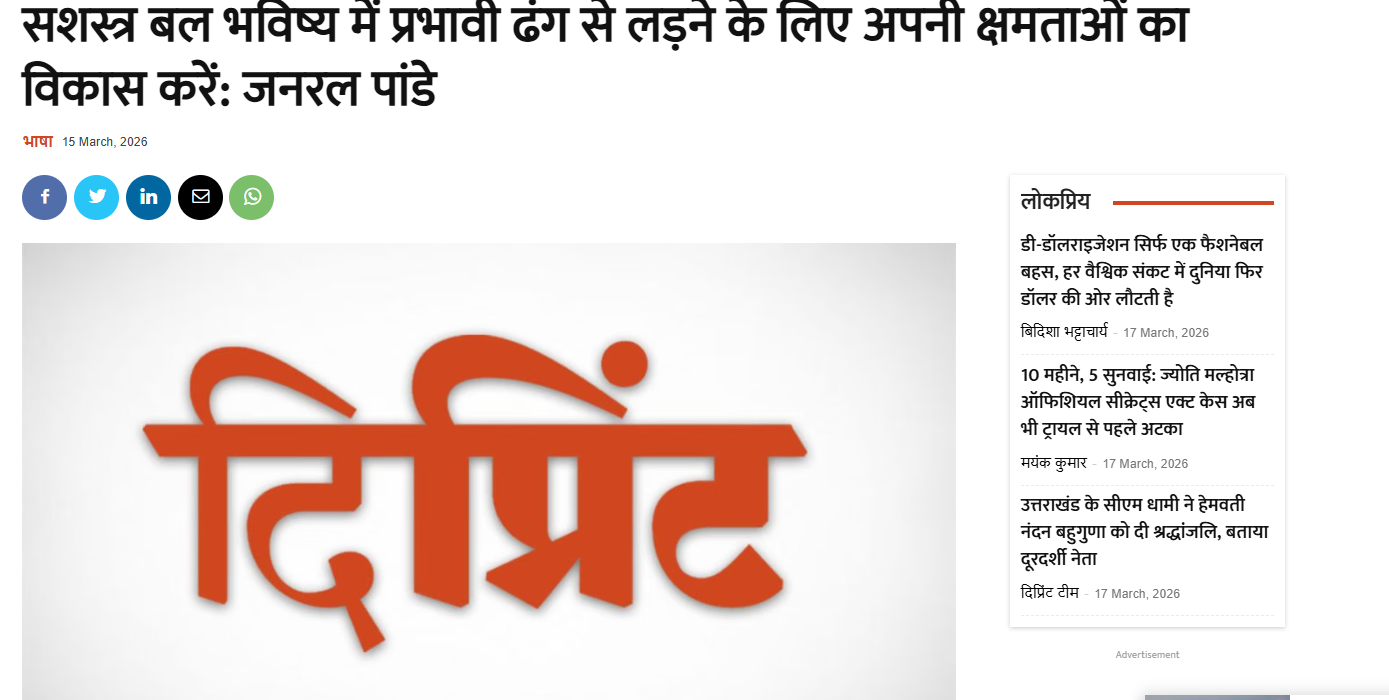
While taking the research forward, we found a report published on March 15, 2026, on the website of ThePrint. This report mentioned the speech delivered by former Army Chief General Manoj Pande, but no report mentioned the statement shown in the viral video.
Conclusion:
Our research found that the audio present in the viral video is AI-generated. In the original video, he did not make any such statement.
