
#FactCheck - AI-Generated Image of Abhishek Bachchan and Aishwarya Rai Falsely Linked to Kedarnath Visit
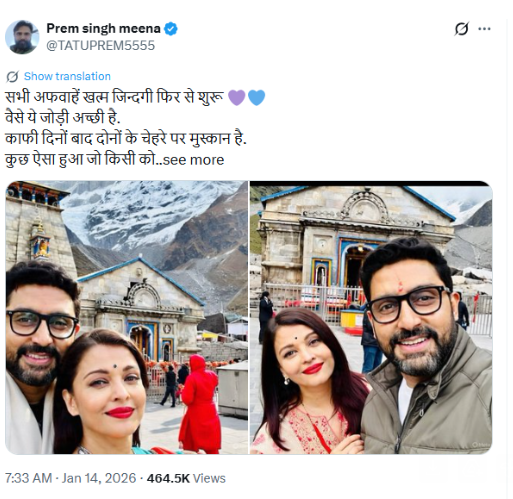
A photo featuring Bollywood actor Abhishek Bachchan and actress Aishwarya Rai is being widely shared on social media. In the image, the Kedarnath Temple is clearly visible in the background. Users are claiming that the couple recently visited the Kedarnath shrine for darshan.
Cyber Peace Foundation’s research found the viral claim to be false. Our research revealed that the image of Abhishek Bachchan and Aishwarya Rai is not real, but AI-generated, and is being misleadingly shared as a genuine photograph.
Claim
On January 14, 2026, a user on X (formerly Twitter) shared the viral image with a caption suggesting that all rumours had ended and that the couple had restarted their life together. The post further claimed that both actors were seen smiling after a long time, implying that the image was taken during their visit to Kedarnath Temple.
The post has since been widely circulated on social media platforms
Fact Check:
To verify the claim, we first conducted a keyword search on Google related to Abhishek Bachchan, Aishwarya Rai, and a Kedarnath visit. However, we did not find any credible media reports confirming such a visit.
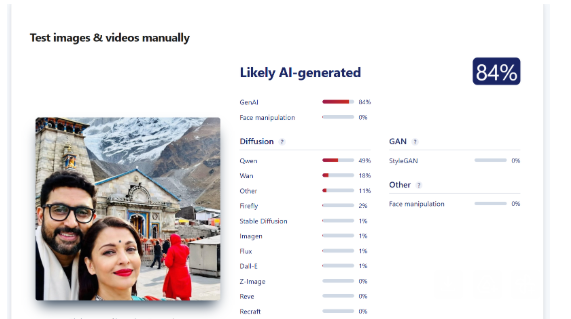
On closely examining the viral image, several visual inconsistencies raised suspicion about it being artificially generated. To confirm this, we scanned the image using the AI detection tool Sightengine. According to the tool’s analysis, the image was found to be 84 percent AI-generated.
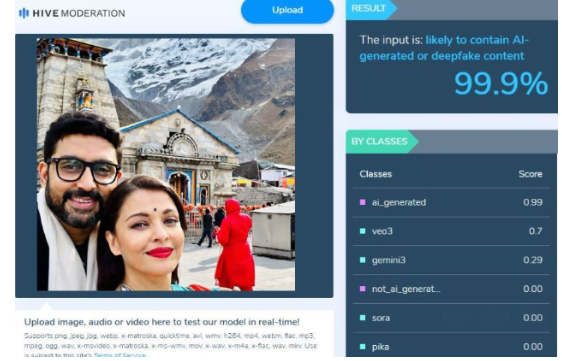
Additionally, we scanned the same image using another AI detection tool, HIVE Moderation. The results showed an even stronger indication, classifying the image as 99 percent AI-generated.
Conclusion
Our research confirms that the viral image showing Abhishek Bachchan and Aishwarya Rai at Kedarnath Temple is not authentic. The picture is AI-generated and is being falsely shared on social media to mislead users.

Related Blogs

Introduction
In a groundbreaking move, India's Reserve Bank has embarked on a transformative journey with its Central Bank Digital Currency (CBDC) project. As the world grapples with the evolving landscape of digital finance, the implications of India's CBDC initiative extend beyond its borders, potentially reshaping global payment systems. The Union Minister of State for Finance, Shri Pankaj Chaudhary, revealed that on October 7, 2022, the Reserve Bank of India released a proposal note on Central Bank Digital Currency (CBDC). Two pilot projects using blockchain-based technology are described in the concept note: Digital Rupee-Wholesale (e₹-W) and Digital Rupee-Retail (e₹-R). Launched on November 1, 2022, the bulk trading pilot aims to increase intermediary competitiveness, particularly in the resolution of trades in the secondary market involving sovereign debt. In parallel, on December 1, 2022, the retail banking pilot, known as e₹-R, got underway in a limited user group with eight banks taking part in stages.
The digital asset known as e₳-R is issued across financial institutions for Person-to-Person (P2P) and Person-to-Merchant (P2M) transactions. It is intended to serve as a virtual currency that represents legal money and exhibits characteristics similar to actual cash. Based on input gathered during the continuing trial phases, the RBI intends to progressively broaden the pilot project's scope.
Central Bank Digital Currency Pilot Projects
Central Bank Digital Currency (CBDC), which the Central Bank of India is promoting, may easily perform an essential part in payments made across borders, according to Reserve Bank Governor Shaktikanta Das. The CBDC is going to be expanded to the international financial markets after being implemented as a trial in both the retail and wholesale industries.
CBDC in International Payments
He emphasized that although physical currency will still exist, the CBDC will eventually replace all forms of money worldwide.
"CBDC is going to be the future currency of the world and it is necessary that every central bank, every country works on CBDC," he stated. He also stated that as worldwide commerce moves more and more around science and technology, CBDCs will play a significant role since they can effectively and affordably speed up payment processing across different countries. Regarding India's foreign exchange reserves, the governor stated that the selection to increase the resources as a safety net and protection versus contagion possibilities was made consciously.
CBDCs' Place in the Transnational Economic Revolution
In certain economies worldwide, having a CBDC internationally accessible could lead to more replacements for foreign currencies rather than the home currencies, which could cause financial aggregates to become volatile and change the mix of instruments of exchange.
CBDC may have benefits related to first-mover savings of scale, and other consequences even in everyday circumstances. If nations with global currencies have established CBDCs, they could strengthen current advantages and disadvantages, including consequences, particularly in terms of revenue. In a similar vein, CBDC might alter the structure of international liquidity while safeguarding asset supply. Additionally, and particularly if imposed abruptly, CBDC may, in certain circumstances, result in significant capital movements and associated repercussions on the foreign exchange rate as well as additional asset prices. Furthermore, nations may encounter difficulties in getting ready for virtual currencies issued by central banks.
The worldwide and international scope of CBDCs accessible to immigrants may become particularly apparent in situations where there is a widespread flight safety concern. In these circumstances, converting a CBDC into a foreign currency would make it possible for capital markets to deleverage more quickly. The elimination of debt challenges could show up as tight finance constraints and abrupt swings in foreign exchange markets if CBDCS expedited its flight from uncertainty.
Deposits of Foreign Exchange and Self-Dependency
Reserve Bank Governor Shaktikanta Das stated "We must rely on ourselves. We must maintain our robust reserves. In order to achieve that goal, we have been amassing quite substantial reserves, and the outside world has come to feel quite confident that India would be able to fulfil its contractual responsibilities to the international community no matter what the obstacles,"
Involvement of RBI in the Currency Market
Given that the trading community was confident that the Reserve Bank of India would be capable of and able to fulfil its contractual responsibilities, the value of the Indian rupee did not decline as dramatically. The RBI governor stated that the RBI does participate in the economy, but that "our engagement operates in two ways," he would not hesitate to acknowledge this.
The Value of Macroeconomic and Budgetary Cooperation
According to RBI Governor Das, the RBI makes purchases and sales of dollars based on the direction in which the financial sector is trending. However, the RBI does not intend to set a certain level for the rupee because it does not consider any specific threshold for the Indian rupee's conversion rate against the US dollar. He also emphasized how crucial it is for both the financial and monetary authorities to work together.
Conclusion
India's CBDC project signals a transformative shift in the global digital finance landscape. Governor Shaktikanta Das envisions CBDCs as the future global currency, emphasizing their role in international payments. The potential impact on financial systems, cross-border transactions, and the need for self-reliance underscore the significance of India's CBDC initiative in shaping the evolving dynamics of the digital economy. As the project progresses, close cooperation between financial and monetary authorities becomes imperative for navigating the challenges and opportunities associated with this groundbreaking venture.
References
- https://economictimes.indiatimes.com/news/economy/policy/central-bank-digital-currency-can-play-important-role-in-cross-border-payment-rbi-guv/articleshow/104706717.cms
- https://www.bis.org/cpmi/publ/d174.pdf
- https://bfsi.economictimes.indiatimes.com/news/fintech/explained-how-rbi-is-leveraging-upi-to-push-the-use-of-retail-cbdc/103591989
- https://www.imf.org/en/News/Articles/2022/02/09/sp020922-the-future-of-money-gearing-up-for-central-bank-digital-currency
- https://www.business-standard.com/economy/news/cbdc-pilot-projects-show-promising-results-rbi-governor-shaktikanta-das-123102601171_1.html

Executive Summary
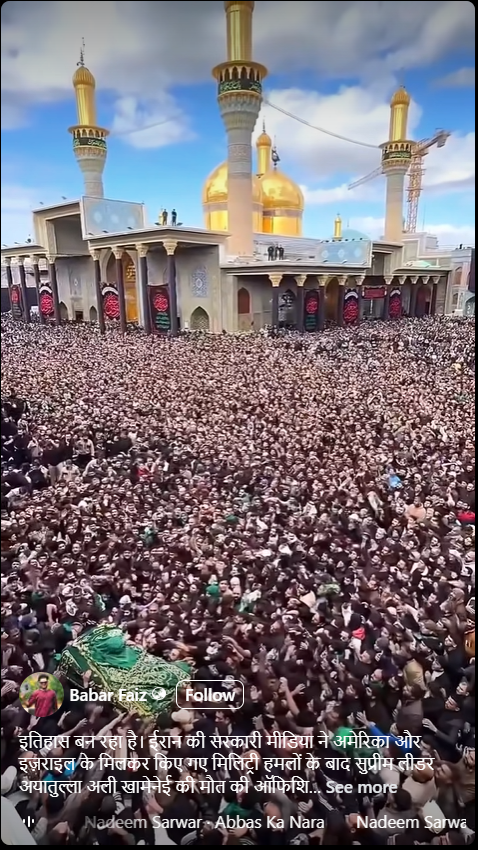
A video showing a massive gathering of people dressed in black is widely circulating on social media. The clip is being shared with the claim that it shows crowds mourning the funeral of Iran’s Supreme Leader Ayatollah Ali Khamenei following his alleged killing in February 2026 However, research by the CyberPeace found that the claim is misleading and the video is unrelated to Iran.
Claim:
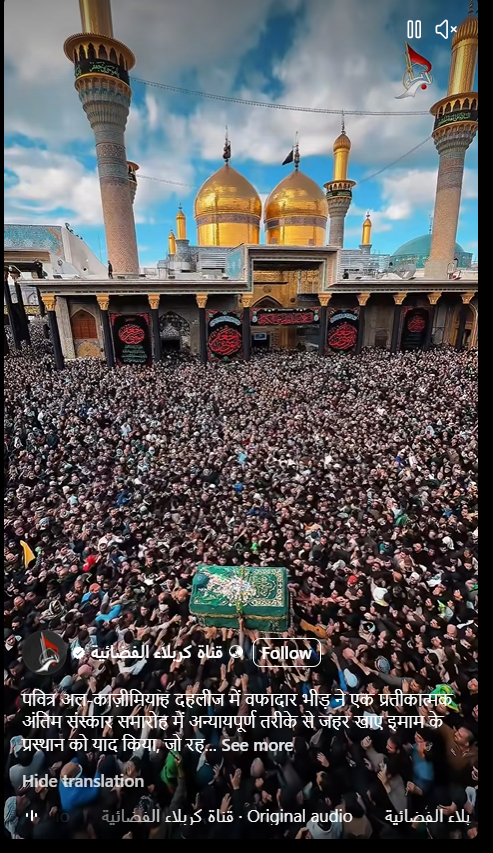
The viral video shows a large crowd gathered in a public square, with a mosque featuring a golden dome visible in the background. Social media posts claim that the footage captures mourners attending Ayatollah Khamenei’s funeral after his reported death in a joint US-Israel operation.
Fact Check:
To verify the claim, we extracted keyframes from the video and conducted a reverse image search. This led us to a similar clip uploaded on January 15 by an Iraqi broadcaster, Karbala TV, on Facebook. In the footage, a large crowd can be seen carrying a symbolic coffin near a shrine with a golden dome—matching the visuals seen in the viral video. According to the Arabic caption, the video shows a “symbolic funeral” procession held at the Kazimayn Shrine in Baghdad, Iraq. The event is part of an annual religious observance commemorating Imam Musa al-Kazim, the seventh Imam in Shia Islam, who is believed to have died after being poisoned in the 8th century.
Every year, large numbers of Shia devotees gather at the shrine in Baghdad to pay their respects during this commemoration. The visuals seen in the viral clip are consistent with this annual gathering.
Conclusion:
The claim that the video shows crowds at Ayatollah Khamenei’s funeral is false. The footage is unrelated and actually depicts a religious gathering in Baghdad, Iraq, held as part of an annual Shia ritual.
Introduction
A message has recently circulated on WhatsApp alleging that voice and video chats made through the app will be recorded, and devices will be linked to the Ministry of Electronics and Information Technology’s system from now on. WhatsApp from now, record the chat activities and forward the details to the Government. The Anti-Government News has been shared on social media.
Message claims
- The fake WhatsApp message claims that an 11-point new communication guideline has been established and that voice and video calls will be recorded and saved. It goes on to say that WhatsApp devices will be linked to the Ministry’s system and that Facebook, Twitter, Instagram, and all other social media platforms will be monitored in the future.
- The fake WhatsApp message further advises individuals not to transmit ‘any nasty post or video against the government or the Prime Minister regarding politics or the current situation’. The bogus message goes on to say that it is a “crime” to write or transmit a negative message on any political or religious subject and that doing so could result in “arrest without a warrant.”
- The false message claims that any message in a WhatsApp group with three blue ticks indicates that the message has been noted by the government. It also notifies Group members that if a message has 1 Blue tick and 2 Red ticks, the government is checking their information, and if a member has 3 Red ticks, the government has begun procedures against the user, and they will receive a court summons shortly.
WhatsApp does not record voice and video calls
There has been news which is spreading that WhatsApp records voice calls and video calls of the users. the news is spread through a message that has been recently shared on social media. As per the Government, the news is fake, that WhatsApp cannot record voice and video calls. Only third-party apps can record voice and video calls. Usually, users use third-party Apps to record voice and video calls.
Third-party apps used for recording voice and video calls
- App Call recorder
- Call recorder- Cube ACR
- Video Call Screen recorder for WhatsApp FB
- AZ Screen Recorder
- Video Call Recorder for WhatsApp
Case Study
In 2022 there was a fake message spreading on social media, suggesting that the government might monitor WhatsApp talks and act against users. According to this fake message, a new WhatsApp policy has been released, and it claims that from now on, every message that is regarded as suspicious will have three 3 Blue ticks, indicating that the government has taken note of that message. And the same fake news is spreading nowadays.
WhatsApp Privacy policies against recording voice and video chats
The WhatsApp privacy policies say that voice calls, video calls, and even chats cannot be recorded through WhatsApp because of end-to-end encryption settings. End-to-end encryption ensures that the communication between two people will be kept private and safe.
WhatsApp Brand New Features
- Chat lock feature: WhatsApp Chat Lock allows you to store chats in a folder that can only be viewed using your device’s password or biometrics such as a fingerprint. When you lock a chat, the details of the conversation are automatically hidden in notifications. The motive of WhatsApp behind the cha lock feature is to discover new methods to keep your messages private and safe. The feature allows the protection of most private conversations with an extra degree of security
- Edit chats feature: WhatsApp can now edit your WhatsApp messages up to 15 minutes after they have been sent. With this feature, the users can make the correction in the chat or can add some extra points, users want to add.
Conclusion
The spread of misinformation and fake news is a significant problem in the age of the internet. It can have serious consequences for individuals, communities, and even nations. The news is fake as per the government, as neither WhatsApp nor the government could have access to WhatsApp chats, voice, and video calls on WhatsApp because of end-to-end encryption. End-to-end encryption ensures to protect of the communications of the users. The government previous year blocked 60 social media platforms because of the spreading of Anti India News. There is a fact check unit which identifies misleading and false online content.
