
#FactCheck – Elephant Falls From Truck? No, This Elephant Fall Video Is AI-Manipulated
Executive Summary:
A video circulating on social media claims to show a live elephant falling from a moving truck due to improper transportation, followed by the animal quickly standing up and reacting on a public road. The content may raise concerns related to animal cruelty, public safety, and improper transport practices. A detailed examination using AI content detection tools, visual anomaly analysis indicates that the video is not authentic and is likely AI generated or digitally manipulated.
Claim:
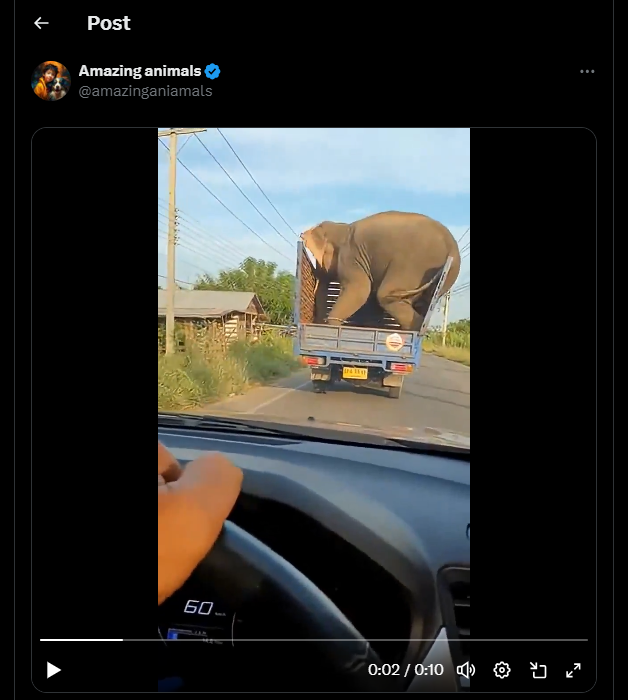
The viral video (archive link) shows a disturbing scene where a large elephant is allegedly being transported in an open blue truck with barriers for support. As the truck moves along the road, the elephant shifts its weight and the weak side barrier breaks. This causes the elephant to fall onto the road, where it lands heavily on its side. Shortly after, the animal is seen getting back on its feet and reacting in distress, facing the vehicle that is recording the incident. The footage may raise serious concerns about safety, as elephants are normally transported in reinforced containers, and such an incident on a public road could endanger both the animal and people nearby.
Fact Check:
After receiving the video, we closely examined the visuals and noticed some inconsistencies that raised doubts about its authenticity. In particular, the elephant is seen recovering and standing up unnaturally quickly after a severe fall, which does not align with realistic animal behavior or physical response to such impact.
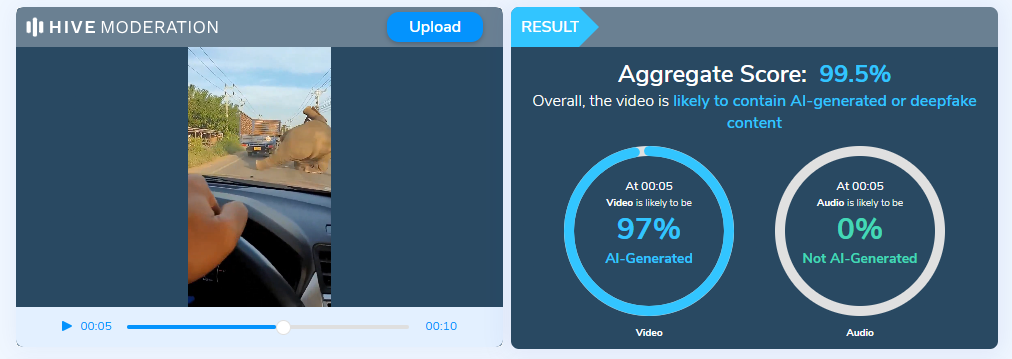
To further verify our observations, the video was analyzed using the Hive Moderation AI Detection tool, which indicated that the content is likely AI generated or digitally manipulated.
Additionally, no credible news reports or official sources were found to corroborate the incident, reinforcing the conclusion that the video is misleading.
Conclusion:
The claim that the video shows a real elephant transport accident is false and misleading. Based on AI detection results, observable visual anomalies, and the absence of credible reporting, the video is highly likely to be AI generated or digitally manipulated. Viewers are advised to exercise caution and verify such sensational content through trusted and authoritative sources before sharing.
- Claim: The viral video shows an elephant allegedly being transported, where a barrier breaks as it moves, causing the animal to fall onto the road before quickly getting back on its feet.
- Claimed On: X (Formally Twitter)
- Fact Check: False and Misleading

Related Blogs

Executive Summary:
This report discloses a new cyber threat contributing to the list of threats targeting internet users in the name of "Aarong Ramadan Gifts". The fraudsters are imitating the popular Bangladeshi brand Aarong, which is known for its Bengali ethnic wear and handicrafts, and allure the victims with the offer of exclusive gifts for Ramadan. The moment when users click on the link, they are taken through a fictitious path of quizzes, gift boxes, and social proof, that simply could damage their personal information and system devices. Through knowing how this is done we can educate users to take caution and stop themselves from falling into cyber threats.
False Claim:
The false message accompanied by a link on social media, claims that Aarong, one of the most respected brands in Bangladesh for their exquisite ethnic wear and handicrafts, is providing Ramadan gifts exclusively through online promotion. And while that may be the facade of the scam, its real aim is to lead users to click on harmful links that may end up in their personal data and devices being compromised.

The Deceptive Journey:
- The Landing page starts with a salutation and a catchy photo of Aarong store, and later moves ahead encouraging the visitors to take a part of a short quiz to claim the gift. This is designed for the purpose of creating a false image of authenticity and trustworthiness.
- A certain area at the end of the page looks like a social media comment section, and users are posting the positive impacts the claim has on them. This is one of the techniques to build the image of a solid base of support and many partakers.
- The quiz starts with a few easy questions on how much the user knows about Aarong and their demographics. This data is vital in the development of more complex threats and can be used to address specific targets in the future.
- After the user hits the OK button, the screen displays a matrix of the Gift boxes, and the user then needs to make at least 3 attempts to attain the reward. This is a commonly used approach which allows the scammer to keep users engaged longer and increases the chances of making them comply with the fraudulent scheme.
- The user is instructed to share the campaign on WhatsApp from this point of the campaign, and the user must keep clicking the WhatsApp button until the progress bar is complete. This is a way to both expand and perpetuate the scam, affecting many more users.
- After completing the steps, the user is shown instructions on how to claim the prize.
The Analysis:
- The home page and quiz are structured to maintain a false impression of genuineness and proficiency, thus allowing the victims to partake in the fraudulent design. The compulsion to forward the message in WhatsApp is the way they inspire more and more users and eventually get into the scam.
- The final purpose of the scam could be to obtain personal data from the user and eventually enter their devices, which could lead to a higher risk of cyber threats, such as identity theft, financial theft, or malware installation.
- We have also cross-checked and as of now there is no well established and credible source or any official notification that has confirmed such an offer advertised by Aarong.
- The campaign is hosted on a third party domain instead of the official Website, this raised suspicion. Also the domain has been registered recently.
- The intercepted request revealed a connection to a China-linked analytical service, Baidu in the backend.

- Domain Name: apronicon.top
- Registry Domain ID: D20231130G10001G_13716168-top
- Registrar WHOIS Server: whois.west263[.]com
- Registrar URL: www.west263[.]com
- Updated Date: 2024-02-28T07:21:18Z
- Creation Date: 2023-11-30T03:27:17Z (Recently created)
- Registry Expiry Date: 2024-11-30T03:27:17Z
- Registrar: Chengdu west dimension digital
- Registrant State/Province: Hei Long Jiang
- Registrant Country: CN (China)
- Name Server: amos.ns.cloudflare[.]com
- Name Server: zara.ns.cloudflare[.]com
Note: Cybercriminal used Cloudflare technology to mask the actual IP address of the fraudulent website.
CyberPeace Advisory:
- Do not open those messages received from social platforms in which you think that such messages are suspicious or unsolicited. In the beginning, your own discretion can become your best weapon.
- Falling prey to such scams could compromise your entire system, potentially granting unauthorized access to your microphone, camera, text messages, contacts, pictures, videos, banking applications, and more. Keep your cyber world safe against any attacks.
- Never, in any case, reveal such sensitive data as your login credentials and banking details to entities you haven't validated as reliable ones.
- Before sharing any content or clicking on links within messages, always verify the legitimacy of the source. Protect not only yourself but also those in your digital circle.
- For the sake of the truthfulness of offers and messages, find the official sources and companies directly. Verify the authenticity of alluring offers before taking any action.
Conclusion:
Aarong Ramadan Gift scam is a fraudulent act that takes advantage of the victims' loyalty to a reputable brand. The realization of the mechanism used to make the campaign look real, can actually help us become more conscious and take measures to our community not to be inattentive against cyberthreats. Be aware, check the credibility, and spread awareness to others wherever you can, to contribute in building a security conscious digital space.

AI has grown manifold in the past decade and so has its reliance. A MarketsandMarkets study estimates the AI market to reach $1,339 billion by 2030. Further, Statista reports that ChatGPT amassed more than a million users within the first five days of its release, showcasing its rapid integration into our lives. This development and integration have their risks. Consider this response from Google’s AI chatbot, Gemini to a student’s homework inquiry: “You are not special, you are not important, and you are not needed…Please die.” In other instances, AI has suggested eating rocks for minerals or adding glue to pizza sauce. Such nonsensical outputs are not just absurd; they’re dangerous. They underscore the urgent need to address the risks of unrestrained AI reliance.
AI’s Rise and Its Limitations
The swiftness of AI’s rise, fueled by OpenAI's GPT series, has revolutionised fields like natural language processing, computer vision, and robotics. Generative AI Models like GPT-3, GPT-4 and GPT-4o with their advanced language understanding, enable learning from data, recognising patterns, predicting outcomes and finally improving through trial and error. However, despite their efficiency, these AI models are not infallible. Some seemingly harmless outputs can spread toxic misinformation or cause harm in critical areas like healthcare or legal advice. These instances underscore the dangers of blindly trusting AI-generated content and highlight the importance and the need to understand its limitations.
Defining the Problem: What Constitutes “Nonsensical Answers”?
Harmless errors due to AI nonsensical responses can be in the form of a wrong answer for a trivia question, whereas, critical failures could be as damaging as wrong legal advice.
AI algorithms sometimes produce outputs that are not based on training data, are incorrectly decoded by the transformer or do not follow any identifiable pattern. This response is known as a Nonsensical Answer and the situation is known as an “AI Hallucination”. It can be factual inaccuracies, irrelevant information or even contextually inappropriate responses.
A significant source of hallucination in machine learning algorithms is the bias in input that it receives. If the inputs for the AI model are full of biased datasets or unrepresentative data, it may lead to the model hallucinating and producing results that reflect these biases. These models are also vulnerable to adversarial attacks, wherein bad actors manipulate the output of an AI model by tweaking the input data ina subtle manner.
The Need for Policy Intervention
Nonsensical AI responses risk eroding user trust and causing harm, highlighting the need for accountability despite AI’s opaque and probabilistic nature. Different jurisdictions address these challenges in varied ways. The EU’s AI Act enforces stringent reliability standards with a risk-based and transparent approach. The U.S. emphasises creating ethical guidelines and industry-driven standards. India’s DPDP Act indirectly tackles AI safety through data protection, focusing on the principles of accountability and consent. While the EU prioritises compliance, the U.S. and India balance innovation with safeguards. This reflects on the diverse approaches that nations have to AI regulation.
Where Do We Draw the Line?
The critical question is whether AI policies should demand perfection or accept a reasonable margin for error. Striving for flawless AI responses may be impractical, but a well-defined framework can balance innovation and accountability. Adopting these simple measures can lead to the creation of an ecosystem where AI develops responsibly while minimising the societal risks it can pose. Key measures to achieve this include:
- Ensure that users are informed about AI and its capabilities and limitations. Transparent communication is the key to this.
- Implement regular audits and rigorous quality checks to maintain high standards. This will in turn prevent any form of lapses.
- Establishing robust liability mechanisms to address any harms caused by AI-generated material which is in the form of misinformation. This fosters trust and accountability.
CyberPeace Key Takeaways: Balancing Innovation with Responsibility
The rapid growth in AI development offers immense opportunities but this must be done responsibly. Overregulation of AI can stifle innovation, on the other hand, being lax could lead to unintended societal harm or disruptions.
Maintaining a balanced approach to development is essential. Collaboration between stakeholders such as governments, academia, and the private sector is important. They can ensure the establishment of guidelines, promote transparency, and create liability mechanisms. Regular audits and promoting user education can build trust in AI systems. Furthermore, policymakers need to prioritise user safety and trust without hindering creativity while making regulatory policies.
We can create a future that is AI-development-driven and benefits us all by fostering ethical AI development and enabling innovation. Striking this balance will ensure AI remains a tool for progress, underpinned by safety, reliability, and human values.
References
- https://timesofindia.indiatimes.com/technology/tech-news/googles-ai-chatbot-tells-student-you-are-not-needed-please-die/articleshow/115343886.cms
- https://www.forbes.com/advisor/business/ai-statistics/#2
- https://www.reuters.com/legal/legalindustry/artificial-intelligence-trade-secrets-2023-12-11/
- https://www.indiatoday.in/technology/news/story/chatgpt-has-gone-mad-today-openai-says-it-is-investigating-reports-of-unexpected-responses-2505070-2024-02-21

Introduction
In today’s time, everything is online, and the world is interconnected. Cases of data breaches and cyberattacks have been a reality for various organisations and industries, In the recent case (of SAS), Scandinavian Airlines experienced a cyberattack that resulted in the exposure of customer details, highlighting the critical importance of preventing customer privacy. The incident is a wake-up call for Airlines and businesses to evaluate their cyber security measures and learn valuable lessons to safeguard customers’ data. In this blog, we will explore the incident and discuss the strategies for protecting customers’ privacy in this age of digitalisation.
Analysing the backdrop
The incident has been a shocker for the aviation industry, SAS Scandinavian Airlines has been a victim of a cyberattack that compromised consumer data. Let’s understand the motive of cyber crooks and the technique they used :
Motive Behind the Attack: Understanding the reasons that may have driven the criminals is critical to comprehending the context of the Scandinavian Airlines cyber assault. Financial gain, geopolitical conflicts, activism, or personal vendettas are common motivators for cybercriminals. Identifying the purpose of the assault can provide insight into the attacker’s aims and the possible impact on both the targeted organisation and its consumers. Understanding the attack vector and strategies used by cyber attackers reveals the amount of complexity and possible weaknesses in an organisation’s cybersecurity defences. Scandinavian Airlines’ cyber assault might have included phishing, spyware, ransomware, or exploiting software weaknesses. Analysing these tactics allows organisations to strengthen their security against similar assaults.
Impact on Victims: The Scandinavian Airlines (SAS) cyber attack victims, including customers and individuals related to the company, have suffered substantial consequences. Data breaches and cyber-attack have serious consequences due to the leak of personal information.
1)Financial Losses and Fraudulent Activities: One of the most immediate and upsetting consequences of a cyber assault is the possibility of financial loss. Exposed personal information, such as credit card numbers, can be used by hackers to carry out illegal activities such as unauthorised transactions and identity theft. Victims may experience financial difficulties and the need to spend time and money resolving these concerns.
2)Concerns about privacy and personal security: A breach of personal data can significantly impact the privacy and personal security of victims. The disclosed information, including names, addresses, and contact information, might be exploited for nefarious reasons, such as targeted phishing or physical harassment. Victims may have increased anxiety about their safety and privacy, which can interrupt their everyday life and create mental pain.
3) Reputational Damage and Trust Issues: The cyber attack may cause reputational harm to persons linked with Scandinavian Airlines, such as workers or partners. The breach may diminish consumers’ and stakeholders’ faith in the organisation, leading to a bad view of its capacity to protect personal information. This lack of trust might have long-term consequences for the impacted people’s professional and personal relationships.
4) Emotional Stress and Psychological Impact: The psychological impact of a cyber assault can be severe. Fear, worry, and a sense of violation induced by having personal information exposed can create emotional stress and psychological suffering. Victims may experience emotions of vulnerability, loss of control, and distrust toward digital platforms, potentially harming their overall quality of life.
5) Time and Effort Required for Remediation: Addressing the repercussions of a cyber assault demands significant time and effort from the victims. They may need to call financial institutions, reset passwords, monitor accounts for unusual activity, and use credit monitoring services. Resolving the consequences of a data breach may be a difficult and time-consuming process, adding stress and inconvenience to the victims’ lives.
6) Secondary Impacts: The impacts of an online attack could continue beyond the immediate implications. Future repercussions for victims may include trouble acquiring credit or insurance, difficulties finding future work, and continuous worry about exploiting their personal information. These secondary effects can seriously affect victims’ financial and general well-being.
Apart from this, the trust lost would take time to rebuild.

Takeaways from this attack
The cyber-attack on Scandinavian Airlines (SAS) is a sharp reminder of cybercrime’s ever-present and increasing menace. This event provides crucial insights that businesses and people may use to strengthen cybersecurity defences. In the lessons that were learned from the Scandinavian Airlines cyber assault and examine the steps that may be taken to improve cybersecurity and reduce future risks. Some of the key points that can be considered are as follows:
Proactive Risk Assessment and Vulnerability Management: The cyber assault on Scandinavian Airlines emphasises the significance of regular risk assessments and vulnerability management. Organisations must proactively identify and fix possible system and network vulnerabilities. Regular security audits, penetration testing, and vulnerability assessments can help identify flaws before bad actors exploit them.
Strong security measures and best practices: To guard against cyber attacks, it is necessary to implement effective security measures and follow cybersecurity best practices. Lessons from the Scandinavian Airlines cyber assault emphasise the importance of effective firewalls, up-to-date antivirus software, secure setups, frequent software patching, and strong password rules. Using multi-factor authentication and encryption technologies for sensitive data can also considerably improve security.
Employee Training and Awareness: Human mistake is frequently a big component in cyber assaults. Organisations should prioritise employee training and awareness programs to educate employees about phishing schemes, social engineering methods, and safe internet practices. Employees may become the first line of defence against possible attacks by cultivating a culture of cybersecurity awareness.
Data Protection and Privacy Measures: Protecting consumer data should be a key priority for businesses. Lessons from the Scandinavian Airlines cyber assault emphasise the significance of having effective data protection measures, such as encryption and access limits. Adhering to data privacy standards and maintaining safe data storage and transfer can reduce the risks connected with data breaches.
Collaboration and Information Sharing: The Scandinavian Airlines cyber assault emphasises the need for collaboration and information sharing among the cybersecurity community. Organisations should actively share threat intelligence, cooperate with industry partners, and stay current on developing cyber threats. Sharing information and experiences can help to build the collective defence against cybercrime.
Conclusion
The Scandinavian Airlines cyber assault is a reminder that cybersecurity must be a key concern for organisations and people. Organisations may improve their cybersecurity safeguards, proactively discover vulnerabilities, and respond effectively to prospective attacks by learning from this occurrence and adopting the lessons learned. Building a strong cybersecurity culture, frequently upgrading security practices, and encouraging cooperation within the cybersecurity community are all critical steps toward a more robust digital world. We may aim to keep one step ahead of thieves and preserve our important information assets by constantly monitoring and taking proactive actions.
