
PCI DSS COMPLIANCE AND WHY IT IS NECESSARY FOR CREDIT CARD INDUSTRY
Introduction
The whole world is shifting towards a cashless economy, with innovative payment transaction systems such as UPI payments, card payments, etc. These payment systems require processing, storage, and movement of millions of cardholders data which is crucial for any successful transaction.
And therefore to maintain the credibility of this payment ecosystem, security or secure movement and processing of cardholders data becomes paramount. Entities involved in a payment ecosystem are responsible for the security of cardholders data. Security is also important because if breaches happen in cardholders data it would amount to financial loss. Fraudsters are attempting smart ways to leverage any kind of security loopholes in the payment system.
So these entities which are involved in the payment ecosystem need to maintain some security standards set by one council of network providers in the payment industry popularly known as the Payment Card Industry Security Standard Council.
Overview of what is PCI and PCI DSS Compliance
Earlier every network providers in the payment industry have their own set of security standards but later they all together i.e., Visa, Mastercard, American Express, Discover, and JCB constituted an independent body to come up with comprehensive security standards like PCI DSS, PA DSS, PCI-PTS, etc. And these network providers ensure the enforcement of the security standards by putting conditions on services being provided to the merchant or acquirer bank.
In other words, PCI DSS particularly is the global standard that provides a baseline of technical and operational requirements designed to protect account data. PCI DSS is a security standard specially designed for merchants and service providers in the payment ecosystem to protect the cardholders data against any fraud or theft.
It applies to all the entities including third-party vendors which are involved in processing storing and transmitting cardholders data. In organization, even all CDE (Card Holder Data Environment) including system components or network component that stores and process cardholders data, has to comply with all the requirements of PCI compliance. Recently PCI has released a new version of PCI DSS v4.0 a few months ago with certain changes from the previous version after three years of the review cycle.
12 Requirements of PCI DSS
This is the most important part of PCI DSS as following these requirements can make any organization to some extent PCI compliant. So what are these requirements:
- Installing firewalls or maintaining security controls in the networks
- Use strong password in order to secure the CDE( Card holders data environment)
- Protection of cardholder data
- Encrypting the cardholder data during transmission over an open and public network.
- Timely detection and protection of the cardholders data environment from any malicious activity or software.
- Regular updating the software thereby maintaining a secure system.
- Rule of business need to know should apply to access the cardholders data
- Identification and authentication of the user are important to access the system components.
- Physical access to cardholders data should be restricted.
- Monitoring or screening of system components to know the malicious activity internally in real-time.
- Regular auditing of security control and finding any vulnerabilities available in the systems.
- Make policies and programs accordingly in order to support information security.
How organization can become PCI compliant
- Scope: First step is to determine all the system components or networks storing and processing cardholders data i.e., Cardholders Data Environment.
- Assess: Then test whether these systems or networks are complying with all the requirements of PCI DSS COMPLIANCE.
- Report: Documenting all the assessment through self assessment questionnaire by answering following questions like whether the requirements are met or not? Whether the requirements are met with customized approach.
- Attest: Then the next step is to complete the attestation process available on the website of PCI SSC.
- Submit: Then organization can submit all the documents including reports and other supporting documents if it is requested by other entities such as payment brands, merchant or acquirer.
- Remediate: Then the organisation should take remedial action for the requirements which are not in place on the system components or networks.
Conclusion
One of the most important issues facing those involved in the digital payment ecosystem is cybersecurity. The likelihood of being exposed to cybersecurity hazards including online fraud, information theft, and virus assaults is rising as more and more users prefer using digital payments.
And thus complying and adopting with these security standards is the need of the hour. And moreover RBI has also mandated all the regulated entities ( NBFCs Banks etc) under one recent notification to comply with these standards.

Related Blogs

Introduction
The Indian Computer Emergency Response Team, CERT-In, is the national statutory agency that responds to Cybersecurity Incidents under the Ministry of Electronics and Information Technology (MeitY) of the Government of India. CERT-In and Information Sharing and Analysis Center (ISAC) have joined hands to develop a focused pool of Cybersecurity Leaders through the National Cyber Security Scholar Program (NCSSP). This National Cyber Security Scholar Program is to create a pool of credible and ethical cybersecurity leaders in the country who prioritise national cyber security in their professional endeavours. This program allows both organisations to jointly issue joint certifications for Cohort 6 of the National Cyber Security Scholar Program (NCSSP). This certification is provided to cybersecurity professionals who complete one of the world’s leading cybersecurity management programs.
About the Program
The National Cybersecurity Scholar (NCSS) is a comprehensive 18-week, 160-hour Instructor-led program for emerging cybersecurity leaders. The ISAC will conduct the program with CERT-IN and KDEM as knowledge partners. This Cyber Security Scholar program aims to provide an extraordinary opportunity, for scholars, to gain hands-on experience in real-world scenarios through activities such as war games. It will allow scholars to acquaint themselves with roles such as that of stakeholders, including attackers, Security Operations Centre (SOC) teams, Forensicators, Chief Information Security Officers (CISOs), and CEOs, and engage in tabletop exercises that simulate a cyber crisis. This program would allow scholars to understand how responses to cyber crises impact the financial performance of an organisation, including, stock prices and sales. It offers a treasure trove of insights into the economic impact of cybersecurity decisions and the importance of proactive risk management.
The program invites applications from various scholars including Mid to senior-level leaders, diplomats and diplomatic corps officers, mid to senior-level government officials involved in homeland and cybersecurity operations, experienced executives from Managed Security Services Providers (MSSPs), faculty members who specialise in new and emerging technologies, cybersecurity professionals in CII sectors and post-doctoral or research scholars in cybersecurity.
CyberPeace Outlook
The National Cyber Security Scholar Program subsumes several key dimensions working towards building a resilient cybersecurity ecosystem for India.
- The program focuses on skill development and enhancing scholars’ knowledge in domains of network security, ethical hacking, cyber forensics, incident response, malware analysis, and threat intelligence.
- The partnership between CERT-In and ISAC, government and Industry entities, ensures that scholars are exposed to different policy-level frameworks and technical expertise, offering a unique blend of perspectives that cater to the country's national security goals and industry best practices.
- The scholar program encourages the development of new methodologies, tools, and frameworks that could be instrumental in tackling future cyber challenges and advancing India's position as a global leader in cybersecurity research and development. Research and innovation in cybersecurity are critical to the program.
- It plays a significant role in providing opportunities for career development by further providing networking platforms with professionals, researchers, and thought leaders in the cybersecurity field, giving them exposure to internships, job placements, and further academic pursuits.
This program aims to support upskilling India’s broader cyber defence strategy through the creation of highly skilled professionals. The scholars are expected to contribute actively to national cybersecurity efforts, whether through roles in government, private sector, or academia, helping to create a more secure and resilient cyberspace. The National Cyber Security Scholar Program is a major advancement in strengthening cybersecurity resilience in India. In a digital world where cyber threats crossing boundaries, such programs are essential for maintaining our national security and economic stability.
References
- https://theprint.in/ani-press-releases/cert-in-and-isac-collaborate-to-develop-focussed-pool-of-cybersecurity-leaders-through-the-national-cyber-security-scholar-program-ncssp/2318021/
- https://isacfoundation.org/national-cyber-security-scholar/
- https://cyberversefoundation.org/national-cyber-security-scholar/

Executive Summary
A video is being widely circulated on social media by Pakistani users as propaganda against the Indian Army. In the video, a man can be seen being beaten by a group of women in the middle of a road. Based on the viral video, it is being claimed that in Phuket, Thailand, Lieutenant General Rajiv Kiran Sahni, DG EME of the Indian Army, was thrashed by "ladyboys" after he allegedly harassed them and refused to pay the full amount.
Research by the CyberPeace Research Wing found the viral claim to be misleading and baseless. The viral video has no connection with Lieutenant General Rajiv Kiran Sahni (DG EME) of the Indian Army. According to credible media reports obtained during the research, this incident took place in Pattaya, Thailand, in December 2025, where a dispute over payment allegedly broke out between an Indian tourist named Raj Jasuja and some transgender women (ladyboys). Subsequently, the tourist was assaulted.
Claim:
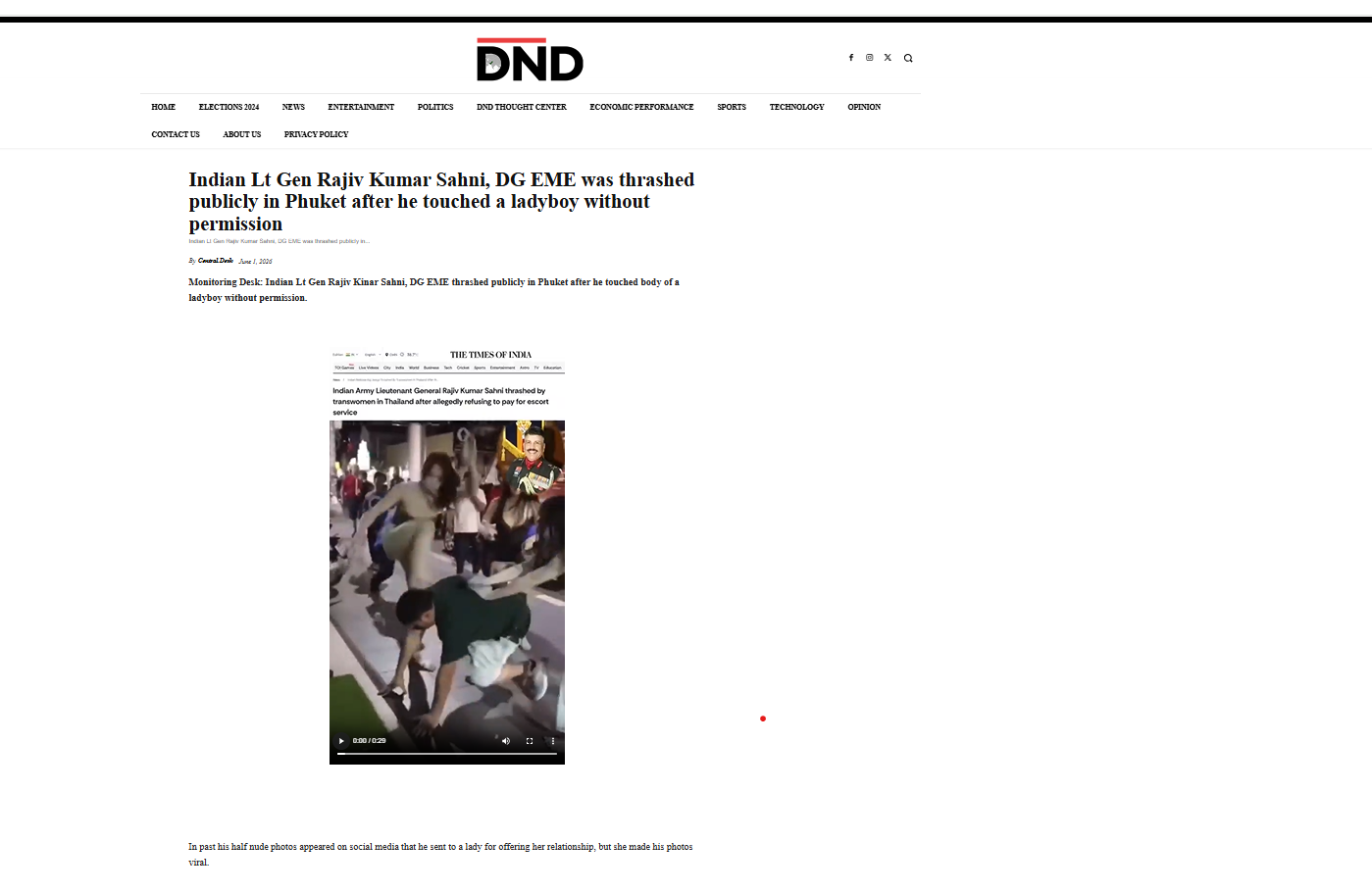
A Pakistani website shared the viral video claiming that Indian Army Lieutenant General Rajiv Kiran Sahni (DG EME) was publicly thrashed in Phuket, Thailand, by ladyboys after he harassed them and refused to pay the full amount.
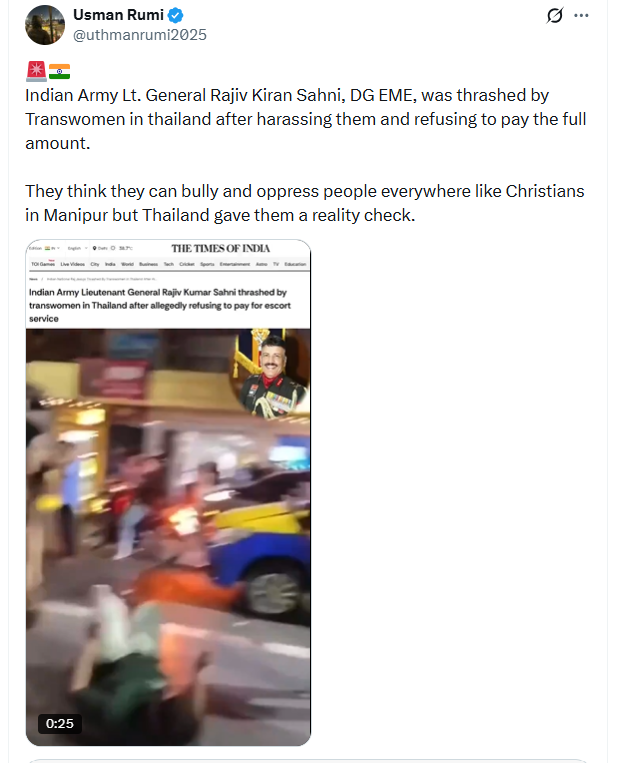
Meanwhile, on the social site X (formerly Twitter), a user shared the viral video and wrote, “Indian Army Lt Gen Rajiv Kiran Sahni, DG EME, thrashed by Thai ladyboys in Phuket after harassing them and refusing to pay full amount. They think they can bully and oppress people everywhere like Christians in Manipur, but Thailand showed them the reality.”
https://x.com/uthmanrumi2025/status/2061554209036898369
Fact Check:
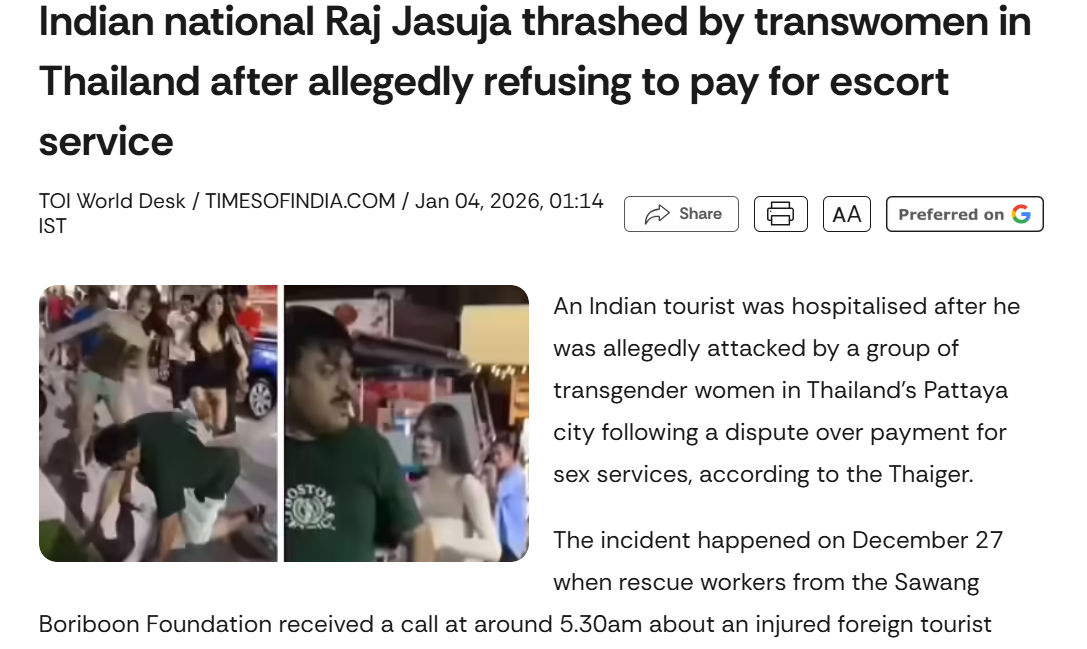
To investigate the claim made with the viral video, we conducted a reverse search of the video's keyframes. During this process, we found a report by The Times of India. The report, published on January 4, 2026, stated that “According to 'The Thaiger', an Indian tourist was hospitalized in Pattaya, Thailand. It is alleged that a group of transgender women attacked him following a dispute over payment for escort services. The incident occurred on December 27, when rescue workers from the Sawang Boriboon Foundation received a call around 5:30 AM regarding an injured foreign tourist near the beachside entrance of Walking Street. According to the rescue workers who found the victim, he was identified as 52-year-old Indian national Raj Jasuja. Injury marks were clearly visible on his face and the back of his head. He was given first aid before being taken to the hospital for further treatment. A 19-year-old Thai witness, Pongpol Boonchid, told police and rescue workers that the fight began when Raj was seen arguing with a transgender sex worker near the entry gate of Walking Street. The row escalated as both began chasing and hitting each other. According to the witness, the transgender woman then called several of her friends, who arrived and collectively attacked the Indian tourist. It is believed the fight started over money, as the tourist reportedly did not pay the full amount agreed upon for the services. Raj has not made any public statement regarding the incident.”
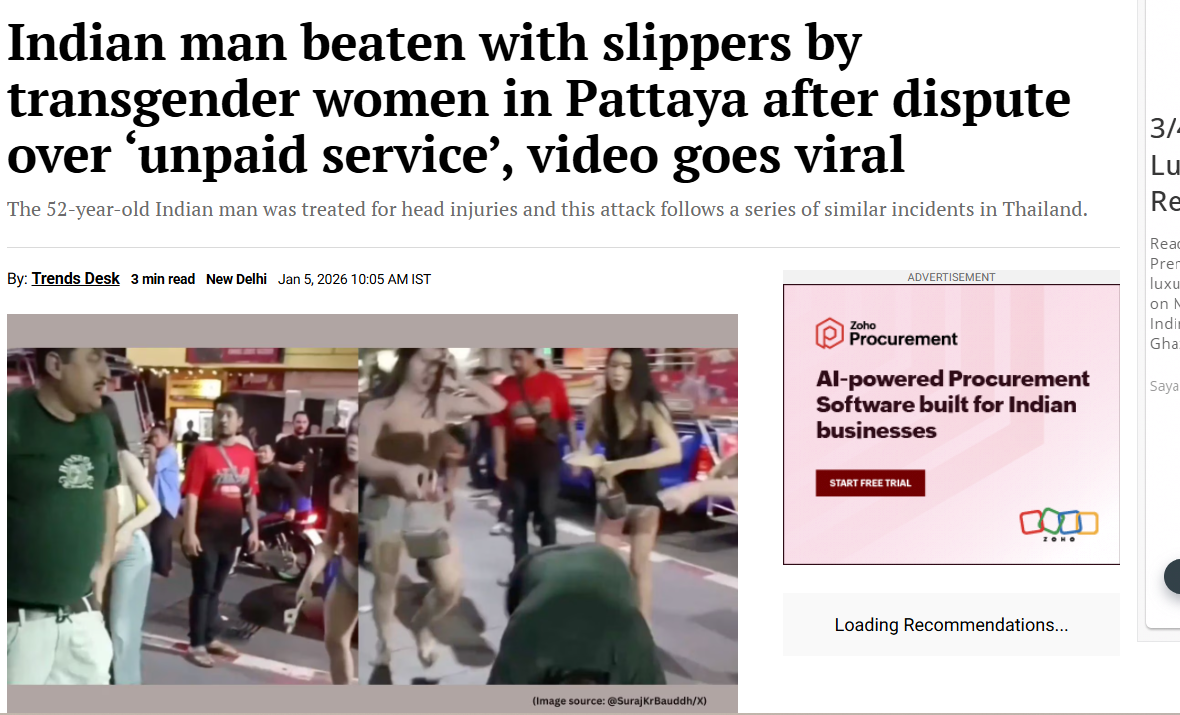
Furthermore, another report by The Indian Express, published on January 5, 2026, stated regarding the incident: “A group of transgender women allegedly beat up an Indian tourist in Pattaya, Thailand, according to a local media report. The dispute reportedly arose over non-payment of fees for sex services. In a viral video from December 27, three transgender women are seen hitting the 52-year-old man with slippers. The situation worsened when the man refused to pay the requested amount and tried to leave the spot in a car. The transgender women accused the man of not paying. Subsequently, he was allegedly kicked and punched, after which emergency responders intervened. According to a report by 'The Thaiger', the man suffered injuries to his face and the back of his head. He was given first aid on the spot and later taken to Pattamaku Hospital for further treatment. A Thai eyewitness told rescue workers that he saw the man arguing with a transgender sex worker near the entrance of the famous 'Walking Street' area. The witness stated that the argument turned into a physical altercation, with both parties reportedly chasing and hitting each other, after which others joined in, turning it into a group attack. According to the report, the witness further claimed the dispute occurred because the Indian tourist allegedly did not pay the full amount fixed for sexual services. Thai police said they would ask the man to file a formal complaint once he fully recovers.”
Conclusion:
Our research found the viral claim to be misleading and baseless. The viral video has no connection with Lieutenant General Rajiv Kiran Sahni (DG EME) of the Indian Army. According to credible media reports, the incident occurred in Pattaya, Thailand, where in December 2025, an Indian tourist named Raj Jasuja had a dispute over payment with some transgender women (ladyboys), leading to the assault.

Introduction
When a tragedy strikes, moments are fragile, people are vulnerable, emotions run high, and every second is important. In such critical situations, information becomes as crucial as food, water, shelter, and medication. As soon as any information is received, it often leads to stampedes and chaos. Alongside the tragedy, whether natural or man-made, emerges another threat: misinformation. People, desperate for answers, cling to whatever they can find.
Tragedies can take many forms. These may include natural disasters, mass accidents, terrorist activities, or other emergencies. During the 2023 earthquakes in Turkey, misinformation spread on social media claiming that the Yarseli Dam had cracked and was about to burst. People believed it and began migrating from the area. Panic followed, and search and rescue teams stopped operations in that zone. Precious hours were lost. Later, it was confirmed to be a rumour. By then, the damage was already done.
Similarly, after the recent plane crash in Ahmedabad, India, numerous rumours and WhatsApp messages spread rapidly. One message claimed to contain the investigation report on the crash of Air India flight AI-171. It was later called out by PIB and declared fake.
These examples show how misinformation can take control of already painful moments. During emergencies, when emotions are intense and fear is widespread, false information spreads faster and hits harder. Some people share it unknowingly, while others do so to gain attention or push a certain agenda. But for those already in distress, the effect is often the same. It brings ore confusion, heightens anxiety, and adds to their suffering.
Understanding Disasters and the Role of Media in Crisis
Disaster can be defined as a natural or human-caused situation that causes a transformation from a usual life of society into a crisis that is far beyond its existing response capacity. It can have minimal or maximum effects, from mere disruption in daily life practices to as adverse as inability to meet basic requirements of life like food, water and shelter. Hence, the disaster is not just a sudden event. It becomes a disaster when it overwhelms a community’s ability to cope with it.
To cope with such situations, there is an organised approach called Disaster Management. It includes preventive measures, minimising damages and helping communities recover. Earlier, public institutions like governments used to be the main actors in disaster management, but today, with every small entity having a role, academic institutions, media outlets and even ordinary people are involved.
Communication is an important element in disaster management. It saves lives when done correctly. People who are vulnerable need to know what’s happening, what they should do and where to seek help. It involves risk in today’s instantaneous communication.
Research shows that the media often fails to focus on disaster preparedness. For example, studies found that during the 2019 Istanbul earthquake, the media focused more on dramatic scenes than on educating people. Similar trends were seen during the 2023 Turkey earthquakes. Rather than helping people prepare or stay calm, much of the media coverage amplified fear and sensationalised suffering. This shows a shift from preventive, helpful reporting to reactive, emotional storytelling. In doing so, the media sometimes fails in its duty to support resilience and worse, can become a channel for spreading misinformation during already traumatic events. However, fighting misinformation is not just someone’s liability. It is penalised in the official disaster management strategy. Section 54 of the Disaster Management Act, 2005 mentions that "Whoever makes or circulates a false alarm or warning as to disaster or its severity or magnitude, leading to panic, shall, on conviction, be punishable with imprisonment which may extend to one year or with a fine."
AI as a Tool in Countering Misinformation
AI has emerged as a powerful mechanism to fight against misinformation. AI technologies like Natural Language Processing (NLP) and Machine Learning (ML) are effective in spotting and classifying misinformation with up to 97% accuracy. AI flags unverified content, leading to a 24% decrease in shares and 7% drop in likes on platforms like TikTok. Up to 95% fewer people view content on Facebook when fact-checking labels are used. Facebook AI also eliminates 86% of graphic violence, 96% of adult nudity, 98.5% of fake accounts and 99.5% of content related to terrorism. These tools help rebuild public trust in addition to limiting the dissemination of harmful content. In 2023, support for tech companies acting to combat misinformation rose to 65%, indicating a positive change in public expectations and awareness.
How to Counter Misinformation
Experts should step up in such situations. Social media has allowed many so-called experts to spread fake information without any real knowledge, research, or qualification. In such conditions, real experts such as authorities, doctors, scientists, public health officials, researchers, etc., need to take charge. They can directly address the myths and false claims and stop misinformation before it spreads further and reduce confusion.
Responsible journalism is crucial during crises. In times of panic, people look at the media for guidance. Hence, it is important to fact-check every detail before publishing. Reporting that is based on unclear tips, social media posts, or rumours can cause major harm by inciting mistrust, fear, or even dangerous behaviour. Cross-checking information, depending on reliable sources and promptly fixing errors are all components of responsible journalism. Protecting the public is more important than merely disseminating the news.
Focus on accuracy rather than speed. News spreads in a blink in today's world. Media outlets and influencers often come under pressure to publish it first. But in tragic situations like natural disasters and disease outbreaks, rushing to come first is not as important as accuracy is, as a single piece of misinformation can spark mass-scale panic and can slow down emergency efforts and lead people to make rash decisions. Taking a little more time to check the facts ensures that the information being shared is helpful, not harmful. Accuracy may save numerous lives during tragedies.
Misinformation spreads quickly it can only be prevented if people learn to critically evaluate what they hear and see. This entails being able to spot biased or deceptive headlines, cross-check claims and identify reliable sources. Digital literacy is of utmost importance; it makes people less susceptible to fear-based rumours, conspiracy theories and hoaxes.
Disaster preparedness programs should include awareness about the risks of spreading unverified information. Communities, schools and media platforms must educate people on how to respond responsibly during emergencies by staying calm, checking facts and sharing only credible updates. Spreading fake alerts or panic-inducing messages during a crisis is not only dangerous, but it can also have legal consequences. Public communication must focus on promoting trust, calm and clarity. When people understand the weight their words can carry during a crisis, they become part of the solution, not the problem.
References:
- https://dergipark.org.tr/en/download/article-file/3556152
- https://www.dhs.gov/sites/default/files/publications/SMWG_Countering-False-Info-Social-Media-Disasters-Emergencies_Mar2018-508.pdf
- https://english.mathrubhumi.com/news/india/fake-whatsapp-message-air-india-crash-pib-fact-check-fcwmvuyc
- https://www.dhs.gov/sites/default/files/publications/SMWG_Countering-False-Info-Social-Media-Disasters-Emergencies_Mar2018-508.pdf
