
MeitY’s Efforts in Combatting Deepfakes
Recognizing As the Ministry of Electronic and Information Technology (MeitY) continues to invite proposals from academicians, institutions, and industry experts to develop frameworks and tools for AI-related issues through the IndiaAI Mission, it has also funded two AI projects that will deal with matters related to deepfakes as per a status report submitted on 21st November 2024. The Delhi court also ordered the nomination of the members of a nine-member Committee constituted by the MeitY on 20th November 2024 (to address deepfake issues) and asked for a report within three months.
Funded AI projects :
The two projects funded by MeitY are:
- Fake Speech Detection Using Deep Learning Framework- The project was initiated in December 2021 and focuses on detecting fake speech by creating a web interface for detection software this also includes investing in creating a speech verification software platform that is specifically designed for testing fake speech detection systems. It is set to end in December 2024.
- Design and Development of Software for Detecting Deepfake Videos and Images- This project was funded by MeitY from January 2022 to March 2024. It also involved the Centre for Development of Advanced Computing (C-DAC), Kolkata and Hyderabad as they have developed a prototype tool capable of detecting deepfakes. Named FakeCheck, it is designed as a desktop application and a web portal aiming to detect deepfakes without the use of the internet. Reports suggest that it is currently undergoing the testing phase and awaiting feedback.
Apart from these projects, MeitY has released their expression of interest for proposals in four other areas which include:
- Tools that detect AI-generated content along with traceable markers,
- Tools that develop an ethical AI framework for AI systems to be transparent and respect human values,
- An AI risk management and assessment tool that analyses threats and precarious situations of AI-specific risks in public AI use cases and;
- Tools that can assess the resilience of AI in stressful situations such as cyberattacks, national disasters, operational failures, etc.
CyberPeace Outlook
Deepfakes pose significant challenges to critical sectors in India, such as healthcare and education, where manipulated content can lead to crimes like digital impersonation, misinformation, and fraud. The rapid advancement of AI, with developments (regarding regulation) that can’t keep pace, continues to fuel such threats. Recognising these risks, MeitY’s IndiaAI mission, promoting investments and encouraging educational institutions to undertake AI projects that strengthen the country's digital infrastructure comes in as a guiding light. A part of the mission focuses on developing indigenous solutions, including tools for assessment and regulation, to address AI-related threats effectively. While India is making strides in this direction, the global AI landscape is evolving rapidly, with many nations advancing regulations to mitigate AI-driven challenges. Consistent steps, including inviting proposals and funding projects provide the much-needed impetus for the mission to be realized.
References
- https://economictimes.indiatimes.com/tech/technology/meity-dot-at-work-on-projects-for-fair-ai-development/articleshow/115777713.cms?from=mdr
- https://www.hindustantimes.com/india-news/meity-seeks-tools-to-detect-deepfakes-label-ai-generated-content-101734410291642.html
- https://www.msn.com/en-in/news/India/meity-funds-two-ai-projects-to-detect-fake-media-forms-committee-on-deepfakes/ar-AA1vMAlJ
- https://indiaai.gov.in/

Related Blogs

Introduction
In a landmark move for India’s growing artificial intelligence (AI) ecosystem, ten cutting-edge Indian startups have been selected to participate in the prestigious Global AI Accelerator Programme in Paris. This initiative, jointly facilitated by the Ministry of Electronics and Information Technology (MeitY) under the IndiaAI mission, aims to project India’s AI innovation on the global stage, empower startups to scale impactful solutions while fostering cross-border collaboration.
Launched in alignment with the vision of India as a global AI powerhouse, the IndiaAI initiative has been working on strengthening domestic AI capabilities. Participation in the Paris Accelerator Programme is a direct extension of this mission, offering Indian startups access to world-class mentorship, investor networks, and a thriving innovation ecosystem in France, one of Europe’s AI capitals.
Global Acceleration for Local Impact
The ten selected startups represent diverse verticals, from conversational AI to cybersecurity, edtech and surveillance intelligence. This selection was made after a rigorous evaluation of innovation potential, scalability, and societal impact. Each of these ventures represents India's technological ambition and capacity to solve real-world problems through AI.
The significance of this opportunity goes beyond business growth. It sets the foundation for collaborative policy dialogues, ethical AI development, and bilateral innovation frameworks. With rising global scrutiny on issues such as AI safety, bias, and misinformation, the need for making efforts for a more responsible innovation takes centre stage.
CyberPeace Outlook
India’s participation opens up a pivotal chapter in India's AI diplomacy. Through such initiatives, the importance of AI is not confined just to commercial tools but also as a cornerstone of national security, citizen safety, and digital sovereignty can be explored. As AI systems increasingly integrate with critical infrastructure from health to law enforcement, the role of cyber resilience becomes significant. With the increasing engagement of AI in several sensitive sectors like audio-video surveillance and digital edtech, there is an urgent need for secure-by-design innovation. Including parameters such as security, ethics, and accountability into the development lifecycle becomes important, aligning with its broader goal of harmonising with digital progress.
Conclusion
India’s participation in the Paris Accelerator Programme signifies its commitment to shaping global AI norms and innovation diplomacy. As Indian startups interact with European regulators, investors, and technologists, they carry the responsibility of representing not just business acumen but the values of an open, inclusive, and secure digital future.
This global exposure also feeds directly into India’s domestic AI strategies, a global platform informing policy evolution, enhancing research and development networks, and building a robust talent pipeline. Programmes like these act as bridges, ensuring India remains adaptive in the ever-evolving AI landscape. Encouraging such global engagements while actively working with stakeholders to build frameworks safeguarding national interests, protecting civil liberties, and fostering innovation becomes paramount. As India takes this global leap, the journey ahead must be shaped by innovation, collaboration, and vigilance.
References
- https://egov.eletsonline.com/2025/05/indiaai-selects-10-innovative-startups-for-prestigious-ai-accelerator-programme-in-paris/#:~:text=The%2010%20startups%20selected%20for,audio%2Dvideo%20analytics%20for%20surveillance.
- https://www.pib.gov.in/PressReleasePage.aspx?PRID=2132377
- https://inc42.com/buzz/meet-the-10-indian-ai-startups-selected-for-global-acceleration-programme/
- https://www.businessworld.in/article/govt-to-send-10-ai-startups-to-paris-accelerator-in-push-for-global-reach-558251

Amid the popularity of OpenAI’s ChatGPT and Google’s announcement of introducing its own Artificial Intelligence chatbot called Bard, there has been much discussion over how such tools can impact India at a time when the country is aiming for an AI revolution.
During the Budget Session, Finance Minister Nirmala Sitharaman talked about AI, while her colleague, Minister of State (MoS) for Electronics and Information Technology Rajeev Chandrasekhar discussed it at the India Stack Developer Conference.
While Sitharaman stated that the government will establish three centres of excellence in AI in the country, Chandrashekhar at the event mentioned that India Stack, which includes digital solutions like Aadhaar, Digilocker and others, will become more sophisticated over time with the inclusion of AI.
As AI chatbots become the buzzword, News18 discusses with experts how such tech tools will impact India.
AI IN INDIA
Many experts believe that in a country like India, which is extremely diverse in nature and has a sizeable population, the introduction of technologies and their right adoption can bring a massive digital revolution.
For example, Manoj Gupta, Cofounder of Plotch.ai, a full-stack AI-enabled SaaS product, told News18 that Bard is still experimental and not open to everyone to use while ChatGPT is available and can be used to build applications on top of it.
He said: “Conversational chatbots are interesting since they have the potential to automate customer support and assisted buying in e-commerce. Even simple banking applications can be built that can use ChatGPT AI models to answer queries like bank balance, service requests etc.”
According to him, such tools could be extremely useful for people who are currently excluded from the digital economy due to language barriers.
Ashwini Vaishnaw, Union Minister for Communications, Electronics & IT, has also talked about using such tools to reduce communication issues. At World Economic Forum in Davos, he said: “We integrated our Bhashini language AI tool, which translates from one Indian language to another Indian language in real-time, spoken and text everything. We integrated that with ChatGPT and are seeing very good results.”
‘DOUBLE-EDGED SWORD’
Sundar Balasubramanian, Managing Director, India & SAARC, at Check Point Software, told News18 that generative AI like ChatGPT is a “double-edged sword”.
According to him, used in the right way, it can help developers write and fix code quicker, enable better chat services for companies, or even be a replacement for search engines, revolutionising the way people search for information.
“On the flip side, hackers are also leveraging ChatGPT to accelerate their bad acts and we have already seen examples of such exploitations. ChatGPT has lowered the bar for novice hackers to enter the field as they are able to learn quicker and hack better through asking the AI tool for answers,” he added.
Balasubramanian also stated that CPR has seen the quality of phishing emails improve tremendously over the past 3 months, making it increasingly difficult to discern between legitimate sources and a targeted phishing scam.
“Despite the emergence of the use of generative AI impacting cybercrime, Check Point is continually reminding organisations and individuals of the significance of being vigilant as ChatGPT and Codex become more mature, it can affect the threat landscape, for both good and bad,” he added.
While the real-life applications of ChatGPT include several things ranging from language translation to explaining tricky math problems, Balasubramanian said it can also be used for making the work of cyber researchers and developers more efficient.
“Generative AI or tools like ChatGPT can be used to detect potential threats by analysing large amounts of data and identifying patterns that may indicate malicious activity. This can help enterprises quickly identify and respond to a potential threat before it escalates to something more,” he added.
POSITIVE FACTORS
Major Vineet Kumar, Founder and Global President of CyberPeace Foundation, believes that the deployment of AI chatbots has proven to be highly beneficial in India, where a booming economy and increasing demand for efficient customer service have led to a surge in their use. According to him, both ChatGPT and Bard have the potential to bring significant positive change to various industries and individuals in India.
“ChatGPT has already made an impact by revolutionising customer service, providing instant and accurate support, and reducing wait time. It has automated tedious and complicated tasks for businesses and educational institutions, freeing up valuable time for more significant activities. In the education sector, ChatGPT has also improved learning experiences by providing quick and reliable information to students and educators,” he added.
He also said there are several possible positive impacts that the AI chatbots, ChatGPT and Bard, could have in India and these include improved customer experience, increased productivity, better access to information, improved healthcare, improved access to education and better financial services.
Reference Link : https://www.news18.com/news/explainers/confused-about-chatgpt-bard-experts-tell-news18-how-openai-googles-ai-chatbots-may-impact-india-7026277.html
Executive Summary
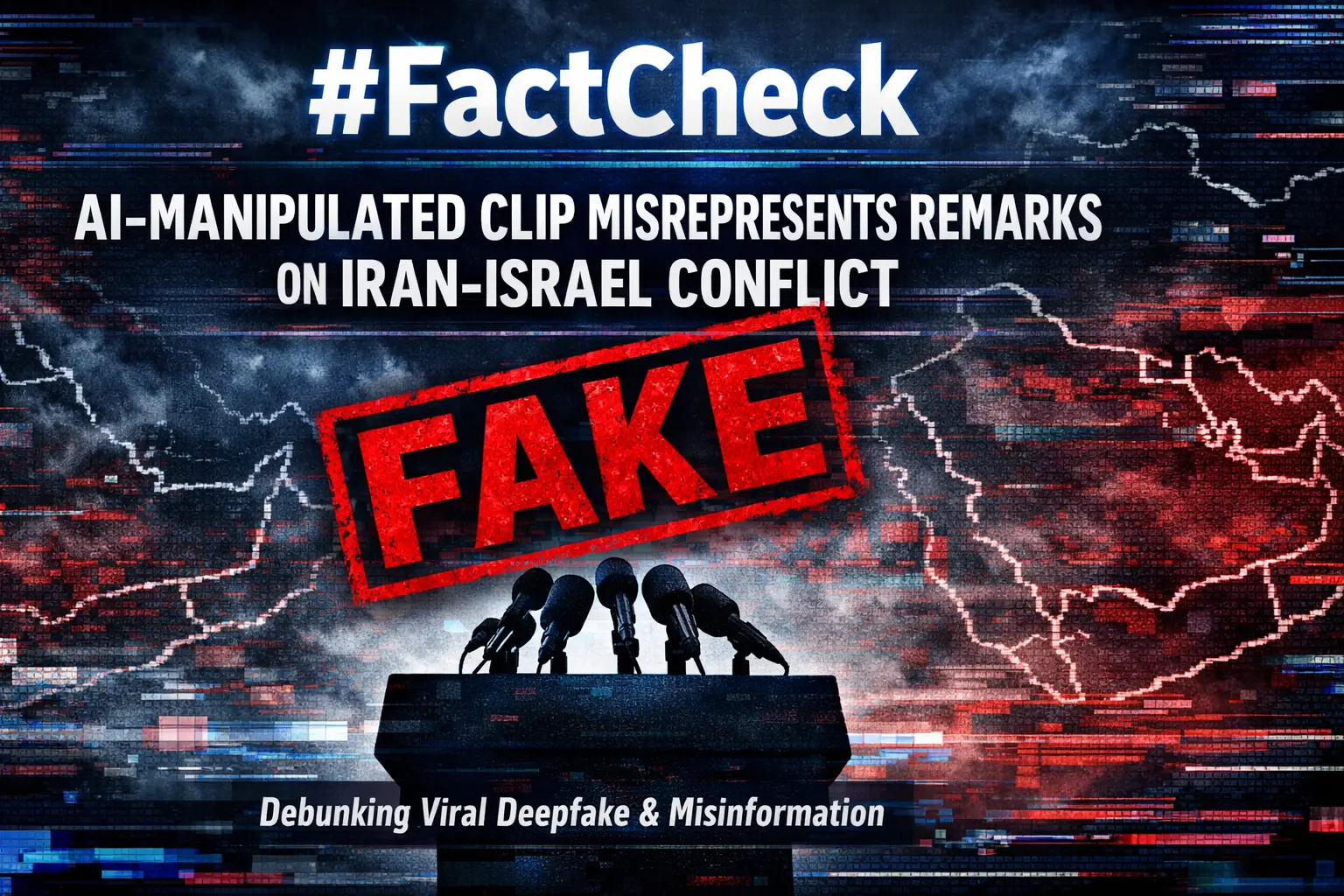
Amid the ongoing conflict between the US-Israel and Iran, a video of Indian Prime Minister Narendra Modi is being widely circulated on social media. In the clip, he is allegedly heard supporting Israel and calling Iran a “terrorist state.” The video also appears to show him speaking about the idea of “Akhand Bharat.” Many users are sharing this video as genuine. However, a detailed research by the CyberPeacefound that the claim is false. The viral video is a deepfake created using AI technology.
Claim:
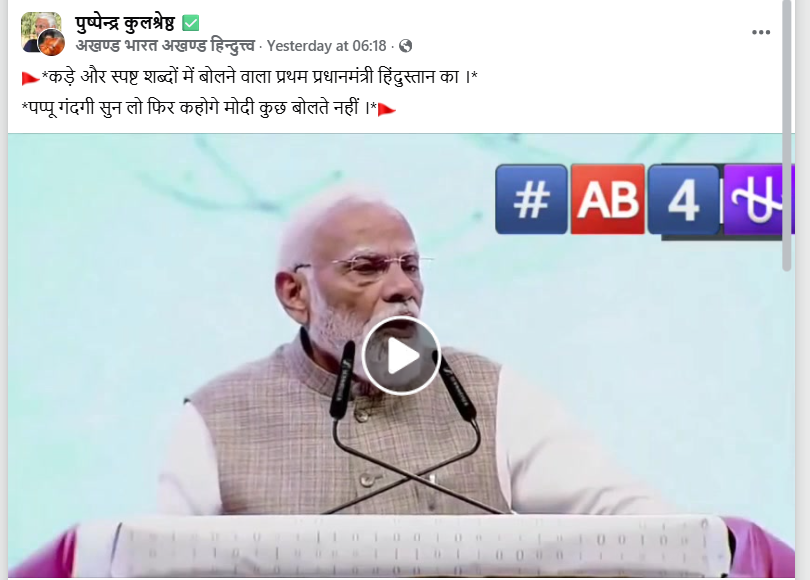
A Facebook page named “Pushpendra Kulshreshtha” shared the video on March 23, 2026, with a caption suggesting that PM Modi made strong remarks in support of Israel and against Iran.
Fact Check:
To verify the claim, we first conducted a keyword search to find any credible reports or official statements where PM Modi made such remarks. However, no reliable news reports or authentic videos supporting the claim were found. We then extracted keyframes from the viral video and performed a reverse image search using Google Lens. This led us to the original video posted on the X (formerly Twitter) handle of ANI on March 12, 2026.
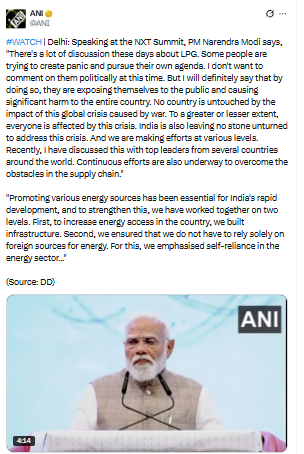
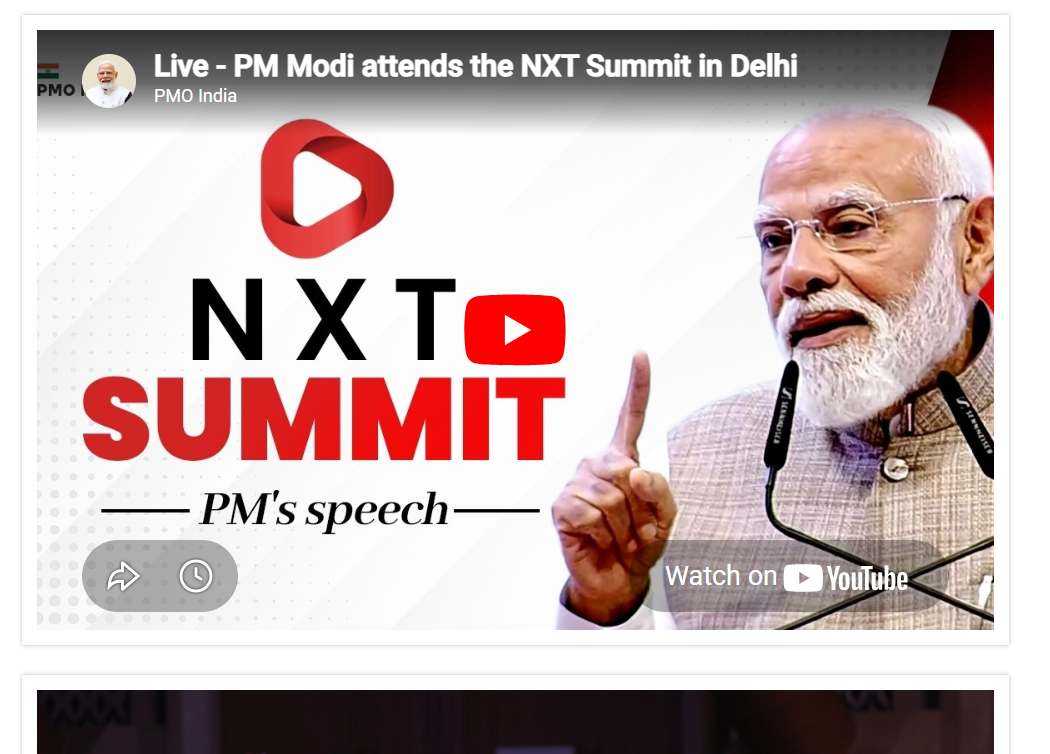
The visuals, including PM Modi’s attire and the stage setup, matched the viral clip—indicating that the fake video was created using this original footage. However, in the authentic video, PM Modi did not make any statements about Iran, Israel, or “Akhand Bharat” as seen in the viral version. In the original footage, PM Modi is seen addressing the NXT Summit in Delhi, where he spoke about the global energy crisis arising from ongoing conflicts and highlighted the expansion of LPG and PNG facilities in India. Additionally, a customised keyword search led us to a press release issued by the Prime Minister's Office regarding his address at the summit. The statement heard in the viral clip was not found there either.
Conclusion:
The viral video of PM Modi is a deepfake. He did not make any statement calling Iran a “terrorist state” or expressing support for Israel in the manner shown. The original video is from a summit held in Delhi and has been manipulated using AI to spread misleading claims.
