
I4C's Inclusion Under PMLA: Strengthening India's Fight Against Cybercrime and Money Laundering
Introduction
In a major policy shift aimed at synchronizing India's fight against cyber-enabled financial crimes, the government has taken a landmark step by bringing the Indian Cyber Crime Coordination Centre (I4C) under the ambit of the Prevention of Money Laundering Act (PMLA). In the notification released in the official gazette on 25th April, 2025, the Department of Revenue, Ministry of Finance, included the Indian Cyber Crime Coordination Centre (I4C) under Section 66 of the Prevention of Money Laundering Act, 2002 (hereinafter referred to as “PMLA”). The step comes as a significant attempt to resolve the asynchronous approach of different agencies (Enforcement Directorate (ED), State Police, CBI, CERT-In, RBI) set up under the government responsible for preventing and often possessing key information regarding cyber crimes and financial crimes. As it is correctly put, "When criminals sprint and the administration strolls, the finish line is lost.”
The gazetted notification dated 25th April, 2025, read as follows:
“In exercise of the powers conferred by clause (ii) of sub-section (1) of section 66 of the Prevention of Money-laundering Act, 2002 (15 of 2003), the Central Government, on being satisfied that it is necessary in the public interest to do so, hereby makes the following further amendment in the notification of the Government of India, in the Ministry of Finance, Department of Revenue, published in the Gazette of India, Extraordinary, Part II, section 3, sub-section (i) vide number G.S.R. 381(E), dated the 27th June, 2006, namely:- In the said notification, after serial number (26) and the entry relating thereto, the following serial number and entry shall be inserted, namely:— “(27) Indian Cyber Crime Coordination Centre (I4C).”.
Outrunning Crime: Strengthening Enforcement through Rapid Coordination
The usage of cyberspace to commit sophisticated financial crimes and white-collar crimes is a one criminal parallel passover that no one was looking forward to. The disenchanted reality of today’s world is that the internet is used for as much bad as it is for good. The internet has now entered the financial domain, facilitating various financial crimes. Money laundering is a financial crime that includes all processes or activities that are in connection with the concealment, possession, acquisition, or use of proceeds of crime and projecting it as untainted money. In the offence of money laundering, there is an intricate web and trail of financial transactions that are hard to track, as they are, and with the advent of the internet, the transactions are often digital, and the absence of crucial information hampers the evidentiary chain. With this new step, the Enforcement Directorate (ED) will now make headway into the investigation with the information exchange under PMLA from and to I4C, removing the obstacles that existed before this notification.
Impact
The decision of the finance ministry has to be seen in terms of all that is happening around the globe, with the rapid increase in sophisticated financial crimes. By formally empowering the I4C to share and receive information with the Enforcement Directorate under PMLA, the government acknowledges the blurred lines between conventional financial crime and cybercrime. It strengthens India’s financial surveillance, where money laundering and cyber fraud are increasingly two sides of the same coin. The assessment of the impact can be made from the following facilitations enabled by the decision:
- Quicker internet detection of money laundering
- Money trail tracking in real time across online platforms
- Rapid freeze of cryptocurrency wallets or assets obtained fraudulently
Another important aspect of this decision is that it serves as a signal that India is finally equipping itself and treating cyber-enabled financial crimes with the gravitas that is the need of the hour. This decision creates a two-way intelligence flow between cybercrime detection units and financial enforcement agencies.
Conclusion
To counter the fragmented approach in handling cyber-enabled white-collar crimes and money laundering, the Indian government has fortified its legal and enforcement framework by extending PMLA’s reach to the Indian Cyber Crime Coordination Centre (I4C). All the decisions and the brainstorming that led up to this notification are crucial at this point in time for the cybercrime framework that India needs to be on par with other countries. Although India has come a long way in designing a robust cybercrime intelligence structure, as long as it excludes and works in isolation, it will be ineffective. So, the current decision in discussion should only be the beginning of a more comprehensive policy evolution. The government must further integrate and devise a separate mechanism to track “digital footprints” and incorporate a real-time red flag mechanism in digital transactions suspected to be linked to laundering or fraud.

Related Blogs
.webp)
Introduction
In the multifaceted world of international trade and finance, cross-border transactions constitute the heart of economic relationships that span the globe. The threads that intertwine forming the fabric of global commerce are ceaselessly dynamic and exhibit an intricate pattern of complexity especially when it comes to the regulated movement of capital. It's a domain where economies connect, where businesses engage in sublime commerce, and where technology and regulation intersect at critical juncture. These guidelines will play a critical role in the regulation of capital, fortification of financial integrity, and transparency of regulatory and cross-border payments. The key highlights of this regulation include strict pre-authorization for non-bank entities, mandating specific accounts for import and export PA-CBs and a transaction ceiling of 25,00,000 Rupees.
The Vigilance of RBI
The Reserve Bank of India (RBI), ever vigilant in its shepherding role over the nation's financial stability and integrity, has taken decisive strides to dispel the haze that once clouded this critical sector. With the issuance of a revelatory circular dated October 31, 2023, the RBI has unveiled a groundbreaking framework that redefines the terrain for these pivotal financial entities, aptly christened as Payment Aggregators – Cross Border (PA-CB). In deploying this comprehensive array of regulations, the RBI demonstrates a robust commitment to harmonizing and synchronizing the oversight of payments within the country's financial fabric, extending its meticulous regulatory weave from domestic Payment Aggregators (PAs) to the PA-CBs, a sector previously undistinguished in formal oversight.
The prescriptive measures announced by the RBI are nothing short of a regulatory beacon that cuts through the fog of uncertainty, illuminating a clear path forward for entities dedicated to facilitating cross-border payment transactions pertaining to the import and export of permissible goods and services in India through online modes. Inclusiveness is a hallmark of the RBI’s directive, encompassing a diverse cadre of financial actors, ranging from Authorized Dealer (AD) banks and conventional Payment Aggregators (PAs), to the emergent breed of PA-CBs actively engaged in processing these critical international payment transactions.
Key Aspects of Regulation
One of the most striking aspects of this new regulatory regime is the RBI's insistence on pre-authorization. All non-bank entities providing PA-CB services are impelled to apply to the apex bank for authorisation by April 30, 2024. This is far from a perfunctory gesture; it represents a profound departure from the bygone era when these entities functioned under a patchwork of provisional guidelines and ad-hoc circulars. Indeed, with this resolute move, the RBI signals its intention to embrace these entities within its direct regulatory gambit, an acknowledgement of the shifting tides and progressive intricacies characteristic of cross-border payments.
The tapestry of new rules is complex, setting forth an array of prerequisites for entities aspiring for authorization. For instance, non-bank PA-CBs are obliged to register with the Financial Intelligence Unit-India (FIU-IND) as a preliminary step before commencing the application process. Moreover, the financial benchmarks set are notably rigorous. Non-banks must boast a minimum net worth of ₹15 crores at the time of the application—a figure that escalates to a robust ₹25 crores by the fiscal deadline of March 31, 2026.
Way Forward
As if these requirements weren't indicative enough of the RBI’s penchant for detail and precision, the guidelines become yet more granular when addressing specific types of PA-CBs. Import-only PA-CBs are mandatorily obliged to maintain an Import Collection Account (ICA) with an AD Category-I scheduled commercial bank, while export-only PA-CBs are instructed to maintain an Export Collection Account (ECA), which can be maintained in Indian Rupees (INR) or any permissible foreign currency. The nuance here is palpable; payments for import transactions must be received in a meticulously managed escrow account of the PA, prior to being funneled into the ICA for smooth settlement with overseas merchants.
Conversely, export-only PA-CBs' proceeds from international sales must be swiftly credited to the relevant currency ECA. This meticulous accounting ensures that the flow of funds is both transparent and traceable, adhering to the utmost standards of financial probity.
Yet, perhaps the most emphatic of the RBI's pronouncements is the establishment of a transaction ceiling. PA-CBs have their per-transaction limit capped at ₹25,00,000 for each unit of goods or services exchanged. This calculated move is transparent in its objective to mitigate risk—a crucial aspect when one considers the potential implications of these transactions on the country’s fiscal health and the integrity of its financial systems.
It is no exaggeration to declare that with these guidelines, the RBI is effectuating a seismic shift in the regulation of cross-border payment transactions. There's a fundamental transformation taking place—a metamorphosis—from a loosely defined existence of PA-CBs to one of distinct clarity, under the direct and unswerving supervisory gaze of the regulator. The compliance burden, indeed, has become heavier, yet the return is a compass that points decisively towards secure harbours.
As we embark upon the fresh horizons that these rules bring into view, it is imperative to acknowledge that the RBI's regulatory innovations represent far more than a mere codification of dos and don'ts. They embody a visionary stride towards safeguarding and fortifying the architecture of international payments, a critical component of India's burgeoning presence on the world economic stage.
Conclusion
The journey ahead, as we navigate these newly charted waters with the RBI's guidelines as our steadfast North Star, will no doubt be replete with challenges, adaptations and learning curves for the array of operational entities. But it is with confidence we can say, the path is set; the map is clear. The complex labyrinth of cross-border financial transactions is now demystified, and the RBI's clarion call beckons us towards a future marked by regulation, security, and above all else, reliability in the cosmopolitan tapestry of global trade. RBI’s guidelines provide a comprehensive framework for standardizing cross-border financial transactions in India. This decision is a monumental step towards maintaining cyber peace in cyberspace.
References:
- https://www.rbi.org.in/Scripts/NotificationUser.aspx?Id=12561&Mode=0
- https://www2.deloitte.com/in/en/pages/tax/articles/tax-alert-Regulation-of-payment-aggregator-cross-border-pa-cb.html
- https://www.jsalaw.com/newsletters-and-updates/rbis-new-guidelines-to-govern-payment-aggregators-in-cross-border-transactions/
Executive Summary
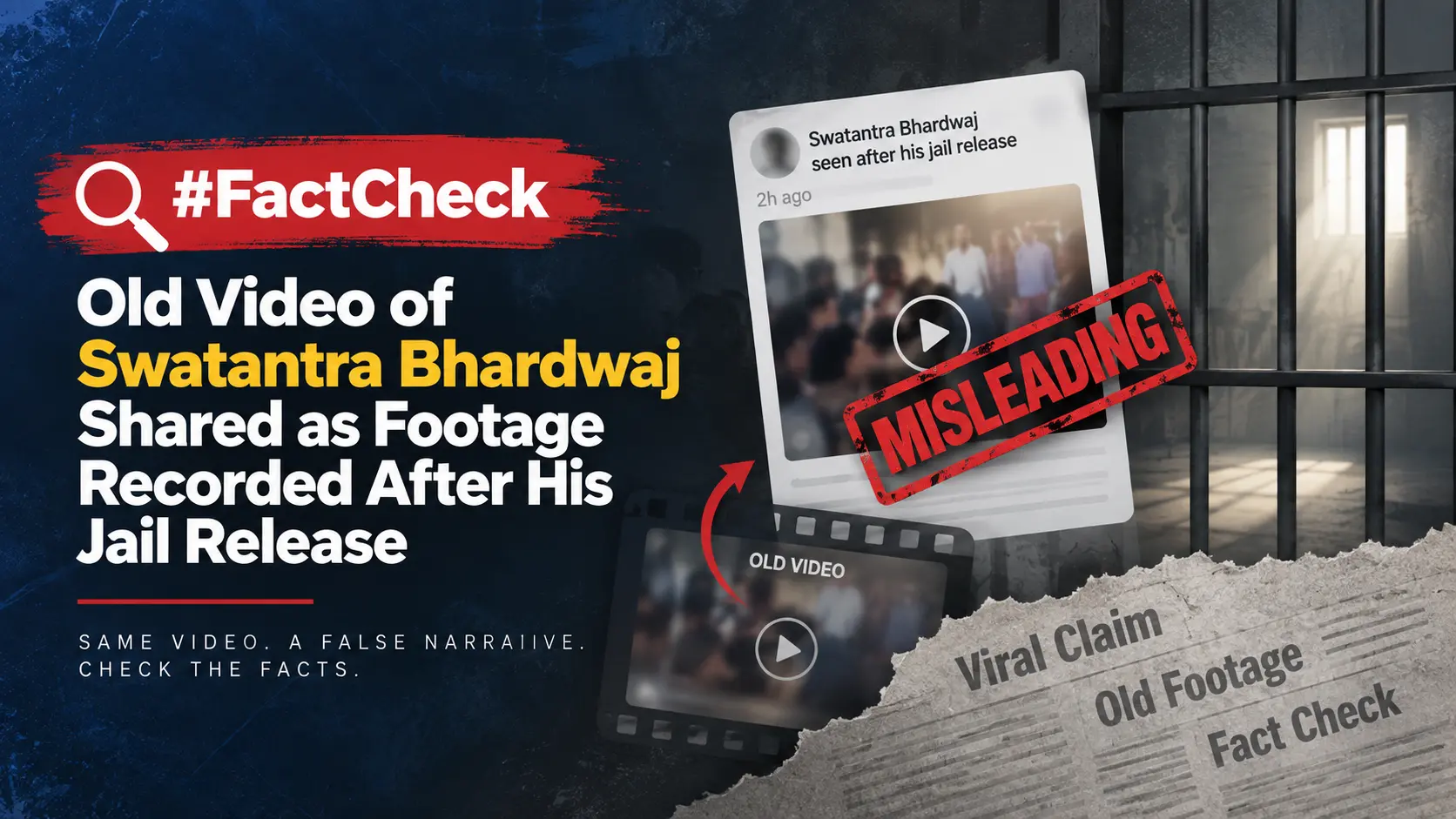
A video of Swatantra Bhardwaj is being shared on social media. Another man can also be seen with Bhardwaj in the video. Swatantra Bhardwaj came into the spotlight following an alleged assault involving the father of a protester during a protest by the Cockroach Janta Party at Jantar Mantar. Social media posts claim that the video was recorded immediately after his release from jail and shows him openly threatening people. CyberPeace Research Wing’s Research found the viral claim to be false. Our Research revealed that the video being shared on social media is old. Swatantra Bhardwaj was released from jail on September 17, while our Research found that the video has been available online since June. Therefore, the claim that the video was recorded immediately after Bhardwaj’s release from jail is misleading.
Claim:
A Facebook user shared the viral video on September 17, 2026, with the caption: “The Indian judicial system has failed once again... Swatantra Bhardwaj has started again immediately after coming out, even though the court has imposed a condition that he will not make any statements to the media. But listen to what he is saying.” The post link, archive link, and screenshot are provided below.
https://www.facebook.com/reel/1349048917301713

Fact Check
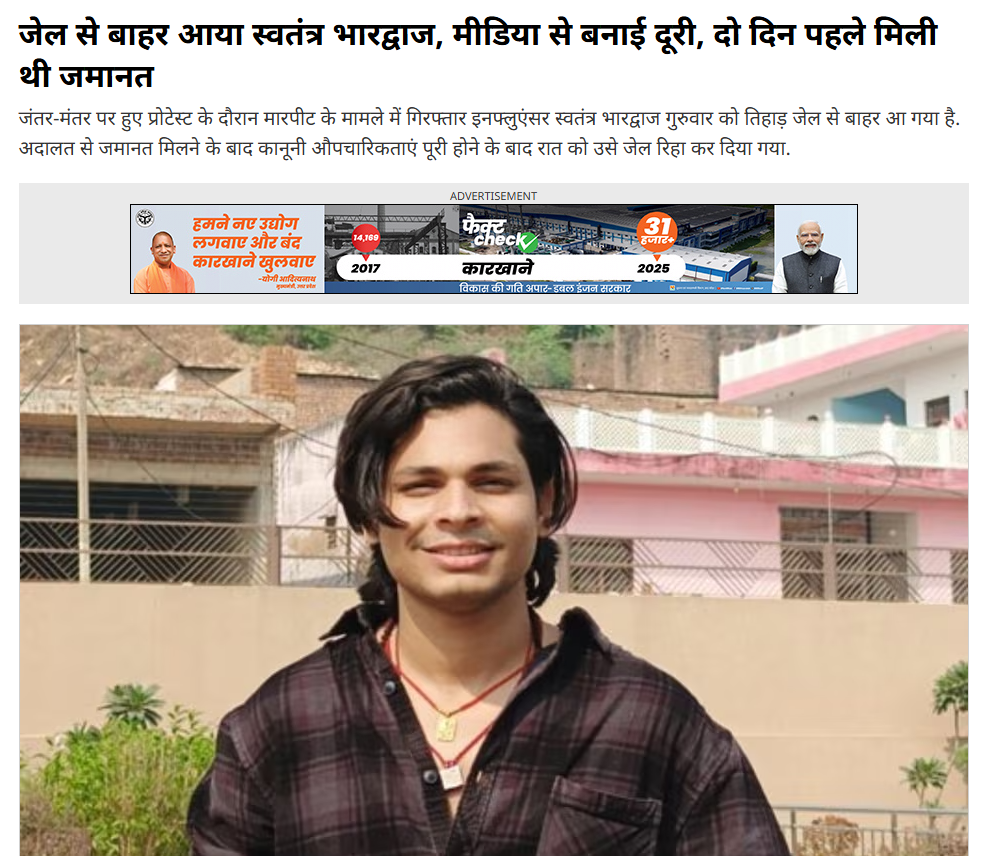
To verify the date of Swatantra Bhardwaj’s release from jail, we searched Google using relevant keywords. During the search, we found a report published by Aaj Tak on September 18, 2026. According to the report, social media influencer Swatantra Bhardwaj, who came into the spotlight following an alleged assault during a protest at Jantar Mantar, was released from Delhi’s Tihar Jail on September 17, 2026, after being granted bail by the court and completing the necessary legal formalities. Soon after walking out of the main gate of the jail, he ran towards a taxi and left without speaking to the media personnel present there. The post link and screenshot are provided below.
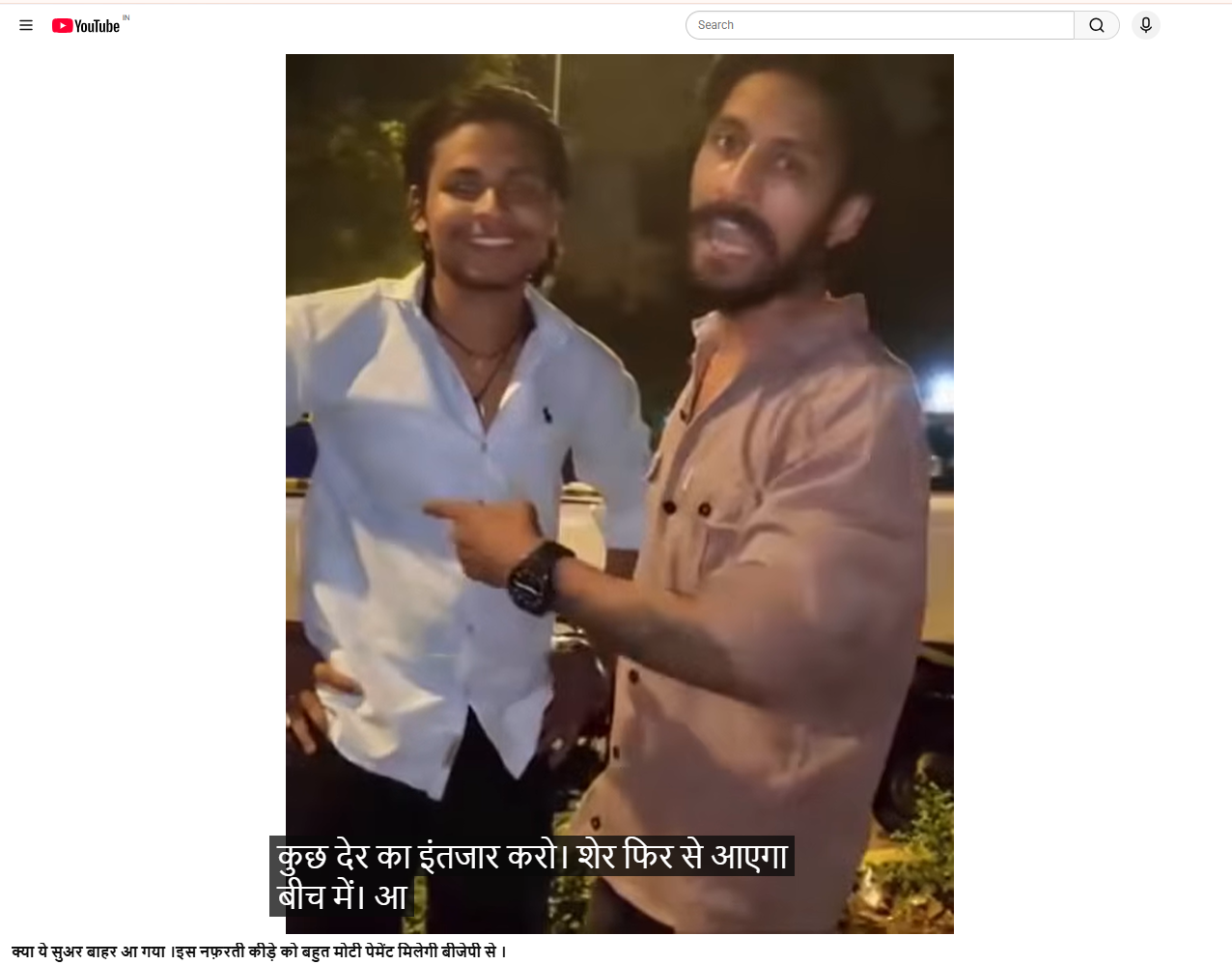
To verify the authenticity of the viral claim, we conducted a reverse image search of the keyframes from the video. During the search, we found the same video on a YouTube channel, where it was published on September 7, 2026. Meanwhile, the report mentioned above clearly states that Swatantra Bhardwaj was released from Delhi’s Tihar Jail on September 17, 2026. The report link and screenshot are provided below.
https://www.youtube.com/watch?v=-3V0pwJbpwg
At the end of our Research, we found another version of the same video, which was uploaded by a person identified as Vaibhav Kumar on June 26, 2026. The post link and screenshot are provided below.
https://www.instagram.com/reels/DaBs7Q-T8xc/

Conclusion
Our Research found that the video being shared on social media is old. Swatantra Bhardwaj was released from jail on September 17, while our Research found that the video had already been available online since June. Therefore, the claim that the video was recorded immediately after Bhardwaj’s release from jail is misleading.
Executive Summary
A picture is rapidly going viral on social media, showing Indian cricketer Virat Kohli and actor Anushka Sharma having breakfast together. Users are sharing this photo, presenting it as a "candid" (real) moment.
Research by the CyberPeace Research Wing revealed that the photo of Virat Kohli and Anushka Sharma having breakfast is completely fake. This image does not depict a real moment, but has been created using Artificial Intelligence (AI).
Claim
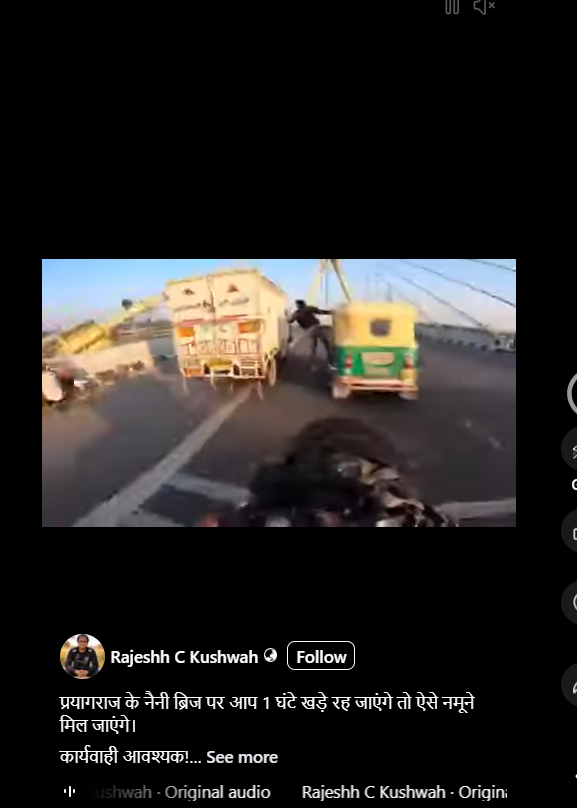
A picture is rapidly going viral on social media, showing Indian cricketer Virat Kohli and actor Anushka Sharma having breakfast together. Users are sharing this photo, presenting it as a "candid" (real) moment.
https://www.facebook.com/reel/951138134598230
Fact Check
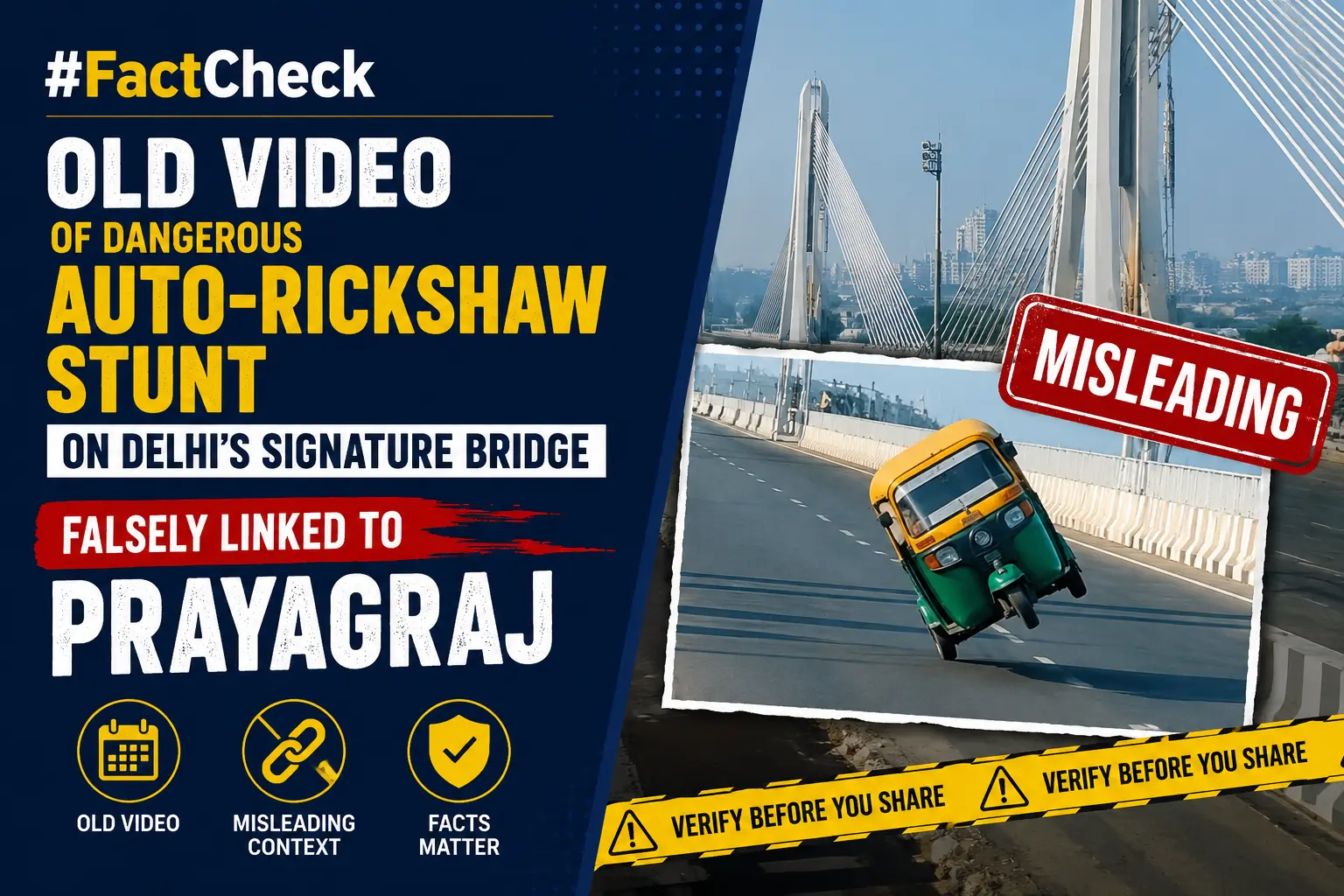
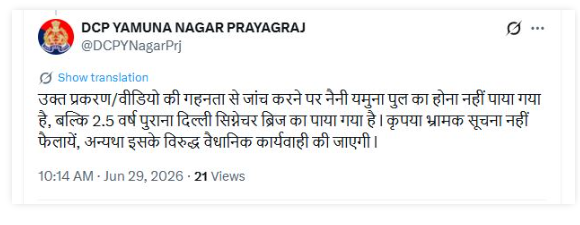
We extracted several keyframes from the viral video and searched them using the Google Lens tool. We found that this video was also quite viral on X (formerly Twitter). Responding to users, the official X handle of DCP Yamuna Nagar, Prayagraj, stated, “Upon a detailed research of the said matter/video, it has been found that it is not from the Naini Yamuna Bridge, but is a 2.5-year-old video from Delhi’s Signature Bridge. Please do not spread misleading information, otherwise legal action will be initiated against it.”
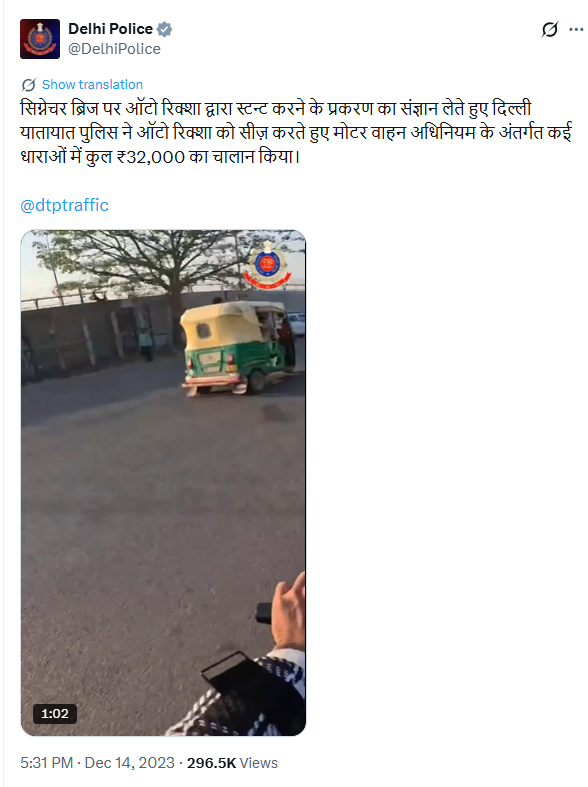
During our search, we found a post on the official X handle of the Delhi Police. Sharing the viral video, they wrote that taking cognizance of the auto-rickshaw stunt incident on the Signature Bridge, the Delhi Traffic Police seized the auto-rickshaw and issued a challan totaling ₹32,000 under various sections of the Motor Vehicles Act.
https://x.com/DelhiPolice/status/1735268792434057352?s=20
Conclusion
In our research, the viral post turned out to be fake. A video of an incident that took place on Delhi's Signature Bridge in 2023 is now being falsely circulated to spread misinformation as an incident from a bridge in Prayagraj. No such incident has taken place on the Naini Bridge in Prayagraj.
