
Google's Full Stack, India's Fine Print | Reading the AI Data Centre Boom Beyond the Headline
Introduction
As AI becomes more deeply integrated into everyday life and industries, Google Cloud is increasing its investment in AI-ready data centres worldwide, with India emerging as a key part of its expansion plans. Thomas Kurian’s latest India visit highlighted Google Cloud’s expanding ambitions in the country. Beyond the $15 billion, 1GW Visakhapatnam data centre announced in October 2025, Google is planning a larger multi-year AI infrastructure push, backed by partnerships with major enterprises across banking, healthcare, and digital services. This reflects a shift where countries are not only competing to create advanced AI technologies but also to build the infrastructure needed to support and lead the future AI economy. But it's worth being precise about what "building infrastructure" actually means here because it is private, foreign-headquartered capital constructing facilities on Indian soil, under terms that remain largely opaque to the public that will depend on them. That distinction matters more than the investment headline suggests.
The Promise and Pressure of Google’s Full-Stack AI Strategy
For decades, data centres were mainly built to store information, host websites, and support cloud applications. The rise of generative AI has completely changed that role. Today's systems need massive computing power both to train models on huge datasets and to run them every time someone generates content or automates a task. It is distinguished from traditional workloads mainly due to relying on proprietary technologies like GPU or TPU, alongside advanced networking and dynamic storage systems that complement each other and work in unison. The efforts of Google to create its own TPUs are understandable as they played a vital role in a number of achievements made by Google DeepMind. Today, the companies, government entities, and people turning to AI solutions put enormous pressure on the processing of data.
The companies that are building this infrastructure are shaping ecosystems on which others will depend on. Google’s “full stack” approach that infers controlling everything from chips and AI models to cloud platforms and applications which may improve efficiency and reduce costs, but it also creates deeper dependence on a single provider. Like a hospital adopting an AI platform is not just purchasing software; over time, its data systems, workflows, and operations can become closely tied to the underlying cloud ecosystem.
This concern when viewed against the concentration of the global cloud market: Amazon Web Services, Microsoft Azure, and Google Cloud together control roughly two-thirds of global cloud infrastructure, making them the dominant gatekeepers of enterprise computing. As these same companies move upward into AI models and applications while controlling the compute layer beneath them, the debate is no longer only about market share, it is about control over the entire AI value chain.
Why Location Matters and Why It Isn't Enough
In traditional internet services, a delay of a few milliseconds rarely mattered. However, future AI applications like autonomous vehicles, AI-assisted diagnostics, automated factory robotics will demand near-instant decision-making and cannot always depend on servers thousands of kilometres away. Regional data centres reduce that latency, which matters especially for India, where hundreds of millions are expected to interact with AI-powered services in the coming years. There is also the question of data sovereignty, and this is where the infrastructure narrative gets ahead of the regulatory reality. Governments worldwide are increasingly concerned about where citizens' and companies' data is stored and processed and local data centres are presented as the answer, but physical proximity does not automatically translate into legal accountability. Google has acknowledged that it bills cloud revenue through whichever global entity corresponds to the data centre being accessed which means an Indian client's spending on Google Cloud infrastructure inside India may still not be booked, taxed, or contractually governed as an Indian transaction. Google Cloud India Pvt. Ltd reported just ₹2,065.4 crore in FY25 revenue, strikingly disconnected from the scale of a $15 billion facility and its roster of major Indian clients. Servers on Indian soil do not by themselves guarantee that India captures the tax base, the leverage, or the oversight that "data sovereignty" implies.
This gap is widened by where India's own data protection framework stands. The Digital Personal Data Protection (DPDP) Act, 2023 leaves retention periods and purpose limitation loosely specified under Sections 8(7) and 12, and its enforcement rules are still being finalised. When hospitals or banks process data through a foundation-model platform like Gemini Enterprise, questions like where processing occurs and what audit trail exists for cross-border flows are not resolved by a local data centre's presence. At present, they rely mostly on vendor assurance rather than independent verification.
Economic Opportunities: More Than Just Servers
AI data centres are often imagined as buildings filled with computers, but their economic impact extends further, into energy systems, construction, engineering, semiconductor supply chains, and skilled technical work. Countries hosting these facilities can benefit from investment and job creation, while local businesses gain access to AI tools without building expensive infrastructure of their own.
For India, expanded AI infrastructure could support ambitions to become a global technology hub, and could narrow the gap in access to high-performance computing that has historically disadvantaged smaller companies and researchers. That potential is real. But it should be weighed against the terms on which it arrives, whether the economic value generated is captured domestically through tax revenue and enforceable local accountability, or whether India functions primarily as a hosting site while value accrues elsewhere. The current revenue-booking structure suggests the latter is, at minimum, a live risk rather than a settled question.
The Environmental Challenge of AI Expansion
However, what remains less discussed is the environmental cost behind this expansion from its impact on the power grid and water required for cooling to clearing use of renewable energy. A 1GW facility, the scale for the Visakhapatnam project is comparable to the output of a mid-sized power plant dedicated entirely to compute demand. As models grow larger and adoption accelerates, this level of energy and water consumption has become one of the central concerns of the global AI infra. As much attention as the investment figures receive, the sustainability issue behind such large-scale infrastructure deserves equal visibility.
The Future: AI Infrastructure as National Infrastructure
The expansion of Google Cloud's AI data centres show a change in how the world views computing. Data centres are no longer invisible facilities operating in the background; they are becoming strategic infrastructure comparable to power grids and telecom networks. That comparison should prompt that infrastructure this consequential is usually made subject to public oversight, licensing conditions, and accountability mechanisms proportionate to its importance which is missing so far. Google Cloud's investment and the compute capacity it brings will lower barriers for Indian enterprises and researchers who have long lacked access to frontier-scale infrastructure. Against this backdrop, India needs to develop the regulatory, tax, and competition frameworks to ensure that the foundation serves the country hosting it, rather than the company that owns it.
Beyond Compute: The Emerging Question of AI Sovereignty
The next phase of the AI race may not be defined only by who builds the most capable models, but by who governs the infrastructure, standards, and decision making systems that those models depend upon. As advances in artificial general intelligence and discussions around superintelligence move from research laboratories into policy circles, control over compute resources is becoming a matter of strategic importance comparable to control over energy reserves or communication networks. Nations that rely entirely on external providers for advanced AI infrastructure may eventually find themselves dependent not merely for technology services, but for economic productivity, public administration, healthcare delivery, and national security capabilities. For India, the challenge is therefore larger than attracting investment. It is about ensuring meaningful domestic participation in ownership, governance, talent development, and oversight so that the intelligence systems shaping the future remain aligned with national priorities and public interest.
References

Related Blogs

Executive Summary
A video of Prime Minister Narendra Modi and Chinese President Xi Jinping is being shared on social media. The video is being shared with the claim that during the BRICS Summit, Prime Minister Modi gifted Xi Jinping a portrait featuring his own image. The post also takes aim at Prime Minister Modi based on this claim. Research by CyberPeace found that the video dates back to October 2019 and shows an exchange of gifts between Prime Minister Narendra Modi and Chinese President Xi Jinping. On the concluding day of the Mamallapuram Summit, Prime Minister Modi gifted Xi Jinping a large, handcrafted silk shawl. In return, Xi Jinping presented Prime Minister Modi with a porcelain souvenir bearing his portrait.
Claim:
A video of Prime Minister Narendra Modi and Chinese President Xi Jinping is being shared on Facebook with the claim that during the BRICS Summit, Prime Minister Modi gifted Xi Jinping a portrait of himself.
https://www.facebook.com/watch/?v=1109664078425193

Fact Check
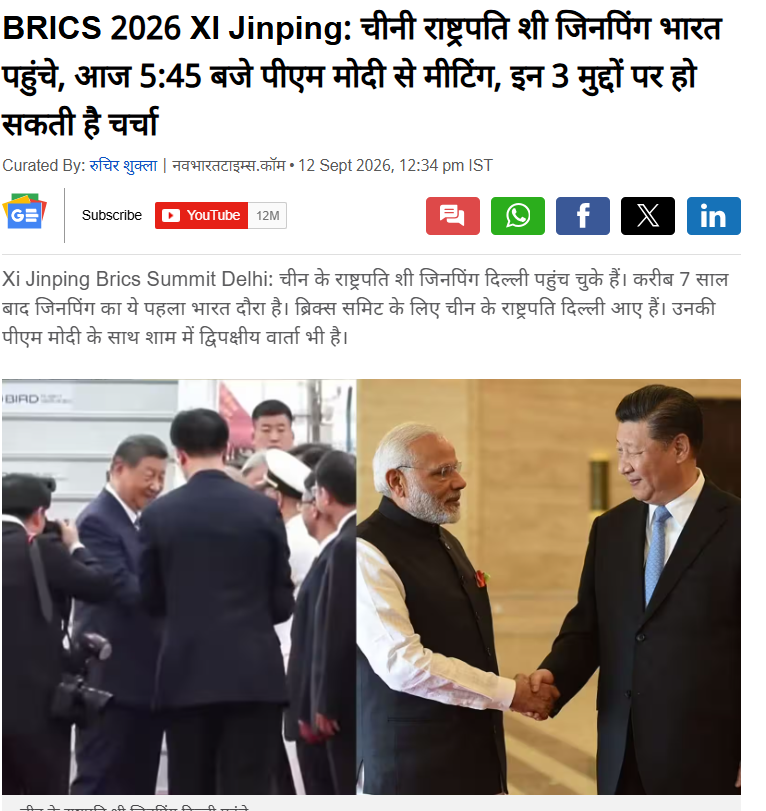
To verify the authenticity of the viral claim, we conducted a Google search using relevant keywords. During the search, we found a report published by Navbharat Times on September 12, 2026. According to the report, Chinese President Xi Jinping has arrived in Delhi to attend the 18th BRICS Summit. His aircraft landed at Palam Airport at around noon on Saturday. This is his first visit to India in nearly seven years.The report further stated that Prime Minister Narendra Modi and Xi Jinping were scheduled to meet at around 5 pm on the same day. This made it clear during our research that the video being shared on social media is not from the current BRICS Summit and is an old video.
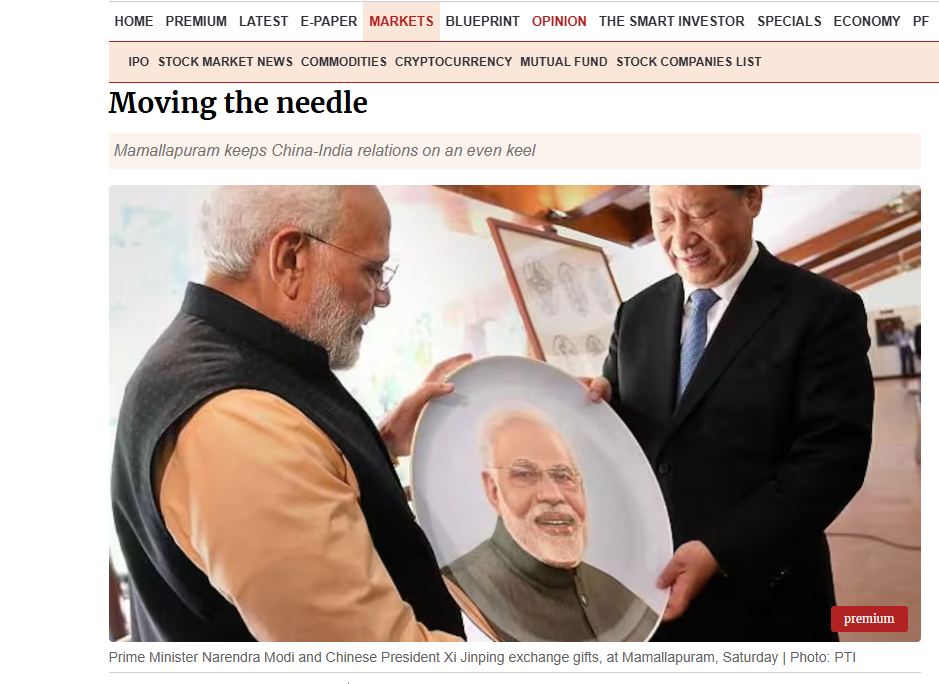
To verify the authenticity of the viral claim, we conducted a reverse image search of the keyframes from the video. During the search, we found a report published by Business Standard on October 13, 2019, which contained visuals from the viral video. According to the report, Chinese President Xi Jinping left for Nepal on Saturday aboard an Air China aircraft, concluding his second informal summit with Prime Minister Narendra Modi, which signalled a recalibration of bilateral ties. Xi spent around 24 hours in India.During his visit, he travelled to Mamallapuram near Chennai and held informal talks with Prime Minister Narendra Modi. Delegation-level talks between the two countries were also held.
https://www.business-standard.com/article/opinion/moving-the-needle-119101300820_1.html
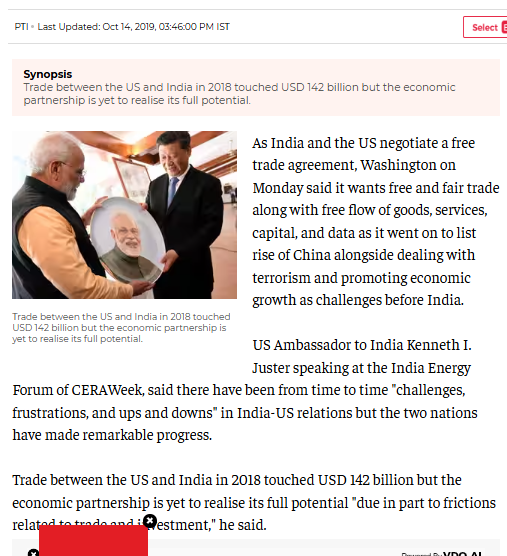
In the next step of our research, we found a report published by Economic Times on October 14, 2019. The report also contained the same visuals from the viral video and presented them in their original context.
Conclusion
The evidence gathered during our research makes it clear that the video being shared on social media is not from the BRICS Summit, but is an old video from 2019. This confirms that the video is being shared on social media by taking it out of its original context and falsely linking it to the BRICS Summit. Therefore, the claim that the viral video is from the BRICS Summit is misleading.

Executive Summary
A video is being shared on social media showing a large amount of debris cascading down a mountain amid multi-storey buildings. The video is being shared with the claim that it shows a landslide incident in Nepal. CyberPeace Research found the viral claim to be false. Our research found that the viral video is AI-generated and is being shared with a misleading claim.
Claim:
A Facebook user shared the viral video on September 29, 2026, with the caption, “A horrifying scene of a mountain collapsing in Nepal.” The post link, archive link and screenshot are provided below.
https://x.com/ptravidwivedi/status/2104934750595219494

Fact Check
To verify the authenticity of the viral claim, we conducted a reverse image search using keyframes from the video. However, we did not find any credible media reports or other reliable sources related to the video during the search. Upon closely examining the viral video, we noticed several inconsistencies that raised suspicions that the video may be AI-generated.
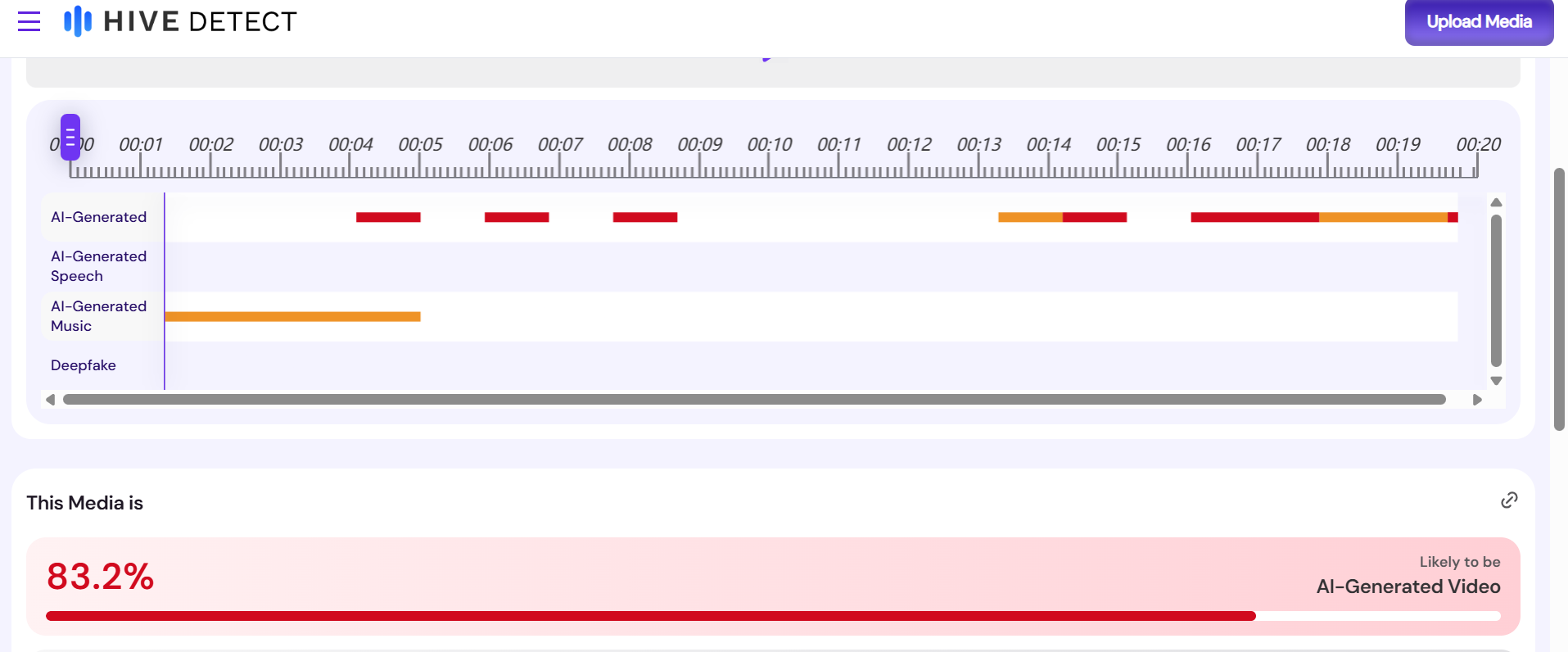
As part of the next step in our research, we scanned the video using the AI detection tool Hive Detect. According to the results, the viral video has an 83 per cent likelihood of being AI-generated.

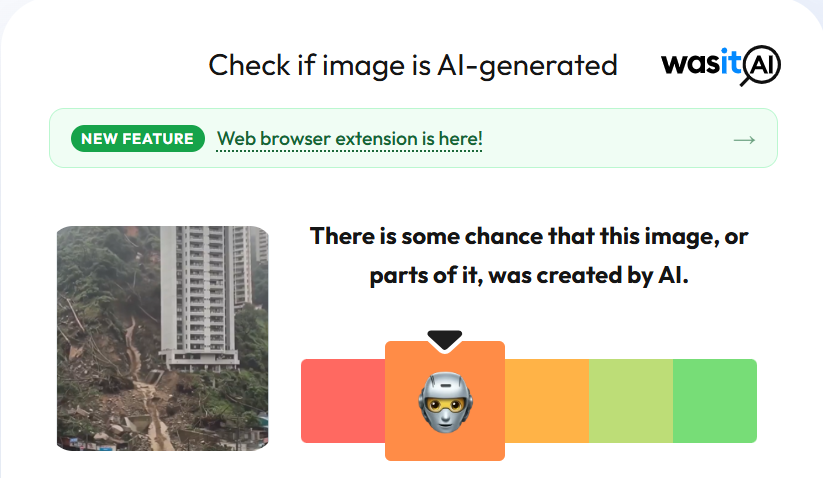
At the end of our research, we scanned the viral video using the AI detection tool WasIt AI. According to the results, the viral video was found to be AI-generated.

Conclusion
Our research found that the viral video is AI-generated and is being shared with a misleading claim.

Executive Summary
A video of Indian cricketer Rohit Sharma is being widely shared on social media, purportedly showing him saying, “If you want me to play in the next World Cup and you are with me, then share and like this video.” However, CyberPeace Research Wing found the viral claim to be false. Our research found that the viral video is not authentic but AI-generated and is being circulated with a misleading claim.
Claim:
A Facebook user shared the viral video on September 28 with the caption, “If you want me to play in the next World Cup and you are with me, then share and like this video.” The post link, archived link and screenshot are provided below.
https://www.facebook.com/reel/27349791221308658

Fact check
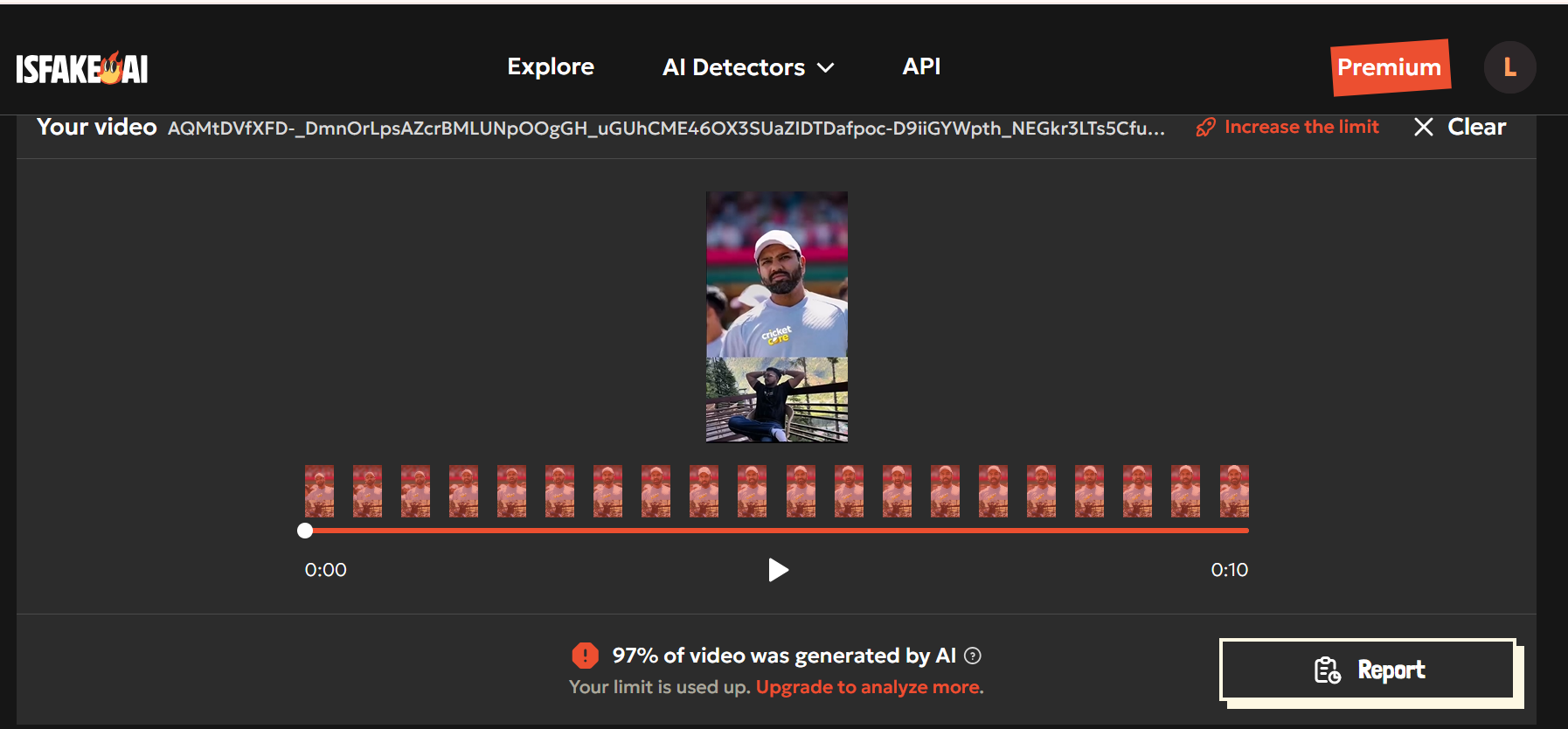
To verify the viral claim, we conducted a Google search using relevant keywords. During the search, we did not find any credible media reports corroborating the claim. As part of our research, we scanned the viral video using the AI detection tool ISFAKEAI. According to the tool’s results, the video was 97 per cent AI-generated.
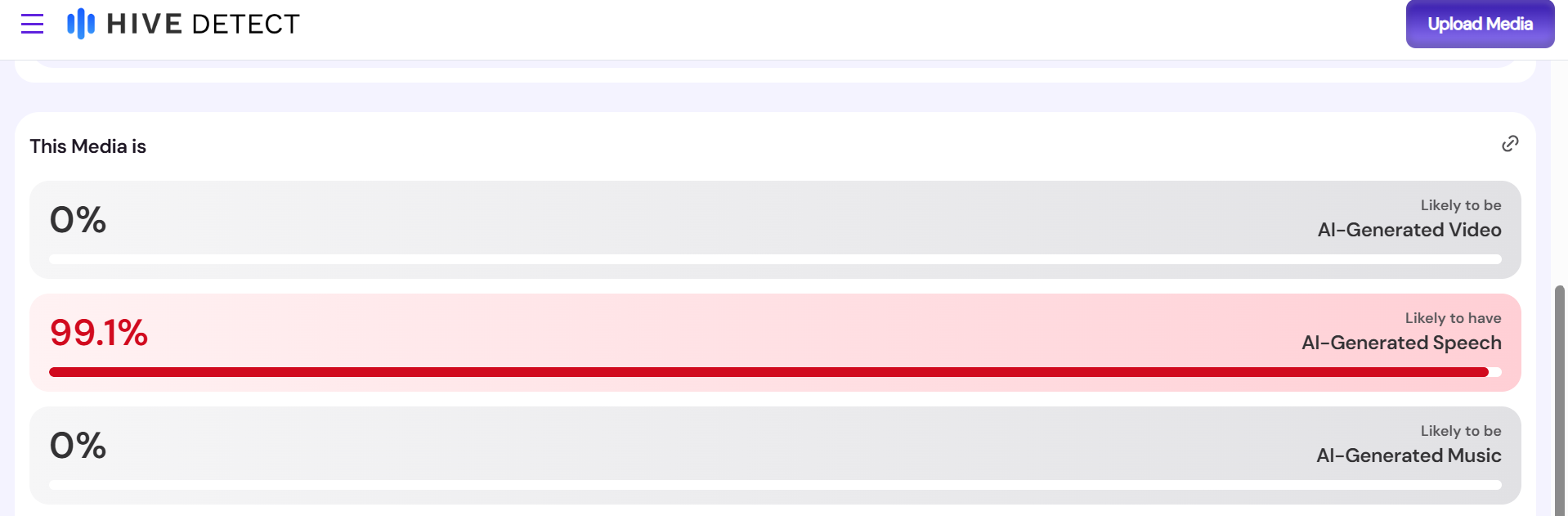
We further analysed the video using Hive Detect, which found that the speech in the viral video was 99 per cent AI-generated.
Conclusion:
Our research found that the viral video is not authentic but AI-generated. The video is being circulated on social media with a misleading claim that it shows an aeroplane being affected by the alleged ‘Arnab’ cyclone in Ahmedabad.
