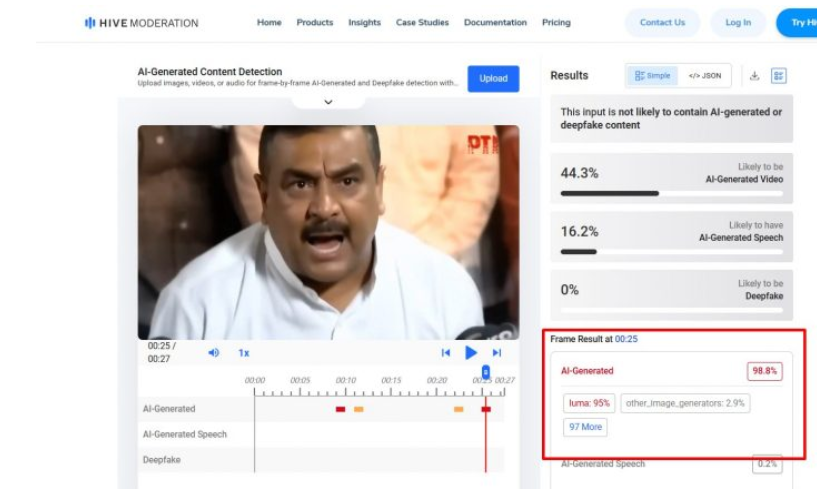
#FactCheck-Deepfake Video Falsely Shows DRDO Chief Claiming ‘Agni-6 Was Washed with Cow Urine’
Executive Summary
A video of Dr. Samir V. Kamat, Chairman of the Defence Research and Development Organisation (DRDO), is going viral on social media. In the clip, he appears to claim that Prime Minister Narendra Modi instructed scientists to wash the Agni-6 missile with cow urine, and later use a mixture of cow dung and urine to prevent rusting. Research by CyberPeace Research Wing found that the video is a deepfake, created by manipulating original footage using AI tools. It was also shared by an account previously known for posting anti-India misinformation and is reportedly banned in India.
Claim
An X user named “Lovely” shared the video on May 1, 2026, alleging that Indian scientists were using cow urine and dung in missile development under government direction. The post used derogatory language and criticized India’s scientific community.

Fact Check
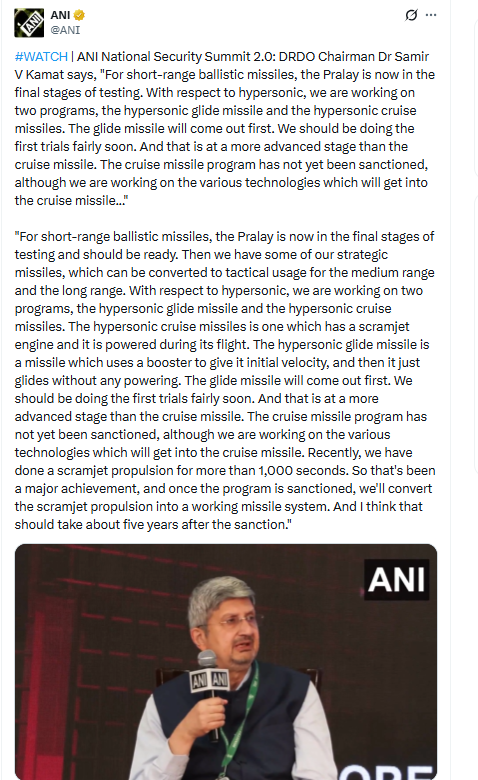
To verify the claim, we searched relevant keywords on Google but found no credible media reports supporting such statements by the DRDO chief. We then extracted keyframes from the viral clip and conducted a reverse image search using Google Lens. This led us to the original video posted by ANI on April 30, 2026. The footage is from the National Security Summit 2.0, where Dr. Kamat spoke about India’s missile development programs.
In the authentic video, Dr. Kamat discusses short-range ballistic missiles like ‘Pralay’, and advancements in hypersonic glide and cruise missile technologies, including scramjet propulsion. There is no mention of cow urine, cow dung, or any such practices.
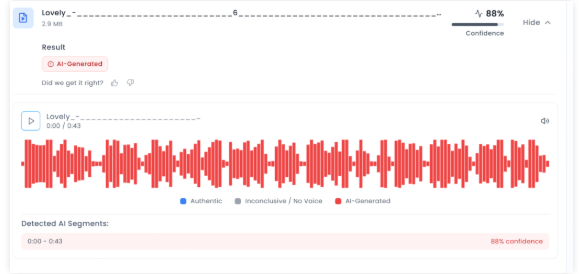
Further analysis using AI detection tool Aurigin indicated an 88% probability that the viral video was AI-generated or manipulated.
Conclusion
Our research confirms that the viral video is fake and AI-manipulated. Dr. Samir V. Kamat never made any statement about washing missiles with cow urine. The clip is a deepfake created to spread misinformation and mislead viewers.
Related Blogs

Introduction
Cyber-attacks are another threat in this digital world, not exclusive to a single country, that could significantly disrupt global movements, commerce, and international relations all of which experienced first-hand when a cyber-attack occurred at Heathrow, the busiest airport in Europe, which threw their electronic check-in and baggage systems into a state of chaos. Not only were there chaos and delays at Heathrow, airports across Europe including Brussels, Berlin, and Dublin experienced delay and had to conduct manual check-ins for some flights further indicating just how interconnected the world of aviation is in today's world. Though Heathrow assured passengers that the "vast majority of flights" would operate, hundreds were delayed or postponed for hours as those passengers stood in a queue while nearly every European airport's flying schedule was also negatively impacted.
The Anatomy of the Attack
The attack specifically targeted Muse software by Collins Aerospace, a software built to allow various airlines to share check-in desks and boarding gates. The disruption initially perceived to be technical issues soon turned into a logistical nightmare, with airlines relying on Muse having to engage in horror-movie-worthy manual steps hand-tagging luggage, verifying boarding passes over the phone, and manually boarding passengers. While British Airways managed to revert to a backup system, most other carriers across Heathrow and partner airports elsewhere in Europe had to resort to improvised manual solutions.
The trauma was largely borne by the passengers. Stories emerged about travelers stranded on the tarmac, old folks left barely able to walk without assistance, and even families missing important connections. It served to remind everyone that the aviation world, with its schedules interlocked tightly across borders, can see even a localized system failure snowball into a continental-level crisis.
Cybersecurity Meets Aviation Infrastructure
In the last two decades, aviation has become one of the more digitally dependent industries in the world. From booking systems and baggage handling issues to navigation and air traffic control, digital systems are the invisible scaffold on which flight operations are supported. Though this digitalization has increased the scale of operations and enhanced efficiency, it must have also created many avenues for cyber threats. Cyber attackers increasingly realize that to target aviation is not just about money but about leverage. Just interfering with the check-in system of a major hub like Heathrow is more than just financial disruption; it causes panic and hits the headlines, making it much more attractive for criminal gangs and state-sponsored threat actors.
The Heathrow incident is like the worldwide IT crash in July 2024-thwarting activities of flights caused by a botched Crowdstrike update. Both prove the brittleness of digital dependencies in aviation, where one failure point triggering uncontrollable ripple effects spanning multiple countries. Unlike conventional cyber incidents contained within corporate networks, cyber-attacks in aviation spill on to the public sphere in real time, disturbing millions of lives.
Response and Coordination
Heathrow Airport first added extra employees to assist with manual check-in and told passengers to check flight statuses before traveling. The UK's National Cyber Security Centre (NCSC) collaborated with Collins Aerospace, the Department for Transport, and law enforcement agencies to investigate the extent and source of the breach. Meanwhile, the European Commission published a statement that they are "closely following the development" of the cyber incident while assuring passengers that no evidence of a "widespread or serious" breach has been observed.
According to passengers, the reality was quite different. Massive passenger queues, bewildering announcements, and departure time confirmations cultivated an atmosphere of chaos. The wrenching dissonance between the reassurances from official channel and Kirby needs to be resolved about what really happens in passenger experiences. During such incidents, technical restoration and communication flow are strategies for retaining public trust in incidents.
Attribution and the Shadow of Ransomware
As with many cyber-attacks, questions on its attribution arose quite promptly. Rumours of hackers allegedly working for the Kremlin escaped into the air quite possibly inside seconds of the realization, Cybersecurity experts justifiably advise against making conclusions hastily. Extortion ransomware gangs stand the last chance to hold the culprits, whereas state actors cannot be ruled out, especially considering Russian military activity under European airspace. Meanwhile, Collins Aerospace has refused to comment on the attack, its precise nature, or where it originated, emphasizing an inherent difficulty in cyberattribution.
What is clear is the way these attacks bestow criminal leverage and dollars. In previous ransomware attacks against critical infrastructure, cybercriminal gangs have extorted millions of dollars from their victims. In aviation terms, the stakes grow exponentially, not only in terms of money but national security and diplomatic relations as well as human safety.
Broader Implications for Aviation Cybersecurity
This incident brings to consideration several core resilience issues within aviation systems. Traditionally, the airports and airlines had placed premium on physical security, but today, the equally important concept of digital resilience has come into being. Systems such as Muse, which bind multiple airlines into shared infrastructure, offer efficiency but, at the same time, also concentrate that risk. A cyber disruption in one place will cascade across dozens of carriers and multiple airports, thereby amplifying the scale of that disruption.
The case also brings forth redundancy and contingency planning as an urgent concern. While BA systems were able to stand on backups, most other airlines could not claim that advantage. It is about time that digital redundancies, be it in the form of parallel systems or isolated backups or even AI-driven incident response frameworks, are built into aviation as standard practice and soon.
On the policy plane, this incident draws attention to the necessity for international collaboration. Aviation is therefore transnational, and cyber incidents standing on this domain cannot possibly be handled by national agencies only. Eurocontrol, the European Commission, and cross-border cybersecurity task forces must spearhead this initiative to ensure aviation-wide resilience.
Human Stories Amid a Digital Crisis
Beyond technical jargon and policy response, the human stories had perhaps the greatest impact coming from Heathrow. Passengers spoke of hours spent queuing, heading to funerals, and being hungry and exhausted as they waited for their flights. For many, the cyber-attack was no mere headline; instead, it was ¬ a living reality of disruption.
These stories reflect the fact that cybersecurity is no hunger strike; it touches people's lives. In critical sectors such as aviation, one hour of disruption means missed connections for passengers, lost revenue for airlines, and inculcates immense emotional stress. Crisis management must therefore entail technical recovery and passenger care, communication, and support on the ground.
Conclusion
The cybersecurity crisis of Heathrow and other European airports emphasizes the threat of cyber disruption on the modern legitimacy of aviation. The use of increased connectivity for airport processes means that any cyber disruption present, no matter how small, can affect scheduling issues regionally or on other continents, even threatening lives. The occurrences confirm a few things: a resilient solution should provide redundancy not efficiency; international networking and collaboration is paramount; and communicating with the traveling public is just as important (if not more) as the technical recovery process.
As governments, airlines, and technology providers analyse the disruption, the question is longer if aviation can withstand cyber threats, but to what extent it will be prepared to defend itself against those attacks. The Heathrow crisis is a reminder that the stake of cybersecurity is not just about a data breach or outright stealing of money but also about stealing the very systems that keep global mobility in motion. Now, the aviation industry is tested to make this disruption an opportunity to fortify the digital defences and start preparing for the next inevitable production.
References
- https://www.bbc.com/news/articles/c3drpgv33pxo
- https://www.theguardian.com/business/2025/sep/21/delays-continue-at-heathrow-brussels-and-berlin-airports-after-alleged-cyber-attack
- https://www.reuters.com/business/aerospace-defense/eu-agency-says-third-party-ransomware-behind-airport-disruptions-2025-09-22/

Overview:
It is worth stating that millions of Windows users around the world are facing the Blue Screen of Death (BSOD) problem that makes systems shutdown or restart. This has been attributed to a CrowdStrike update that was released recently and has impacted many organizations, financial institutions, and government agencies across the globe. Indian airlines have also reported disruptions on X (formerly Twitter), informing passengers about the issue.
Understanding Blue Screen of Death:
Blue Screen errors, also known as black screen errors or STOP code errors, can occur due to critical issues forcing Windows to shut down or restart. You may encounter messages like "Windows has been shut down to prevent damage to your computer." These errors can be caused by hardware or software problems.
Impact on Industries
Some of the large U. S. airlines such as American Airlines, Delta Airlines, and United Airlines had to issue ground stops because of communication problems. Also, several airports on Friday suffered a massive technical issue in check-in kiosks for IndiGo, Akasa Air, SpiceJet, and Air India Express.
The Widespread Issue
The issue seems widespread and is causing disruption across the board as Windows PCs are deployed at workplaces and other public entities like airlines, banks, and even media companies. It has been pointed out that Windows PCs use a special cybersecurity solution from a company called CrowdStrike that seems to be the culprit for this outage, affecting most Windows PC users out there.
Microsoft's Response
The issue was acknowledged by Microsoft and the mitigations are underway. The company in its verified X handle Microsoft 365 status has shared a series information on the latest outage and they are looking into the matter. The issue is under investigation.
In one of the posts from Microsoft Azure, it is mentioned that they have become aware of an issue affecting Virtual Machines (VMs) running Windows Client and Windows Server with the CrowdStrike Falcon agent installed. These VMs may encounter a bug check (BSOD) and become stuck in a restarting state. Their analysis indicates that this issue started approximately at 19:00 UTC on July 18th. They have provided recommendations as follows:
Restore from Backup: In case customers have available backups prior to 19:00 UTC on July 18th, they should recover VM data from the backups. If the customer is using Azure Backup, they can get exact steps on how to restore VM data in the Azure portal. here.
Offline OS Disk Repair: Alternatively, customers can attempt offline repair of the OS disk by attaching an unmanaged disk to the affected VM. Encrypted disks may require additional steps to unlock before repair. Once attached, delete the following file:
Windows/System/System32/Drivers/CrowdStrike/C00000291*.sys
After deletion, reattach the disk to the original VM.
Microsoft Azure is actively investigating additional mitigation options for affected customers. We will provide updates as we gather more information.
Resolving Blue Screen Errors in Windows
Windows 11 & Windows 10:
Blue Screen errors can stem from both hardware and software issues. If new hardware was added before the error, try removing it and restarting your PC. If restarting is difficult, start your PC in Safe Mode.
To Start in Safe Mode:
From Settings:
Open Settings > Update & Security > Recovery.
Under "Advanced startup," select Restart now.
After your PC restarts to the Choose an option screen, select Troubleshoot > Advanced options > Startup Settings > Restart.
After your PC restarts, you'll see a list of options. Select 4 or press F4 to start in Safe Mode. If you need to use the internet, select 5 or press F5 for Safe Mode with Networking.
From the Sign-in Screen:
Restart your PC. When you get to the sign-in screen, hold the Shift key down while you select Power > Restart.
After your PC restarts, follow the steps above.
From a Black or Blank Screen:
Press the power button to turn off your device, then turn it back on. Repeat this two more times.
After the third time, your device will start in the Windows Recovery Environment (WinRE).
From the Choose an option screen, follow the steps to enter Safe Mode.
Additional Help:
Windows Update: Ensure your system has the latest patches.
Blue Screen Troubleshooter: In Windows, open Get Help, type Troubleshoot BSOD error, and follow the guided walkthrough.
Online Troubleshooting: Visit Microsoft's support page and follow the recommendations under "Recommended Help."
If none of those steps help to resolve your Blue Screen error, please try the Blue Screen Troubleshooter in the Get Help app:
- In Windows, open Get Help.
- In the Get Help app, type Troubleshoot BSOD error.
- Follow the guided walkthrough in the Get Help app.
[Note: If you're not on a Windows device, you can run the Blue Screen Troubleshooter on your browser by going to Contact Microsoft Support and typing Troubleshoot BSOD error. Then follow the guided walkthrough under "Recommended Help."]
For detailed steps and further assistance, please refer to the Microsoft support portal or contact their support team.
CrowdStrike’s Response:
In the statement given by CrowdStrike, they have clearly mentioned it is not any cyberattack and their resources are working to fix the issue on Windows. Further, they have identified the deployment issue and fixed the same. Crowdstrike mentions about their problematic versions as follows:
- “Channel file "C-00000291*.sys" with timestamp of 0527 UTC or later is the reverted (good) version.
- Channel file "C-00000291*.sys" with timestamp of 0409 UTC is the problematic version.
Note: It is normal for multiple "C-00000291*.sys files to be present in the CrowdStrike directory - as long as one of the files in the folder has a timestamp of 0527 UTC or later, that will be the active content.”
The CrowdStrike will be providing latest updates on the same and advises their customers and organizations to contact their officials officially to get latest updates and accurate information. It is encouraged to refer to customer’s support portal for further help.
Stay safe and ensure regular backups to mitigate the impact of such issues.
References:
https://status.cloud.microsoft/
https://www.crowdstrike.com/blog/statement-on-falcon-content-update-for-windows-hosts/

Introduction
As the world seemingly shrinks under the vast, ever-stretching canopy of the internet, the channels through which information flows are becoming increasingly enigmatic and tangled. In the digital world, the gulf between fact and fabrication narrows dramatically, with the veracity of information too often lost in the flood. Amidst the torrents of data, platforms like YouTube, a veritable Goliath in the video streaming sphere, are finding themselves at the forefront of a critical battle against the dark forces of fake news and disinformation—a war that is waged with the intensity of any historical conflict over truth and influence.
It is in this volatile theatre that Google's video behemoth, YouTube, under the scrutiny of the global eye, announces its strategic campaign to shield against the onslaught of misinformation. With India, the world's most populous democracy, on the cusp of its monumental general elections, the stakes could hardly be higher. YouTube's involvement thus evolves beyond corporate social responsibility—it becomes a crusade for the integrity of information, a paladin for the democratic process, and a protector of the public’s right to factual reporting.
The Campaign
The campaign envisioned by YouTube India's vanguard is multifaceted and robust, aimed at rooting out the insidious tendrils of fake news where they lie. At the heart of this mission are two pivotal strategies that form the backbone of YouTube's defense. Firstly, a rigorous misinformation policy, which heralds as a bastion against content designed with duplicitous intent. YouTube Indian Head Ishan Chatterjee elucidates, 'Our misinformation policies clearly state that if the content has been technically manipulated with the intent to deceive a user and there's a danger of real-world harm...we will act against that content.' It is an exhortation of YouTube's commitment to a culture of truth and an acknowledgement of the platform's influence and responsibility. This process, however, is more complex than it appears; it is tangled in socio-political nuances and demands an uncompromising vigilance to identify and dispel falsehoods.
Yet, this is merely the foundation upon which YouTube’s strategy rests. The second prong of their stratagem is even more ambitious—intending not only to eradicate the chaff of misinformation but also to till the soil with the seeds of verifiable, authoritative news content. This is an initiative to resuscitate the public's faith in digital information sources. By allying with credible news publishers and fostering a symbiosis with independent journalists, YouTube has taken up the mantle of an institution that not just police content, but cultivates it, transforming the barren desert of online falsehoods into an oasis of enlightenment.
News on YouTube is symbiotic with the larger consciousness of its users, driving content consumption and engaging millions who seek out current affairs, investigative reports, and in-depth analysis on the platform. The democratisation of news, once the hallowed ground of traditional broadcast and print media, now finds its theatre online. Chatterjee insightfully notes the ascending trend of news story engagement on YouTube Shorts and Connected TV (CTV)—two emergent platforms that have revolutionised content delivery and consumption. CTV, in particular, has skyrocketed in popularity within the past five years, boasting over 58 million viewers in India consuming YouTube content from the comfort of their living rooms as of June 2023, per analytics.
This phenomenon is acutely observed by YouTube's Director and Global Head of Responsibility, Tim Katz, who delineates a portrait of the Indian market's distinctive hunger for live content, particularly news, on CTV. Katz's observations carry an air of fascination, 'The other two things that have been exciting to see are that we've seen a lot of growth, particularly during sensitive moments, with large news stories occurring certainly during an election cycle, and we just see very large growth from many of our authoritative partners.'
The Implications of the Campaign
The tapestry of YouTube's news ecosystem is a rich mosaic of diversity, including independent journalists, broadcasters, legacy print publications, and digital-first media organisations. Katz underscores the gravity of nurturing such a broad and dynamic news environment on the platform, a gesture of YouTube's commitment to a holistic information landscape.
An illuminating report from the Google News Initiative, forged in cooperation with Kantar, reiterates the dominance of video as the consummate medium for news consumption across a spectrum of languages and formats in India. It paints a picture of a nation of insatiable news consumers, with nearly every second Indian language internet user engaging with news content, a substantial proportion hailing from urban locales. Of particular resonance is hyperlocal news, which plucks the chords of local interests and concerns, touching the lives of seven out of ten citizens.
Moreover, the economic impetus behind YouTube’s role in the media firmament is brought to light in the Oxford Economics Impact Report, revealing a staggering 70% of Indian media and music companies with a YouTube presence acknowledge the platform as a crucial revenue stream.
Conclusion
Poised upon the sharp edge of an electric election season—a season that will no doubt be drenched in a spectrum of information, both fact and fable—YouTube's convictions stand as a beacon of reliability. Their initiative is more than a method—it's a philosophy, a dedication to purifying the information sphere. In the digital epoch, where the battle lines for truth are drawn in bytes and bandwidth, YouTube’s rallying cry for responsibility, its vow to safeguard democratic ideals, and its unyielding commitment to illuminating the corridors of knowledge are more than strategies; they are pillars on which a well-informed, engaged, and enlightened citizenry can lean.