
#FactCheck -Bangladesh protest video falsely shared as police firing incident in Bihar’s Siwan
Executive Summary
A video is being widely shared on social media with the claim that a youth was killed in police firing in Bihar’s Siwan. The viral 1-minute-22-second video shows a young man standing with a stick in his hand. Moments later, gunfire is heard, after which he appears to be injured and collapses. His associates are then seen carrying him away from the spot. CyberPeace Research Wing’s research found that the claim is false. The research revealed that the viral video is not from Bihar’s Siwan but dates back to the student protests in Bangladesh in July 2024.
Claim:
The video was shared on X with a caption claiming that it shows a police firing incident in Bihar’s Siwan, where a student was allegedly killed after police opened fire with AK-47 rifles.
The caption stated, “This video is going viral on social media. It is being claimed that this video is from Siwan, Bihar, where police fired AK-47s at students. During the firing, a youth was hit by two bullets and died.”
https://x.com/Deshmukh_0/status/2082053481993740701

Fact Check:
To verify the authenticity of the viral claim, we extracted keyframes from the video and conducted a reverse image search. During the research, we found a longer version of the same video uploaded on the YouTube channel of a Bangladeshi news portal on July 16, 2024.
According to the video description, the footage shows the death of student Abu Sayed during protests in Rangpur, Bangladesh, on July 16, 2024.
https://www.youtube.com/watch?v=iuf7H0MNIaI

Further research led us to a report published by bdnews24, which also carried visuals matching those seen in the viral video. The report stated that on July 16, 2024, Abu Sayed, an English Department student at Begum Rokeya University in Rangpur, Bangladesh, died after being shot during the protests.
https://bdnews24.com/bangladesh/87ef7e69c496#google_vignette

Conclusion:
The evidence gathered during the research confirms that the viral video claiming to show a youth being killed in police firing in Bihar’s Siwan is misleading. The video is actually from Bangladesh and shows the death of student Abu Sayed during the July 2024 protests in Rangpur. The old footage is being shared with a false claim linking it to a recent incident in Bihar.

Related Blogs

Executive Summary:
Social media is buzzing with a link that claims to offer an iPhone 15 as a gift from LuLu Hypermarket, presented as part of Holi celebrations. This article examines the deceptive tactics behind this fraudulent offer and provides guidance on recognizing and avoiding such scams.
False Claim:
The link being shared is misleading and falsely claims that LuLu Hypermarket is giving away free iPhone 15 phones. This is taking advantage of the Holi festival to trick unsuspecting people. When users click on the link, they are redirected multiple times and end up on a page with LuLu Hypermarket's photo and some simple questions. Fake comments are also used to make the offer seem genuine, but it is all a deception.
The Deceptive Scheme:
The plan uses psychological tricks by linking the offer to a famous brand and a popular celebration. The landing page's simplicity and phoney comments try to make users trust it and feel like they need to act fast, so they'll join the scam.
The Fraudulent Campaign Analysed:
The scammers are using psychological tactics to manipulate people. They're exploiting the trust people have in LuLu Hypermarket and the excitement around the new iPhone 15 during the Holi festival. The fake questionnaire serves no real purpose, but it's a way to engage users and make the scam seem legitimate. Testimonials claiming people have successfully received the iPhone 15 are also fake, designed to create a false sense of credibility. Users are prompted to select a "gift box," which adds an interactive element to draw them in further. When a user selects a box, they're falsely congratulated on winning the iPhone 15, giving them a sense of accomplishment. Finally, users are urged to share the link via WhatsApp to "claim" the gift, spreading the scam to more potential victims.
What do we Analyse? :
- We analyse the deceptive tactics employed by the scam, including psychological manipulation, false engagement techniques, and fake testimonials, all aimed at convincing users of the offer's legitimacy.
Link : (https://sophisticateddistort[.]top/nTiwpTTTT526?llue1696559991144)
- It is important to note that at this particular point, there has not been any official declaration or a proper confirmation of an offer made by Lulu Hypermarket So, people must be very careful when encountering such messages because they are often employed as lures in phishing attacks or misinformation campaigns. Before engaging or transmitting such claims, it is always advisable to authenticate the information from trustworthy sources in order to protect oneself online and prevent the spread of wrongful information
- The campaign is hosted on a third party domain instead of any official Website of LuLu Hypermarket, this raised suspicion. Also the domain was registered last year.
- The intercepted request revealed a connection to a China-linked analytical service, Baidu in the backend.

- Domain Name: sophisticateddistort.top
- Registry Domain ID: D20230629G10001G_04181852-top
- Registrar WHOIS Server: whois.west263.com
- Registrar URL: www.west263.com
- Updated Date: 2023-07-01T02:55:34Z
- Creation Date: 2023-06-29T06:05:00Z
- Registry Expiry Date: 2024-06-29T06:05:00Z
- Registrar: Chengdu west dimension digital
- Registrant State/Province: Shan Xi
- Registrant Country: CN (China)
- Name Server: curt.ns.cloudflare.com
- Name Server: harlee.ns.cloudflare.com
Note: Cybercriminal used Cloudflare technology to mask the actual IP address of the fraudulent website.
CyberPeace Advisory:
- Do not open those messages received from social platforms in which you think that such messages are suspicious or unsolicited. In the beginning, your own discretion can become your best weapon.
- Falling prey to such scams could compromise your entire system, potentially granting unauthorised access to your microphone, camera, text messages, contacts, pictures, videos, banking applications, and more. Keep your cyber world safe against any attacks.
- Never, in any case, reveal such sensitive data as your login credentials and banking details to entities you haven't validated as reliable ones.
- Before sharing any content or clicking on links within messages, always verify the legitimacy of the source. Protect not only yourself but also those in your digital circle.
- For the sake of the truthfulness of offers and messages, find the official sources and companies directly. Verify the authenticity of alluring offers before taking any action.
Conclusion:
During the festive season, as we engage in merrymaking and online activities, we should be mindful of fraudster's exploitation strategies. Another instance is the illegitimate Lulu Hypermarket offer of the upcoming iPhone 15. With the knowledge and carefulness, we can report any suspicious actions to avoid being victims of fraud in this way. Keep in mind the fact that legitimate offers are usually issued by trustworthy sources while if, the offer looks too good to be true, then it is rather a scam.

Introduction
The European Union has fined the meta $ 1.3 billion for infringing the EU privacy laws by transferring the personal data of Facebook users to the United States. The EU fined Meta’s business in Ireland. As per the European Union, transferring Personal data to the US is a breach of the General data protection Regulation or European Union law on data protection and privacy.
GDPR Compliance
The terms of GDPR promise to gather users’ personal information legally and under strict conditions. And those who collect and manage personal data must protect users’ personal data from exploitation. The GDPR restricts an organisation’s capacity to transfer personal data outside the EU if the transfer is solely based on that body’s evaluation of the sufficiency of the personal data’s protection. Transfers should only be made where European authorities have determined that a third country, a territory within that third country, or an international organisation provides acceptable protection for data protection.
Violation by Meta
The punishment, announced by Ireland’s Data Protection Commission, might be one of the most significant in the five years since the European Union passed the landmark General Data Protection Regulation. According to regulators, Facebook failed to comply with a 2020 judgment by the European Union’s top court that Facebook data transferred over the Atlantic was not sufficiently safeguarded from American espionage agencies. However, whether Meta will ever need to encrypt Facebook users’ data in Europe is still being determined. Meta announced it would appeal the ruling, launching a potentially legal procedure.
Simultaneously, European Union and American officials are negotiating a new data-sharing pact that would provide legal protections for Meta and scores of other companies to continue moving information between the US and Europe. This pact could overturn much of the European Union’s Monday ruling.
Article 46(1) GDPR Has been violated by the meta, And as per the Irish privacy.
What is required by the GDPR before transferring personal information across national boundaries?

Personal data transfers to countries outside the European Economic Area are generally permitted if these nations are regarded to provide a sufficient degree of data protection. According to Article 45 of the GDPR, the European Commission evaluates the degree of personal data protection in third countries.
The European Union judgment demonstrates how government rules are upending the borderless way data has traditionally migrated. Companies are increasingly being pressed to store data within the country where it is acquired rather than allowing it to transfer freely to data centres around the world as a result of data-protection requirements, national security laws, and other regulations.
The US internet giant had previously warned that if forced to stop using SCCs (standard contractual clauses) without a proper alternative data transfer agreement in place, it would be compelled to shut down services such as Facebook and Instagram in Europe.
What will happen next for Facebook in Europe?
The ruling includes a six-month transition period before it must halt data flows, meaning the service will continue to operate in the meantime. (More specifically, Meta has been given a five-month transition period to freeze any future transfer of personal data to the United States and a six-month deadline to terminate the unlawful processing and/or storage of European user data it has previously transferred without a legitimate legal basis. Meta has also stated that it will appeal and appears to seek a stay of execution while it pursues its legal arguments in court.
Conclusion
The GDPR places restrictions on transferring personal data outside the European Union to third-party nations or international bodies to ensure that the GDPR’s level of protection for individuals is not jeopardised. But the meta violated the European Union’s privacy laws by the user’s personal information to the US. Under the compliance of GDPR, transferring and sending personal information to users intentionally is an offence. and presently, the personal data of Facebook users has been breached by the Meta, as they shared the information with the US.

Executive Summary
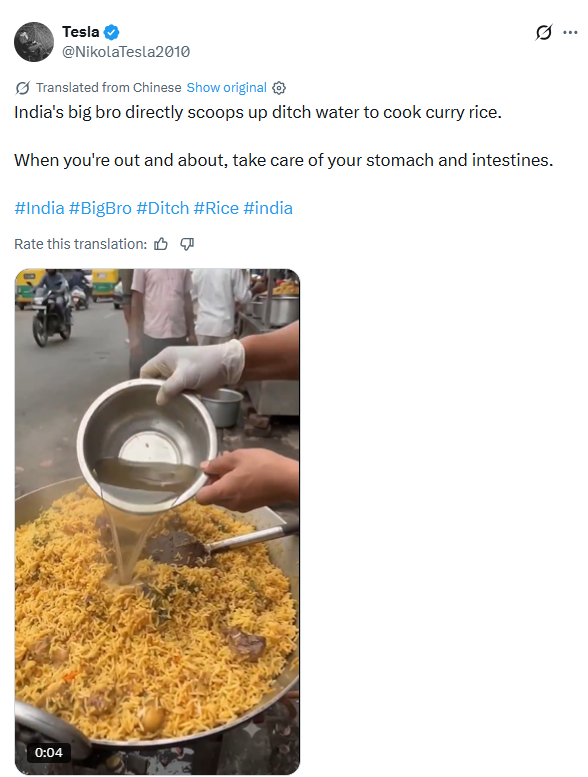
A video is being widely shared on social media, purportedly showing a person drawing water from a drain and using it to cook biryani. The video is being shared as being from India. Some users sharing the video are also advising people to take care of their stomach and intestinal health while eating and drinking outside. A research done by the Research Wing of the CyberPeace found that the viral video is not authentic but AI-generated and is being shared with a misleading claim.
Claim:
A user on the social media platform Facebook shared the viral video with the caption: “A person in India is cooking biryani using water from a drain.” The post link, archive link and screenshot are provided below.
https://x.com/NikolaTesla2010/status/2094021398113226802?s=20
Fact Check:
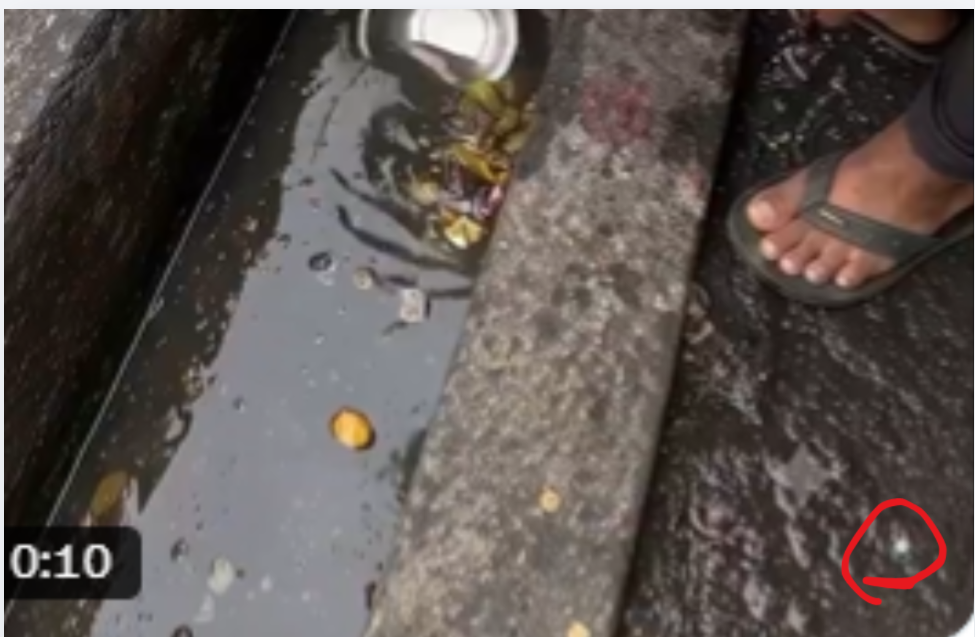
Upon closely examining the viral video, we noticed the Google Gemini logo clearly visible in the bottom-right corner. This raised suspicions that the video could be AI-generated.
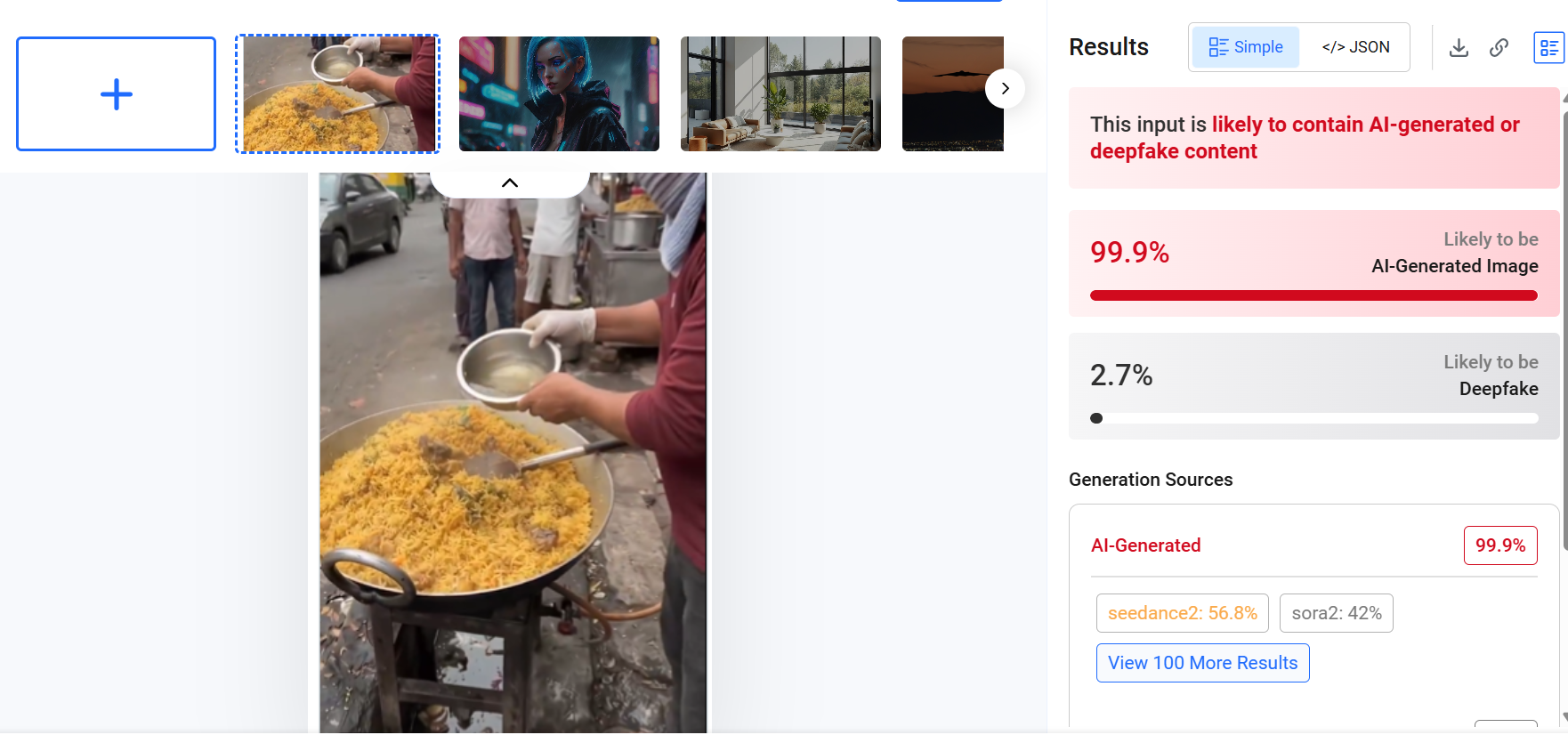
As part of our research, we ran the video through the AI detection tool Hive Moderation. According to the results, the viral video is 99 percent likely to be AI-generated.
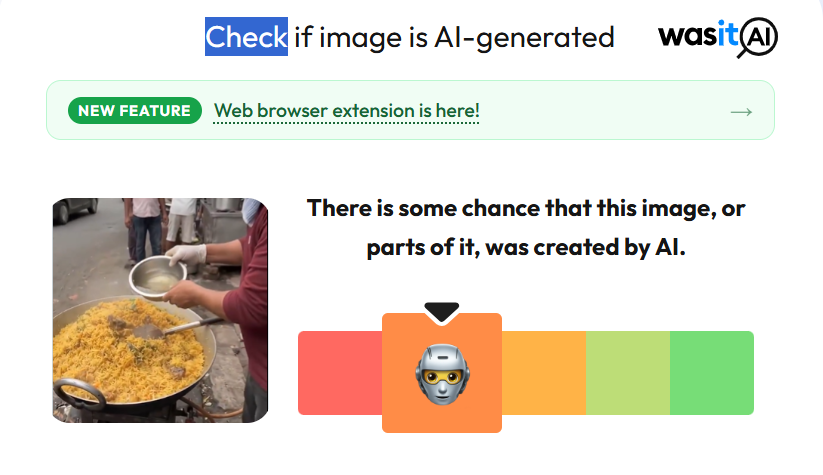
As part of our research, we scanned the video using WasIt AI. According to the results, the viral video is AI-generated.
Conclusion
The evidence gathered during our research establishes that the viral video claiming to show a person cooking biryani using water from a drain in India is misleading. The Google Gemini logo is clearly visible in the video, while AI detection tools Hive Moderation and WasIt AI also identified the footage as AI-generated. Therefore, the video does not depict a genuine incident.
