
#FactCheck: Viral letter allegedly issued by PMO on reservation is fake, AI-generated document
Executive Summary
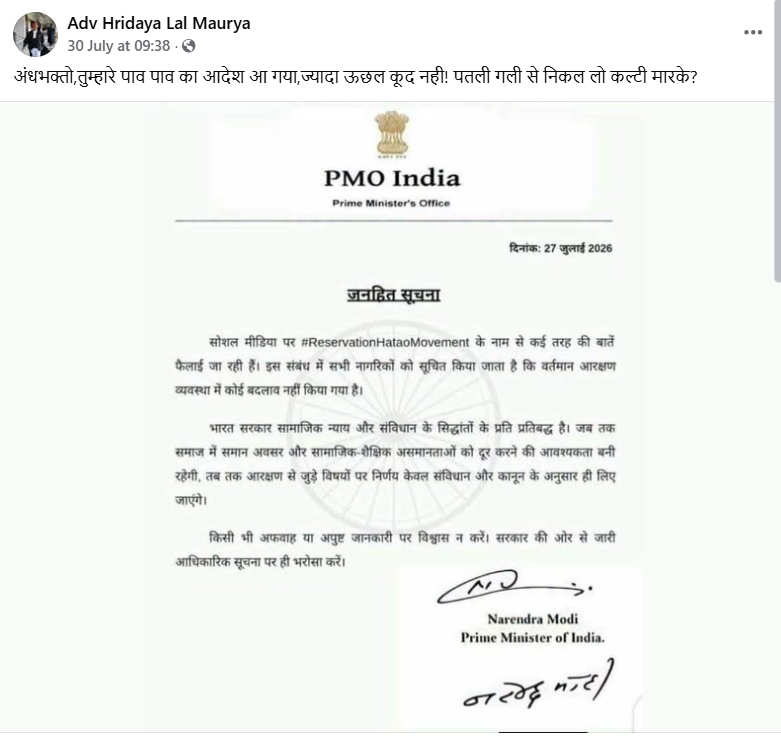
A purported letter issued in the name of the Prime Minister’s Office (PMO) is being widely shared on social media. The letter claims that the government has not made any changes to the reservation system regarding the “Remove Reservation Movement” and appeals to people not to pay attention to rumours. The viral letter is dated July 27, 2026, and also carries what appear to be Prime Minister Narendra Modi’s signatures in both Hindi and English.
CyberPeace Research Wing’s research found the viral claim to be false. The research revealed that the Prime Minister’s Office (PMO) has neither issued any official statement regarding reservation nor released any such letter. No credible media reports related to the alleged letter were found. The research further revealed that the purported reservation-related letter circulating on social media was a fake document created with the help of AI.
Claim:
A Facebook user shared the alleged letter issued in the name of the Prime Minister’s Office on July 30, 2026, claiming that the government has not made any changes to the reservation system in connection with the “Remove Reservation Movement” and appealed to citizens not to believe rumours. The viral letter bears the date July 27, 2026, and displays signatures of Prime Minister Narendra Modi in both Hindi and English. The archived link and screenshot of the post are provided below:
https://www.facebook.com/share/p/1b9nD5k3As/
Factcheck
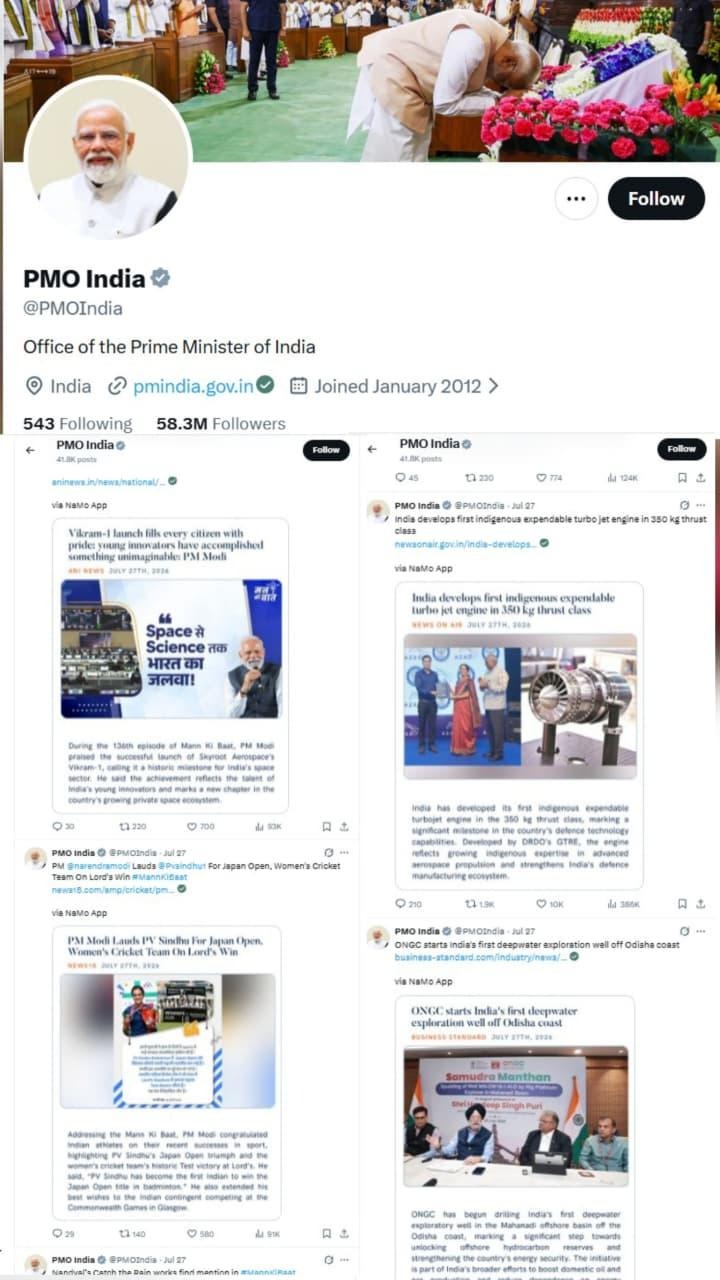
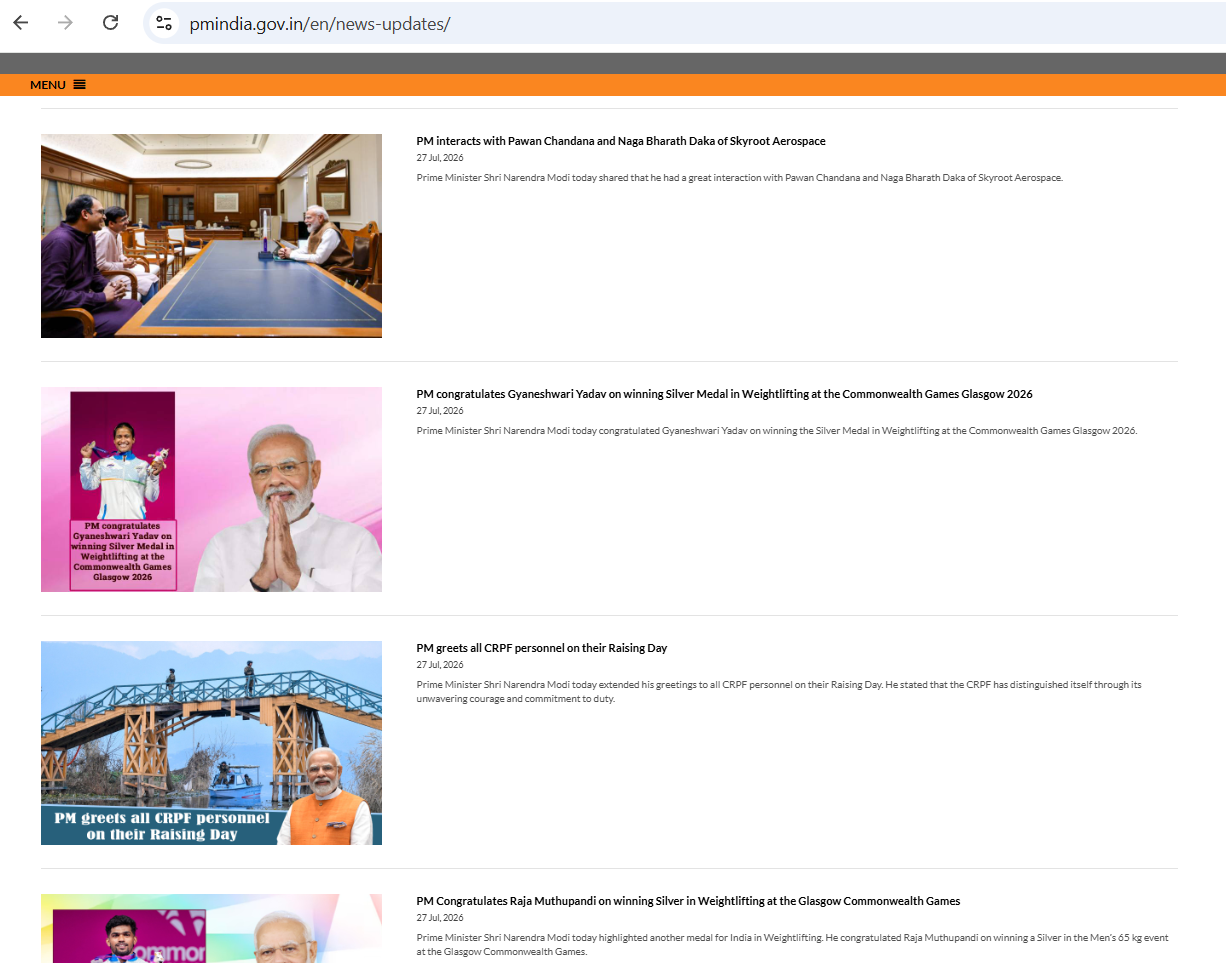
To verify the authenticity of the viral claim, we conducted a Google search using relevant keywords. However, no credible media reports related to the alleged letter were found. During the next stage of the research, we scanned the official X account (formerly Twitter) of PMO India. We did not find any such letter posted on July 27 or around that date. Continuing the research, we checked the official website of PMO India. No such letter was found in the news updates section or anywhere else on the website that could confirm the viral claim.
Further, we reviewed the press releases issued by the Prime Minister’s Office on July 27 available on the official website of the Press Information Bureau (PIB). We found no press release or official communication related to reservation or matching the viral letter.
https://www.pmindia.gov.in/en/
As part of the research, we scanned the viral letter using the AI detection tool Image Detector. The results indicated that the document was 93 percent likely to be AI-generated.

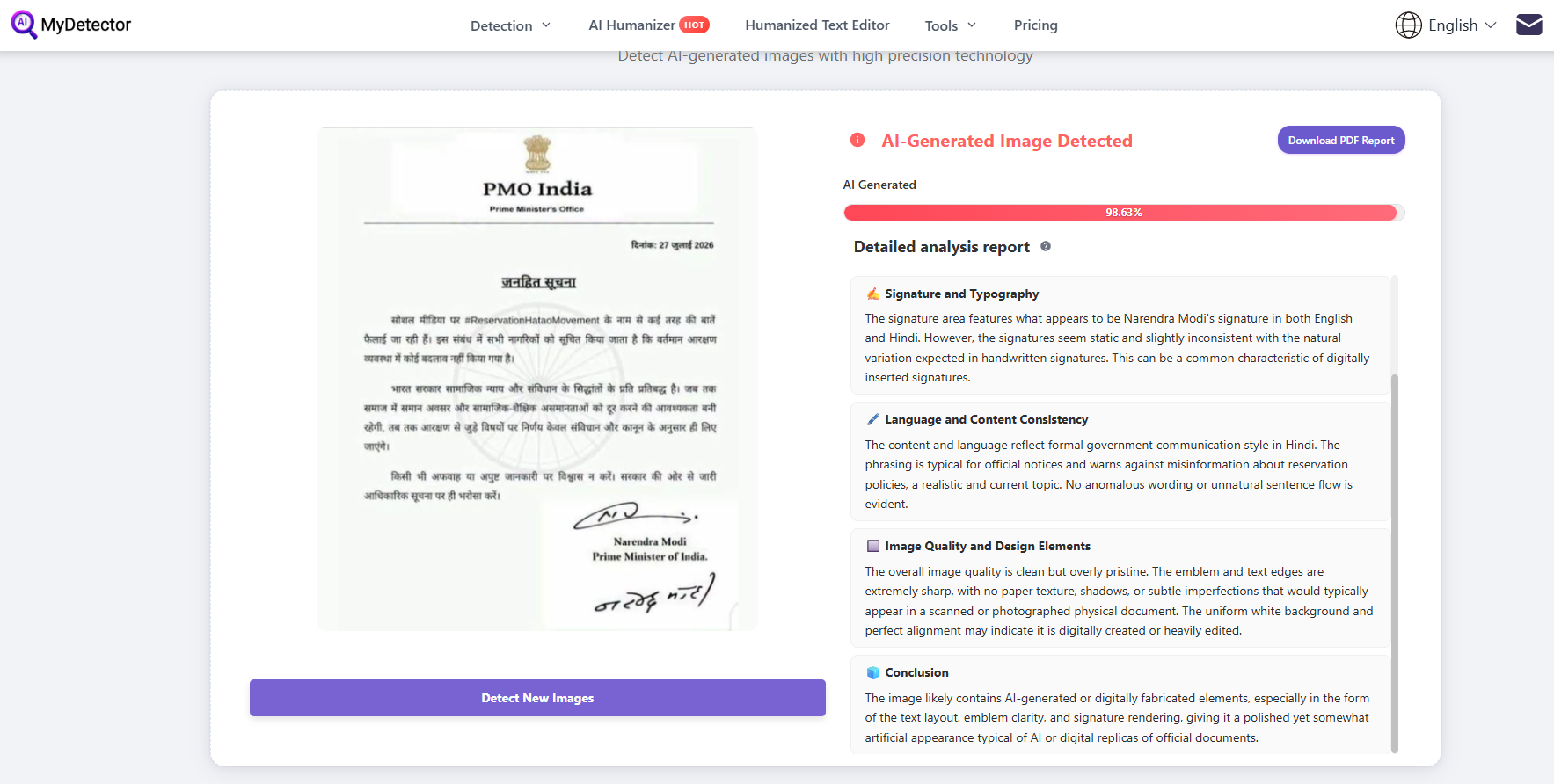
We also analysed the viral letter using another AI detection tool, My Detector. The results showed a 98 percent probability that the letter was created using AI.
Conclusion:
Our research found no official evidence confirming that the Prime Minister’s Office issued the viral letter. The purported PMO letter regarding reservation was found to be fake and AI-generated.

Related Blogs

Introduction
Mr Rajeev Chanderashekhar, MoS, Ministry of Electronics and Information Technology, on 09 March 2023, held a stakeholder consultation on the Digital India Bill. This bill will be the successor to the Information technology Act 2000 and provide a set of regulations and laws which will govern cyberspace in times to come. The consultation was held in Bangalore and was the first of many such consultations where the Digital India bill is to be discussed. These public stakeholder consultations will provide direct public feedback to the ministry, and this will help create a safe and secure ecosystem of Indian Cyber Laws.
What is the Digital India Act?
Cyberspace has evolved the fastest as compared to any other industry, and the evolution of the growth cannot be presumed to be stagnant or stuck as we see new technologies and gadgets being invented all across the globe. The ease created by using technology has changed how we live and function. However, bad actors often use these advantages or fruits of technology to wreak havoc upon the nation’s cyberspace. The use of technology is always governed by the application of usage and safeguard policies and laws. As technology is growing exponentially, it is pertinent that we have laws which are in congruence with today’s time and technology. This is keenly addressed by the Digital India Act, which will be the legislation governing Indian Cyberspace in times to come. This was the need of the hour in order to have the judiciary, legislature and law enforcement agencies ahead of the curve when it comes to cyber crimes and laws.
What is the Digital India Bill’s primary goal?
The Digital India Bill’s goal is to guarantee an institutional structure for accountability and that the internet in India is accessible, unhindered by user harm or criminal activity. The law will apply to new technologies, algorithmic social media platforms, artificial intelligence, user risks, the diversity of the internet, and the regulation of intermediaries. The diversity of the internet, user hazards, artificial intelligence, social media platforms, and intermediary regulation are all discussed.
Why is the Digital India Bill necessary?
The number of internet users in the country currently exceeds 760 million; in the upcoming years, this number will reach 1.2 billion. Despite the fact that the internet is useful and promotes connectivity, there are a number of user damages nearby. Thus, it is crucial to enact legislation to set forth new guidelines for individuals’ rights and responsibilities and mention the requirement to gather data.
Major Elements of the Digital India Act
Major Elements of the Digital India Bill, which will eventually become an Act, which will contribute massively towards a safe cyber-ecosystem, some of these elements aim towards the following-
- The legislation attempts to establish an internet regulator.
- Women and Child safety.
- Safe harbour for intermediaries.
- The right of the individual to secure his information and the requirement to utilise personal data for legal purposes provide the main obstacles to data protection or regulation. The law tries to deal with this difficulty.
- A limit will be placed on how far a person’s personal information can be accessed for legal reasons.
- The majority of the bill’s characteristics are contrasted with the EU’s General Data Protection Regulation.
The Way Ahead
As we ride the wave of developments in cyberspace regarding emerging technologies and automated gadgets, it becomes pertinent that the state takes due note of such technologies and the courts take cognisance of offences committed by using technology. Law enforcement agencies must also train police personnel who can effectively and efficiently investigate cybercrime cases. The ministry also released a few bills last year, such as – the Telecommunication Bill, 2022, Intermediary Rules and the Digital Personal Data Protection Bill, 2022, to better address the shortcomings and the issues in cyberspace and how to safeguard the netizens. The Digital India Act will essentially create a synergy between the current bills and the new ones to come in order to create a wholesome, safe and secure Indian cyber ecosystem.
Conclusion
Digital India Bill is necessary to address the challenges of cyberspace, like personal data and privacy, and policies related to online child and women safety to create a and create a modern and comprehensive legal framework that aligns with global standards of cyber laws. The draft of the bill is expected to come out by July. The ministry looks forward to maximising the impact of the bill through such continuous and effective public consultation to understand and fulfil the expectations and requirements of the Indian netizen, thus empowering him/her equivalent to the netizen of a developed country.
Introduction
India is becoming more digital. People are using cards and phones to pay for things. This means there is a risk of people stealing card information and committing fraud. The Payment Card Industry Data Security Standard or PCI DSS is a set of rules that helps companies keep card information safe. It was created by the PCI Security Standards Council, which was started by Visa, Mastercard, American Express, Discover and JCB. The goal of PCI DSS is to reduce the risk of data breaches and card fraud by making sure companies have security controls in place. For India, where digital payments are becoming more popular, PCI DSS is becoming a thing to do.
Applicability in India
PCI DSS applies to all companies in India that store, process or transmit card information. This includes banks, payment companies like Razorpay, PayU and CCAvenue and online sellers. Even companies that use a hosted payment page are responsible for following the rules. Companies that have their payment forms and handle card information have to follow more rules.
Why PCI DSS Matters
Payment security is very important for customers to trust a company. If a company has a security breach it can expose a lot of card information. Damage the company's reputation. In India, where cybercrime's a big problem, PCI DSS helps companies keep card information safe. It has rules for firewalls, encryption, access controls and regular testing to prevent fraud.
Regulatory Landscape: The RBIs Role
PCI DSS is not a law in India. The Reserve Bank of India or RBI has made it a requirement. The RBI has rules that require companies to follow PCI DSS and have security audits. Non-bank companies have to get permission from the RBI and follow rules to store payment information in India. This makes PCI DSS a standard for keeping card information safe in India.
Key Requirements and the Compliance Process
The current version of PCI DSS has twelve requirements that companies have to follow. These requirements include building a network protecting card information and regular testing. Companies have to start by identifying what parts of their system handle card information. Then do a gap analysis to see what they need to do to comply. Smaller companies can usually do this in a week but bigger companies may take several months.
Common Challenges and Practical Solutions
Some problems companies face when trying to comply with PCI DSS include old computer systems that cannot handle modern encryption and unclear rules that make it hard to know what to do. Some solutions include separating the card information system from the rest of the network using tokens and encryption to keep card information safe and regularly checking for vulnerabilities.
Business and Regulatory Benefits
Following PCI DSS rules can help companies avoid penalties and have security breaches. It can also make it easier for companies to work with banks and card networks and build trust with customers. Regulators also look favorably on companies that follow the rules.
Recent Developments and Trends
The RBI has been making rules and requiring companies to follow PCI DSS more closely. As digital payments become more popular it is likely that the RBI will keep making rules to keep card information safe.
As India's digital economy grows, keeping payment information safe is becoming more important. PCI DSS is a set of rules that helps companies keep card information safe. The RBI has made it a requirement for companies to follow these rules. Companies that follow the rules can build trust with customers. Avoid security breaches.
Conclusion
As India's digital economy deepens, protecting payment data is no longer optional; it is the price of participating in the card ecosystem. PCI DSS gives banks, fintechs, gateways and merchants a common, internationally recognised language for security, while RBI's guidelines add local regulatory teeth. Organisations that treat compliance as a continuous discipline, rather than a once-a-year audit exercise, will find it easier to earn customer trust, avoid costly breaches, and scale with confidence. For every business touching cardholder data in India, the message is clear: PCI DSS compliance is now foundational to running a secure, trustworthy digital payments operation.
References
- https://www.pcisecuritystandards.org/document_library/
- https://www.rbi.org.in/Scripts/BS_ViewMasDirections.aspx
- https://www.rbi.org.in/Scripts/NotificationUser.aspx
- https://www.rbi.org.in/Scripts/NotificationUser.aspx?Id=11822
- https://www.incorpx.io/blog/pci-dss-compliance-ecommerce-fintech-india
- https://cyraacs.com/pci-dss-compliance-checklist
- https://www.skydo.com/blog/pci-dss-compliance-guide
- https://www.cybercrime.gov.in/
Introduction
Meta has announced that E2EE in Instagram direct messages is ending entirely. Every day, billions of people send messages they consider private. A medical update to a family member. A photograph meant for one person. A conversation they would never have in public. For years, end-to-end encryption (E2EE) was the technology that made that privacy possible: the digital equivalent of a sealed envelope that only the sender and receiver could open. After May 8, 2026, this will change.
Understanding the Adoption Gap
Meta pointed to low user adoption as the reason for this change. Few people were using encrypted messaging on Instagram, the company said, so the feature was not worth keeping. That explanation raises some questions. Encryption was never switched on by default. Users had to find it and turn it on themselves. It was not advertised. And it was only available in certain regions to begin with, something Meta noted on its own Help Centre page. Features that require users to actively seek them out tend to get used far less than those that simply work from the start. WhatsApp demonstrates this clearly; encryption has been on by default since 2016, for every user, with no action required. Back in 2019, Mark Zuckerberg spoke publicly about building privacy into Meta’s messaging platforms as a core direction for the company. The current decision shows a different vision for the company.
The Commercial Dimension
Encrypted message content is not accessible for advertising purposes by design. In December 2025, Meta updated its privacy policy to allow interactions with its Meta AI assistant to inform personalized advertising recommendations across its platforms. With encryption removed from Instagram direct messages, the content of those conversations enters a data environment that already serves Meta’s advertising systems. Meta has not made a direct public statement connecting these two decisions, but technology analysts and privacy researchers have noted the commercial implications of making previously inaccessible message content available within that ecosystem.
What This Means for Users
From May 8, 2026, the content of Instagram direct messages will be accessible to Meta’s systems. This includes messages relating to personal matters that users may have previously sent under the assumption of encryption. A related concern is the question of data security. Unencrypted message content stored on platform servers creates a larger surface area of sensitive information that could be exposed in the event of a security breach. As platforms collect and retain greater volumes of personal data, the potential consequences of unauthorised access grow correspondingly.
But, there is an argument on the other side. Law enforcement agencies and child safety organisations have long maintained that end-to-end encryption limits their ability to detect and act on harmful content. Removing encryption does make certain forms of platform-level content moderation technically feasible where they were not before.
India’s Supreme Court: The Warning Nobody Heeded
India’s Supreme Court said it plainly when hearing the case against Meta’s 2021 WhatsApp privacy policy, which forced hundreds of millions of users to accept data sharing with Facebook or lose access entirely. Chief Justice Surya Kant called it “a decent way of committing theft of private information” and asked how ordinary people could meaningfully consent to policies written in language they cannot understand. He made it human with one line: “A poor woman selling fruits on the streets — will she understand the terms of your policy?” The court ordered Meta not to share a single word of user data until the case is resolved. When Meta’s lawyers argued that encryption protects users anyway, the bench pushed back: encryption protects message content, not the metadata surrounding it. Who you talk to, how often, at what time, from where: all of it is still harvested. The Competition Commission’s own advocate summarised the entire arrangement in four words: “We are the products.”
WhatsApp: A Question Worth Asking
Instagram, Messenger, and WhatsApp are three products inside one ecosystem, owned by Meta, serving one business model. Instagram’s encryption is already gone. Is WhatsApp next in line ?
WhatsApp has over 850 million monthly active users in India alone. People do not use it for entertainment, it is how families talk, how businesses run, how essential daily communication happens. It is infrastructure, not an app. Meta acquired it in 2014 promising no ads, no data exploitation. By 2021 that promise was already bending. By 2025 ads appeared in the Status section. Both original co-founders had long since left the company over exactly these concerns. Instagram’s encryption survived until it conflicted with revenue and regulation. WhatsApp’s encryption exists today under the same ownership, the same business model, and the same tightening global regulatory pressure. That is not a reason to panic. It is a reason to pay attention.
Conclusion
Encryption is not permanent. It is a design choice, and like any design choice, it can be undone when priorities shift. After May 8, 2026, Instagram direct messages will no longer be protected the way they once were. For most users, this change will pass unnoticed. But the data those conversations contain will now be accessible in ways it previously was not. What platforms do with user data is rarely announced loudly. Paying attention to the quiet changes matters.
References
- https://help.instagram.com/491565145294150
- https://www.theguardian.com/technology/2026/mar/18/instagram-to-remove-end-to-end-encryption-for-private-messages-in-may
- https://www.androidpolice.com/why-meta-is-getting-rid-of-e2ee/
- https://digitalpolicyalert.org/change/13307
- https://www.skadden.com/insights/publications/2025/06/take-it-down-act
- https://timesofindia.indiatimes.com/india/you-cant-play-with-right-of-privacy-of-citizens-scs-big-warning-to-whatsapp-meta-over-take-it-or-leave-it-policy/articleshow/127878524.cms#
- https://proton.me/blog/instagram-end-to-end-encryption
- https://www.forbes.com/sites/parmyolson/2018/09/26/exclusive-whatsapp-cofounder-brian-acton-gives-the-inside-story-on-deletefacebook-and-why-he-left-850-million-behind/
