
#FactCheck: False claim that WHO warned 87% Indians may get cancer by 2035 due to milk adulteration resurfaces
Executive Summary
A post is going viral across various social media platforms claiming that the World Health Organization (WHO) has issued a warning over the issue of adulteration in food products. According to the claim, WHO has warned that milk adulteration is continuously increasing in India and if it continues, 87 percent of Indians will suffer from cancer by 2035. CyberPeace Research Wing’s research found that the viral claim has been circulating on social media for several years. Earlier, the same claim was shared with the year changed to 2025, stating that 87 percent of Indians would suffer from cancer by that year. Now, the year has been changed from 2025 to 2035 and the claim is being circulated again. WHO has repeatedly denied this claim and termed it fake news.
Claim:
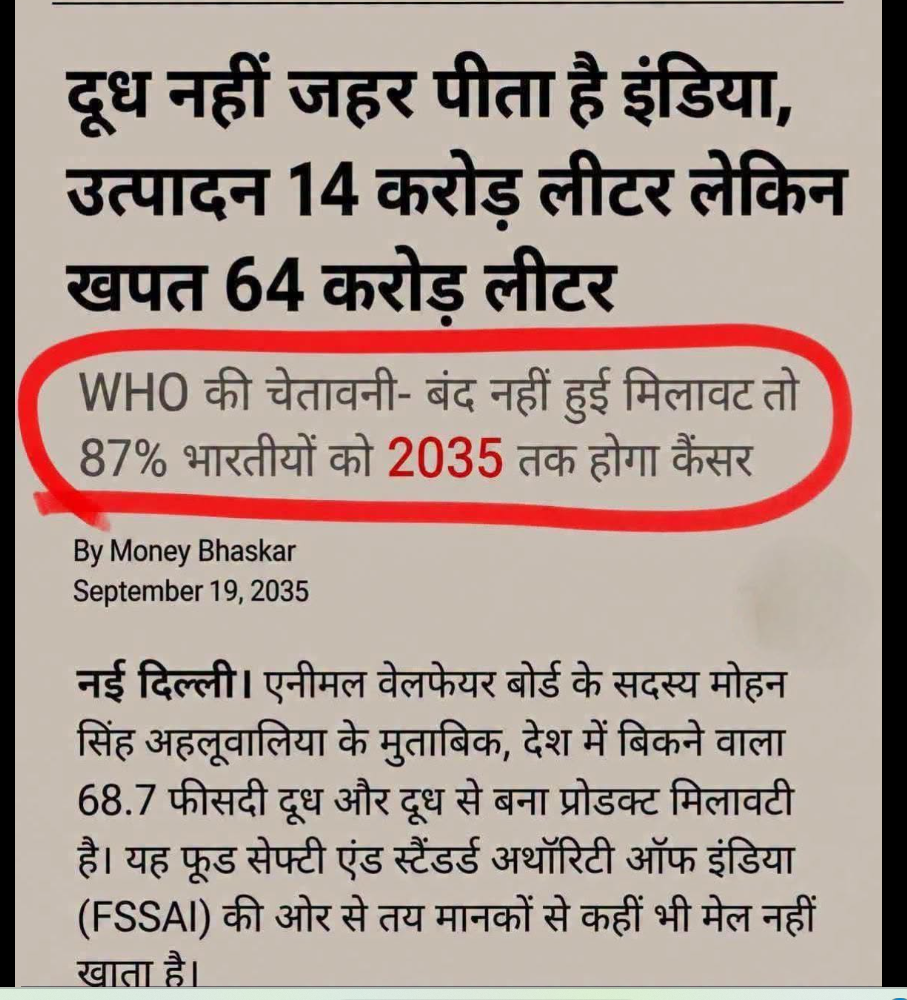
A Facebook user named ‘Vikalp Kuchamancity’ shared the viral post on August 3, 2026, with a caption claiming, “India produces 14 crore litres of milk, but consumption is 64 crore litres. Where does this extra milk come from? WHO has warned that if adulteration is not stopped, 87 percent of Indians may suffer from cancer by 2035.”
https://www.facebook.com/photo/?fbid=968660469565357&set=a.109816988783047
Fact Check:
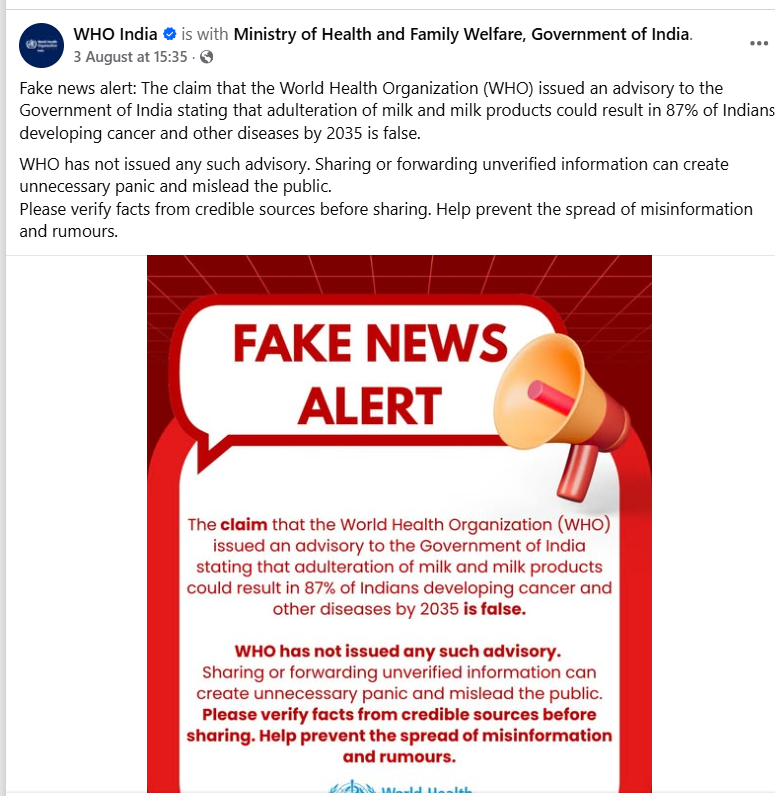
While examining the viral post, we noticed that the report displayed in the image carries the date September 19, 2035, even though the current year is 2026. This raised initial doubts about the authenticity of the claim.To investigate further, we conducted a Google search using relevant keywords. During the search, we found a post from the official Facebook page of WHO India, shared on August 3, 2026. The post denied the viral claim and stated that it is false that WHO issued any advisory to the Indian government warning that adulteration in milk and dairy products could lead to cancer and other diseases among 87 percent of Indians by 2035. WHO clarified that no such advisory has been issued.
WHO India Facebook link:
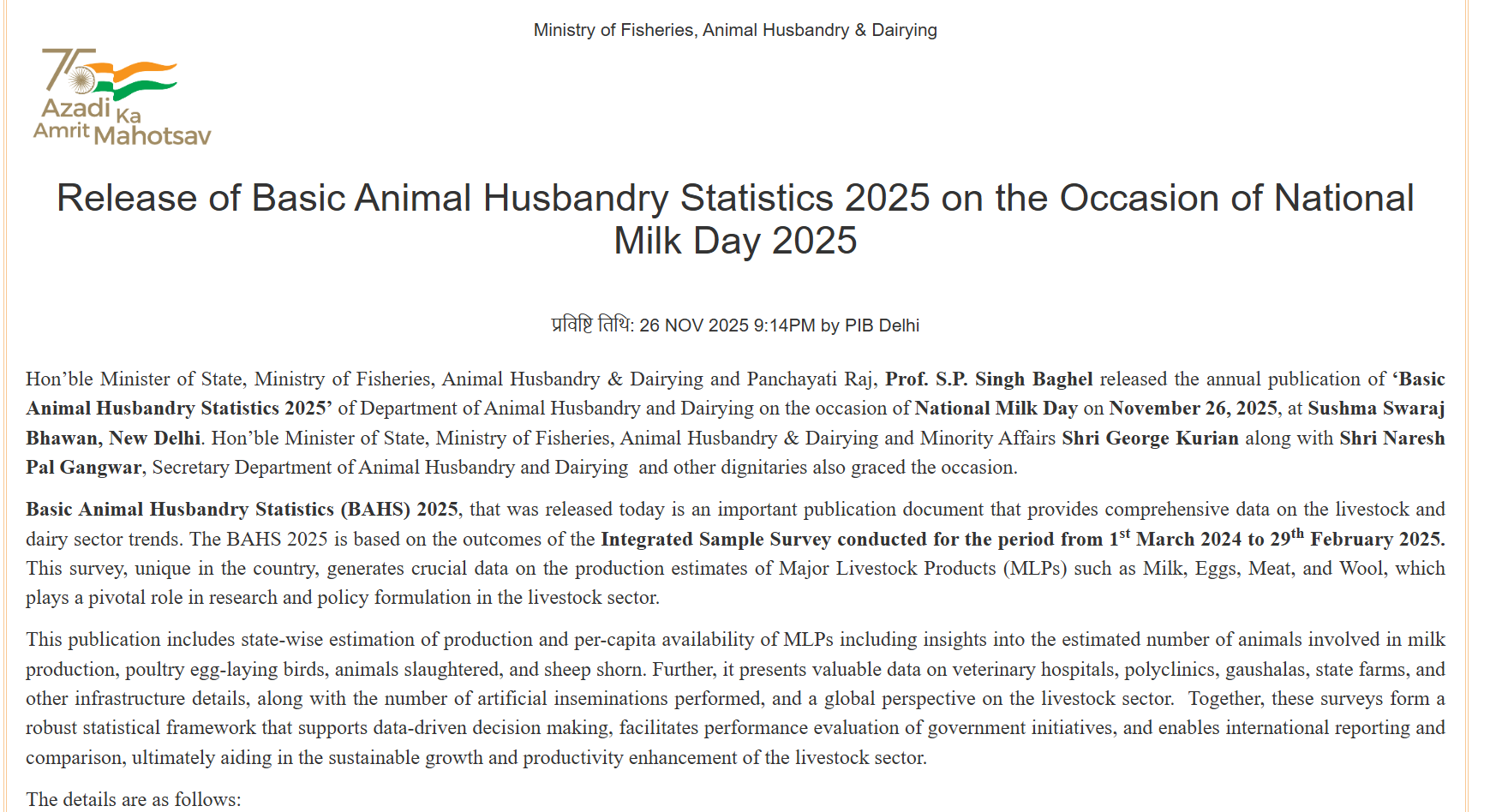
According to data mentioned in a press release issued by the Government of India on November 26, 2025, the country’s total milk production was estimated at 247.87 million tonnes in 2024-25, compared to 239.30 million tonnes in 2023-24. The per capita availability of milk increased from 319 grams per day in 2014-15 to 485 grams per day in 2024-25. The top five milk-producing states are Uttar Pradesh (15.66%), Rajasthan (14.82%), Madhya Pradesh (9.12%), Gujarat (7.78%), and Maharashtra (6.71%). Together, these states contribute 54.09% of India’s total milk production.
https://www.pib.gov.in/PressReleasePage.aspx?PRID=2195049®=3&lang=2
Conclusion:
The research confirmed that there is no evidence of any WHO warning stating that 87 percent of Indians could develop cancer by 2035 due to milk adulteration. WHO has clarified that it has not issued any such advisory. The viral claim is a recycled false claim that has been repeatedly circulated with changed dates.

Related Blogs
Executive Summary
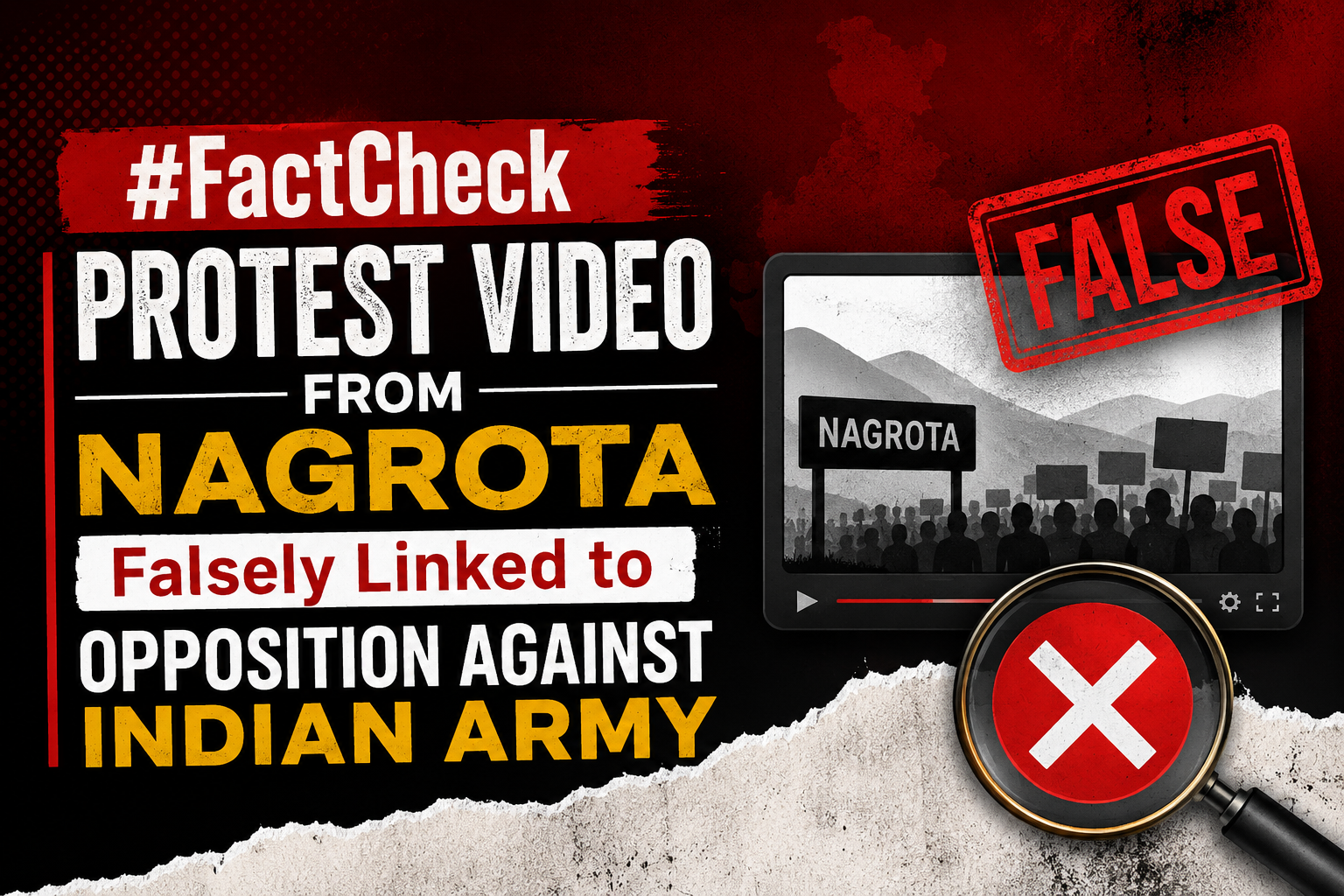
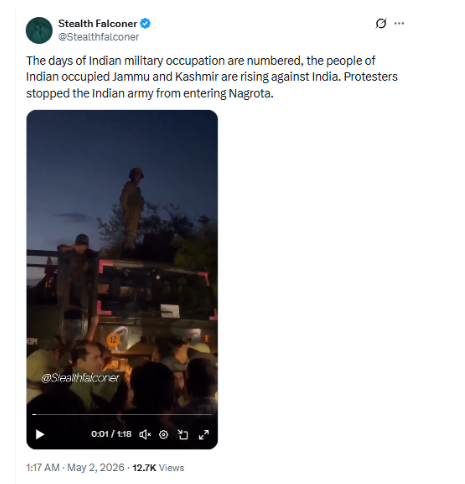
A video is being widely circulated on social media by Pakistani propaganda-linked users, showing a group of people protesting on a road. It is being claimed that protesters in Jammu & Kashmir stopped Indian Army personnel from entering Nagrota, indicating growing public opposition against the forces. Research by CyberPeace Research Wing found that the claim is misleading. The viral video is unrelated to any protest against the Indian Army.
Claim
A user posted the video on X, claiming: “The days of Indian military occupation are numbered; people of Jammu & Kashmir have risen against India. Protesters stopped the Indian Army from entering Nagrota.”
- https://x.com/Stealthfalconer/status/2050301106623045758?s=20
Fact Check
During the research, the CyberPeace Research Wing team found no evidence of any such incident where civilians blocked or opposed the Indian Army in Nagrota. Further probe led to a post by an X user “Defence News Of INDIA,” which contained the full version of the viral video. The accompanying information clarified that the protest took place in Dansal’s Badsu Panchayat area of Nagrota and was led by BJP MLA Devayani Rana.
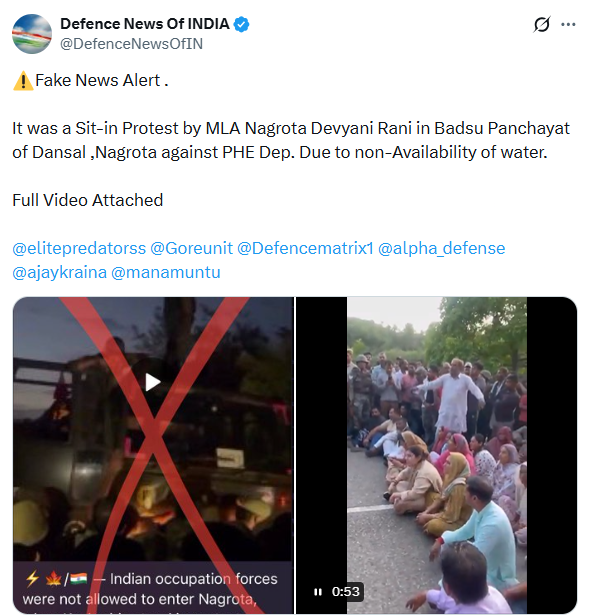
The protest was organized against the Public Health Engineering (PHE) Department over severe water shortage issues in the region. Locals, along with the MLA, staged a sit-in to highlight the lack of water supply.
We also found multiple media reports, including from KBC News – Kashmir and Jammu Links News, confirming that Devayani Rana led a road blockade protest in her constituency over water scarcity and accused the Jal Shakti Department of negligence and administrative failure. Additionally, videos of the same protest were available on social media platforms, including live streams shared from Devayani Rana’s official pages.

Conclusion
Our research confirms that the viral claim is false and misleading. The video does not show any protest against the Indian Army. It is actually from a demonstration led by Devayani Rana and local residents over water shortage issues in Nagrota.

Introduction
Cybercrimes have been traversing peripheries and growing at a fast pace. Cybercrime is known to be an offensive action that either targets or operates through a computer, a computer network or a networked device, according to Kaspersky. In the “Era of globalisation” and a “Digitally coalesced world”, there has been an increase in International cybercrime. Cybercrime could be for personal or political objectives. Nevertheless, Cybercrime aims to sabotage networks for motives other than gain and be carried out either by organisations or individuals. Some of the cybercriminals have no national boundaries and are considered a global threat. They are likewise inordinately technically adept and operate avant-garde strategies.
The 2023 Global Risk Report points to exacerbating geopolitical apprehensions that have increased the advanced persistent threats (APTs), which are evolving globally as they are ubiquitous. Christine Lagarde, the president of the European Central Bank and former head of the International Monetary Fund (IMF), in 2020 cautioned that a cyber attack could lead to a severe economic predicament. Contemporary technologies and hazardous players have grown at an exceptional gait over the last few decades. Also, cybercrime has heightened on the agenda of nation-states, establishments and global organisations, as per the World Economic Forum (WEF).
The Role of the United Nations Ad Hoc Committee
In two shakes, the United Nations (UN) has a major initiative to develop a new and more inclusive approach to addressing cybercrime and is presently negotiating a new convention on cybercrime. The following convention seeks to enhance global collaboration in the combat against cybercrime. The UN has a central initiative to develop a unique and more inclusive strategy for addressing cybercrime. The UN passed resolution 74/247, which designated an open-ended ad hoc committee (AHC) in December 2019 entrusted with setting a broad global convention on countering the use of information and Communication Technologies (ICTs) for illicit pursuits.
The Cybercrime treaty, if adopted by the UN General Assembly (UNGA) would be the foremost imperative UN mechanism on a cyber point. The treaty could further become a crucial international legal framework for global collaboration on arraigning cyber criminals, precluding and investigating cybercrime. There have correspondingly been numerous other national and international measures to counter the criminal use of ICTs. However, the UN treaty is intended to tackle cybercrime and enhance partnership and coordination between states. The negotiations of the Ad Hoc Committee with the member states will be completed by early 2024 to further adopt the treaty during the UNGA in September 2024.
However, the following treaty is said to be complex. Some countries endorse a treaty that criminalises cyber-dependent offences and a comprehensive spectrum of cyber-enabled crimes. The proposals of Russia, Belarus, China, Nicaragua and Cuba have included highly controversial recommendations. Nevertheless, India has backed for criminalising crimes associated with ‘cyber terrorism’ and the suggestions of India to the UN Ad Hoc committee are in string with its regulatory strategy in the country. Similarly, the US, Japan, the UK, European Union (EU) member states and Australia want to include core cyber-dependent crimes.
Nonetheless, though a new treaty could become a practical instrument in the international step against cybercrime, it must conform to existing global agencies and networks that occupy similar areas. This convention will further supplement the "Budapest Cybercrime Convention" on cybercrime that materialised in the 1990s and was signed in Budapest in the year 2001.
Conclusion
According to Cyber Security Ventures, global cybercrime is expected to increase by 15 per cent per year over the next five years, reaching USD 10.5 trillion annually by 2025, up from USD 3 trillion in 2015. The UN cybercrime convention aims to be more global. That being the case, next-generation tools should have state-of-the-art technology to deal with new cyber crimes and cyber warfare. The global crevasse in nation-states due to cybercrime is beyond calculation. It could lead to a great cataclysm in the global economy and threaten the political interest of the countries on that account. It is crucial for global governments and international organisations. It is necessary to strengthen the collaboration between establishments (public and private) and law enforcement mechanisms. An “appropriately designed policy” is henceforward the need of the hour.
References
- https://www.kaspersky.co.in/resource-center/threats/what-is-cybercrime
- https://www.cyberpeace.org/
- https://www.interpol.int/en/Crimes/Cybercrime
- https://www.bizzbuzz.news/bizz-talk/ransomware-attacks-on-startups-msmes-on-the-rise-in-india-cyberpeace-foundation-1261320
- https://www.financialexpress.com/business/digital-transformation-cyberpeace-foundation-receives-4-million-google-org-grant-3282515/
- https://www.chathamhouse.org/2023/08/what-un-cybercrime-treaty-and-why-does-it-matter
- https://www.weforum.org/agenda/2023/01/global-rules-crack-down-cybercrime/
- https://www.weforum.org/publications/global-risks-report-2023/
- https://www.imf.org/external/pubs/ft/fandd/2021/03/global-cyber-threat-to-financial-systems-maurer.htm
- https://www.eff.org/issues/un-cybercrime-treaty#:~:text=The%20United%20Nations%20is%20currently,of%20billions%20of%20people%20worldwide.
- https://cybersecurityventures.com/hackerpocalypse-cybercrime-report-2016/
- https://www.coe.int/en/web/cybercrime/the-budapest-convention
- https://economictimes.indiatimes.com/tech/technology/counter-use-of-technology-for-cybercrime-india-tells-un-ad-hoc-group/articleshow/92237908.cms?utm_source=contentofinterest&utm_medium=text&utm_campaign=cppst
- https://consultation.dpmc.govt.nz/un-cybercrime-convention/principlesandobjectives/supporting_documents/Background.pdf
- https://unric.org/en/a-un-treaty-on-cybercrime-en-route/
%20(1).webp)
Introduction
Bumble’s launch of its ‘Opening Move’ feature has sparked a new narrative on safety and privacy within the digital dating sphere and has garnered mixed reactions from users. It was launched against the backdrop of women stating that the ‘message first’ policy of Bumble was proving to be tedious. Addressing the large-scale review, Bumble launched its ‘Opening Move’ feature, whereby users can either craft or select from pre-set questions which potential matches may choose to answer to start the conversation at first glance. These questions are a segue into meaningful and insightful conversation from the get-go and overstep the traditional effort to start engaging chats between matched users. This feature is an optional feature that users may enable and as such does not prevent a user from exercising the autonomy previously in place.
Innovative Approach to Conversation Starters
Many users consider this feature as innovative; not only does it act as a catalyst for fluid conversation but also cultivates insightful dialogue, fostering meaningful interactions that are devoid of the constraint of superficial small talk. The ‘Opening Moves’ feature may also be aligned with unique scientific research indicating that individuals form their initial attractions within 3-seconds of intimate interaction, thereby proving to be a catalyst to the decision-making process of an individual in the attraction time frame.
Organizational Benefits and Data Insights
From an organisational standpoint, the feature is a unique solution towards localisation challenges faced by apps; the option of writing a personalised ‘Opening Move’ implies setting prompts that are culturally relevant and appropriate in a specific area. Moreover, it is anticipated that Bumble may enhance and improve user experience within the platform through data analysis. Data from responses to an ‘Opening Move’ may provide valuable insights into user preferences and patterns by analysing which pre-set prompts garner more responses over others and how often is a user-written ‘Opening Move’ successful in obtaining a response in comparison with Bumble’s pre-set prompts. A quick glance at Bumble’s privacy policy[1] shows that data storing and transferring of chats between users are not shared with third parties, further safeguarding personal privacy. However, Bumble does use the chat data for its own internal purposes after removing personally identifiable information from chats. The manner of such review and removal of data has not been specified, which may raise challenges depending upon whether the reviewer is a human or an algorithm.
However, some users perceive the feature as counterproductive to the company’s principle of ‘women make the first move’. While Bumble aims to market the feature as a neutral ground for matched users based on the exercise of choice, users see it as a step back into the heteronormative gender expectations that most dating apps conform to, putting the onus of the ‘first move’ on men. Many male users have complained that the feature acts as a catalyst for men to opt out of the dating app and would most likely refrain from interacting with profiles enabled with the ‘Opening Move’ feature, since the pressure to answer in a creative manner is disproportionate with the likelihood their response actually being entertained.[2] Coupled with the female users terming the original protocol as ‘too much effort’, the preset questions of the ‘Opening Move’ feature may actively invite users to categorise potential matches according to arbitrary questions that undermine real-life experiences, perspectives and backgrounds of each individual.[3]
Additionally, complications are likely to arise when a notorious user sets a question that indirectly gleans personal or sensitive, identifiable information. The individual responding may be bullied or be subjected to hateful slurs when they respond to such carefully crafted conversation prompts.
Safety and Privacy Concerns
On the corollary, the appearance of choice may translate into more challenges for women on the platform. The feature may spark an increase in the number of unsolicited, undesirable messages and images from a potential match. The most vulnerable groups at present remain individuals who identify as females and other sexual minorities.[4] At present, there appears to be no mechanism in place to proactively monitor the content of responses, relying instead on user reporting. This approach may prove to be impractical given the potential volume of objectionable messages, necessitating a more efficient solution to address this issue. It is to be noted that in spite of a user reporting, the current redressal systems of online platforms remain lax, largely inadequate and demonstrate ineffectiveness in addressing user concerns or grievances. This lack of proactiveness is violative of the right to redressal provided under the Digital Personal Data Protection Act, 2023. It is thought that the feature may actually take away user autonomy that Bumble originally aimed to grant since Individuals who identify as introverted, shy, soft-spoken, or non-assertive may refrain from reporting harassing messages altogether, potentially due to discomfort or reluctance to engage in confrontation. Resultantly, it is anticipated that there would be a sharp uptake in cases pertaining to cyberbullying, harassment and hate speech (especially vulgar communications) towards both the user and the potential match.
From an Indian legal perspective, dating apps have to adhere to the Information Technology Act, 2000 [5], the Information Technology (Intermediary and Digital Media Ethics) Rules 2021 [6] and the Digital Personal Data Protection Act, 2023, that regulates a person’s digital privacy and set standards on the kind of content an intermediary may host. An obligation is cast upon an intermediary to uprise its users on what content is not allowed on its platform in addition to mandating intimation of the user’s digital rights. The lack of automated checks, as mentioned above, is likely to make Bumble non-compliant with the ethical guidelines.
The optional nature of the ‘Opening Move’ grants users some autonomy. However, some technical updates may enhance the user experience of this feature. Technologies like AI are an effective aid in behavioural and predictive analysis. An upgraded ‘matching’ algorithm can analyse the number of un-matches a profile receives, thereby identifying and flagging a profile having multiple lapsed matches. Additionally, the design interface of the application bearing a filter option to filter out flagged profiles would enable a user to be cautious while navigating through the matches. Another possible method of weeding out notorious profiles is by deploying a peer-review system of profiles whereby a user has a singular check-box that enables them to flag a profile. Such a checkbox would ideally be devoid of any option for writing personal comments and would bear a check box stating whether the profile is most or least likely to bully/harass. This would ensure that a binary, precise response is recorded and any coloured remarks are avoided. [7]
Governance and Monitoring Mechanisms
From a governance point of view, a monitoring mechanism on the manner of crafting questions is critical. Systems should be designed to detect certain words/sentences and a specific manner of framing sentences to disallow questions contrary to the national legal framework. An onscreen notification having instructions on generally acceptable manner of conversations as a reminder to users to maintain cyber hygiene while conversing is also proposed as a mandated requirement for platforms. The notification/notice may also include guidelines on what information is safe to share in order to safeguard user privacy. Lastly, a revised privacy policy should establish the legal basis for processing responses to ‘Opening Moves’, thereby bringing it in compliance with national legislations such as the Digital Personal Data Protection Act, 2023.
Conclusion
Bumble's 'Opening Move' feature marks the company’s ‘statement’ step to address user concerns regarding initiating conversations on the platform. While it has been praised for fostering more meaningful interactions, it also raises not only ethical concerns but also concerns over user safety. While the 'Opening Move' feature can potentially enhance user experience, its success is largely dependent on Bumble's ability to effectively navigate the complex issues associated with this feature. A more robust monitoring mechanism that utilises newer technology is critical to address user concerns and to ensure compliance with national laws on data privacy.
Endnotes:
- [1] Bumble’s privacy policy https://bumble.com/en-us/privacy
- [2] Discussion thread, r/bumble, Reddit https://www.reddit.com/r/Bumble/comments/1cgrs0d/women_on_bumble_no_longer_have_to_make_the_first/?share_id=idm6DK7e0lgkD7ZQ2TiTq&utm_content=2&utm_medium=ios_app&utm_name=ioscss&utm_source=share&utm_term=1&rdt=65068
- [3] Mcrea-Hedley, Olivia, “Love on the Apps: When did Dating Become so Political?”, 8 February 2024 https://www.service95.com/the-politics-of-dating-apps/
- [4] Gewirtz-Meydan, A., Volman-Pampanel, D., Opuda, E., & Tarshish, N. (2024). ‘Dating Apps: A New Emerging Platform for Sexual Harassment? A Scoping Review. Trauma, Violence, & Abuse, 25(1), 752-763. https://doi.org/10.1177/15248380231162969
- [5] Information Technology Act, 2000 https://www.indiacode.nic.in/bitstream/123456789/13116/1/it_act_2000_updated.pdf
- [6] Information Technology (Intermediary Guidelines and Digital Media Ethics) Rules 2021 https://www.meity.gov.in/writereaddata/files/Information%20Technology%20%28Intermediary%20Guidelines%20and%20Digital%20Media%20Ethics%20Code%29%20Rules%2C%202021%20%28updated%2006.04.2023%29-.pdf
- [7] Date Confidently: Engaging Features in a Dating App (Use Cases), Consaguous, 10 July 2023 https://www.consagous.co/blog/date-confidently-engaging-features-in-a-dating-app-use-cases
