
#FactCheck: Video from Bangladesh Protest Falsely Linked to Attack on BSF Personnel in Tripura
Executive Summary
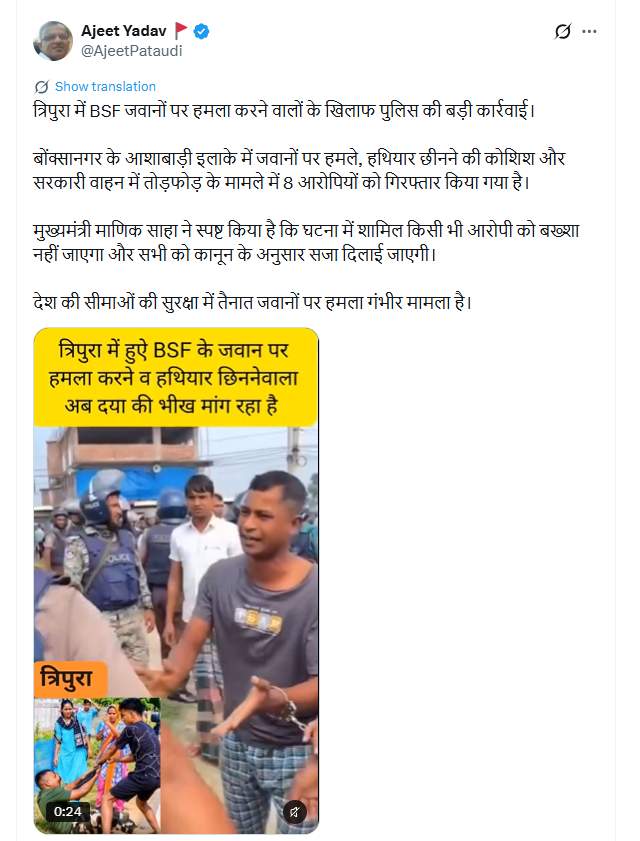
A video is being shared on social media with the claim that a man who attacked BSF personnel in Tripura is now pleading with the police for mercy. However, CyberPeace Research found that the video is not from Tripura but from a protest in the Gazipur area of Bangladesh.
Claim:
A 27-second video is going viral, showing several uniformed personnel taking a man into custody and allegedly assaulting him. The man can also be seen pleading with the police to let him go. A text overlay in the video reads: “The person who attacked BSF personnel and snatched their weapons in Tripura is now begging for mercy.”
https://x.com/AjeetPataudi/status/2118256235577569544
Fact Check
To verify the viral video being linked to the alleged attack on BSF personnel in Tripura, we conducted a reverse image search using its keyframes. During the search, we found the same visuals in a video uploaded on November 3, 2026, on the YouTube channel of Bangladeshi news outlet Prothom Alo.
The headline and description accompanying the video identified the footage as being from a protest by garment factory workers in Gazipur, Bangladesh.
https://www.youtube.com/watch?v=FidQprRzYPg

Additionally, we found the same visuals in a video uploaded on November 3, 2026, on the Facebook account of another Bangladeshi media outlet, Kaler Kantho. The caption accompanying the video also identified it as showing the arrest of two individuals during a protest by garment factory workers in the Bhogra Bypass area of Gazipur.
https://www.facebook.com/reel/30009212345348428

Conclusion
The evidence gathered during our research clearly establishes that the viral video, which is being linked to the alleged attackers of BSF personnel in Tripura, is actually from Bangladesh.

Related Blogs

Executive Summary
A video showing two men attempting to break into a house, only to be confronted by armed personnel who force them to kneel, is being widely shared on social media in the context of the upcoming West Bengal Assembly elections. The clip is being circulated with claims that it shows Central Reserve Police Force personnel intervening after workers of the Trinamool Congress allegedly tried to intimidate locals. However, an research by the CyberPeace Research Wing found that the claim is false. The viral video has no connection to India or the West Bengal elections and is being shared with a misleading narrative.
Claim
A Facebook user named Devashish Ajitkumar Bhattacharya shared the video on April 20, 2026, with the caption suggesting that TMC workers attempted to threaten people but were stopped by CRPF personnel deployed in West Bengal.
- Archive link: https://perma.cc/R42V-49FV

Fact Check
To verify the claim, we extracted keyframes from the viral video and conducted a reverse image search. This led us to the same video uploaded on August 17, 2024, on the official YouTube channel of Bangladeshi news outlet Dhaka Post. The details accompanying the video confirmed that the incident took place in Bangladesh.
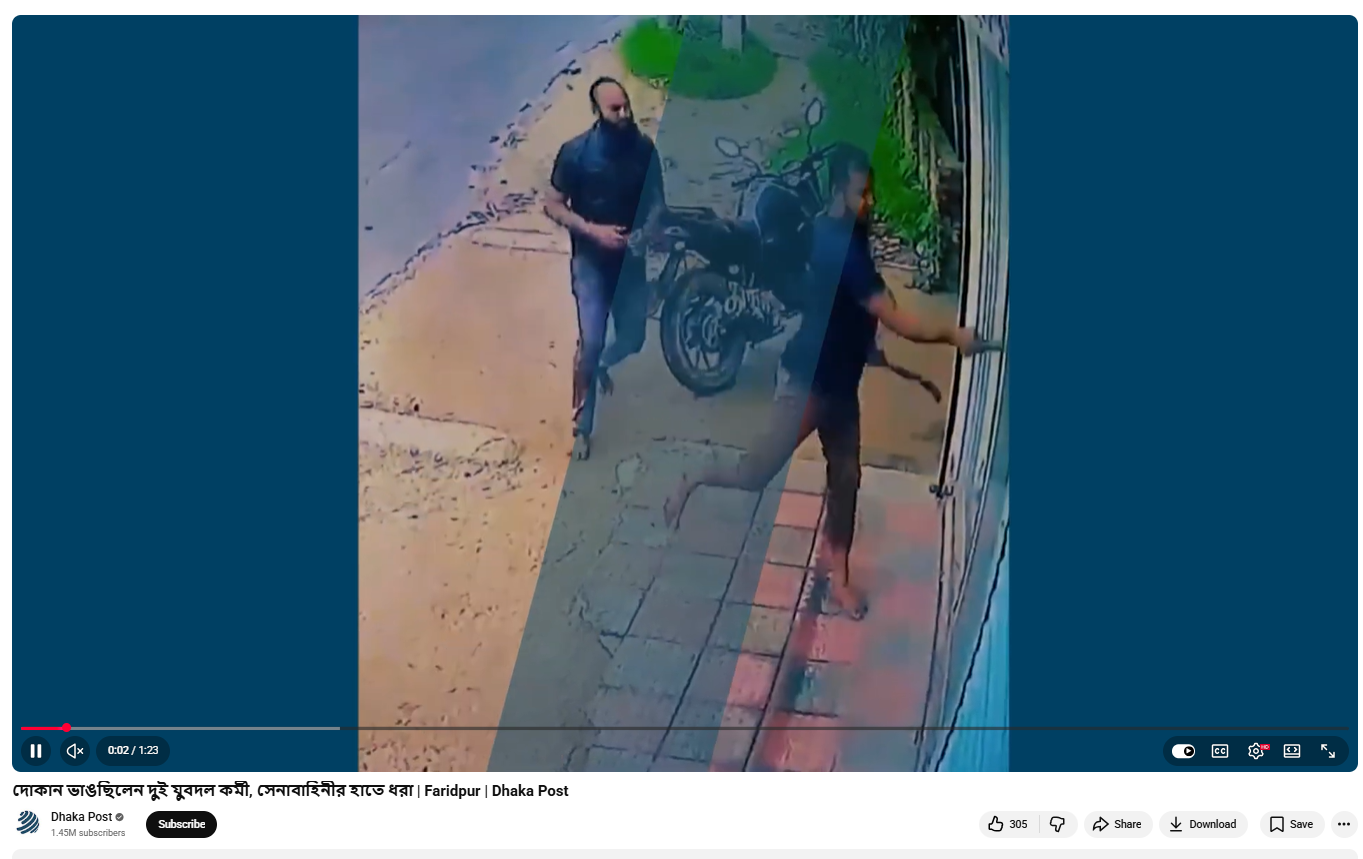
Further research led us to a report published on August 17, 2024, by 24 Hours Khobor, which stated that the incident occurred in Faridpur, Bangladesh. According to the report, a clash broke out between two groups, following which the army intervened and arrested two individuals identified as Tutul Hossain and Dukhu Mia. Both were later sent to jail by a court.

Conclusion
The viral claim linking the video to the West Bengal Assembly elections is false. The footage does not show any incident involving CRPF personnel or political workers in India. Instead, it is from an unrelated घटना in Bangladesh that took place in 2024. The video has been taken out of context and is being circulated with a misleading narrative to create confusion around the ongoing election environment.

On March 02, 2023, the Biden-Harris Administration unveiled the National Cybersecurity Plan to ensure that all Americans can enjoy the advantages of a secure digital environment. In this pivotal decade, the United States will reimagine cyberspace as a tool to achieve our goals in a way that is consistent with our values. These values include a commitment to economic security and prosperity, respect for human rights and fundamental freedoms, faith in our democracy and its institutions, and a commitment to creating a fair and diverse society. This goal cannot be achieved without a dramatic reorganisation of the United States’ cyberspace responsibilities, roles, and resources.
VISION- AIM
A more planned, organised, and well-resourced strategy to cyber protection is necessary for today’s rapidly developing world. State and non-state actors alike are launching creative new initiatives to challenge the United States. New avenues for innovation are opening up as next-generation technologies attain maturity and digital interdependencies are expanding. Thus, this Plan lays forth a plan to counter these dangers and protect the digital future. Putting it into effect can safeguard spending on things like infrastructure, clean energy, and the re-shoring of American industry.
The USA will create its digital environment by:
- Defensible if the cyber defence is comparatively easier, more effective, cheaper
- Resilient, where the impacts of cyberattacks and operator mistakes are lasting and little widespread.
- Values-aligned, where our most cherished values shape—and are in turn reinforced by— our digital world.
Already, the National Security Strategy, Executive Order 14028 (Improving the Nation’s Cybersecurity), National Security Memorandum 5 (Improving Cybersecurity for Critical Infrastructure Control Systems), M-22-09 (Moving the U.S. Government Toward Zero-Trust Cybersecurity Principles), and National Security Memorandum 10 (Improving Cybersecurity for Federal Information Systems) have all been issued to help secure cyberspace and our digital ecosystem (Promoting United States Leadership in Quantum Computing While Mitigating Risks to Vulnerable Cryptographic Systems). The Strategy builds upon previous efforts by acknowledging that the Internet serves not as an end in itself but as a means to a goal—the achievement of our highest ideals.
There are five key points that constitute the National Cybersecurity Strategy:
1. Defend Critical Infrastructure –
Defend critical infrastructure by, among other things: i) enacting cybersecurity regulations to secure essential infrastructure; (ii) boosting public-private sector collaboration; (iii) integrating federal cybersecurity centres; (iv) updating federal incident response plans and processes; and (v) modernising federal systems in accordance with zero trust principles.
2. Disrupt and Dismantle Threat Actors
Disrupt and dismantle threat actors, including by i) integrating military, diplomatic, information, financial, intelligence, and law enforcement competence, (ii) strengthening public-private sector collaborations, (iii) increasing the speed and scale of intelligence sharing and victim information, (iv) preventing the abuse of U.S.-based infrastructure, and (v) increasing disruption campaigns and other endeavours against ransomware operators;
3. Shape Market Forces to Drive Security and Resilience
The federal government can help shape market forces that drive security and resilience by doing the following: i) supporting legislative efforts to limit organisations’ ability to collect, use, transfer, and maintain personal information and providing strong protections for sensitive data (such as geolocation and health data), (ii) boosting IoT device security via federal research, development, sourcing, risk management efforts, and IoT security labelling programs, and (iii) instituting legislation establishing standards for the security of IoT devices. (iv) strengthening cybersecurity contract standards with government suppliers, (v) studying a federal cyber insurance framework, and (vi) using federal grants and other incentives to invest in efforts to secure critical infrastructure.
4. Invest in a Resilient Future
Invest in a resilient future by doing things like i) securing the Internet’s underlying infrastructure, (ii) funding federal cybersecurity R&D in areas like artificial intelligence, cloud computing, telecommunications, and data analytics used in critical infrastructure, (iii) migrating vulnerable public networks and systems to quantum-resistant cryptography-based environments, and (iv) investing hardware and software systems that strengthen the resiliency, safety, and security of these areas, (v) enhancing and expanding the nation’s cyber workforce; and (vi) investing in verifiable, strong digital identity solutions that promote security, interoperability, and accessibility.
5. Forge International Partnerships to Pursue Shared Goals
The United States should work with other countries to advance common interests, such as i) forming international coalitions to counter threats to the digital ecosystem; (ii) increasing the scope of U.S. assistance to allies and partners in strengthening cybersecurity; (iii) forming international coalitions to reinforce global norms of responsible state behaviour; and (v) securing global supply chains for information, communications, and operational technologies.
Conclusion:
The Strategy results from months of work by the Office of the National Cyber Director (“ONCD”), the primary cybersecurity policy and strategy advisor to President Biden and coordinates cybersecurity engagement with business and international partners. The National Security Council will oversee the Strategy’s implementation through ONCD and the Office of Management and Budget.
In conclusion, we can say that the National Cybersecurity Plan of the Biden administration lays out an ambitious goal for American cybersecurity that is to be accomplished by the end of the decade. The administration aims to shift tasks and responsibilities to those organisations in the best position to safeguard systems and software and to encourage incentives for long-term investment in cybersecurity to build a more cyber-secure future.
It is impossible to assess the cyber strategy in a vacuum. It’s critical to consider the previous efforts and acknowledge the ones that still need to be made. The implementation specifics for several aspects of the approach are left up to a yet-to-be-written plan.
Given these difficulties, it would be simple to voice some pessimism at this stage regarding the next effort that will be required. Yet, the Biden administration has established a vision for cybersecurity oriented towards the future, with novel projects that could fundamentally alter how the United States handles and maintains cybersecurity. The Biden administration raised the bar for cybersecurity by outlining this robust plan, which will be challenging for succeeding administrations to let go. Also, it has alerted Congress to areas where it will need to act.
References:
- https://www.whitehouse.gov/briefing-room/statements-releases/2023/03/02/fact-sheet-biden-harris-administration-announces-national-cybersecurity-strategy/
- https://www.huntonprivacyblog.com/2023/03/02/white-house-releases-national-cybersecurity-strategy/
- https://www.lawfareblog.com/biden-harris-administration-releases-new-national-cybersecurity-strategy
Introduction
The Department of Telecommunications (DoT) changed course just 48 hours after the directive dated December 1, 2025, sparked controversy. On December 3, 2025, the department publicly reversed its directive to smartphone manufacturers to pre-install the Sanchar Saathi app starting in March of the following year. The withdrawal marked the ending of a tumultuous, quick-paced event that highlighted how dynamic digital policy can be in a democracy.
The DoT explained its move in calculated terms. The government said that the first mandate was no longer necessary due to an abrupt increase in voluntary app downloads brought on by the public furore. The agency stated , “The mandate to install the app was meant to accelerate the process because the number of users has been growing rapidly.”
The app in question is not new. When it was first introduced in 2023, it was intended to be a public safety where people could report suspicious calls, identify numbers registered in their name, block stolen devices using their IMEI, confirm the authenticity of their handset, and report fraudulent international calls that were disguised as Indian numbers. The platform has quietly expanded over the past two years with features like utilities to check mobile connections, as well as Chakshu for reporting fraud. When used freely, it has helped numerous people in navigating the increasingly complex web of online scams.
Balancing Protection and Personal Freedom
In India, there isn’t much precedent for requiring all phones to have a certain government backed app installed. While operators supported TRAI’s DND app in 2018 and emergency numbers were integrated during the pandemic, they did not go into the territory of compulsory pre-installation.
Legal experts have time and again pointed out that although the government can control telecommunications for security reasons, any mandatory action pertaining to personal devices may be subject to constitutional review under the right to privacy, as stated in the Puttaswamy ruling. Not because the app is flawed in and of itself, but rather because every transition from voluntary adoption to mandatory compliance necessitates a higher standard of necessity, proportionality, and protections.
The Pulse of the Policy
The DoT’s stated rationale was clear: fake, duplicated or spoofed IMEIs represent a major cyber-security threat. India currently faces some of the world’s highest levels of SIM misuse, digital impersonation, online extortion, and device cloning crimes. Even a small fraction of compromised devices can do great harm in a nation with over a billion active mobile users.
The DoT’s AI and Digital Intelligence Unit, a small seven-person team in charge of SIM security, fighting illicit telecom setups, and collaborating with financial regulators on quickly changing fraud patterns, issued the Sanchar Saathi directive as part of a larger set of security-focused measures. One order required platforms such as WhatsApp to make sure that web sessions were terminated after six hours and that accounts only functioned when the registered SIM card was present in the device.
When taken as a whole, these orders indicate a clear strategic goal, the government is working to close systemic gaps that organised crime, particularly identity theft and device-level fraud, exploits. However, they also highlight the complex relationship between public opinion and security requirements. The government’s quick reversal in the Sanchar Saathi case demonstrated a crucial realization: digital safety mechanisms can only be effective when people feel educated, valued, and in charge.
CyberPeace Perspective & The Middle Path
CyberPeace stated that whenever a digital tool comes into contact with identity, data, or mobile access, public concern is inevitable. However, it is also emphasised that Sanchar Saathi is not a surveillance tool, instead can empower citizens.
Even with the rolled back mandate, it is reaffirmed that cornerstones of digital trust are accountability, openness, audits, and unambiguous permissions. India can maintain both safety and rights through responsible implementation, ethical design, and open communication.
References
- https://www.thehindu.com/sci-tech/technology/what-is-the-sanchar-saathi-app-why-is-the-government-mandating-its-pre-installation/article70350322.ece
- https://theprint.in/opinion/sharp-edge/sanchar-saathi-app-modi-govt/2797917/
- https://www.pib.gov.in/PressReleasePage.aspx?PRID=2198110®=3&lang=2
- https://sancharsaathi.gov.in/SancharSaathiDocuments/ImportantDocuments/DoT%20issues%20directions%20for%20pre-installation%20of%20Sanchar%20Saathi%20App%20in%20mobile%20handsets%20to%20verify%20the%20genuineness%20of%20mobile%20handsets.pdf
- https://cyberpeace.org/resources/blogs/sanchar-saathi-portal-a-solution-for-mobile-phone-theft-and-data-protection
- https://cyberpeace.org/resources/blogs/chakshu-and-dip-shielding-citizens-from-online-frauds
- https://cyberpeace.org/resources/blogs/financial-risk-indicator-launched-by-dot-to-strengthen-cybersecurity
