
#FactCheck-Video Falsely Shared as Nepal Expelling Bangladeshis; Actually Shows Anti-Encroachment Drive in Dhaka
Executive Summary
A video showing uniformed personnel removing street vendors and damaging roadside stalls is being circulated on social media with the false claim that the Nepal government has started expelling Bangladeshis from the country. The viral clip is around 49 seconds long and shows authorities clearing vendors from a public area. Nepali audio can also be heard in the background, which appears to have added to the misleading narrative.
However, an research by the CyberPeace Research Wing found that the claim is false. The video is not from Nepal, but from Bangladesh’s capital Dhaka, where authorities were carrying out an anti-encroachment operation near the National Stadium.
Claim:
The video was shared on X with a caption claiming that a Hindu-led government in Nepal had begun driving Bangladeshis out of the country.

Fact Check:
A close examination of the video revealed several signs contradicting the claim. Text written in Bengali can be seen at multiple places in the footage. The caps worn by uniformed personnel also appear to display “Bangladesh Police.” Investigators also noticed a stadium-like structure in the background. Comparing the visuals with street-view imagery available on Google Maps led to a match near the National Stadium area in Dhaka, Bangladesh.


Further verification found a video uploaded on March 18, 2025, by a Bangladeshi news portal on YouTube containing scenes matching the viral clip. The caption described it as footage from an anti-encroachment drive in the Gulistan area of Dhaka.

A similar version of the video was also found on a Bangladeshi Instagram account uploaded on March 17, where it was again described as police action against illegal encroachments. The video credit was attributed to a person named Zahir Rehan.

While the exact date of the original footage could not be independently confirmed, available evidence clearly links the video to Bangladesh and not Nepal.
Conclusion:
The viral claim that Nepal has begun expelling Bangladeshis is false. The video actually shows an anti-encroachment drive carried out by authorities in Dhaka, Bangladesh.

Related Blogs
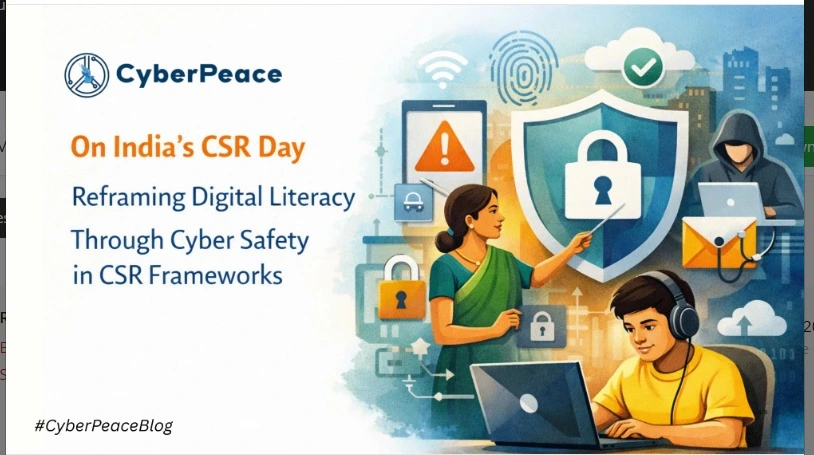
Introduction
" सर्वे भवन्तु सुखिनः, सर्वे सन्तु निरामयाः " May all be happy, may all be free from suffering. This timeless invocation reflects a vision of collective well-being, where progress is meaningful only when shared, and protection extends to every individual in society. This very philosophy lies at the heart of Corporate Social Responsibility, which seeks to ensure that growth is not isolated or unequal, but inclusive, ethical, and mindful of the broader social good.
At its core, Corporate Social Responsibility is not merely a statutory obligation, it is a reflection of a deeper ethical commitment, an acknowledgement that growth must carry with it a sense of duty towards society. In many ways, CSR embodies the idea that progress without responsibility is incomplete, and that corporations, as key actors shaping modern life, must help safeguard the very communities they engage with.
Reframing Digital Literacy Through Cyber Safety in CSR Frameworks
In India, this moral vision has been given a legal structure under the Companies Act, 2013, CSR Schedule VII, which mandates certain classes of companies to allocate a portion of their profits towards socially beneficial activities. Section 135 of the Act requires companies meeting specified financial thresholds to undertake CSR initiatives, guided by principles of inclusivity, sustainability, and social welfare. The underlying values are clear, CSR is intended not as charity, but as a strategic and accountable contribution to societal development.
Schedule VII of the Act further outlines the broad areas that qualify as CSR, including “Education and Digital Literacy”, gender equality, rural development, and measures for reducing inequalities. Within this framework, promoting “digital literacy” has increasingly been recognised as a legitimate and necessary CSR activity, especially in the context of a rapidly digitising society like India.
However, the current understanding of digital literacy within CSR remains incomplete. It often emphasises access and usage, teaching individuals how to navigate digital platforms, use devices, and engage with online services. What remains insufficiently addressed is the question of safety. In an environment where cyber fraud, data breaches, online harassment, and identity theft are becoming increasingly common, digital literacy without cyber awareness risks becoming a partial and potentially harmful intervention.
Embedding cyber awareness and capacity building within ‘digital literacy’ in explicit form is therefore not optional, it is essential. This includes equipping individuals with the ability to recognise online threats, protect personal data, understand digital consent, and respond effectively to cyber risks. It also requires recognising that vulnerable populations, including first-time internet users, women, and marginalised communities, often face disproportionate exposure to cyber harm.
“It is pertinent to note that Cybersecurity awareness training is relevant to CSR but is not yet consistently implemented as an explicit CSR activity. It is often included indirectly within digital literacy programs, highlighting the need for a more structured, progressive and integrated approach.”
Given this reality, there is a strong case for explicitly recognising cyber awareness as a distinct and integral component of CSR activities, rather than treating it as an implicit subset of digital literacy. Doing so would not only align CSR with contemporary societal risks but also ensure that corporate interventions move beyond enabling access to actively ensuring safety.
In a digital society, empowerment without protection is incomplete. If CSR is to truly reflect its foundational values, it must evolve to address not just the opportunities of the digital age, but also its risks.
Why Cyber Safety Must Be Central to CSR
The current state of digital ecosystems, which used to operate as secondary systems, now functions as essential systems that support government operations, banking systems, educational institutions, and social communication. The digital environment has its vulnerabilities, which create direct dangers for people in society. The elderly, first-time internet users, and rural communities face higher cyber threat risks because they often lack knowledge and protective resources on responsible use. The implementation of CSR initiatives that provide digital access to these groups, along with how to handle risks, will create greater benefit for their safety. Organisations must encourage the implementation of cyber safety training in their CSR programs because doing so will create value while fulfilling their ethical obligations. The empowerment process needs to achieve complete success, which protects people from any potential dangers according to the "do no harm" principle.
Key Components of CyberPeace-Aligned Digital Literacy
To make CSR initiatives more effective and future-ready, organisations should incorporate the following elements into their digital literacy programs:
- Cyber Awareness and Risk Recognition: The training program teaches participants how to recognise typical security threats, which include phishing attacks and scams, deepfake technology and misinformation.
- Data Protection and Privacy Literacy: The program teaches users how to protect their personal information, together with the process of giving consent and the methods used to handle their online presence.
- Responsible Digital Behaviour: The program teaches people how to use the internet responsibly by showing them how to make ethical decisions that require both respect and accountability while understanding the legal consequences of their actions.
- Incident Response and Reporting Mechanisms: The program teaches users about cyber incident response, which includes all reporting methods and available support resources.
- Inclusion-Focused Design: The program develops specific solutions which protect various demographic groups from their particular vulnerabilities while maintaining accessibility and essential programmatic relevance.
Policy and Institutional Alignment
The integration of cyber safety into corporate social responsibility lets organisations achieve their national objectives, which include:
- Strengthening digital trust and resilience
- Supporting safe digital inclusion initiatives
- Complementing the efforts of institutions working on cybersecurity awareness and capacity building
The structured approach requires organisations to execute three specific steps, which include:
- Partnering with cybersecurity organisations and civil society
- Developing standardised cyber awareness modules
- The organisation will use behavioural change indicators to evaluate its impact instead of relying on access metrics.
The Way Forward
Digital-era Corporate Social Responsibility needs to transition from its present state of providing access to digital resources toward establishing secure online platforms for users. The understanding of digital literacy needs to shift from its current status as a technical ability toward its new definition as a social competency that encompasses safety, responsibility and resilience training.
Companies need to understand their digital transformation obligations because their digital transformation efforts require them to handle all associated risks. The implementation of cyber safety within corporate social responsibility frameworks will enable organisations to develop a secure and trustworthy digital environment that includes all users.
Conclusion
The implementation of corporate social responsibility needs to fulfil its core mission of creating societal benefits through inclusive practices that span all current digital possibilities and their associated security threats. The field of digital literacy requires a new framework that combines digital safety practices with its existing educational materials.
The digital safety practice ensures that people obtain essential knowledge and skills that enable them to use digital resources securely when they access online content. The process of accomplishing shared community prosperity needs to establish a framework that benefits every person through social advancement and the protection of their rights.
References
- https://upload.indiacode.nic.in/schedulefile?aid=AC_CEN_22_29_00008_201318_1517807327856&rid=79
- https://www.allresearchjournal.com/archives/2025/vol11issue4/PartF/11-5-60-511.pdf
- https://www.unesco.org/en/dtc-finance-toolkit-factsheets/corporate-social-responsibility-csr
- https://www.investopedia.com/terms/c/corp-social-responsibility.asp
- https://digitalmarketinginstitute.com/blog/corporate-16-brands-doing-corporate-social-responsibility-successfully
- https://www.imd.org/blog/sustainability/csr-strategy/

Executive Summary
A video is being shared on social media with the claim that a BJP MLA assaulted a man during a bridge inauguration ceremony in Assam. In the viral clip, a man is seen grabbing a young man and slapping him amid a crowd. He is then seen uprooting a banana plant and attacking the same man with it. A research done by the Research Wing of the CyberPeace found the claim accompanying the viral video to be misleading. The research revealed that the man seen assaulting the youth is not a BJP MLA, but former AIUDF MLA Samsul Huda. The video is being shared on social media with his identity falsely described as that of a BJP MLA.
Claim:
A Facebook user shared the viral video with the caption: “The arrogance of BJP leaders is at its peak, which means their end is now certain. He is a BJP MLA from Assam. When the inauguration ribbon turned pink instead of red, he lost his temper and started beating the person.” The post further stated: “If this mistake is considered a crime, then these MLAs should be beaten every day in the streets and neighbourhoods because they commit much bigger mistakes.”
The link to the post, its archive link, and a screenshot are provided below.

Factcheck
To verify the authenticity of the viral claim, the Desk first extracted keyframes from the video and conducted a reverse image search using Google Lens. During the search, the Desk found the same video on the official YouTube channel of Northeast Live, which was uploaded on March 18, 2025. The link to the post and a screenshot are provided below.
https://www.youtube.com/watch?v=L5zrgLbI6NA

According to the video report, former AIUDF MLA from Bilasipara East, Samsul Huda, lost his temper over an issue while attending the foundation stone-laying ceremony of a bridge in Bilasipara, Assam. During the incident, he assaulted an employee of the construction company who was standing nearby. As the research progressed, the Desk found a report published by India Today NE on March 20, 2025, which carried the same visuals from the viral video. The link to the report and a screenshot are provided below.

According to the report, former AIUDF MLA from Bilasipara East in Assam’s Dhubri district, Samsul Huda, had attended a bridge foundation stone-laying ceremony, where he assaulted an employee of the construction company.
Conclusion
The Desk’s research found the claim accompanying the viral video to be misleading. The person seen assaulting the youth in the video is not a BJP MLA, but former AIUDF MLA Samsul Huda. The video is being shared on social media with his identity falsely described as that of a BJP MLA.
.webp)
Introduction
In an era where organisations are increasingly interdependent through global supply chains, outsourcing and digital ecosystems, third-party risk has become one of the most vital aspects of enterprise risk management. The SolarWinds hack, the MOVEit vulnerabilities and recent software vendor attacks all serve as a reminder of the necessity to enhance Third-Party Risk Management (TPRM). As cyber risks evolve and become more sophisticated and as regulatory oversight sharpens globally, 2025 is a transformative year for the development of TPRM practices. This blog explores the top trends redefining TPRM in 2025, encompassing real-time risk scoring, AI-driven due diligence, harmonisation of regulations, integration of ESG, and a shift towards continuous monitoring. All of these trends signal a larger movement towards resilience, openness and anticipatory defence in an increasingly dependent world.
Real-Time and Continuous Monitoring becomes the Norm
The old TPRM methods entailed point-in-time testing, which typically was an annual or onboarding process. By 2025, organisations are shifting towards continuous, real-time monitoring of their third-party ecosystems. Now, authentic advanced tools are making it possible for companies to take a real-time pulse of the security of their vendors by monitoring threat indicators, patching practices and digital footprint variations. This change has been further spurred by the growth in cyber supply chain attacks, where the attackers target vendors to gain access to bigger organisations. Real-time monitoring software enables the timely detection of malicious activity, equipping organisations with a faster defence response. It also guarantees dynamic risk rating instead of relying on outdated questionnaire-based scoring.
AI and Automation in Risk Assessment and Due Diligence
Manual TPRM processes aren't sustainable anymore. In 2025, AI and machine learning are reshaping the TPRM lifecycle from onboarding and risk classification to contract review and incident handling. AI technology can now analyse massive amounts of vendor documentation and automatically raise red flags on potential issues. Natural language processing (NLP) is becoming more common for automated contract intelligence, which assists in the detection of risky clauses or liability gaps or data protection obligations. In addition, automation is increasing scalability for large organisations that have hundreds or thousands of third-party relationships, eliminating human errors and compliance fatigue. However, all of this must be implemented with a strong focus on security, transparency, and ethical AI use to ensure that sensitive vendor and organisational data remains protected throughout the process.
Risk Quantification and Business Impact Mapping
Risk scoring in isolation is no longer adequate. One of the major trends for 2025 is the merging of third-party risk with business impact analysis (BIA). Organisations are using tools that associate vendors to particular business processes and assets, allowing better knowledge of how a compromise of a vendor would impact operations, customer information or financial position. This movement has resulted in increased use of risk quantification models, such as FAIR (Factor Analysis of Information Risk), which puts dollar values on risks associated with vendors. By using the language of business value, CISOs and risk officers are more effective at prioritising risks and making resource allocations.
Environmental, Social, and Governance (ESG) enters into TPRM
As ESG keeps growing on the corporate agenda, organisations are taking TPRM one step further than cybersecurity and legal risks and expanding it to incorporate ESG-related factors. In 2025, organisations evaluate if their suppliers have ethical labour practices, sustainable supply chains, DEI (Diversity, Equity, Inclusion) metrics and climate impact disclosures. This growth is not only a reputational concern, but also a third-party non-compliance with ESG can now invoke regulatory or shareholder action. ESG risk scoring software and vendor ESG audits are becoming components of onboarding and performance evaluations.
Shared Assessments and Third-Party Exchanges
With the duplication of effort by having multiple vendors respond to the same security questionnaires, the trend is moving toward shared assessments. Systems such as the SIG Questionnaire (Standardised Information Gathering) and the Global Vendor Exchange allow vendors to upload once and share with many clients. This change not only simplifies the due diligence process but also enhances data accuracy, standardisation and vendor experience. In 2025, organisations are relying more and more on industry-wide vendor assurance platforms to minimise duplication, decrease costs and maximise trust.
Incident Response and Resilience Partnerships
Another trend on the rise is bringing vendors into incident response planning. In 2025, proactive organisations address major vendors as more than suppliers but as resilience partners. This encompasses shared tabletop exercises, communication procedures and breach notification SLAs. With the increasing ransomware attacks and cloud reliance, organisations are now calling for vendor-side recovery plans, RTO and RPO metrics. TPRM is transforming into a comprehensive resilience management function where readiness and not mere compliance takes centre stage.
Conclusion
Third-Party Risk Management in 2025 is no longer about checklists and compliance audits; it's a dynamic, intelligence-driven and continuous process. With regulatory alignment, AI automation, real-time monitoring, ESG integration and resilience partnerships leading the way, organisations are transforming their TPRM programs to address contemporary threat landscapes. As digital ecosystems grow increasingly complex and interdependent, managing third-party risk is now essential. Early adopters who invest in tools, talent and governance will be more likely to create secure and resilient businesses for the AI era.
References
- https://finance.ec.europa.eu/publications/digital-operational-resilience-act-dora_en
- https://digital-strategy.ec.europa.eu/en/policies/nis2-directive
- https://www.meity.gov.in/data-protection-framework
- https://securityscorecard.com
- https://sharedassessments.org/sig/
- https://www.fairinstitute.org/fair-model
