
#FactCheck-Video falsely links Lt Gen Rajiv Ghai to party dance clip; actually shows content creator’s father
Executive Summary
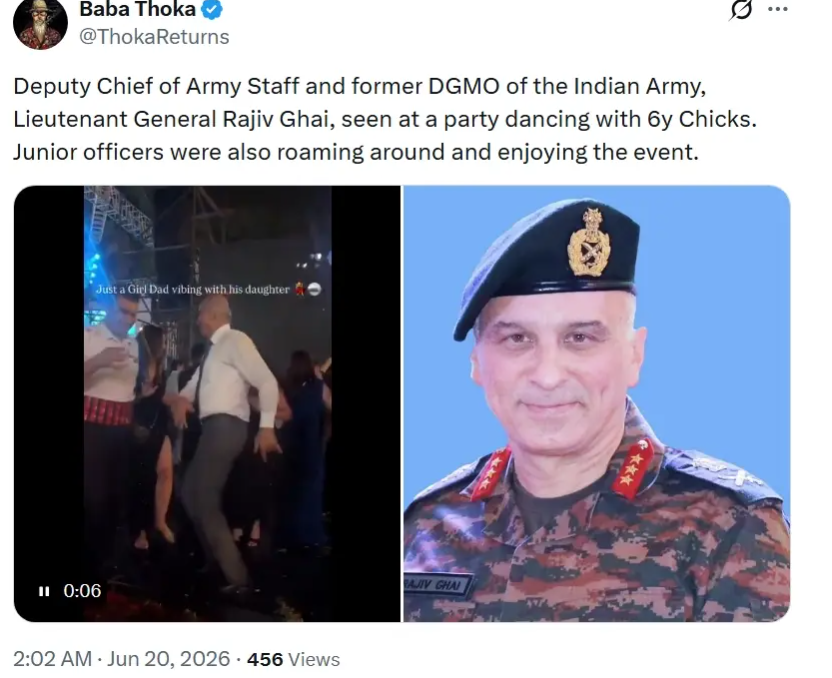
A video circulating on social media claims to show the Deputy Chief of Army Staff and former DGMO of the Indian Army, Lieutenant General Rajiv Ghai, dancing with a young woman at a party. Users sharing the clip further allege that other junior military officers were also present at the event. CyberPeace Research Wing research found the claim to be misleading. The viral video has no connection with the Indian Army, Lt Gen Rajiv Ghai, or any official military function. The person seen in the video is actually the father of content creator Akanksha Sehgal, who has featured him in multiple videos on her social media accounts.
Claim:
A Pakistani handle ‘Baba Thoka’ shared the video on X, alleging that Lt Gen Rajiv Ghai was seen dancing with young women at a party and that junior officers were also present.
- https://x.com/ThokaReturns/status/2068069535715147896?s=20
- https://archive.ph/H9EA0
Fact Check:
A reverse image search of keyframes from the viral video led to the same clip being found on Instagram handle ‘akku_sehgal_’, posted on December 14, 2025. The video caption read: “POV – when your dad and your music taste match.”

Further examination of the content creator Akanksha Sehgal’s Instagram profile showed multiple videos featuring the same father-daughter duo, confirming that the man in the viral clip frequently appears in her content.

Conclusion:
The viral video claiming to show Lieutenant General Rajiv Ghai dancing at a party is misleading. The individual seen in the video is not the senior Indian Army officer but the father of content creator Akanksha Sehgal.

Related Blogs

Introduction
Assisted Reproductive Technology (“ART”) refers to a diverse set of medical procedures designed to aid individuals or couples in achieving pregnancy when conventional methods are unsuccessful. This umbrella term encompasses various fertility treatments, including in vitro fertilization (IVF), intrauterine insemination (IUI), and gamete and embryo manipulation. ART procedures involve the manipulation of both male and female reproductive components to facilitate conception.
The dynamic landscape of data flows within the healthcare sector, notably in the realm of ART, demands a nuanced understanding of the complex interplay between privacy regulations and medical practices. In this context, the Information Technology (Reasonable Security Practices And Procedures And Sensitive Personal Data Or Information) Rules, 2011, play a pivotal role, designating health information as "sensitive personal data or information" and underscoring the importance of safeguarding individuals' privacy. This sensitivity is particularly pronounced in the ART sector, where an array of personal data, ranging from medical records to genetic information, is collected and processed. The recent Assisted Reproductive Technology (Regulation) Act, 2021, in conjunction with the Digital Personal Data Protection Act, 2023, establishes a framework for the regulation of ART clinics and banks, presenting a layered approach to data protection.
A note on data generated by ART
Data flows in any sector are scarcely uniform and often not easily classified under straight-jacket categories. Consequently, mapping and identifying data and its types become pivotal. It is believed that most data flows in the healthcare sector are highly sensitive and personal in nature, which may severely compromise the privacy and safety of an individual if breached. The Information Technology (Reasonable Security Practices And Procedures And Sensitive Personal Data Or Information) Rules, 2011 (“SPDI Rules”) categorizes any information pertaining to physical, physiological, mental conditions or medical records and history as “sensitive personal data or information”; this definition is broad enough to encompass any data collected by any ART facility or equipment. These include any information collected during the screening of patients, pertaining to ovulation and menstrual cycles, follicle and sperm count, ultrasound results, blood work etc. It also includes pre-implantation genetic testing on embryos to detect any genetic abnormality.
But data flows extend beyond mere medical procedures and technology. Health data also involves any medical procedures undertaken, the amount of medicine and drugs administered during any procedure, its resultant side effects, recovery etc. Any processing of the above-mentioned information, in turn, may generate more personal data points relating to an individual’s political affiliations, race, ethnicity, genetic data such as biometrics and DNA etc.; It is seen that different ethnicities and races react differently to the same/similar medication and have different propensities to genetic diseases. Further, it is to be noted that data is not only collected by professionals but also by intelligent equipment like AI which may be employed by any facility to render their service. Additionally, dissemination of information under exceptional circumstances (e.g. medical emergency) also affects how data may be classified. Considerations are further nuanced when the fundamental right to identity of a child conceived and born via ART may be in conflict with the fundamental right to privacy of a donor to remain anonymous.
Intersection of Privacy laws and ART laws:
In India, ART technology is regulated by the Assisted Reproductive Technology (Regulation) Act, 2021 (“ART Act”). With this, the Union aims to regulate and supervise assisted reproductive technology clinics and ART banks, prevent misuse and ensure safe and ethical practice of assisted reproductive technology services. When read with the Digital Personal Data Protection Act, 2023 (“DPDP Act”) and other ancillary guidelines, the two legislations provide some framework regulations for the digital privacy of health-based apps.
The ART Act establishes a National Assisted Reproductive Technology and Surrogacy Registry (“National Registry”) which acts as a central database for all clinics and banks and their nature of services. The Act also establishes a National Assisted Reproductive Technology and Surrogacy Board (“National Board”) under the Surrogacy Act to monitor the implementation of the act and advise the central government on policy matters. It also supervises the functioning of the National Registry, liaises with State Boards and curates a code of conduct for professionals working in ART clinics and banks. Under the DPDP Act, these bodies (i.e. National Board, State Board, ART clinics and banks) are most likely classified as data fiduciaries (primarily clinics and banks), data processors (these may include National Board and State boards) or an amalgamation of both (these include any appropriate authority established under the ART Act for investigation of complaints, suspend or cancellation of registration of clinics etc.) depending on the nature of work undertaken by them. If so classified, then the duties and liabilities of data fiduciaries and processors would necessarily apply to these bodies. As a result, all bodies would necessarily have to adopt Privacy Enhancing Technologies (PETs) and other organizational measures to ensure compliance with privacy laws in place. This may be considered one of the most critical considerations of any ART facility since any data collected by them would be sensitive personal data pertaining to health, regulated by the Information Technology (Reasonable Security Practices And Procedures And Sensitive Personal Data Or Information) Rules, 2011 (“SPDI Rules 2011”). These rules provide for how sensitive personal data or information are to be collected, handled and processed by anyone.
The ART Act independently also provides for the duties of ART clinics and banks in the country. ART clinics and banks are required to inform the commissioning couple/woman of all procedures undertaken and all costs, risks, advantages, and side effects of their selected procedure. It mandatorily ensures that all information collected by such clinics and banks to not informed to anyone except the database established by the National Registry or in cases of medical emergency or on order of court. Data collected by clinics and banks (these include details on donor oocytes, sperm or embryos used or unused) are required to be detailed and must be submitted to the National Registry online. ART banks are also required to collect personal information of donors including name, Aadhar number, address and any other details. By mandating online submission, the ART Act is harmonized with the DPDP Act, which regulates all digital personal data and emphasises free, informed consent.
Conclusion
With the increase in active opt-ins for ART, data privacy becomes a vital consideration for all healthcare facilities and professionals. Safeguard measures are not only required on a corporate level but also on a governmental level. It is to be noted that in the 262 Session of the Rajya Sabha, the Ministry of Electronics and Information Technology reported 165 data breach incidents involving citizen data from January 2018 to October 2023 from the Central Identities Data Repository despite publicly denying. This discovery puts into question the safety and integrity of data that may be submitted to the National Registry database, especially given the type of data (both personal and sensitive information) it aims to collate. At present the ART Act is well supported by the DPDP Act. However, further judicial and legislative deliberations are required to effectively regulate and balance the interests of all stakeholders.
References
- The Information Technology (Reasonable Security Practices And Procedures And Sensitive Personal Data Or Information) Rules, 2011
- Caring for Intimate Data in Fertility Technologies https://dl.acm.org/doi/pdf/10.1145/3411764.3445132
- Digital Personal Data Protection Act, 2023
- https://www.wolterskluwer.com/en/expert-insights/pharmacogenomics-and-race-can-heritage-affect-drug-disposition
.webp)
Executive Summary:
A viral video of the Argentina football team dancing in the dressing room to a Bhojpuri song is being circulated in social media. After analyzing the originality, CyberPeace Research Team discovered that this video was altered and the music was edited. The original footage was posted by former Argentine footballer Sergio Leonel Aguero in his official Instagram page on 19th December 2022. Lionel Messi and his teammates were shown celebrating their win at the 2022 FIFA World Cup. Contrary to viral video, the song in this real-life video is not from Bhojpuri language. The viral video is cropped from a part of Aguero’s upload and the audio of the clip has been changed to incorporate the Bhojpuri song. Therefore, it is concluded that the Argentinian team dancing to Bhojpuri song is misleading.

Claims:
A video of the Argentina football team dancing to a Bhojpuri song after victory.


Fact Check:
On receiving these posts, we split the video into frames, performed the reverse image search on one of these frames and found a video uploaded to the SKY SPORTS website on 19 December 2022.

We found that this is the same clip as in the viral video but the celebration differs. Upon further analysis, We also found a live video uploaded by Argentinian footballer Sergio Leonel Aguero on his Instagram account on 19th December 2022. The viral video was a clip from his live video and the song or music that’s playing is not a Bhojpuri song.

Thus this proves that the news that circulates in the social media in regards to the viral video of Argentina football team dancing Bhojpuri is false and misleading. People should always ensure to check its authenticity before sharing.
Conclusion:
In conclusion, the video that appears to show Argentina’s football team dancing to a Bhojpuri song is fake. It is a manipulated version of an original clip celebrating their 2022 FIFA World Cup victory, with the song altered to include a Bhojpuri song. This confirms that the claim circulating on social media is false and misleading.
- Claim: A viral video of the Argentina football team dancing to a Bhojpuri song after victory.
- Claimed on: Instagram, YouTube
- Fact Check: Fake & Misleading

Introduction
In recent years, the city of Hyderabad/Cyberabad has emerged as a technology hub, a place with the strong presence of multi corporations, Startups, and research institutions, Hyderabad has become a hub of innovations and technological advancement. However, this growing land of cyber opportunities has also become a hub for cybercriminals as well. In this blog post, we shall explore the reasons why professionals are being targeted and the effects of cyber fraud on techies. Through this investigation, we hope to raise awareness about the seriousness of the problem as well as give vital insights and techniques for Cyberabad’s computer workers to defend themselves against cyber theft. We can work together to make Cyberabad’s technology ecosystem safer and more secure.
Defining Cyber Fraud
In today’s age, where everything has an interconnected digital world, cyber fraud cases are increasing daily. Cyber fraud encompasses a wide range of threats and techniques employed by bad actors, such as Phishing, Ransomware, identity theft, online scams, data breaches, and fake websites designed for users. The sophistication of cyber fraud techniques is constantly evolving, making it challenging for individuals and organisations to stay ahead. Cybercriminals use software vulnerabilities, social engineering tactics, and flaws in cybersecurity defences to carry out their harmful operations. Individuals and organisations must grasp these dangers and tactics to protect themselves against cyber fraud.
Impact of Cyber Frauds
The consequences of Falling victim to cyber fraud can be devastating, both personally and professionally. The emotional and financial toll on individuals may be a challenge. Identity theft may lead to damaged credit scores, fraudulent transactions, and years of recovery work to rehabilitate one’s image. Financial fraud can result in depleted bank accounts, unauthorised charges, and substantial monetary losses. Furthermore, being tricked and violated in the digital environment can generate anxiety, tension, and a lack of confidence.
The impact of cyber fraud goes beyond immediate financial losses and can have long-term consequences for individuals’ and organisations’ entire well-being and stability. As the threat environment evolves, it is critical for people and organisations to recognise the gravity of these repercussions and take proactive actions to protect themselves against cyber theft.

Why are Cyberabad Tech Professionals Targeted?
Tech professionals in Cyberabad are particularly vulnerable to cyber due to various factors. Firstly, their expertise and knowledge in technology make them attractive targets for cybercrooks. These professionals possess valuable coding, Software, and administration skills, making them attractive to cybercriminals.
Secondly, the nature of work often involves enormous use of technology, including regular internet contacts, email exchanges, and access to private information. This expanded digital presence exposes them to possible cyber dangers and makes them more vulnerable to fraudsters’ social engineering efforts. Furthermore, the fast-moving nature of the tech industry, with many deadlines and work pressure to deliver, can create a distraction. This can let them click on some malicious links or share sensitive information unknowingly all these factors let the cyber criminals exploit vulnerabilities.
Unveiling the Statistics
According to various reports, 80% of cyber fraud victims in Hyderabad are techies; the rest are the public targeted by cyber crooks. This surprising number emphasises the critical need to address the vulnerabilities and threats this specific segment within the IT community faces.
Going further into the data, we can acquire insights into the many forms of cyber fraud targeting tech workers, the strategies used by cybercriminals, and the impact these occurrences have on individuals and organisations. Examining precise features and patterns within data might give important information for developing successful preventative and protection methods.
Factors Contributing
Several reasons contribute to the elevated risk of cyber fraud among ICT professionals in Cyberabad. Understanding these aspects helps explain why this group is specifically targeted and may be more vulnerable to such assaults.
Technical Expertise: Tech workers frequently have specialised technical knowledge, but this knowledge may only sometimes extend to cybersecurity. Their primary concentration is writing software, designing systems, or implementing technologies, which may result in missing possible vulnerabilities or a lack of overall cybersecurity understanding.
Confidence in Technology: IT workers have a higher level of confidence in technology because of their knowledge and dependence on technology. This trust can sometimes make individuals more vulnerable to sophisticated frauds or social engineering approaches that prey on their faith in the services they utilise.
Time Constraints and Pressure: Tech workers frequently operate under tight deadlines and tremendous pressure to reach project milestones. This may result in hurried decision-making or disregarding possible warning signals of cyber fraud, rendering them more exposed to assaults that prey on time-sensitive circumstances.
Cybercriminals know that technology workers have valuable knowledge, trade secrets, and intellectual property that may be economically profitable. As a result, they are attractive targets for attacks aiming at stealing sensitive data or gaining unauthorised access to critical systems.
The best practices that cyber techies can apply to safeguard their personal and professional data by following these simple tips:
Strong Passwords: create a strong password, using passwords for all your online accounts and changing them regularly. Remember to use unique combinations!
MFA (Multi-Factor Authentication): Enable MFA wherever possible. This provides an extra degree of protection by requiring a second form of verification, such as a code texted to your mobile device and your password.
Use Secured WiFi: Use secure and encrypted Wi-Fi networks, especially while viewing sensitive information. Avoid connecting to public or unprotected networks, as they can be readily exploited. Recognising Red Flags and Staying Ahead
Social Engineering: Be sceptical of unwanted solicitations or offers, both online and offline. Cybercriminals may try to persuade or fool you using social engineering tactics. Before revealing any personal or private information, think critically and confirm the veracity of the request.
Secure Web Browsing: Only browse trustworthy websites with valid SSL certificates (look for “https://” in the URL). Avoid clicking on strange links or downloading files from unknown sources since they may contain malware or ransomware.
Report Suspicious actions: If you encounter any suspicious or fraudulent actions, report them to the relevant authorities, such as the Cyber Crime Police or your organisation’s IT department. Reporting events can assist in avoiding additional harm and aid in identifying and apprehending hackers.
Stay Current on Security Practises: Stay up to speed on the newest cybersecurity risks and best practices. Follow credible sources, participate in cybersecurity forums or seminars, and remain current on new threats and preventative measures.

Conclusion
The rise in cybercrimes and fraud cases among tech experts in Cyberabad is a disturbing trend that requires prompt intervention. We can establish a safer tech cluster that lives on creativity, trust, and resilience by adopting proactive actions, raising awareness, and encouraging cooperation. Let us work together to prevent cybercrime and ensure the future of Cyberabad’s IT ecosystem.
