
#FactCheck: Old Video from Jammu’s Maharaja Hari Singh Birth Anniversary Procession Falsely Linked to CJP’s Proposed Protest at Jantar Mantar
Executive Summary
The Cockroach Janata Party (CJP) has called for a protest against Chief Election Commissioner Gyanesh Kumar and a “Chalo Delhi” campaign at Jantar Mantar in New Delhi on Saturday, October 10. Meanwhile, a video is being widely shared on social media showing a large number of people carrying saffron flags and walking on a road. The video is being shared with the claim that the people seen in it are members of Hindu organisations marching towards Jantar Mantar in large numbers to oppose the CJP’s proposed protest. CyberPeace Research found that the viral video is old and shows a procession held at Dogra Chowk in Jammu on the occasion of Maharaja Hari Singh’s birth anniversary.
Claim
A Facebook user shared the viral video with the caption,“News is coming that Hindu organisations have started a movement called the ‘Catch Cockroach Campaign’. Yes, they have given the campaign this name. A large number of people from Hindu organisations are leaving for Jantar Mantar. Brother Deepak... my free advice is... leave for America, because these are very ‘cruel people’ who can change 500 years of history in five hours... Jai Bhawani, Jai Shivaji, now it’s your turn.”The post link, archive link and screenshot are provided below.
https://www.facebook.com/photo/?fbid=1660133012350967&set=a.536762061354740

Fact Check
To verify the claim, we first conducted a reverse image search of a frame from the viral video using Google Lens. Through this search, we found the same video posted on an Instagram page named Rana Ashish Singh on February 21, 2023. However, the post did not provide any information that could help verify the actual origin or context of the video.
https://www.instagram.com/reels/Co61z_zMQr6/

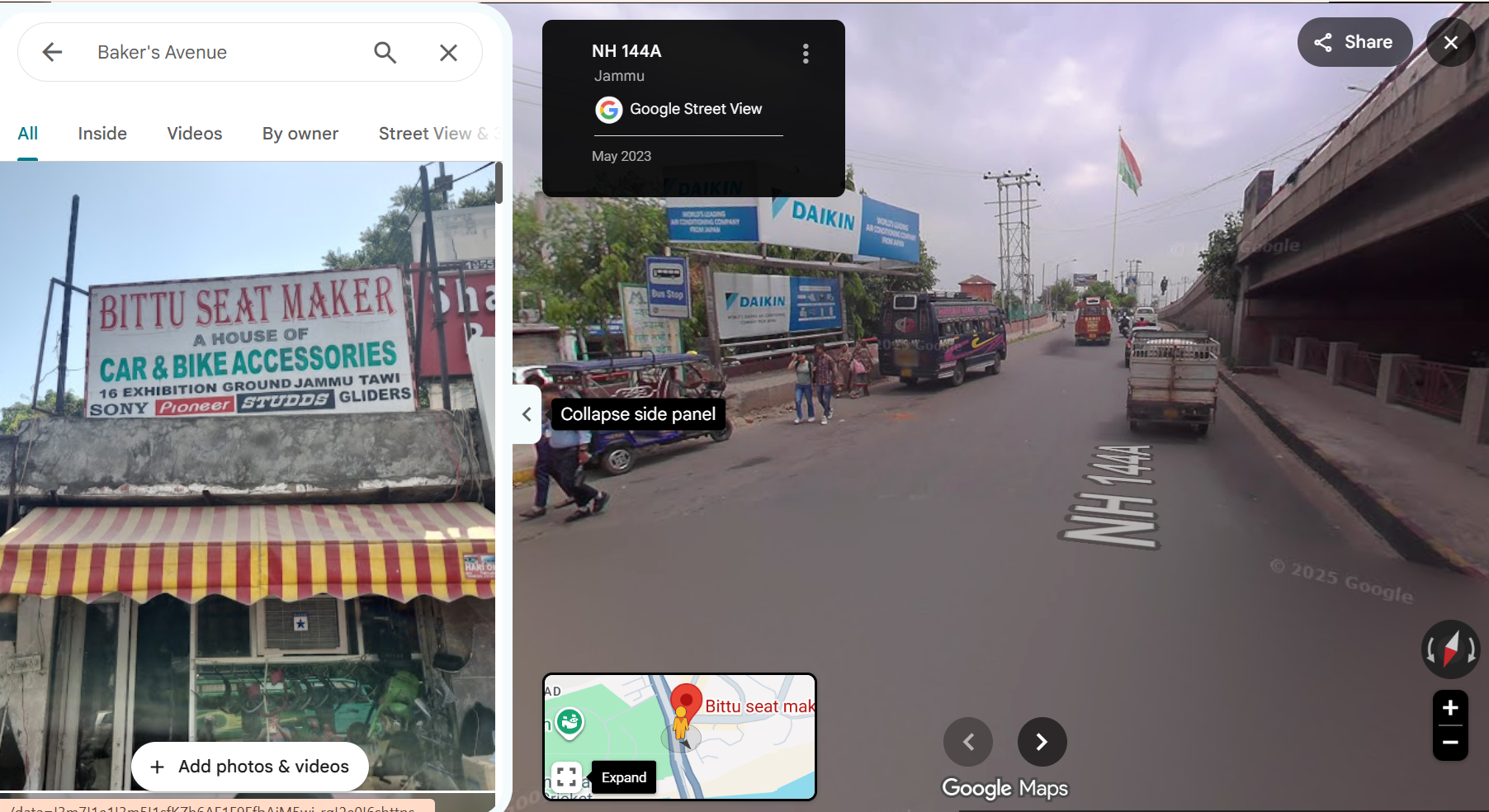
In our further research, we found a higher-quality version of the viral video on the Instagram account ‘@anilgiri4659’, posted in February 2023. On closely analysing the video, we noticed the words “Jai Chandi Maa” written on one of the vehicles, while the number plate of another black vehicle displayed “JK” followed by some digits. We also noticed “Baker’s Avenue” written on the roof of a shop, with a signboard next to it bearing the words “Sport Music” in red. A white building with some black designs painted on it was also visible on the left side of the video. Further into the video, a red-coloured building could be seen. Based on these visual clues, we suspected that the video could be from Jammu and Kashmir.
https://www.instagram.com/reels/CpKOrGkv6SV/

Using these clues, we carried out a geolocation analysis to identify the location and road visible in the viral video. Our research found that the location shown in the viral video is Dogra Chowk in Prem Nagar, Jammu. To further verify this, a comparative analysis of the visuals from the viral video and the corresponding location can be seen in the graphics below.
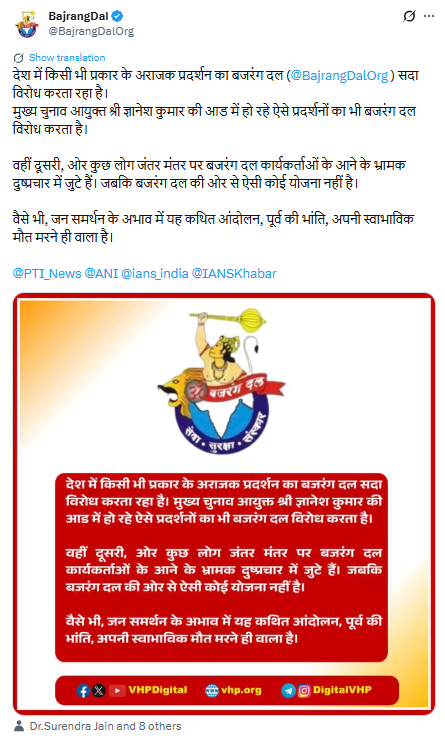
We also found a clarification issued by the official X account of Bajrang Dal regarding the claim that its workers would gather at Jantar Mantar. The post also described the viral claim as misleading and clarified that there is no such plan from Bajrang Dal.
https://x.com/BajrangDalOrg/status/2108059565753536897
Conclusion
CyberPeace Research found that the viral video does not show a protest against Chief Election Commissioner Gyanesh Kumar in Delhi. Instead, it shows a procession at Dogra Chowk in Prem Nagar, Jammu, held in September 2022 on the occasion of Maharaja Hari Singh’s birth anniversary. Therefore, the claim that members of Hindu organisations are marching towards Jantar Mantar to oppose the CJP’s proposed protest is misleading.

Related Blogs

Introduction
As AI becomes more deeply integrated into everyday life and industries, Google Cloud is increasing its investment in AI-ready data centres worldwide, with India emerging as a key part of its expansion plans. Thomas Kurian’s latest India visit highlighted Google Cloud’s expanding ambitions in the country. Beyond the $15 billion, 1GW Visakhapatnam data centre announced in October 2025, Google is planning a larger multi-year AI infrastructure push, backed by partnerships with major enterprises across banking, healthcare, and digital services. This reflects a shift where countries are not only competing to create advanced AI technologies but also to build the infrastructure needed to support and lead the future AI economy. But it's worth being precise about what "building infrastructure" actually means here because it is private, foreign-headquartered capital constructing facilities on Indian soil, under terms that remain largely opaque to the public that will depend on them. That distinction matters more than the investment headline suggests.
The Promise and Pressure of Google’s Full-Stack AI Strategy
For decades, data centres were mainly built to store information, host websites, and support cloud applications. The rise of generative AI has completely changed that role. Today's systems need massive computing power both to train models on huge datasets and to run them every time someone generates content or automates a task. It is distinguished from traditional workloads mainly due to relying on proprietary technologies like GPU or TPU, alongside advanced networking and dynamic storage systems that complement each other and work in unison. The efforts of Google to create its own TPUs are understandable as they played a vital role in a number of achievements made by Google DeepMind. Today, the companies, government entities, and people turning to AI solutions put enormous pressure on the processing of data.
The companies that are building this infrastructure are shaping ecosystems on which others will depend on. Google’s “full stack” approach that infers controlling everything from chips and AI models to cloud platforms and applications which may improve efficiency and reduce costs, but it also creates deeper dependence on a single provider. Like a hospital adopting an AI platform is not just purchasing software; over time, its data systems, workflows, and operations can become closely tied to the underlying cloud ecosystem.
This concern when viewed against the concentration of the global cloud market: Amazon Web Services, Microsoft Azure, and Google Cloud together control roughly two-thirds of global cloud infrastructure, making them the dominant gatekeepers of enterprise computing. As these same companies move upward into AI models and applications while controlling the compute layer beneath them, the debate is no longer only about market share, it is about control over the entire AI value chain.
Why Location Matters and Why It Isn't Enough
In traditional internet services, a delay of a few milliseconds rarely mattered. However, future AI applications like autonomous vehicles, AI-assisted diagnostics, automated factory robotics will demand near-instant decision-making and cannot always depend on servers thousands of kilometres away. Regional data centres reduce that latency, which matters especially for India, where hundreds of millions are expected to interact with AI-powered services in the coming years. There is also the question of data sovereignty, and this is where the infrastructure narrative gets ahead of the regulatory reality. Governments worldwide are increasingly concerned about where citizens' and companies' data is stored and processed and local data centres are presented as the answer, but physical proximity does not automatically translate into legal accountability. Google has acknowledged that it bills cloud revenue through whichever global entity corresponds to the data centre being accessed which means an Indian client's spending on Google Cloud infrastructure inside India may still not be booked, taxed, or contractually governed as an Indian transaction. Google Cloud India Pvt. Ltd reported just ₹2,065.4 crore in FY25 revenue, strikingly disconnected from the scale of a $15 billion facility and its roster of major Indian clients. Servers on Indian soil do not by themselves guarantee that India captures the tax base, the leverage, or the oversight that "data sovereignty" implies.
This gap is widened by where India's own data protection framework stands. The Digital Personal Data Protection (DPDP) Act, 2023 leaves retention periods and purpose limitation loosely specified under Sections 8(7) and 12, and its enforcement rules are still being finalised. When hospitals or banks process data through a foundation-model platform like Gemini Enterprise, questions like where processing occurs and what audit trail exists for cross-border flows are not resolved by a local data centre's presence. At present, they rely mostly on vendor assurance rather than independent verification.
Economic Opportunities: More Than Just Servers
AI data centres are often imagined as buildings filled with computers, but their economic impact extends further, into energy systems, construction, engineering, semiconductor supply chains, and skilled technical work. Countries hosting these facilities can benefit from investment and job creation, while local businesses gain access to AI tools without building expensive infrastructure of their own.
For India, expanded AI infrastructure could support ambitions to become a global technology hub, and could narrow the gap in access to high-performance computing that has historically disadvantaged smaller companies and researchers. That potential is real. But it should be weighed against the terms on which it arrives, whether the economic value generated is captured domestically through tax revenue and enforceable local accountability, or whether India functions primarily as a hosting site while value accrues elsewhere. The current revenue-booking structure suggests the latter is, at minimum, a live risk rather than a settled question.
The Environmental Challenge of AI Expansion
However, what remains less discussed is the environmental cost behind this expansion from its impact on the power grid and water required for cooling to clearing use of renewable energy. A 1GW facility, the scale for the Visakhapatnam project is comparable to the output of a mid-sized power plant dedicated entirely to compute demand. As models grow larger and adoption accelerates, this level of energy and water consumption has become one of the central concerns of the global AI infra. As much attention as the investment figures receive, the sustainability issue behind such large-scale infrastructure deserves equal visibility.
The Future: AI Infrastructure as National Infrastructure
The expansion of Google Cloud's AI data centres show a change in how the world views computing. Data centres are no longer invisible facilities operating in the background; they are becoming strategic infrastructure comparable to power grids and telecom networks. That comparison should prompt that infrastructure this consequential is usually made subject to public oversight, licensing conditions, and accountability mechanisms proportionate to its importance which is missing so far. Google Cloud's investment and the compute capacity it brings will lower barriers for Indian enterprises and researchers who have long lacked access to frontier-scale infrastructure. Against this backdrop, India needs to develop the regulatory, tax, and competition frameworks to ensure that the foundation serves the country hosting it, rather than the company that owns it.
Beyond Compute: The Emerging Question of AI Sovereignty
The next phase of the AI race may not be defined only by who builds the most capable models, but by who governs the infrastructure, standards, and decision making systems that those models depend upon. As advances in artificial general intelligence and discussions around superintelligence move from research laboratories into policy circles, control over compute resources is becoming a matter of strategic importance comparable to control over energy reserves or communication networks. Nations that rely entirely on external providers for advanced AI infrastructure may eventually find themselves dependent not merely for technology services, but for economic productivity, public administration, healthcare delivery, and national security capabilities. For India, the challenge is therefore larger than attracting investment. It is about ensuring meaningful domestic participation in ownership, governance, talent development, and oversight so that the intelligence systems shaping the future remain aligned with national priorities and public interest.
References

Introduction
For years, the story of terror recruitment in Jammu & Kashmir followed a familiar arc: physical infiltration across the Line of Control, local Over Ground Workers (OGWs) acting as couriers, and recruitment pitches on mainstream apps like WhatsApp and Facebook Messenger. Indian security agencies built entire surveillance architectures around that arc. Now, officials say, the architecture is being outflanked in a way few anticipated: through pornography and dating platforms.
The New Front: Chat Rooms Nobody Is Watching
According to officials cited in recent reporting, Pakistan-based terror handlers working in coordination with Pakistan's ISI have begun exploiting the real-time chat features built into pornography and dating websites to reach recruits in Jammu & Kashmir. These pornography platforms feature real-time chat tools that operate under the guise of helping users find dates nearby, and handlers are exploiting that feature to broadcast messages and coordinate activities. It's a strikingly mundane pivot for an organisation engaged in violent extremism, but that is precisely the point that nobody expects a counter-terror dragnet to be watching a dating chatbox.
Officials say the tactic is designed to evade the surveillance that has become standard on conventional social media platforms, allowing handlers to convey instructions to recruits while staying off the radar of established monitoring tools. WhatsApp, Signal and Facebook Messenger have all, in various ways, become known quantities to Indian intelligence subject to legal intercepts, metadata analysis and years of institutional familiarity. A chat window buried inside an adult content site is not.
Tor, Encrypted Nodes, and Apps Built to Disappear
Other than porn sites, investigators have also flagged a cluster of niche, privacy-first messaging apps that route traffic through Tor-based, encrypted nodes to mask user identity. Security agencies have placed a wide array of specialised digital tools under scrutiny, with terror handlers relying on Tor-based messaging applications like Coatex and Conion to route data through encrypted nodes and obscure user identities. Access to at least one of these apps' installation files is reportedly already restricted within India, though enforcement against sideloaded Android packages remains an uphill battle.
What makes these platforms attractive to handlers isn't unique code so much as the design philosophy behind privacy-first messaging generally. Some of these apps offer only basic encryption, while others go further with end-to-end encryption, self-destructing messages, and strong on-device encryption algorithms that keep data processing off any third-party server. Several reportedly allow account creation without a phone number or SIM verification, stripping away one of the most basic identity anchors that Indian telecom-linked surveillance depends on.
There's also an operational, almost logistical, reason for the shift: connectivity. Officials note that some of these applications provide end-to-end encryption, self-destructing messages and registration without a phone number or email, making it difficult for security agencies to trace users, even as terror networks also shift away from commonly used platforms. In the hilly, forested and often poorly connected terrain of Jammu's border districts, apps engineered to function on weak 2G or EDGE networks have an obvious tactical advantage over data-hungry mainstream platforms.
VPNs, Banned Apps, and a Cat-and-Mouse Game
Virtual Private Networks add another layer of obfuscation, letting operatives access apps banned in India and mask the geographic origin of their traffic. This isn't new tradecraft, but its pairing with adult-content chat infrastructure and Tor-routed messaging represents a genuinely novel combination in the Kashmir context, according to the officials describing the pattern to reporters.
The broader trend line, officials say, is a steady migration away from platforms Indian agencies have learned to monitor. Terror networks are increasingly moving away from mainstream, commonly used platforms in favour of more obscure alternatives, forcing intelligence agencies into a perpetual game of catch-up: each time a monitoring capability matures against one platform, handlers migrate to the next.
This is not the first time investigators have flagged this cat-and-mouse dynamic. Reporting on a recent case in Jammu's Bathindi area described a 19-year-old allegedly radicalised through the encrypted app. Session the same platform reportedly linked to suspects in a Delhi bomb plot investigation after months of contact with Pakistan-based handlers. Investigators in that case noted that terror organisations have increasingly turned to multi-layered encrypted messaging services specifically to evade monitoring by intelligence agencies.
The Virtual SIM Problem
Alongside app-layer evasion, foreign-issued virtual SIM cards remain a persistent headache for investigators. The most cited example remains the 2019 Pulwama attack investigation, in which agencies reportedly traced more than 40 virtual SIM cards to the Jaish-e-Mohammed suicide bomber and his network numbers that could be provisioned and abandoned without ever touching an Indian telecom's KYC system. That case became something of a template for how virtual and foreign-registered numbers can be used to build communication chains that are extremely difficult to map after the fact, since there is no physical SIM, no retail purchase record, and often no domestic carrier data trail at all.
More recent J&K cases echo the same pattern in a different form. Police investigating a cross-border radicalisation network noted that intelligence agencies now suspect unauthorised SIM card distribution is being used by terrorists to communicate with handlers across the border, part of a broader push to choke off the logistical and communication backbone that keeps sleeper modules alive even when direct physical contact with a local handler is minimal or non-existent.
How Agencies Are Responding
To their credit, security agencies aren't standing still. Officials say cyber-surveillance frameworks are actively being redesigned to map and intercept these "off-grid" communication channels, a phrase that itself signals how far outside traditional monitoring territory this recruitment method has moved. Agencies say they continue to adapt their cyber-surveillance frameworks specifically to map and intercept these off-grid communication channels. That has included moving to restrict access to specific APKs, tightening scrutiny of virtual number providers, and, as seen in recent CIK (Counter Intelligence Kashmir) operations, proactively disrupting online propaganda networks before recruitment pitches can mature into operational plots. One recent CIK operation, for instance, intercepted attempts to recruit two teenage boys who were allegedly being fed terror content in the direction of a Pakistan-based handler, underlining how young the target pool for these campaigns has become.
Conclusion
What this episode really illustrates isn't a single clever trick but a structural truth about counter-terror surveillance: it is inherently reactive. Every time agencies build competence around a platform, handlers find a low-attention, high-friction-to-monitor alternative: first fringe messaging apps, then Tor-routed clients, and now the sprawling, largely unregulated back-end of adult content platforms, which few people would ever think to associate with national security. It's a reminder that the fight against radicalisation online is no longer confined to obviously "extremist" corners of the internet; it can hide in plain sight, inside the most ordinary-looking corners of the web.
Sources
- New J-K terror tactic: Pornography apps, Tor network used for secret messaging — The Tribune
- New J&K terror tactic: Handlers turn to porn sites, encrypted apps to contact recruits — Deccan Herald
- Terrorists using porn website, encrypted apps for chats with recruits — Organiser
- New J&K Terror Tactic: Pornography Apps, Tor Network Used For Secret Messaging — Kashmir Dot Com
- From WhatsApp to Porn Sites: Terror Groups Adopt New Digital Tactic in J&K — Jammu Kashmir Now
- Jammu teenager's arrest exposes cross-border radicalisation network — The Tribune
- After OGW network, J&K cops target communication channel of terrorists — The Tribune
- CIK busts online radical network, foils recruitment of two minors — The Tribune
Introduction
In today’s hyper-connected world, information spreads faster than ever before. But while much attention is focused on public platforms like Facebook and Twitter, a different challenge lurks in the shadows: misinformation circulating on encrypted and closed-network platforms such as WhatsApp and Telegram. Unlike open platforms where harmful content can be flagged in public, private groups operate behind a digital curtain. Here, falsehoods often spread unchecked, gaining legitimacy because they are shared by trusted contacts. This makes encrypted platforms a double-edged sword. It is essential for privacy and free expression, yet uniquely vulnerable to misuse.
As Prime Minister Narendra Modi rightly reminded,
“Think 10 times before forwarding anything,” warning that even a “single fake news has the capability to snowball into a matter of national concern.”
The Moderation Challenge with End-to-End Encryption
Encrypted messaging platforms were built to protect personal communication. Yet, the same end-to-end encryption that shields users’ privacy also creates a blind spot for moderation. Authorities, researchers, and even the platforms themselves cannot view content circulating in private groups, making fact-checking nearly impossible.
Trust within closed groups makes the problem worse. When a message comes from family, friends, or community leaders, people tend to believe it without questioning and quickly pass it along. Features like large group chats, broadcast lists, and “forward to many” options further speed up its spread. Unlike open networks, there is no public scrutiny, no visible counter-narrative, and no opportunity for timely correction.
During the COVID-19 pandemic, false claims about vaccines spread widely through WhatsApp groups, undermining public health campaigns. Even more alarming, WhatsApp rumors about child kidnappers and cow meat in India triggered mob lynchings, leading to the tragic loss of life.
Encrypted platforms, therefore, represent a unique challenge: they are designed to protect privacy, but, unintentionally, they also protect the spread of dangerous misinformation.
Approaches to Curbing Misinformation on End-to-End Platforms
- Regulatory: Governments worldwide are exploring ways to access encrypted data on messaging platforms, creating tensions between the right to user privacy and crime prevention. Approaches like traceability requirements on WhatsApp, data-sharing mandates for platforms in serious cases, and stronger obligations to act against harmful viral content are also being considered.
- Technological Interventions: Platforms like WhatsApp have introduced features such as “forwarded many times” labels and limits on mass forwarding. These tools can be expanded further by introducing AI-driven link-checking and warnings for suspicious content.
- Community-Based Interventions: Ultimately, no regulation or technology can succeed without public awareness. People need to be inoculated against misinformation through pre-bunking efforts and digital literacy campaigns. Fact-checking websites and tools also have to be taught.
Best Practices for Netizens
Experts recommend simple yet powerful habits that every user can adopt to protect themselves and others. By adopting these, ordinary users can become the first line of defence against misinformation in their own communities:
- Cross-Check Before Forwarding: Verify claims from trusted platforms & official sources.
- Beware of Sensational Content: Headlines that sound too shocking or dramatic probably need checking. Consult multiple sources for a piece of news. If only one platform/ channel is carrying sensational news, it is likely to be clickbait or outright false.
- Stick to Trusted News Sources: Verify news through national newspapers and expert commentary. Remember, not everything on the internet/television is true.
- Look Out for Manipulated Media: Now, with AI-generated deepfakes, it becomes more difficult to tell the difference between original and manipulated media. Check for edited images, cropped videos, or voice messages without source information. Always cross-verify any media received.
- Report Harmful Content: Report misinformation to the platform it is being circulated on and PIB’s Fact Check Unit.
Conclusion
In closed, unmonitored groups, platforms like WhatsApp and Telegram often become safe havens where people trust and forward messages from friends and family without question. Once misinformation takes root, it becomes extremely difficult to challenge or correct, and over time, such actions can snowball into serious social, economic and national concerns.
Preventing this is a matter of shared responsibility. Governments can frame balanced regulations, but individuals must also take initiative: pause, think, and verify before sharing. Ultimately, the right to privacy must be upheld, but with reasonable safeguards to ensure it is not misused at the cost of societal trust and safety.
References
- India WhatsApp ‘child kidnap’ rumours claim two more victims (BBC) The people trying to fight fake news in India (BBC)
- Press Information Bureau – PIB Fact Check
- Brookings Institution – Encryption and Misinformation Report (2021)
- Curtis, T. L., Touzel, M. P., Garneau, W., Gruaz, M., Pinder, M., Wang, L. W., Krishna, S., Cohen, L., Godbout, J.-F., Rabbany, R., & Pelrine, K. (2024). Veracity: An Open-Source AI Fact-Checking System. arXiv.
- NDTV – PM Modi cautions against fake news (2022)
- Times of India – Govt may insist on WhatsApp traceability (2019)
- Medianama – Telegram refused to share ISIS channel data (2019)
