
#FactCheck-No, Thai Transgender Women Did Not Assault Indian Army Lieutenant General
Executive Summary
A video is rapidly going viral on social media, with the claim that transgender women assaulted an Indian Army officer in Thailand. The post further claims that the officer had failed to pay the agreed amount, following which the incident took place. A research by CyberPeace’s research wing found that the viral video is fake. In fact, the video shows an incident that took place in Pattaya, Thailand, in December 2025. The 52-year-old Indian national, Raj Jasuja, was allegedly assaulted by a group of transgender women following a dispute over payment for sexual services. Therefore, the claim made in the post is false.
Claim:
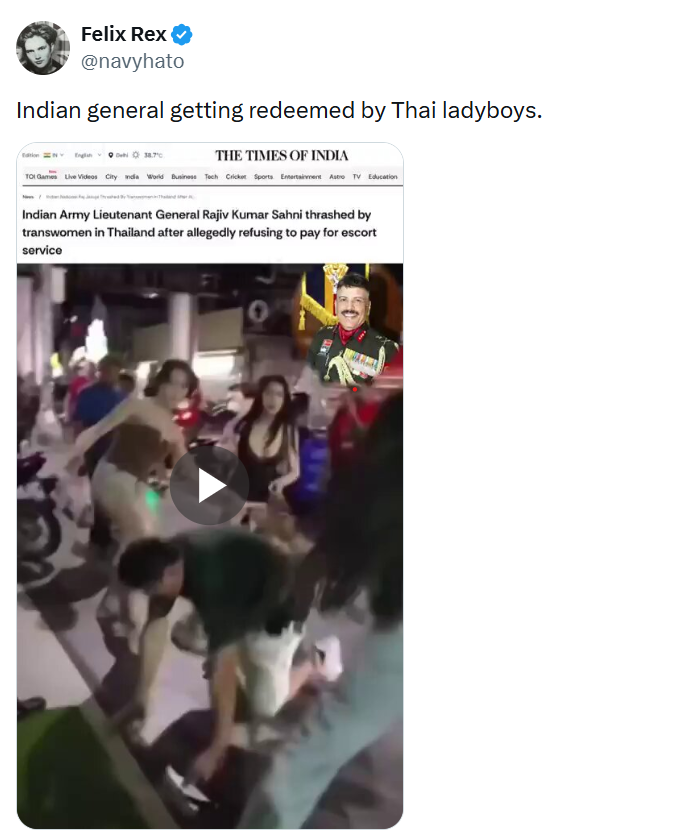
A video shared on social media claims that transgender women assaulted an Indian Army general in Thailand.
https://x.com/navyhato/status/2094322001490116659
https://archive.ph/Scfgd
Fact Check:
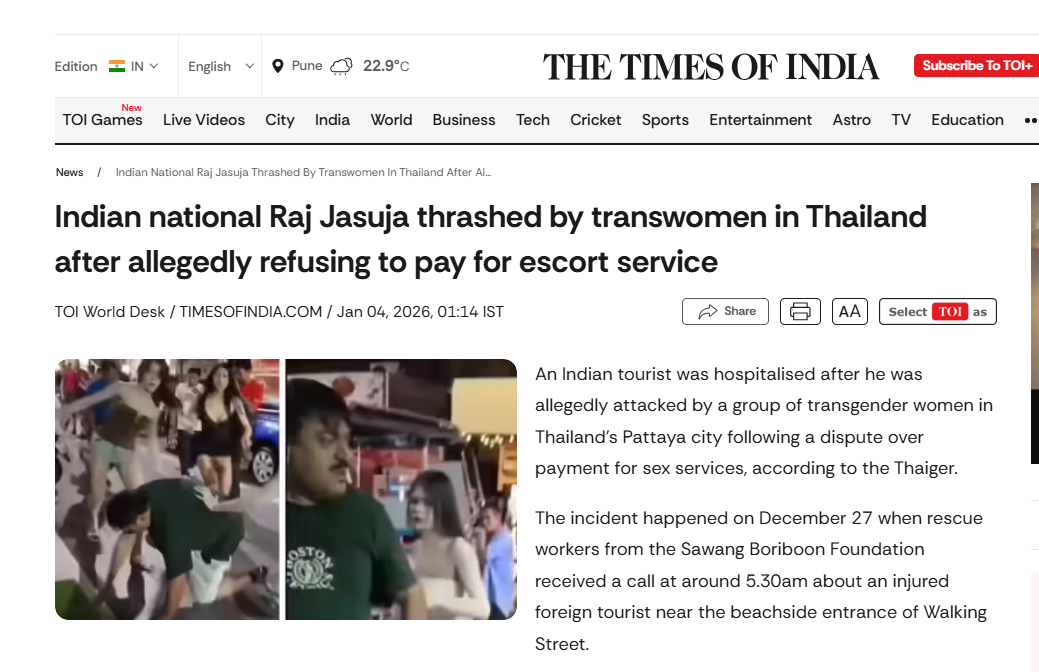
To verify the claim, we conducted a Google search using relevant keywords but found no credible media reports confirming that Indian Army Lieutenant General Rajiv Kumar Sahni was involved in the incident. During the subsequent research, we compared the viral screenshot with the original report published by The Times of India. The comparison revealed that the original headline, “Indian national Raj Jasuja thrashed by transwomen in Thailand after allegedly refusing to pay for escort service,” had been digitally altered to read, “Indian Army Lieutenant General Rajiv Kumar Sahni thrashed by transwomen in Thailand after allegedly refusing to pay for escort service.” Further, both the viral screenshot and the original report display the same breadcrumb trail — “News / Indian National Raj Jasuja Thrashed By Transwomen In T…”. This provides further evidence that the headline in the viral screenshot was digitally manipulated.
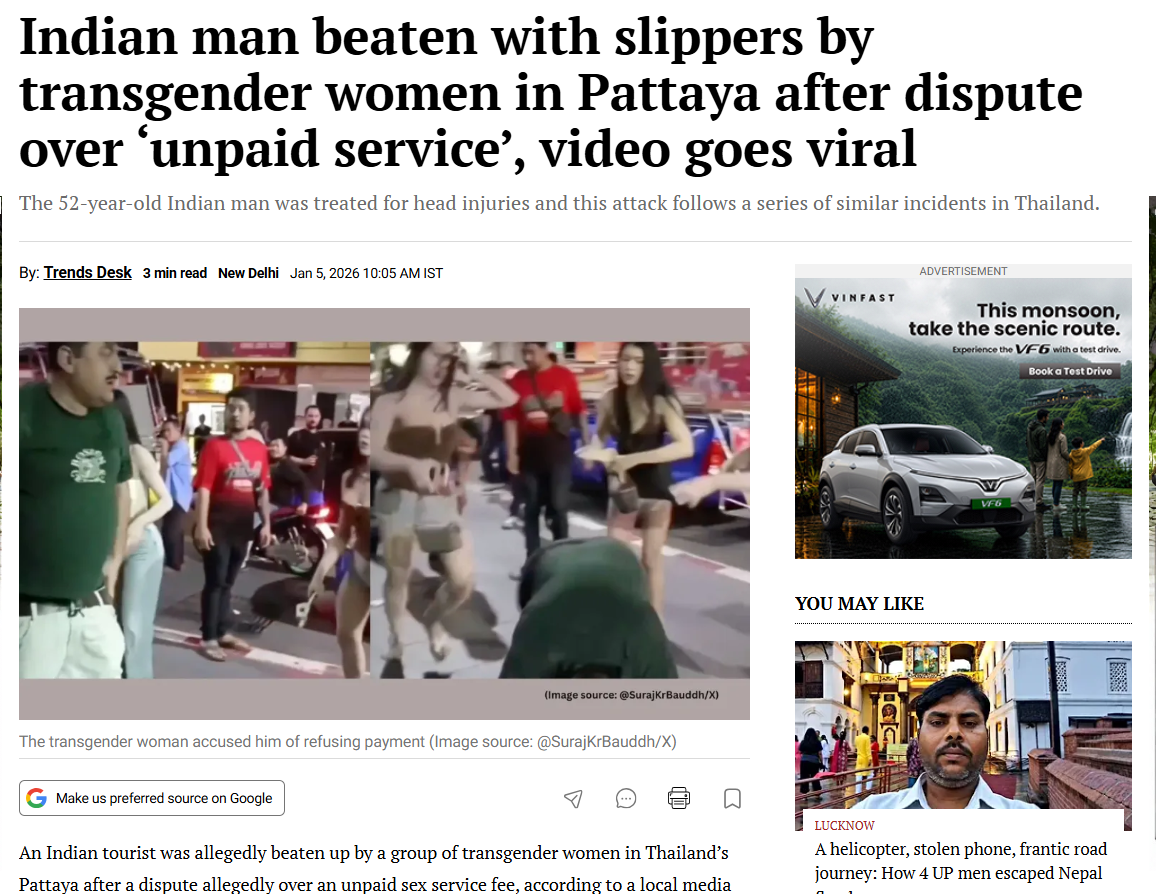
After establishing the context of the viral claim, we conducted a Google search using relevant keywords. During the search, we found a report published on The Indian Express website on January 5, 2026, which featured the same visuals as those seen in the viral video. According to the report, a 52-year-old Indian tourist was allegedly assaulted by a group of transgender women in Pattaya, Thailand. The incident reportedly stemmed from a dispute over an unpaid fee for sexual services. The viral video, recorded on December 27, shows three transgender women allegedly assaulting the man with slippers. According to the report, the dispute escalated after the man allegedly refused to pay the amount demanded and attempted to leave the spot in a car. One of the transgender women reportedly accused him of refusing to make the payment. He was subsequently kicked and beaten before emergency responders intervened.
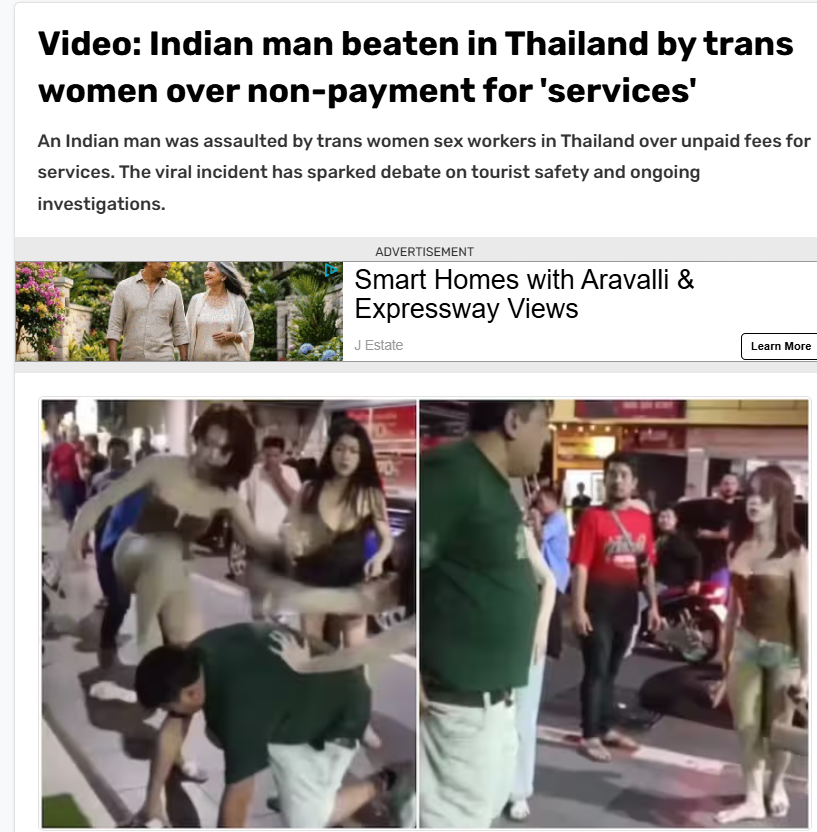
In the next step of our research, we found another report published on the India Today website on January 5, 2026. The report featured the same visuals as those seen in the viral video. According to the report, the incident took place on the morning of December 27, 2025, in the Walking Street area of Pattaya, Thailand.
Conclusion:
Our research found that the claim that Indian Army Lieutenant General Rajiv Kumar Sahni was assaulted in Thailand is false. The viral video actually shows an incident that took place in Pattaya, Thailand, in December 2025, in which 52-year-old Indian national Raj Jasuja was allegedly assaulted by a group of transgender women following a dispute over payment for sexual services. The viral post falsely links the incident to an Indian Army officer, thereby misrepresenting the identity of the person involved.

Related Blogs
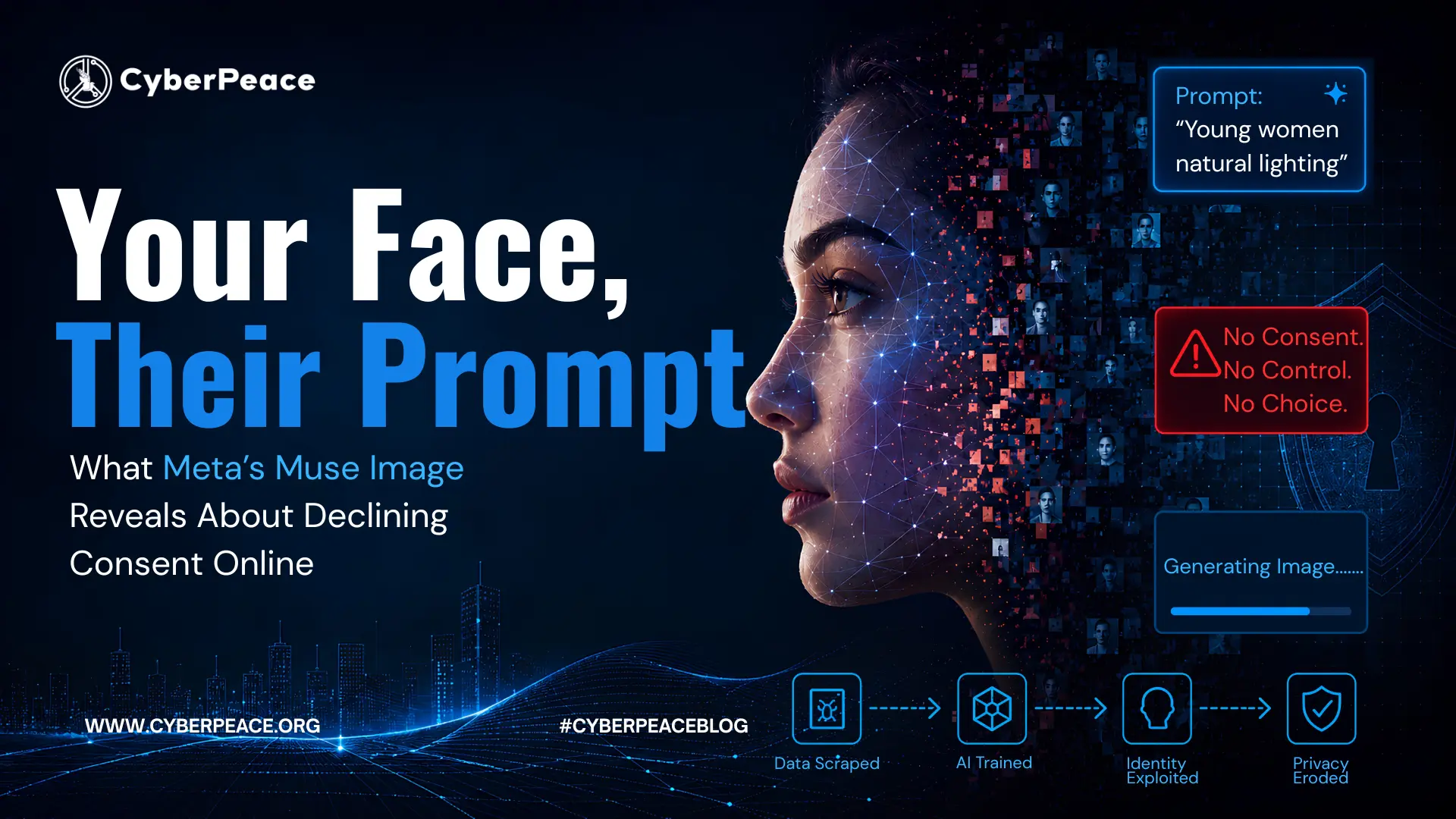
When your digital identity becomes raw material for someone else’s imagination, who really owns your face?
On July 7, 2026, Meta launched Muse Image, the first standalone image-generation model developed by Meta Superintelligence Labs under Alexandr Wang. Positioned as a competitor to OpenAI’s GPT Images 2.0 and Google’s Nano Banana 2, the launch highlights Meta’s growing ambitions in the generative AI race. Yet beneath the technical advancements lies a far more consequential question than what AI can create, but about who gets to decide what it creates with?
That ambition of generative AI comes with a cost, and one of Muse Image's most controversial design choices is its integration with Instagram, which allows public profiles to become creative references for AI-generated images. Users can tag public Instagram accounts in prompts and generate AI images inspired by that person’s publicly available content. Meta presents this as a new form of personalization and creativity. However, critics argue that the feature transforms years of personal photographs into a massive library of AI-ready human identities, where non-action automatically becomes permission. The concern is not just that AI can generate realistic images. The concern is that consent itself is being manipulated in a way.
The opt-out system most users never asked for
Muse Image operates through Meta AI’s integration with Instagram. A user can reference a public Instagram profile in a prompt, allowing the system to generate images influenced by that person’s existing content and likeness. Under the default arrangement, the person whose profile is being referenced may not necessarily approve the generation beforehand.
Meta does provide users with controls to restrict this functionality. The setting exists under Instagram’s “Sharing and reuse” options, where users can disable permissions related to the use of their posts and reels with Meta’s AI features. But the larger issue is the direction in which responsibility flows. Instead of requiring active permission before someone’s likeness becomes available for AI-generated content, the burden is placed on individuals to discover the feature, understand the implications, locate the setting, and disable it. In a digital environment where users already navigate endless privacy menus, cookie banners, and terms of service agreements, expecting meaningful awareness from billions of people becomes unrealistic. Consent that depends on finding the exit door is very different from consent that begins with a choice.
A guide for opting-out
One way of opting out is to have a private account. As verified, Meta does not encroach on private accounts as of now for image-generation.
But if you have a public account, here are the steps that can be followed to secure yourself from Meta’s Muse automatic consent:
On your profile, tap the menu bar which is on the top right (≡), you will enter into ‘setting and activity’, after that you will see an option of ‘sharing and refuse’ and then disable the options under it, namely- Allow people to reuse your content on Instagram and with AI features at Meta. Notably, the changes made will be only for your future content not the already existing content on your public profile.
Why “public” does not mean “available for anything”
The debate around Muse Image highlights a deeper misunderstanding at the center of modern digital platforms: the difference between visibility and reuse. When someone makes an Instagram account public, they are generally making a decision about the audience. They are allowing others to view their photos, discover their profile, or engage with their content. That decision was never traditionally understood as permission for their face, appearance, personal moments, or identity markers to become reusable components in AI-generated media. A photograph posted online has context. It represents a specific moment, purpose, relationship, or expression. Generative AI changes that equation because it separates identity from context. A person’s likeness can be extracted from its original context and placed into entirely new situations created by someone else. Muse Image does not just expand who can see your content. It expands what can be done with it. That distinction is what scales the problem for every public user on the app. The privacy implications become significantly larger because of Instagram’s global reach. With billions of users worldwide, even a small percentage of affected public accounts represents an enormous number of people. Many public profiles do not belong to celebrities, influencers, or creators who intentionally operate as public brands. They belong to students, professionals, small businesses, artists, photographers, and everyday users who simply chose visibility within a social network.
For years, platforms encouraged people to share more, build audiences, and maintain a public digital presence. Now, the meaning of that public presence is changing after the fact. The question becomes: should a decision made years ago to share photos socially automatically extend into permission for generative AI systems built years later?
There is also a catch while opting out. Changing these settings only protects your content from being used in future AI generations, it does not undo anything that has already happened. Any AI images previously created using your public profile will remain unaffected. Essentially, the opt-out works as a shield for what comes next, not a reset button for what has already been created.
A familiar pattern in the AI era
Muse Image reflects a broader pattern emerging across the technology industry. New AI capabilities are introduced at massive scale, participation becomes the default, and individual control arrives afterward through settings that many users may never find. The same debates that once surrounded targeted advertising, data collection, and algorithmic profiling are now moving into a far more personal territory, the human identity itself. Faces are not ordinary data points. Unlike a username, password, or preference setting, a person cannot simply replace their appearance once it has been widely replicated.
Technical solutions such as AI watermarking and content labels may help identify generated material, but they address authenticity after creation. They do not answer the question of whether the generation should have happened in the first place.
Innovation cannot replace consent
The technological progress behind Muse Image is significant. Better image generation, improved text rendering, and more personalized creative tools represent genuine advances in artificial intelligence. But capability alone cannot determine acceptability. The future of AI will not only depend on how realistic images become, how powerful models become, or how quickly companies can deploy new features. It will also depend on whether people feel they have meaningful control over their own digital identities. Muse Image is therefore more than another AI product launch. It represents a defining question for the next phase of the internet: Will our online presence remain something we control, or will it become something others can generate?

Executive Summary
A video showing a scuffle between a group of women and police personnel is being widely shared on social media with the claim that it shows Delhi Police assaulting women protesters at Jantar Mantar. CyberPeace Research Wing ’s research found the claim to be misleading. The viral video is not from Jantar Mantar in Delhi but from an unrelated incident in Dehradun, Uttarakhand. The old footage is being falsely circulated as a recent video from the ongoing protests.
Claim:
A Facebook user shared the viral video claiming that Delhi Police personnel were assaulting women and girls during the protest at Jantar Mantar.
The post link, archive link and screenshot are provided below.
https://www.facebook.com/reel/2864826433884333

Fact Check:
To verify the claim, we extracted keyframes from the viral video and conducted a reverse image search using Google Lens. This led us to the same video uploaded on the Instagram account iamvikasbaliyan on October 15, 2025.
https://www.instagram.com/reels/DP0H_SSE625/
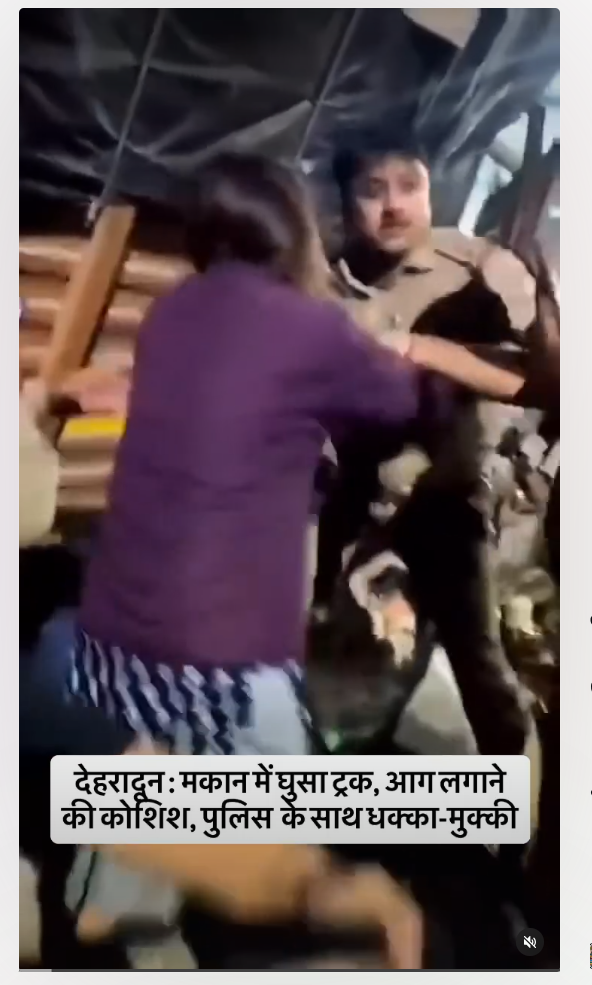
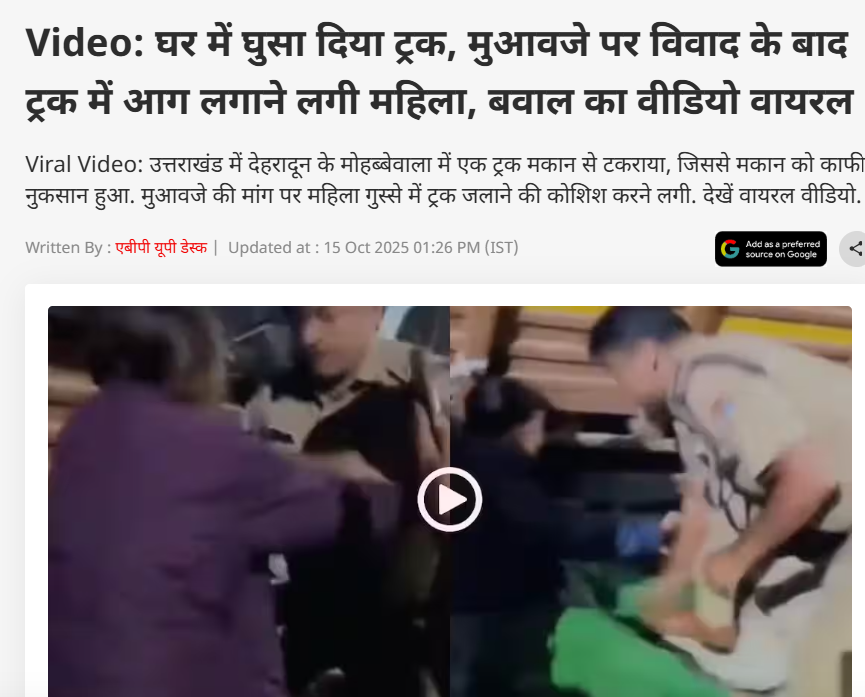
According to the information shared with the post, the incident took place in Mohabbewala, Dehradun, Uttarakhand, after a truck crashed into a house, damaging the property. The homeowner allegedly demanded compensation and, when the issue remained unresolved, attempted to set the truck on fire. When police personnel intervened to stop her, a scuffle broke out between the woman and the police. The viral video captures this incident. In the next stage of the research, we found an ABP News report published on October 15, 2025, carrying the same visuals as the viral video. The report also identified the incident as having occurred in Mohabbewala, Dehradun.
Conclusion:
CyberPeace Research Wing ’s research found the viral claim to be misleading. The video does not show Delhi Police assaulting women protesters at Jantar Mantar. It is an old video from Dehradun, Uttarakhand, showing an unrelated incident that has been falsely linked to the ongoing protests in Delhi.

Introduction
In the digital landscape, there is a rapid advancement of technologies such as generative AI(Artificial Intelligence), deepfake, machine learning, etc. Such technologies offer convenience to users in performing several tasks and are capable of assisting individuals and business entities. Certain regulatory mechanisms are also established for the ethical and reasonable use of such advanced technologies. However, these technologies are easily accessible; hence, cyber-criminals leverage AI tools and technologies for malicious activities or for committing various cyber frauds. By such misuse of advanced technologies, new cyber threats have emerged.
Deepfake Scams
Deepfake is an AI-based technology. Deepfake is capable of creating realistic images or videos which in actuality are created by machine algorithms. Deepfake technology, since easily accessible, is misused by fraudsters to commit various cyber crimes or deceive and scam people through fake images or videos that look realistic. By using the Deepfake technology, cybercriminals manipulate audio and video content, which looks very realistic but, in actuality, is fake.
Voice cloning
To create a voice clone of anyone's, audio can be deepfaked too, which closely resembles a real one but, in actuality, is a fake voice created through deepfake technology. Recently, in Kerala, a man fell victim to an AI-based video call on WhatsApp. He received a video call from a person claiming to be his former colleague. The scammer, using AI deepfake technology, impersonated the face of his former colleague and asked for financial help of 40,000.
Uttarakhand Police issues warning admitting the rising trend of AI-based scams
Recently, Uttarakhand police’s Special Task Force (STF) has issued a warning admitting the widespread of AI technology-based scams such as deepfake or voice cloning scams targeting innocent people. Police expressed concern that several incidents have been reported where innocent people are lured by cybercriminals. Cybercriminals exploit advanced technologies and manipulate innocent people to believe that they are talking to their close ones or friends, but in actuality, they are fake voice clones or deepfake video calls. In this way, cybercriminals ask for immediate financial help, which ultimately leads to financial losses for victims of such scams.
Tamil Nadu Police Issues advisory on deepfake scams
To deceive people, cyber criminals misuse deepfake technologies and target them for financial gain. Recently, Tamilnadu Police Cyberwing have issued an advisory on rising deepfake scams. Fraudsters are creating highly convincing images, videos or voice clones to defraud innocent people and make them victims of financial fraud. The advisory states that you limit the personal data you share you share online and adjust privacy settings. Advisory says to promptly report any suspicious activity or cyber crimes to 1930 or the National Cyber Crime Reporting portal.
Best practices
- Pay attention if you notice compromised video quality because deepfake videos often have compromised or poor video quality and unusual blur resolution, which poses a question to its genuineness. Deepfake videos often loop or unusually freeze, which indicates that the video content might be fabricated.
- Whenever you receive requests for any immediate financial help, act responsively and verify the situation by directly contacting the person on his primary contact number.
- You need to be vigilant and cautious, since scammers often possess a sense of urgency, leading to giving no time for the victim to think about it and deceiving them by making a quick decision. Scammers pose sudden emergencies and demand financial support on an urgent basis.
- Be aware of the recent scams and follow the best practices to stay protected from rising cyber frauds.
- Verify the identity of unknown callers.
- Utilise privacy settings on your social media.
- Pay attention if you notice any suspicious nature, and avoid sharing voice notes with unknown users because scammers might use them as voice samples and create your voice clone.
- If you fall victim to such frauds, one powerful resource available is the National Cyber Crime Reporting Portal (www.cybercrime.gov.in) and the 1930 toll-free helpline number where you can report cyber fraud, including any financial crimes.
Conclusion
AI-powered technologies are leveraged by cybercriminals to commit cyber crimes such as deepfake scams, voice clone scams, etc. Where innocent people are lured by scammers. Hence there is a need for awareness and caution among the people. We should be vigilant and aware of the growing incidents of AI-based cyber scams. Must follow the best practices to stay protected.
References:
- https://www.the420.in/ai-voice-cloning-cyber-crime-alert-uttarakhand-police/
- https://www.trendmicro.com/vinfo/us/security/news/cybercrime-and-digital-threats/exploiting-ai-how-cybercriminals-misuse-abuse-ai-and-ml#:~:text=AI%20and%20ML%20Misuses%20and%20Abuses%20in%20the%20Future&text=Through%20the%20use%20of%20AI,and%20business%20processes%20are%20compromised.
- https://www.ndtv.com/india-news/kerala-man-loses-rs-40-000-to-ai-based-deepfake-scam-heres-what-it-is-4217841
- https://news.bharattimes.co.in/t-n-cybercrime-police-issue-advisory-on-deepfake-scams/
