
#FactCheck-Misleading Video of Building Collapse in Turkey Falsely Shared as Venezuela Earthquake Footage
Executive Summary
A video is being widely shared on social media, claiming it shows a terrifying scene from a recent earthquake in Venezuela. The 9-second clip shows a multi-storey building collapsing like a house of cards, while people nearby are seen running in panic as chaos unfolds. The video is being widely circulated by users as evidence of massive destruction caused by the alleged earthquake in Venezuela. CyberPeace Research Wing research found the claim to be misleading. The viral video has no connection to any recent earthquake in Venezuela. In fact, the footage is from a completely different event that took place nearly three years ago in Turkey. It is being falsely shared with a wrong context on social media.
Claim:
A Facebook user shared the viral video with the caption: “The most dangerous earthquake in 126 years! At least 10,000 deaths in Venezuela earthquake, shocking claim by USGS. Reports say massive destruction has occurred, Caracas airport has also been destroyed. Statement by Yogi Adityanath after Bharat Tiwari’s encounter.” The post link, archived link, and screenshots are provided below.
https://www.facebook.com/groups/2438255879794217/posts/4830038697282578/

FactCheck
To verify the claim, we performed a reverse image search of the video keyframes using Google Lens. During the search, we found the same video on WION’s Facebook page, where it was published on February 6, 2023. The original post link and screenshots are provided below. https://www.facebook.com/watch/?v=917786002738401

The original caption of the video clearly states that it shows a building collapse in Sanliurfa, Turkey, occurring hours after the 7.8-magnitude earthquake that struck the country. Based on clues from the Facebook post, we further searched using relevant keywords and found a report published by The Guardian on February 6, 2023, which also included the viral footage. https://www.theguardian.com/world/video/2023/feb/06/building-collapses-earthquake-aftershock-turkey-video

The report confirms that the video is from the aftermath of the devastating 2023 Turkey earthquake in Sanliurfa, not Venezuela.
Conclusion:
Our research confirms that the viral video has no connection to any recent earthquake in Venezuela. The footage is actually from the 2023 Turkey earthquake and is being falsely shared with a misleading context on social media.

Related Blogs

Introduction
On 1 July 2026, the United Nations published their first draft of the Development of Artificial Intelligence (AI) report. The scientists who authored this document are 40 individuals who comprise the Independent International Scientific Panel on Artificial Intelligence , which was formed by the UN General Assembly in 2025 and chaired by Bengio and Ressa.
The report’s key takeaway message relates to the importance of countries establishing frameworks for the appropriate use of AI technologies as a means of preventing the aggravation of social inequality. UN Secretary-General António Guterres pointed out that without such regulation, society will not be able to enjoy the benefits of these technologies. After all, their explosive development is already beginning to have negative consequences.
This report served as key for the UN Global Dialogue on AI Governance, which was held in Geneva on 6thJuly, 2026.
What Exactly Does the Report Say?
It is not a rulebook, it doesn't create laws. It is more of a survey to get countries on board before they start treaties regarding AI.
This is seen through how much AI has developed from previous technologies, such as electricity taking decades to be common everywhere while the internet took 15 years to get to a billion users, but chatGPT alone got to 100 million users within 2 months. Today, millions of people use AI chatbots, and AI has helped map out 200 million+ protein structures currently helping us get drugs to market much faster.
The report is also cautious. It talks about an "evidence dilemma" , we need evidence to make good AI rules, but by the time it's collected, it might be too late to control the technology. There are 45+ AI frameworks worldwide, but they're disconnected, and some safety checks are done by the same companies that build the AI, raising doubts about their trustworthiness.
The Big Inequality Problem
This is one of the most eye-opening parts of the report. It says the USA has about 75% of the world's most powerful supercomputers, while China has around 15%, together, 90% of the world's top computing power. Most AI models are also built in these two countries, meaning they stand to gain the most from AI's growth.
Here's the shocking part: nearly two-thirds of people in high-income countries will benefit from AI tools. But in low-income countries, only about 5% will see any real benefit. Just because AI tools exist doesn't mean everyone gets equal access — especially poorer countries that depend on other nations for AI tools, cloud services, and data.
The Language Problem
Another major issue is language. Most AI tools work well in English and a few major languages. But for other languages, these tools are far less reliable, which becomes dangerous in fields like healthcare.
The report provides shocking examples of how AI translation software has been mistakenly conflating smallpox with syphilis and gonorrhoea with diabetes. It also describes how an attempt by a nurse to reassure a patient speaking Tigrinya that she was about to be given "IV antibiotics", had in fact, been translated by the software into "IV insecticides".
Other Serious Concerns
The report also warns about darker uses of AI, like creating sexual abuse material and fake explicit videos (deepfakes), which mostly harm women and children. AI-generated disinformation is being used to manipulate elections, while cybercriminals use AI for fraud and other crimes.
In addition, AI could have negative impacts on individuals struggling with mental health issues and even driving vulnerable populations to commit suicide. Moreover, the global AI infrastructure is estimated to release huge amounts of CO2 that is contributing to environmental damage.
What the Report Recommends
Because most of the power over AI development will be controlled by major corporations and nations, the report charges that the system is likely to lead to "unjust hierarchical control over critical systems."
To fix this, the suggestions include:
- Independent groups, not AI companies themselves, should test AI systems.
- Countries should cooperate to regulate artificial intelligence technologies instead of imposing a policy on a particular state.
- The states should develop the technical and language expertise to participate in the global negotiations on AI governance.
- However, the global AI governance should address developing countries’ needs to upgrade their infrastructures, such as electricity and data, and strike a balance between sustainability and digitalization.
Conclusion
This UN report is an important first step, giving countries real scientific evidence as they move towards binding international agreements on AI. Its biggest takeaway is this: AI itself is neutral — neither good nor bad on its own. What makes it good or bad for the world are the choices made by governments, firms, and societies in regulating it. Without proper control, AI technologies may well make inequality even worse than it already is. The negotiations to come will be critical in determining the future of the technology.
References
- United Nations News, 'AI explained: Why the world needs to act now', 1 July 2026
- Euronews, 'Window to control AI is closing and it could widen inequality, UN experts warn', 2 July 2026
- Irish Examiner, 'Rapid spread of AI may worsen global inequality, UN warns', 1 July 2026
- Reuters, 'UN report sees enormous potential benefits, big risks in AI', 1 July 2026
- Preliminary Report of the Independent International Scientific Panel on Artificial Intelligence, United Nations, July 2026

Introduction
On March 12, the Ministry of Corporate Affairs (MCA) proposed the Bill to curb anti-competitive practices of tech giants through ex-ante regulation. The Draft Digital Competition Bill is to apply to ‘Core Digital Services,’ with the Central Government having the authority to update the list periodically. The proposed list in the Bill encompasses online search engines, online social networking services, video-sharing platforms, interpersonal communications services, operating systems, web browsers, cloud services, advertising services, and online intermediation services.
The primary highlight of the Digital Competition Law Report created by the Committee on Digital Competition Law presented to the Parliament in the 2nd week of March 2024 involves a recommendation to introduce new legislation called the ‘Digital Competition Act,’ intended to strike a balance between certainty and flexibility. The report identified ten anti-competitive practices relevant to digital enterprises in India. These are anti-steering, platform neutrality/self-preferencing, bundling and tying, data usage (use of non-public data), pricing/ deep discounting, exclusive tie-ups, search and ranking preferencing, restricting third-party applications and finally advertising Policies.
Key Take-Aways: Digital Competition Bill, 2024
- Qualitative and quantitative criteria for identifying Systematically Significant Digital Enterprises, if it meets any of the specified thresholds.
- Financial thresholds in each of the immediately preceding three financial years like turnover in India, global turnover, gross merchandise value in India, or global market capitalization.
- User thresholds in each of the immediately preceding 3 financial years in India like the core digital service provided by the enterprise has at least 1 crore end users, or it has at least 10,000 business users.
- The Commission may make the designation based on other factors such as the size and resources of an enterprise, number of business or end users, market structure and size, scale and scope of activities of an enterprise and any other relevant factor.
- A period of 90 days is provided to notify the CCI of qualification as an SSDE. Additionally, the enterprise must also notify the Commission of other enterprises within the group that are directly or indirectly involved in the provision of Core Digital Services, as Associate Digital Enterprises (ADE) and the qualification shall be for 3 years.
- It prescribes obligations for SSDEs and their ADEs upon designation. The enterprise must comply with certain obligations regarding Core Digital Services, and non-compliance with the same shall result in penalties. Enterprises must not directly or indirectly prevent or restrict business users or end users from raising any issue of non-compliance with the enterprise’s obligations under the Act.
- Avoidance of favouritism in product offerings by SSDE, its related parties, or third parties for the manufacture and sale of products or provision of services over those offered by third-party business users on the Core Digital Service in any manner.
- The Commission will be having the same powers as vested to a civil court under the Code of Civil Procedure, 1908 when trying a suit.
- Penalty for non-compliance without reasonable cause may extend to Rs 1 lakh for each day during which such non-compliance occurs (max. of Rs 10 crore). It may extend to 3 years or with a fine, which may extend to Rs 25 crore or with both. The Commission may also pass an order imposing a penalty on an enterprise (not exceeding 1% of the global turnover) in case it provides incorrect, incomplete, misleading information or fails to provide information.
Suggestions and Recommendations
- The ex-ante model of regulation needs to be examined for the Indian scenario and studies need to be conducted on it has worked previously in different jurisdictions like the EU.
- The Bill should be aimed at prioritising the fostering of fair competition by preventing monopolistic practices in digital markets exclusively. A clear distinction from the already existing Competition Act, 2002 in its functioning needs to be created so that there is no overlap in the regulations and double jeopardy is not created for enterprises.
- Restrictions on tying and bundling and data usage have been shown to negatively impact MSMEs that rely significantly on big tech to reduce operational costs and enhance customer outreach.
- Clear definitions of "dominant position" and "anti-competitive behaviour" are essential for effective enforcement in terms of digital competition need to be defined.
- Encouraging innovation while safeguarding consumer data privacy in consonance with the DPDP Act should be the aim. Promoting interoperability and transparency in algorithms can prevent discriminatory practices.
- Regular reviews and stakeholder consultations will ensure the law adapts to rapidly evolving technologies.
- Collaboration with global antitrust bodies which is aimed at enhancing cross-border regulatory coherence and effectiveness.
Conclusion
The need for a competition law that is focused exclusively on Digital Enterprises is the need of the hour and hence the Committee recommended enacting the Digital Competition Act to enable CCI to selectively regulate large digital enterprises. The proposed legislation should be restricted to regulate only those enterprises that have a significant presence and ability to influence the Indian digital market. The impact of the law needs to be restrictive to digital enterprises and it should not encroach upon matters not influenced by the digital arena. India's proposed Digital Competition Bill aims to promote competition and fairness in the digital market by addressing anti-competitive practices and dominant position abuses prevalent in the digital business space. The Ministry of Corporate Affairs has received 41-page public feedback on the draft which is expected to be tabled next year in front of the Parliament.
References
- https://www.medianama.com/wp-content/uploads/2024/03/DRAFT-DIGITAL-COMPETITION-BILL-2024.pdf
- https://prsindia.org/files/policy/policy_committee_reports/Report_Summary-Digital_Competition_Law.pdf
- https://economictimes.indiatimes.com/tech/startups/meity-meets-india-inc-to-hear-out-digital-competition-law-concerns/articleshow/111091837.cms?from=mdr
- https://www.mca.gov.in/bin/dms/getdocument?mds=gzGtvSkE3zIVhAuBe2pbow%253D%253D&type=open
- https://www.barandbench.com/law-firms/view-point/digital-competition-laws-beginning-of-a-new-era
- https://www.linkedin.com/pulse/policy-explainer-digital-competition-bill-nimisha-srivastava-lhltc/
- https://www.lexology.com/library/detail.aspx?g=5722a078-1839-4ece-aec9-49336ff53b6c

Executive Summary
A collage made by combining two images is going viral on social media. It is being shared as being related to the recent devastating floods in Nepal. One image in the collage shows a beautiful town before the floods, while the other depicts the destruction caused by the flooding. A research done by the Research Wing of the CyberPeace found the viral claim to be false. The research revealed that the viral image collage circulating on social media is AI-generated and is being falsely shared as visuals of the recent floods in Nepal.
Claim:
A user on social media platform Facebook shared the viral collage with the caption: “Nepal in the morning, Nepal in the evening. The tragedy has shaken all of humanity. The flood originating from China-occupied Tibet devastated Nepal in an instant.”
The link to the post, its archived version, and a screenshot are provided below.
https://www.facebook.com/photo/?fbid=1630488505774559&set=a.467756888714399

Fact Check
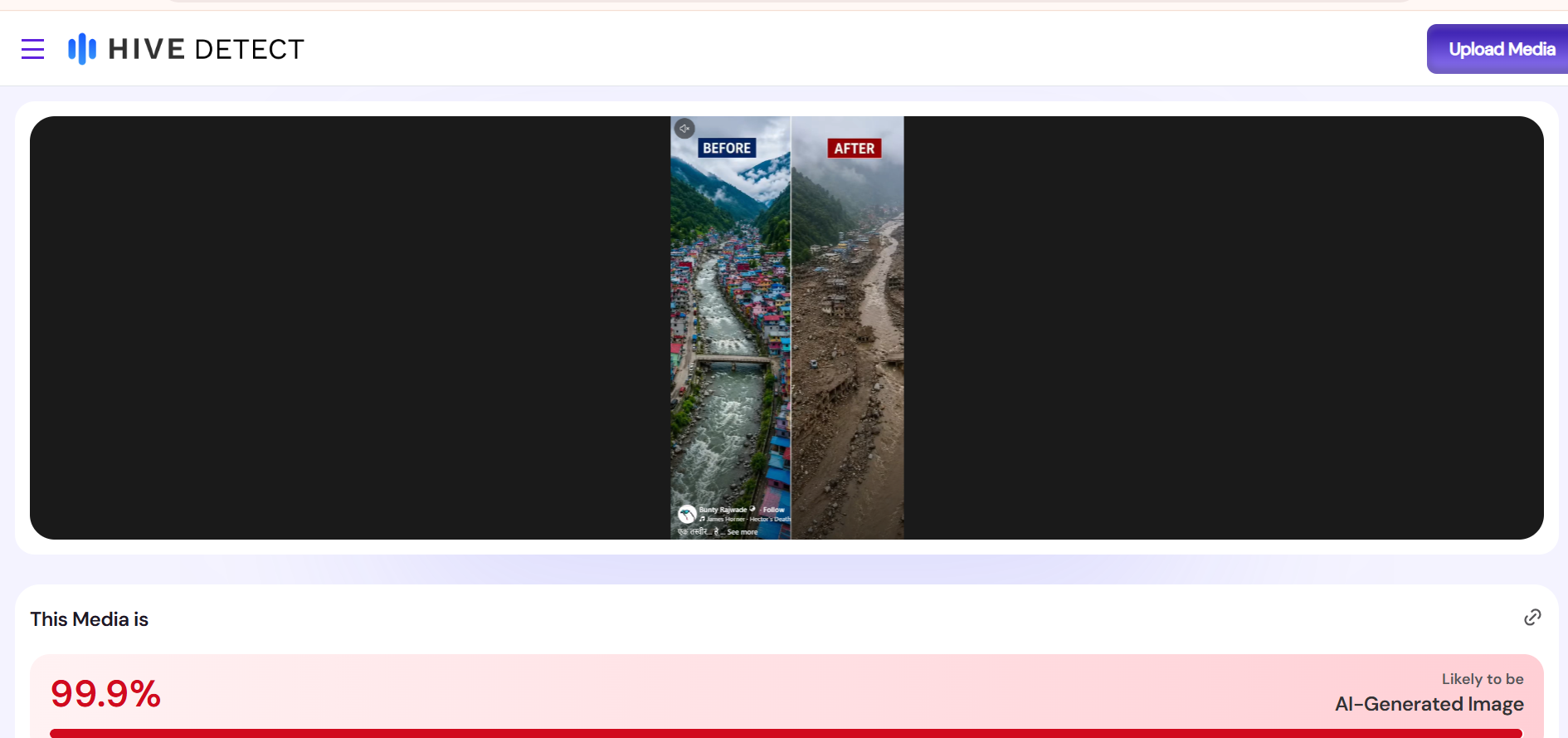
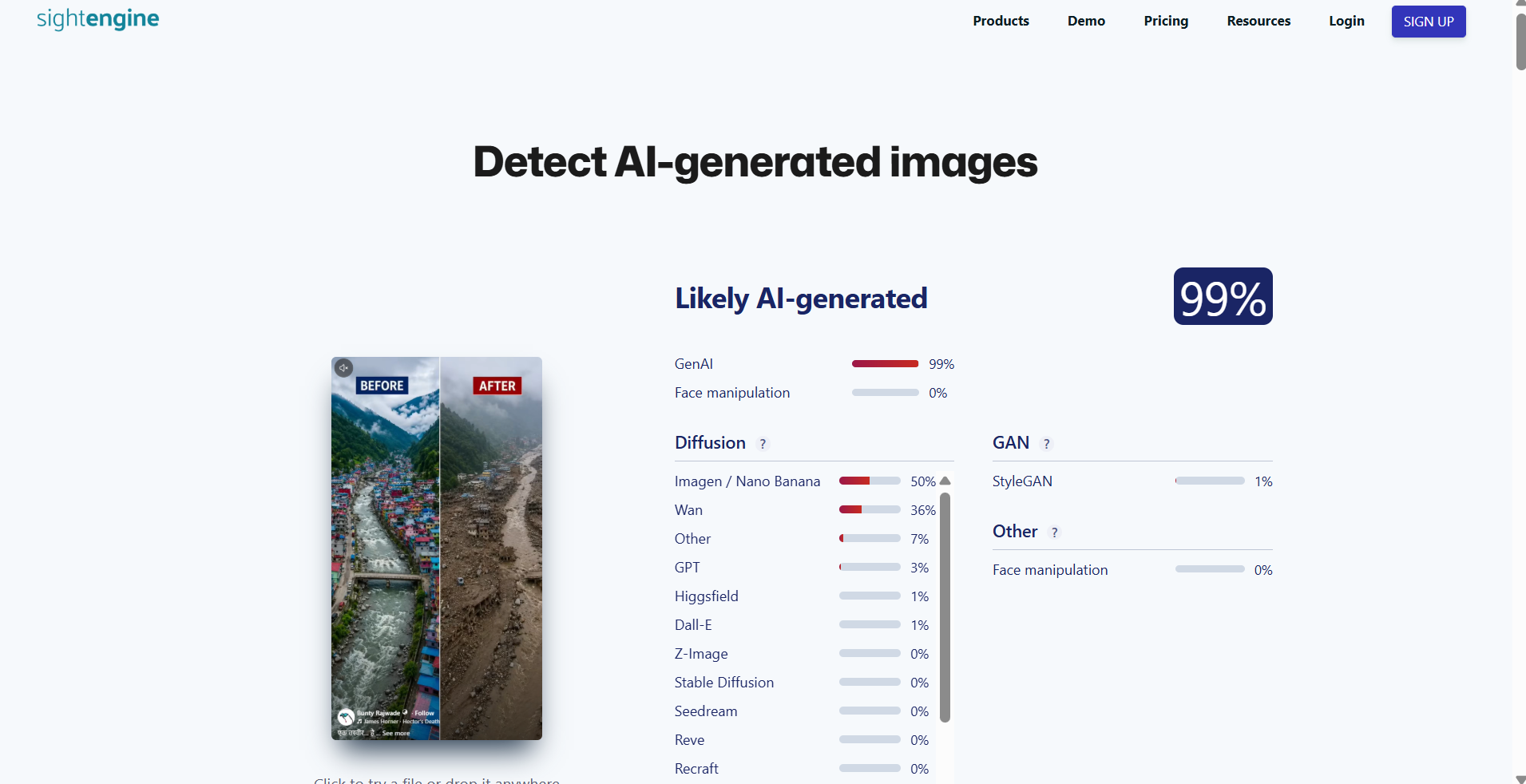
To verify the authenticity of the viral images, the desk first conducted a reverse image search. However, the search did not lead us to any credible media reports or original sources featuring these images. We then closely examined the images. The analysis revealed several anomalies in the structure of the buildings, the vehicles visible on the road, and other elements in the images, further strengthening the suspicion that they were AI-generated. We then scanned the viral image using the AI detection tool Hive Moderation. The tool’s analysis indicated a 99 percent likelihood that the image was AI-generated.
We then scanned the viral image using the AI detection tool Sightengine as well. The tool’s analysis indicated a 99 percent likelihood that the image was AI-generated.
Conclusion
Our research found that the viral collage of images being shared on social media is AI-generated and is being falsely linked to the recent floods in Nepal.
