
#FactCheck:False Claims of Israeli Attack on Indian Embassy Official and MEA Summoning Israeli Ambassador Circulate Alongside Misleading Video
Executive Summary
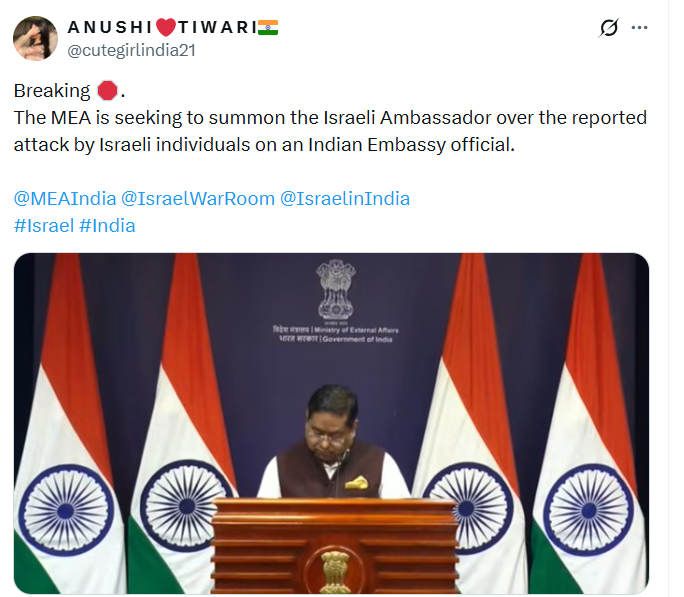
Pakistani propaganda accounts are using fake identities in the names of Indian citizens to circulate claims on social media that the Ministry of External Affairs (MEA) is seeking to summon the Israeli Ambassador over an alleged attack by Israeli individuals on an Indian Embassy official. CyberPeace Research found that the claims regarding an alleged attack by Israeli individuals on an Indian Embassy official are completely baseless and fabricated. These claims are being circulated by Pakistani propaganda networks as part of an ongoing disinformation campaign against India.
Claim:
The Ministry of External Affairs (MEA) has sought to summon the Israeli Ambassador over an alleged attack by Israeli individuals on an Indian Embassy official.
https://x.com/cutegirlindia21/status/2123732811555508496
FACT CHECK
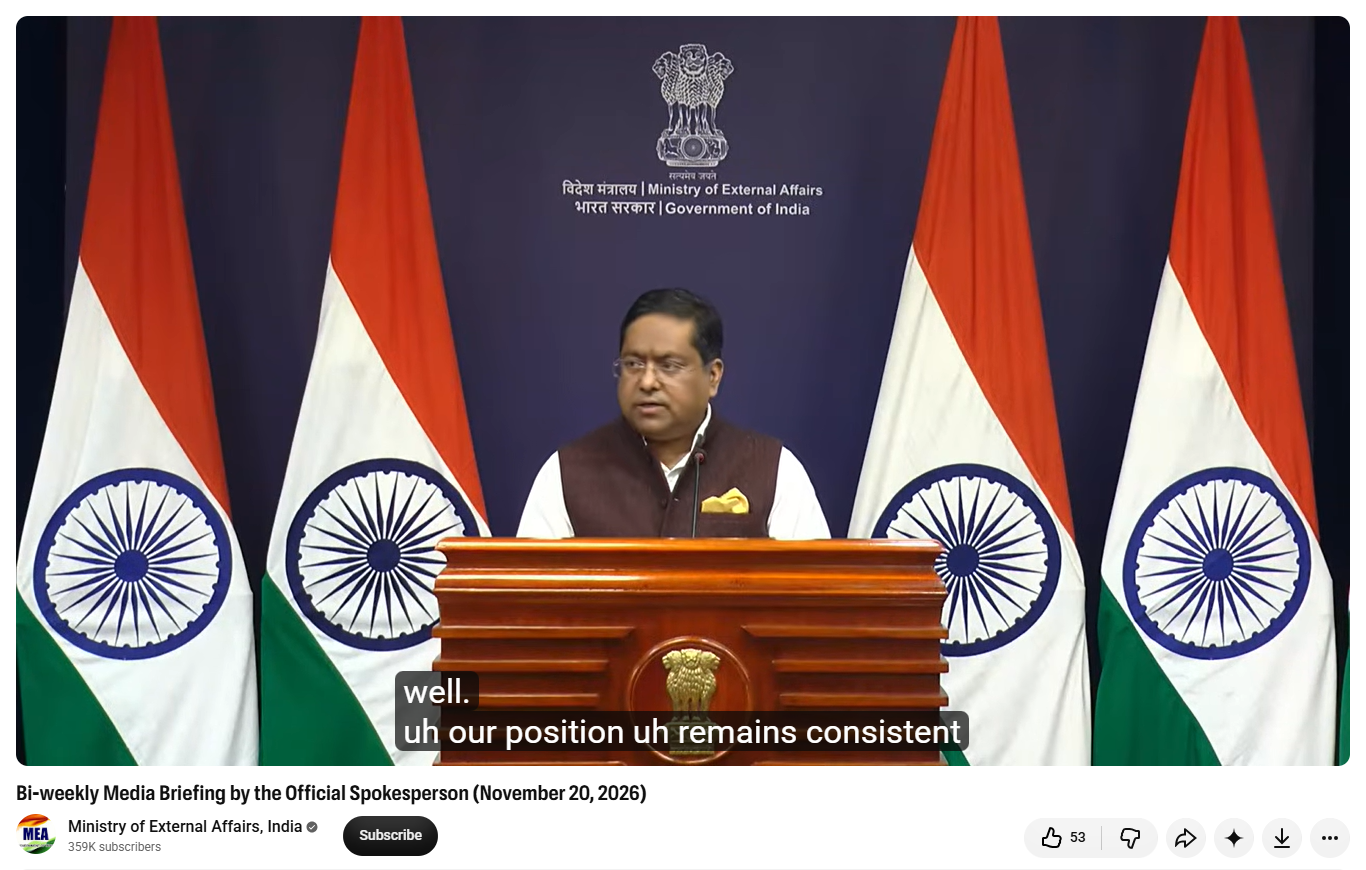
A reverse image search of the keyframes from the viral video led us to the original footage on the official YouTube channel of India's Ministry of External Affairs (MEA). Our research revealed that the video is from the MEA's bi-weekly media briefing held on November 20, 2026, during which the ministry's official spokesperson was responding to questions from journalists.
Furthermore, our research found no credible evidence to substantiate the claims that Israeli individuals attacked an Indian Embassy official or that the Israeli Ambassador was to be summoned in connection with the alleged incident. The claims are baseless and unsubstantiated.
https://www.youtube.com/live/NZ2e9raZ8eA
Conclusion:
Our research found that the claims of Israeli individuals attacking an Indian Embassy official and the Ministry of External Affairs summoning the Israeli Ambassador in connection with the alleged incident are completely baseless. The viral video is actually from the regular media briefing held by India's Ministry of External Affairs on November 20, 2026. The video is being shared on social media with misleading claims by presenting it out of its original context.

Related Blogs

Executive Summary:
False information spread on social media that Flight Lieutenant Shivangi Singh, India’s first female Rafale pilot, had been captured by Pakistan during “Operation Sindoor”. The allegations are untrue and baseless as no credible or official confirmation supports the claim, and Singh is confirmed to be safe and actively serving. The rumor, likely originating from unverified sources, sparked public concern and underscored the serious threat fake news poses to national security.
Claim:
An X user posted stating that “ Initial image released of a female Indian Shivani singh Rafale pilot shot down in Pakistan”. It was falsely claimed that Flight Lieutenant Shivangi Singh had been captured, and that the Rafale aircraft was shot down by Pakistan.


Fact Check:
After doing reverse image search, we found an instagram post stating the two Indian Air Force pilots—Wing Commander Tejpal (50) and trainee Bhoomika (28)—who had ejected from a Kiran Jet Trainer during a routine training sortie from Bengaluru before it crashed near Bhogapuram village in Karnataka. The aircraft exploded upon impact, but both pilots were later found alive, though injured and exhausted.

Also we found a youtube channel which is showing the video from the past and not what it was claimed to be.

Conclusion:
The false claims about Flight Lieutenant Shivangi Singh being captured by Pakistan and her Rafale jet being shot down have been debunked. The image used was unrelated and showed IAF pilots from a separate training incident. Several media also confirmed that its video made no mention of Ms. Singh’s arrest. This highlights the dangers of misinformation, especially concerning national security. Verifying facts through credible sources and avoiding the spread of unverified content is essential to maintain public trust and protect the reputation of those serving in the armed forces.
- Claim: False claims about Flight Lieutenant Shivangi Singh being captured by Pakistan and her Rafale jet being shot down
- Claimed On: Social Media
- Fact Check: False and Misleading
Introduction
With the increasing reliance on digital technologies in the banking industry, cyber threats have become a significant concern. Cyberlaw plays a crucial role in safeguarding the banking sector from cybercrimes and ensuring the security and integrity of financial systems.
The banking industry has witnessed a rapid digital transformation, enabling convenient services and greater access to financial resources. However, this digitalisation also exposes the industry to cyber threats, necessitating the formulation and implementation of effective cyber law frameworks.
Recent Trends in the Banking Industry
Digital Transformation: The banking industry has embraced digital technologies, such as mobile banking, internet banking, and financial apps, to enhance customer experience and operational efficiency.
Open Banking: The concept of open banking has gained prominence, enabling data sharing between banks and third-party service providers, which introduces new cyber risks.
How Cyber Law Helps the Banking Sector
The banking sector and cyber crime share an unspoken synergy due to the mass digitisation of banking services. Thanks to QR codes, UPI and online banking payments, India is now home to 40% of global online banking transactions. Some critical aspects of the cyber law and banking sector are as follows:
Data Protection: Cyberlaw mandates banks to implement robust data protection measures, including encryption, access controls, and regular security audits, to safeguard customer data.
Incident Response and Reporting: Cyberlaw requires banks to establish incident response plans, promptly report cyber incidents to regulatory authorities, and cooperate in investigations.
Customer Protection: Cyberlaw enforces regulations related to online banking fraud, identity theft, and unauthorised transactions, ensuring that customers are protected from cybercrimes.
Legal Framework: Cyberlaw provides a legal foundation for digitalisation in the banking sector, assuring customers that regulations protect their digital transactions and data.
Cybersecurity Training and Awareness: Cyberlaw encourages banks to conduct regular training programs and create awareness among employees and customers about cyber threats, safe digital practices, and reporting procedures.

RBI Guidelines
The RBI, as India’s central banking institution, has issued comprehensive guidelines to enhance cyber resilience in the banking industry. These guidelines address various aspects, including:
Technology Risk Management
Cyber Security Framework
IT Governance
Cyber Crisis Management Plan
Incident Reporting and Response
Recent Trends in Banking Sector Frauds and the Role of Cyber Law
Phishing Attacks: Cyberlaw helps banks combat phishing attacks by imposing penalties on perpetrators and mandating preventive measures like two-factor authentication.
Insider Threats: Cyberlaw regulations emphasise the need for stringent access controls, employee background checks, and legal consequences for insiders involved in fraudulent activities.
Ransomware Attacks: Cyberlaw frameworks assist banks in dealing with ransomware attacks by enabling legal actions against hackers and promoting preventive measures, such as regular software updates and data backups.
Master Directions on Cyber Resilience and Digital Payment Security Controls for Payment System Operators (PSOs)
Draft of Master Directions on Cyber Resilience and Digital Payment Security Controls for Payment System Operators (PSOs) issued by the Reserve Bank of India (RBI). The directions provide guidelines and requirements for PSOs to improve the safety and security of their payment systems, with a focus on cyber resilience. These guidelines for PSOs include mobile payment service providers like Paytm or digital wallet payment platforms.
Here are the highlights-
The Directions aim to improve the safety and security of payment systems operated by PSOs by providing a framework for overall information security preparedness, with an emphasis on cyber resilience.
The Directions apply to all authorised non-bank PSOs.
PSOs must ensure adherence to these Directions by unregulated entities in their digital payments ecosystem, such as payment gateways, third-party service providers, vendors, and merchants.
The PSO’s Board of Directors is responsible for ensuring adequate oversight over information security risks, including cyber risk and cyber resilience. A sub-committee of the Board may be delegated with primary oversight responsibilities.
PSOs must formulate a Board-approved Information Security (IS) policy that covers roles and responsibilities, measures to identify and manage cyber security risks, training and awareness programs, and more.
PSOs should have a distinct Board-approved Cyber Crisis Management Plan (CCMP) to detect, contain, respond, and recover from cyber threats and attacks.
A senior-level executive, such as a Chief Information Security Officer (CISO), should be responsible for implementing the IS policy and the cyber resilience framework and assessing the overall information security posture of the PSO.
PSOs need to define Key Risk Indicators (KRIs) and Key Performance Indicators (KPIs) to identify potential risk events and assess the effectiveness of security controls. The sub-committee of the Board is responsible for monitoring these indicators.
PSOs should conduct a cyber risk assessment when launching new products, services, technologies, or significant changes to existing infrastructure or processes.
PSOs, including inventory management, identity and access management, network security, application security life cycle, security testing, vendor risk management, data security, patch and change management life cycle, incident response, business continuity planning, API security, employee awareness and training, and other security measures should implement various baseline information security measures and controls.
PSOs should ensure that payment transactions involving debit to accounts conducted electronically are permitted only through multi-factor authentication, except where explicitly permitted/relaxed.

Conclusion
The relationship between cyber law and the banking industry is crucial in ensuring a secure and trusted digital environment. Recent trends indicate that cyber threats are evolving and becoming more sophisticated. Compliance with cyber law provisions and adherence to guidelines such as those provided by the RBI is essential for banks to protect themselves and their customers from cybercrimes. By embracing robust cyber law frameworks, the banking industry can foster a resilient ecosystem that enables innovation while safeguarding the interests of all stakeholders or users.
Executive Summary
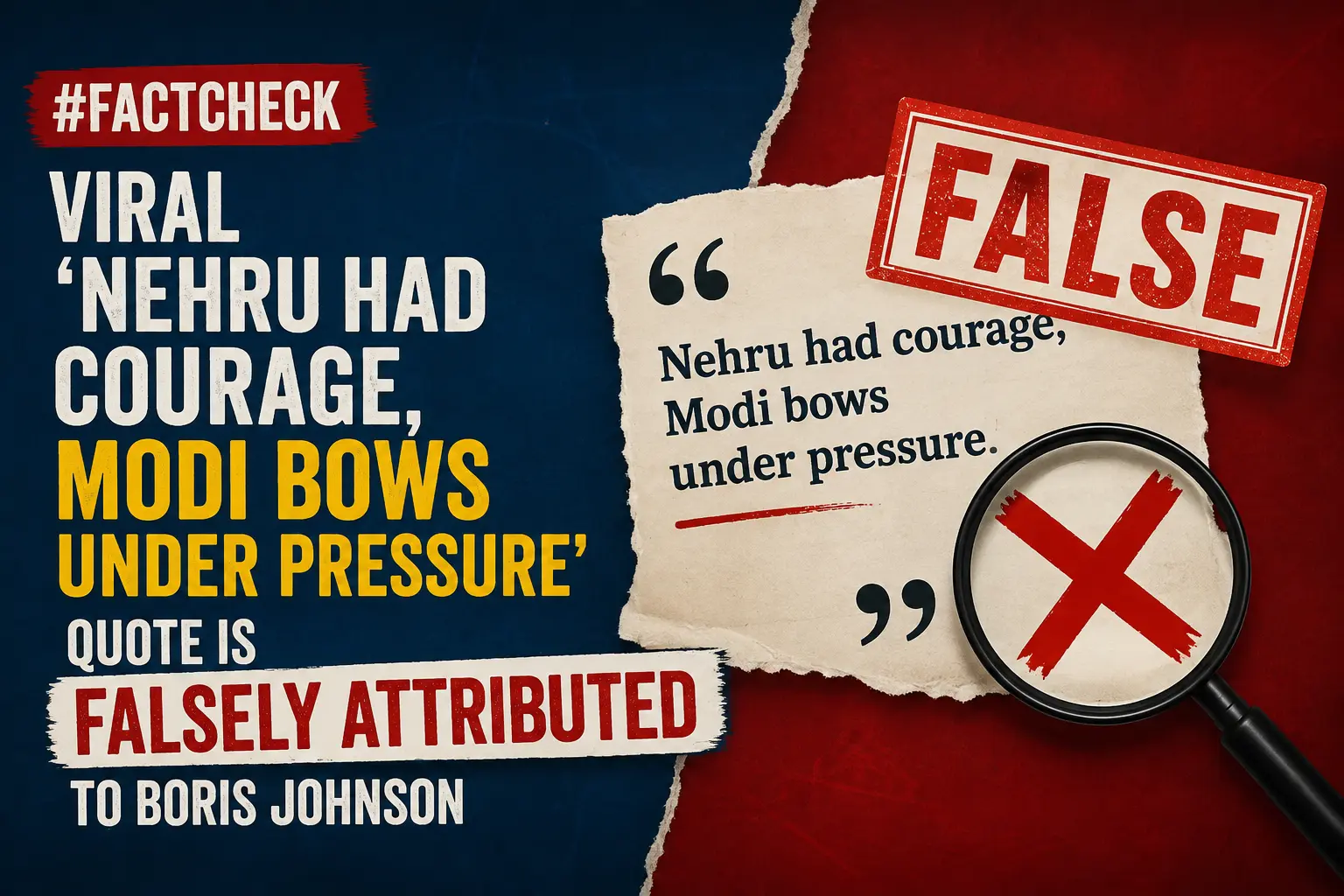
A purported statement attributed to former British Prime Minister Boris Johnson is going viral on social media. The post claims that Johnson said about Prime Minister Narendra Modi, “Modi bows under pressure.” It also attributes a comparison between Jawaharlal Nehru and Modi to Johnson, portraying Nehru as more courageous. A research done by the Research Wing of the CyberPeace found the viral claim to be false. During the research, the team examined Boris Johnson’s interview at the ET World Leaders Forum 2026, along with media reports related to the interview. The available transcript contains no remark by Johnson saying “Modi bows under pressure” or anything similar. On the contrary, he praised the changes and development taking place in India.
Claim:
A user on Instagram shared the viral claim, writing: “The purported statement by former British Prime Minister Boris Johnson has intensified the debate over India’s foreign policy and Prime Minister Narendra Modi’s leadership. The viral claim describes Nehru’s foreign policy as visionary while accusing the Modi government of bowing under pressure and taking shortcuts. The statement has triggered political reactions on social media.” The link to the post, its archive link, and a screenshot are provided below.
https://www.instagram.com/p/Dcdo_TGy-W0/

Fact Check
To verify the authenticity of the viral claim, the Desk examined the available transcript and reports of Boris Johnson’s interview at the ET World Leaders Forum 2026. The Desk found that Johnson also praised India’s current situation. He said that India is going through a “very good period under very strong and stable leadership.” He described India’s progress as “a really wonderful story” and expressed optimism about the country’s future.
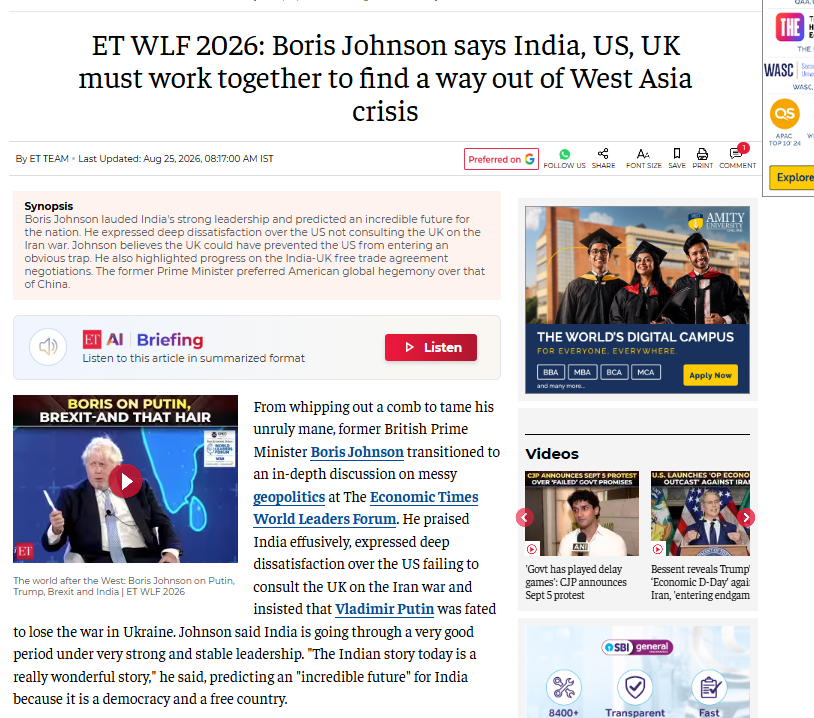
During the interview, Johnson discussed several international issues, including India-UK relations, US-UK ties, NATO defence spending, the Iran war and the Ukraine war. The available interview transcript contains no statement from him saying that “Modi bows under pressure” or that Nehru was more courageous than Modi. Johnson also referred to Jawaharlal Nehru in the context of India-Russia relations. He recalled that the late Queen Elizabeth II had once shared an anecdote about a conversation she had with Nehru in the 1950s, during which Nehru reportedly told her that India would always stand by Russia and that some things never change.

Conclusion
Boris Johnson did not make any statement at the ET World Leaders Forum 2026 suggesting that “Modi bows under pressure” or that “Nehru had courage.” On the contrary, he praised India’s progress and spoke positively about Prime Minister Narendra Modi’s leadership. Johnson did mention Nehru during the conversation, but his reference was in the context of India-Russia relations and an old conversation between Nehru and the late Queen Elizabeth II. He did not compare Nehru with Modi, nor did he criticise Modi. Therefore, the claim circulating on social media attributing the statement “Nehru had courage, Modi bows under pressure” to Boris Johnson is false.
