#FactCheck-AI-Generated Video Falsely Shared as Real Footage of Iran Attack
Executive Summary
A video showing flames and thick smoke rising over a densely populated city at night is being widely circulated on social media. The video is being shared with the claim that it shows the actual visuals of explosions and destruction caused by an attack on Iran. CyberPeace Research Wing ’s research found the viral claim to be false. Our research revealed that the video is not real footage but an AI-generated video, which is being circulated with a false claim.
Claim
A user on social media platform Instagram shared the viral video on July 17, 2026, claiming that it shows the real visuals of an attack on Iran and the massive explosions caused by it.
https://www.instagram.com/reel/Da1_gaXyyoP/?utm_source=ig_web_copy_link&igsh=NTc4MTIwNjQ2YQ==

Fact Check
To verify the authenticity of the viral claim, we extracted multiple keyframes from the video and conducted a reverse image search using Google Lens. During the research, we did not find any credible news report, verified video, or authentic source confirming that the footage was related to any attack on Iran. To further examine the authenticity of the video, we analysed it using multiple AI detection tools. First, we scanned the video using Hive Moderation. The tool’s analysis indicated that the video had a 94.9% probability of being AI-generated, suggesting that the footage may have been created using Artificial Intelligence.
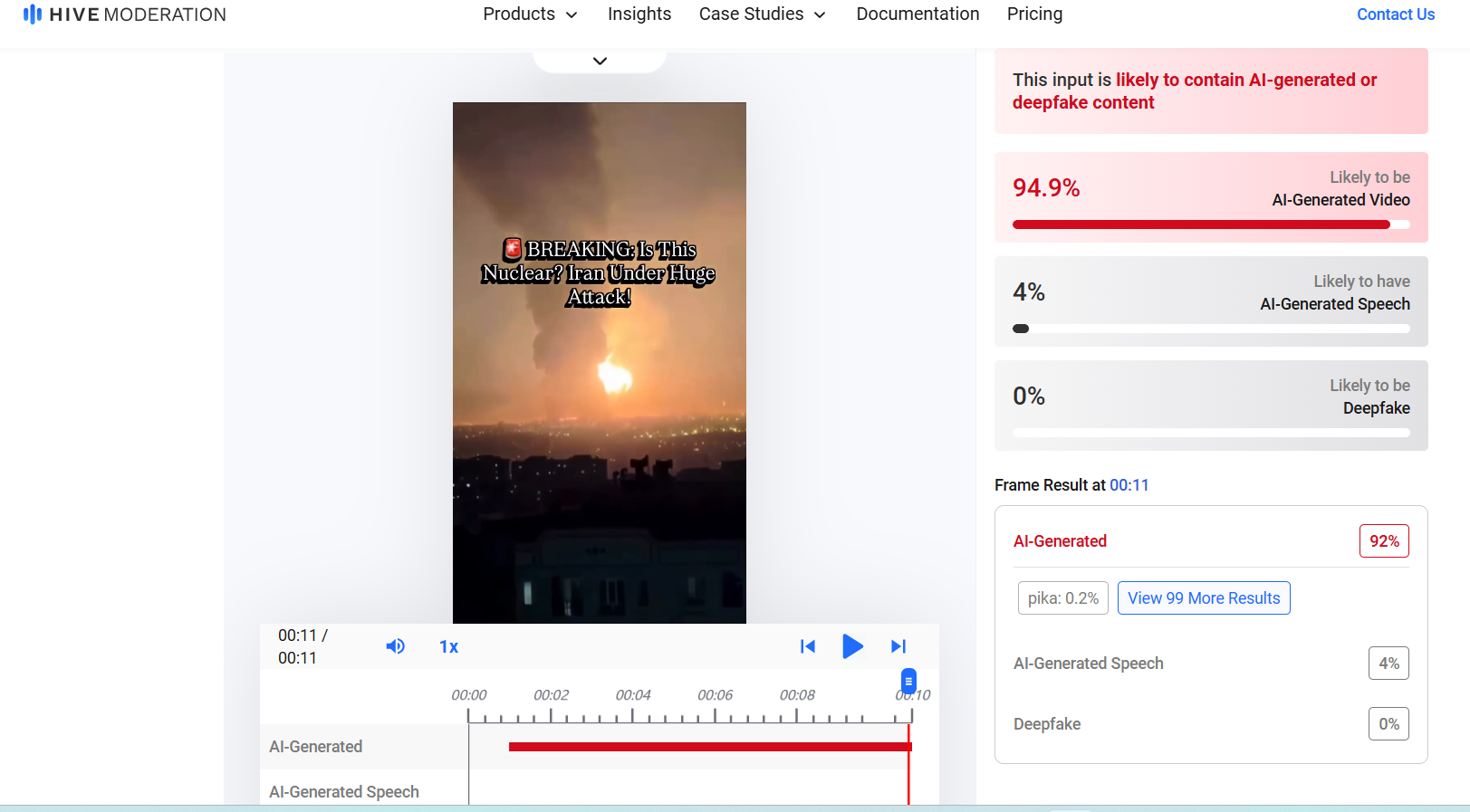
For additional verification, we analysed the video using DetectVideo AI. The tool also indicated that the video was likely AI-generated, with an estimated 80% probability.

We further checked the video using another AI detection tool, AI or Not, which suggested that the footage had a 64% probability of being AI-generated.

At the final stage of verification, we used WasIt.AI, which also indicated that the video was likely AI-generated, with an 88% probability.

Conclusion
CyberPeace Research Wing ’s research found that the viral video does not show real footage of an attack on Iran.The video was created using Artificial Intelligence (AI) and is being falsely shared as authentic visuals of explosions and destruction caused by an attack on Iran. Users are advised to verify such sensational claims before sharing them online.
Related Blogs

Introduction
Romance scams have been rised in India. A staggering 66 percent of individuals in India have been ensnared by the siren songs of deceitful online dating schemes. These are not the attempts of yesteryears but rather a new breed of scams, seamlessly weaving the threads of traditional deceit with the sinew of cutting-edge technologies such as generative AI and deep fakes. A report by Tenable highlights the rise of romance scams in India, which now combine traditional tactics with advanced technologies like generative AI and deepfakes. Over 69% of Indians struggle to distinguish between artificial and authentic human voices. Scammers are using celebrity impersonations and platforms like Facebook to lure victims into a false sense of security.
The Romance Scam
A report by Tenable, the exposure management company, illuminates the disturbing evolution of these romance scams. It reveals a reality: AI-generated deep lakes have attained a level of sophistication where an astonishing 69 percent of Indians confess to struggling to discern between artificial and authentic human voices. This technological prowess has armed scammers with the tools to craft increasingly convincing personas, enabling them to perpetrate their nefarious acts with alarming success.
In 2023 alone, 43 percent of Indians reported falling victim to AI voice scams, with a staggering 83 percent of those targeted suffering financial loss. The scammers, like puppeteers, manipulate their digital marionettes with a deftness that is both awe-inspiring and horrifying. They have mastered the art of impersonating celebrities and fabricating personas that resonate with their targets, particularly preying on older demographics who may be more susceptible to their charms.
Social media platforms, which were once heralded as the town squares of the 21st century, have unwittingly become fertile grounds for these fraudulent activities. They lure victims into a false sense of security before the scammers orchestrate their deceitful symphonies. Chris Boyd, a staff research engineer at Tenable, issues a stern warning against the lure of private conversations, where the protective layers of security are peeled away, leaving individuals exposed to the machinations of these digital charlatans.
The Vulnerability of Individuals
The report highlights the vulnerability of certain individuals, especially those who are older, widowed, or experiencing memory loss. These individuals are systematically targeted by heartless criminals who exploit their longing for connection and companionship. The importance of scrutinising requests for money from newfound connections is underscored, as is the need for meticulous examination of photographs and videos for any signs of manipulation or deceit.
'Increasing awareness and maintaining vigilance are our strongest weapons against these heartless manipulations, 'safeguarding love seekers from the treacherous web of AI-enhanced deception.'
The landscape of love has been irrevocably altered by the prevalence of smartphones and the deep proliferation of mobile internet. Finding love has morphed into a digital odyssey, with more and more Indians turning to dating apps like Tinder, Bumble, and Hinge. Yet, as with all technological advancements, there lurks a shadowy underbelly. The rapid adoption of dating sites has provided potential scammers with a veritable goldmine of opportunity.
It is not uncommon these days to hear tales of individuals who have lost their life savings to a person they met on a dating site or who have been honey-trapped and extorted by scammers on such platforms. A new study, titled 'Modern Love' and published by McAfee ahead of Valentine's Day 2024, reveals that such scams are rampant in India, with 39 percent of users reporting that their conversations with a potential love interest online turned out to be with a scammer.
The study also found that 77 percent of Indians have encountered fake profiles and photos that appear AI-generated on dating websites or apps or on social media, while 26 percent later discovered that they were engaging with AI-generated bots rather than real people. 'The possibilities of AI are endless, and unfortunately, so are the perils,' says Steve Grobman, McAfee’s Chief Technology Officer.
Steps to Safeguard
Scammers have not limited their hunting grounds to dating sites alone. A staggering 91 percent of Indians surveyed for the study reported that they, or someone they know, have been contacted by a stranger through social media or text message and began to 'chat' with them regularly. Cybercriminals exploit the vulnerability of those seeking love, engaging in long and sophisticated attempts to defraud their victims.
McAfee offers some steps to protect oneself from online romance and AI scams:
- Scrutinise any direct messages you receive from a love interest via a dating app or social media.
- Be on the lookout for consistent, AI-generated messages which often lack substance or feel generic.
- Avoid clicking on any links in messages from someone you have not met in person.
- Perform a reverse image search of any profile pictures used by the person.
- Refrain from sending money or gifts to someone you haven’t met in person, even if they send you money first.
- Discuss your new love interest with your trusted friend. It can be easy to overlook red flags when you are hopeful and excited.
Conclusion
The path is fraught with illusions, and only by arming oneself with knowledge and scepticism can one hope to find true connection without falling prey to the mirage of deceit. As we navigate this treacherous terrain, let us remember that the most profound connections are often those that withstand the test of time and the scrutiny of truth.
References
- https://www.businesstoday.in/technology/news/story/valentine-day-alert-deepfakes-genai-amplifying-romance-scams-in-india-warn-researchers-417245-2024-02-13
- https://www.indiatimes.com/amp/news/india/valentines-day-around-40-per-cent-indians-have-been-scammed-while-looking-for-love-online-627324.html
- https://zeenews.india.com/technology/valentine-day-deepfakes-in-romance-scams-generative-ai-in-scams-romance-scams-in-india-online-dating-scams-in-india-ai-voice-scams-in-india-cyber-security-in-india-2720589.html
- https://www.mcafee.com/en-us/consumer-corporate/newsroom/press-releases/2023/20230209.html

Background
Cyber slavery and online trafficking have become alarming challenges in Southeast Asia. Against this backdrop, India successfully rescued 197 of its citizens from Mae Sot in Thailand on November 10, 2025, using two Indian Air Force flights. The evacuees had fled Myanmar’s Myawaddy region in October after intense military operations forced them to escape. This was India’s second rescue effort within a week, following the November 6 mission that brought back 270 nationals from similar conditions. The operations were coordinated by the Indian Embassy in Bangkok and the Consulate in Chiang Mai, with crucial assistance from the Royal Thai Government.
The Operation and Bilateral Cooperation
The operation was carried out with the presence and supervision of Prime Minister Anutin Charnvirakul of Thailand and Indian Ambassador Nagesh Singh, who were both present at the ceremony in Mae Sot. This way, the two countries have not only proved but also cemented their bond to fight the crimes which were mentioned before and more than that, they have even promised to facilitate communication between their authorities. Prime Minister Charnvirakul thanked India for the quick intervention and added that Thailand would be giving the needed support for the repatriation of the other victims as well.
“Both parties reaffirmed their strong commitment to the fight against cross-border crimes, including cyber scams and human trafficking, in the region and to improving cooperation among the relevant agencies in both countries.”, Embassy of India, Bangkok.
The Cyber Scam Network
The Myawaddy area in Myanmar has made a quick shift to become a hotspot for the entire world of cybercrimes. Moreover, the crimes are especially committed by the organised criminal groups that take advantage of foreign nationals. After the Myanmar military imposed a restriction in late October, over 1,500 people from 28 nations moved to Thailand because of the KK Park cyber hub and other centres being raided.
A UN report (2025) indicated that this fraud activity is part of a larger network that extends the countries populated with very low-tech criminals who target the most naïve, and they are the very ones who end up being tortured. The trafficked persons often belong to the local population or come from neighbouring countries and are recruited with the promise of high salaries as IT or customer service agents, only to be imprisoned in a compound where they are forced to perform phishing, investment fraud, and cryptocurrency scams aimed at the victims all over the globe. These centres operate in border territories having poor governance, easy-to-cross borders, and little police presence, hence making human trafficking a major factor contributing to cybercrime.
India’s Response and Preventive Measures
The Indian Embassy in Thailand worked hand in hand with the Thai government to facilitate bringing back and repatriating the Indian citizens who had entered Thailand illegally when they were escaping Myanmar.
The embassy was far from helpless in the matter. In the case of the embassy's advisory, they suggested to the citizens that:
- It is mandatory to check the authenticity of the job offers and the agents before securing employment in other countries.
- Such employment by means of tourist or visa-free entry permits should be avoided, as such entries allow only for a short-duration visit or tourism.
- Be careful of ads claiming high pay for online or remote work in Southeast Asia.
The embassy reiterated the Government of India’s commitment to ensuring easy access to assistance for citizens overseas and to addressing the growing intersection between cyber fraud and human trafficking.
CyberPeace Analysis and Advisory
The case of Myawaddy demonstrates that cybercrime and human trafficking have grappled to become a complicated global threat. The scam centres gradually come to depend on the trafficked labour of people who are being forced to commit the fraud digitally under coercion. This underlines the requirement for the cybersecurity measures that consider the rights of humans and the protection of the victims, not only the technical defence.
- Cybercrime–Human Trafficking Convergence:
Cybercrime has moved up to the level of a human trafficking operation. The unwilling victims of such fraud schemes are scared for their very lives or even more, not of a reliable way out. This situation is such that one cannot tell where cyber exploitation ends and forced labour begins.
- Cross-Border Enforcement Challenges:
To effectively carry out their unlawful acts, the criminals use legal and jurisdictional loopholes that are present across borders. Dismantling such networks requires the regional cooperation of India, Thailand, and ASEAN countries.
- Socioeconomic Vulnerability:
The situation with unemployment being stagnant and the public not being educated about the situation makes people, especially the youth, very prone to scams of getting hired overseas. Thus, to prevent this uneducated flocking to the fraudsters, it is necessary to constantly implant in them the knowledge of online literacy and the importance of verification of job offers.
- Public–Private Coordination:
The scammers’ mode of operation usually includes online recruitment through social media and encrypted platforms where their victims can be found and contacted. In this regard, cooperation among government institutions, tech platforms, and civil society is imperative to put an end to the operation of these digital trafficking channels.
CyberPeace Expert Advisory
To lessen the possibility of such incidents, CyberPeace suggests the following preventive and policy measures:
Individuals:
- Trust but verify: Before giving your approval to anything, always verify the job offer by official embassy websites or MEA-approved recruiting agencies first.
- Watch out for red flags: If a recruiter offers a very high salary for almost no work, asks for tourist visas, or gives no written contract, be very careful and pull out immediately.
- Protect your documents: Give a trusted person the responsibility of keeping both digital and physical copies of your passport and visa, and also register your travel with the MADAD portal.
- Report if in doubt: If an agent looks suspicious, contact the nearest Indian Embassy or Consulate or report it to cybercrime.gov.in or the 1930 Helpline.
Policymakers and Agencies:
- Strengthen Bilateral Task Forces: Set up armed forces of cyber and human trafficking enforcement units in South and Southeast Asian countries.
- Support Regional Awareness Campaigns: In addition to targeted advisories in local languages, the most vulnerable job seekers in Tier-2 and Tier-3 cities should also receive such awareness in their languages.
- Overseas Employment Advertising should be regulated: All digital job postings should be made to meet transparency standards and fraudulent recruitment should be punished with heavy fines.
- Invest in Digital Forensics and Intelligence Sharing: Create common databases for monitoring international cybercriminal groups.
Conclusion
The return of Indian citizens from Thailand represents a significant humanitarian and diplomatic milestone and highlights that cybercrime, though carried out through digital channels, remains deeply human in nature. International cooperation, well-informed citizens, and a rights-based cybersecurity approach are the minimum requirements for a global campaign against the new breed of cybercrime that is characterised by fraud and trafficking working hand in hand. CyberPeace reminds everyone that digital vigilance, verification, and collaboration across borders are the most effective ways to prevent online abuse and such crimes.
Reference
- https://www.ndtv.com/india-news/197-indians-repatriated-from-thailand-by-special-indian-air-force-flights-9611934
- https://www.thehindu.com/news/national/india-airlifts-citizens-who-worked-in-myanmar-cybercrime-hub-from-thailand/article70264322.ece
- https://www.mea.gov.in/Images/attach/03-List-4-2024.pdf

Executive Summary:
A photographer breaking down in tears in a viral photo is not connected to the Ram Mandir opening. Social media users are sharing a collage of images of the recently dedicated Lord Ram idol at the Ayodhya Ram Mandir, along with a claimed shot of the photographer crying at the sight of the deity. A Facebook post that posts this video says, "Even the cameraman couldn't stop his emotions." The CyberPeace Research team found that the event happened during the AFC Asian Cup football match in 2019. During a match between Iraq and Qatar, an Iraqi photographer started crying since Iraq had lost and was out of the competition.
Claims:
The photographer in the widely shared images broke down in tears at seeing the icon of Lord Ram during the Ayodhya Ram Mandir's consecration. The Collage was also shared by many users in other Social Media like X, Reddit, Facebook. An Facebook user shared and the Caption of the Post reads,


Fact Check:
CyberPeace Research team reverse image searched the Photographer, and it landed to several memes from where the picture was taken, from there we landed to a Pinterest Post where it reads, “An Iraqi photographer as his team is knocked out of the Asian Cup of Nations”

Taking an indication from this we did some keyword search and tried to find the actual news behind this Image. We landed at the official Asian Cup X (formerly Twitter) handle where the image was shared 5 years ago on 24 Jan, 2019. The Post reads, “Passionate. Emotional moment for an Iraqi photographer during the Round of 16 clash against ! #AsianCup2019”

We are now confirmed about the News and the origin of this image. To be noted that while we were investigating the Fact Check we also found several other Misinformation news with the Same photographer image and different Post Captions which was all a Misinformation like this one.
Conclusion:
The recent Viral Image of the Photographer claiming to be associated with Ram Mandir Opening is Misleading, the Image of the Photographer was a 5 years old image where the Iraqi Photographer was seen Crying during the Asian Cup Football Competition but not of recent Ram Mandir Opening. Netizens are advised not to believe and share such misinformation posts around Social Media.
- Claim: A person in the widely shared images broke down in tears at seeing the icon of Lord Ram during the Ayodhya Ram Mandir's consecration.
- Claimed on: Facebook, X, Reddit
- Fact Check: Fake